.svg)
Subscribe to our newsletter and get insights on how to grow your personal brand.
Thank you! Your submission has been received!
Oops! Something went wrong while submitting the form.
.svg)



Most entrepreneurs hit a wall with their personal brand not because they run out of ideas, but because they lack a system. The real challenge isn't creating more content—it's building a content engine that amplifies your voice without burning you out.
To do this, you have to stop thinking like a creator who’s always on the hamster wheel and start acting like an architect who designs the whole system. This means building repeatable workflows, setting up your core content pillars, and bringing in a lean team to help you execute. It’s how you turn content from a daily chore into your most powerful growth asset.
Every founder dreams of having a personal brand that feels like it's everywhere, consistently delivering value across every platform. But let's be real—most get stuck. They’re trapped in the endless cycle of brainstorming, creating, and posting. It’s a fast track to burnout, not a breakthrough.
The answer isn’t to work harder. It's to work smarter by designing a system from the ground up.
This guide is your playbook for making that critical shift: from a hands-on creator to a visionary content architect. A creator worries about the next post. An architect builds the entire ecosystem where that post—and hundreds more like it—can thrive.

Switching to an architect's mindset is all about focusing on the system, not the individual pieces of content. It’s a game-changer.
Here’s what that looks like in practice:
The whole point is to build a content machine that runs without you having to manually turn the crank every single day. This frees you up to focus on big-picture strategy, building key relationships, and doing the visionary work only a founder can do.
Before we dive into the "how," it's helpful to see the big picture. Here are the core pillars we'll be building throughout this guide. Think of this as the blueprint for your content engine.
Each of these pillars is a critical component. Miss one, and the whole structure gets wobbly. Get them right, and you'll have a system that not only keeps up but actually accelerates your growth.
And the investment is well worth it. The global content creation market is on track to hit USD 73.49 billion by 2031. This isn't just some vanity metric; it shows that your audience's appetite for high-quality content is exploding. An ad-hoc, "winging it" approach just won't cut it anymore. Let's build the machine you need.
Trying to scale your content without a clear plan is a recipe for disaster. I’ve seen it a hundred times. You end up with a ton of generic, unfocused noise that just doesn’t connect with anyone. Before you even think about upping your output, you need a solid foundation. This is your North Star—the thing that ensures every single piece of content reinforces your authority and actually has a purpose.
If you just start posting more for the sake of it, you’ll dilute your message. Fast. A well-defined blueprint acts as your quality control, keeping your brand’s voice potent and authentic, no matter how much you produce. And it all starts with your content pillars.
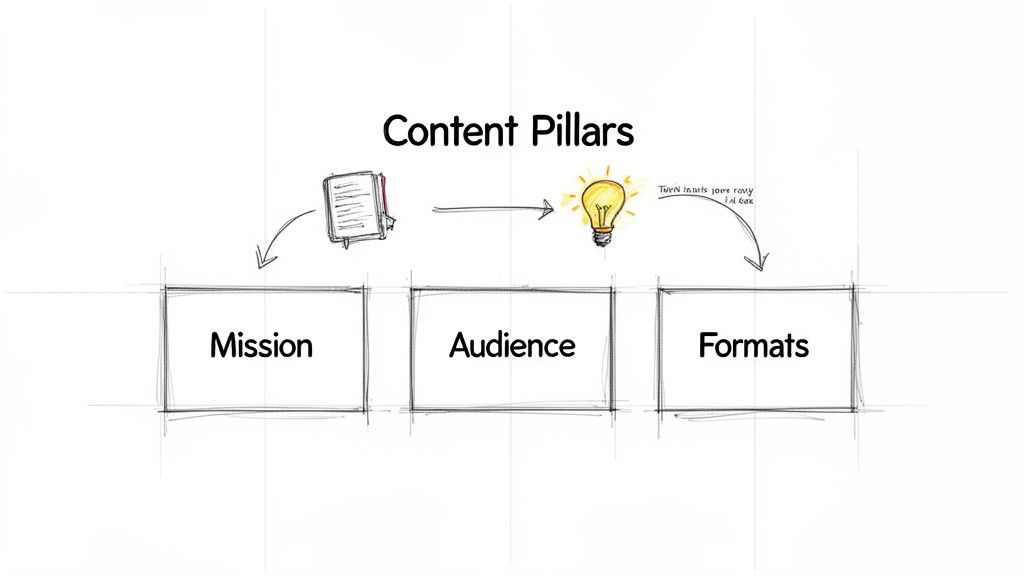
Your content pillars are the 3-5 core themes you’re going to own. These aren’t just random topics you pull out of a hat. They live at the intersection of your unique expertise, your brand's mission, and what your audience is genuinely struggling with. Think of them as the foundational columns holding up your entire content strategy.
For a leadership coach I worked with, we landed on these pillars:
Everything you create needs to tie back to one of these pillars. No exceptions. This is how you build consistency and teach your audience what to expect from you. It’s how you become the go-to expert in those specific domains.
Most founders think they need to dream up brand-new ideas from scratch every single day. That’s a lie. The truth is, you're probably sitting on a goldmine of raw material right now. A content source audit is just a systematic way of mining your own experiences and knowledge for ideas.
I’m not talking about recycling old blog posts. This is about diving deep into the undocumented assets you already have. This stuff is almost always more authentic and valuable than anything you could brainstorm in a formal meeting.
Your most powerful content ideas aren't hiding in keyword research tools. They're in your sent emails, your client onboarding calls, and the questions you answer over and over again.
Here’s exactly where to look for these hidden gems:
This simple audit turns what you already know into an endless well of ideas that are perfectly aligned with your brand from day one.
Okay, you’ve got your pillars and you’ve unearthed a ton of raw material. The final step is connecting the dots. You need to map your content ideas directly to the problems your audience is facing at different stages of their journey.
This makes sure you have a balanced mix of content—some to attract new followers, some to nurture leads, and some to delight your existing clients. It’s a strategic approach that guarantees your content isn’t just consistent, but actually gets people to take action. This blueprint is the essential first step to building a content engine that can truly scale with you.
If you want to scale your content, sporadic bursts of creativity just won't cut it. You have to move past the ad-hoc approach and build a structured, repeatable workflow—what I call a content assembly line. This is where the real magic happens, turning raw ideas into polished assets with the kind of consistency and quality that builds brands.
An assembly line isn't about killing creativity; it's about channeling it. When you systemize the mundane parts of the process, you free up your brainpower for the stuff that actually matters: high-impact storytelling and strategic thinking. This is how you go from feeling like you're constantly playing catch-up to being weeks ahead.
The bedrock of any system that can scale is clear documentation. Standard Operating Procedures (SOPs) are your team's single source of truth for how content gets made. They wipe out the guesswork, slash errors, and make bringing on new team members incredibly smooth.
Here's my rule: if a task isn't documented, you can't delegate it or scale it. Period.
Think of an SOP as a simple recipe for a specific content task. It needs to be so clear that someone with zero context could pick it up and get the job 80% right on their first go.
A solid SOP should include:
The point isn't to create a rigid, bureaucratic manual. It's to build a living library of your best practices that empowers your team to execute flawlessly without you having to look over their shoulder.
As audience expectations get higher, having professional processes becomes a real competitive edge. The digital content creation market is projected to explode from USD 32.28 billion in 2024 to USD 69.80 billion by 2030, all driven by demand for high-quality, strategic content. Without solid SOPs, you’ll be left in the dust. You can read more about the growth in digital content creation on Grand View Research.
One of the biggest killers of creative energy is context switching—that constant jumping between writing, recording, designing, and scheduling. Content batching is the perfect antidote. It’s simply the practice of grouping similar tasks together and knocking them out in focused blocks of time.
Instead of trying to do a little bit of everything each day, you create themed days or even weeks.
Here’s what a batching schedule could look like:
This method is so powerful because it allows for deep focus, which massively improves both your speed and the quality of your work. You're not wasting time setting up and tearing down a camera every day, and you keep your brain in one mode—like writing—for a sustained period.
A truly efficient content assembly line squeezes every last drop of value from each piece of content. This is where a documented repurposing workflow is a game-changer. Stop seeing a blog post as a single asset. Start seeing it as the raw material for a dozen smaller pieces.
A good system makes this happen automatically, not as an afterthought.
For instance, here’s a simple SOP for repurposing one long-form video:
When you systemize this, you create a content multiplier. This is one of the core principles of scaling your efforts. Putting smart content repurposing strategies into play can dramatically extend your reach and optimize your output, turning one day of creation into a week-long stream of value.
Think of your content process like an assembly line. It’s only as fast as the tools you're using. In our world, technology is the ultimate leverage—it's what lets you multiply your output without having to clone yourself. This isn't about chasing every shiny new app that pops up. It's about building a solid, integrated tech stack that handles the repetitive work so you can focus on what you do best: strategy and storytelling.
Let’s be real, when you're scaling a personal brand, your time is your most valuable asset. The right technology buys you that time back. It automates the monotonous tasks that kill your creative energy, keeps your quality consistent, and makes sure nothing ever falls through the cracks. The end goal is a seamless workflow where the tech manages the mechanics, leaving you in your zone of genius.
Artificial intelligence has gone from some far-off concept to a must-have tool in every creator's toolkit. But here's the key: view AI as a powerful assistant, not a replacement for your own voice. It's a collaborator that helps you demolish the blank page and speed up your workflow from raw idea to first draft.
I use AI in three main ways, and it’s been a game-changer:
This isn't just a trend; it’s the new standard. Projections show that by 2026, a staggering 80% of marketers will use AI for content creation. For personal brands, this is about more than just keeping up. It's about gaining a serious competitive edge by producing more personalized content, faster. You can dig into more stats on this in HubSpot's latest marketing report.
A well-chosen tech stack works like a well-oiled machine, automating tasks across the entire content lifecycle. Your stack doesn’t have to be complicated or break the bank, but it does need to be integrated. Each tool should solve a specific problem and, ideally, "talk" to the others to cut down on manual hand-offs.
Here’s a simple way to visualize how your content moves from an idea to your audience.
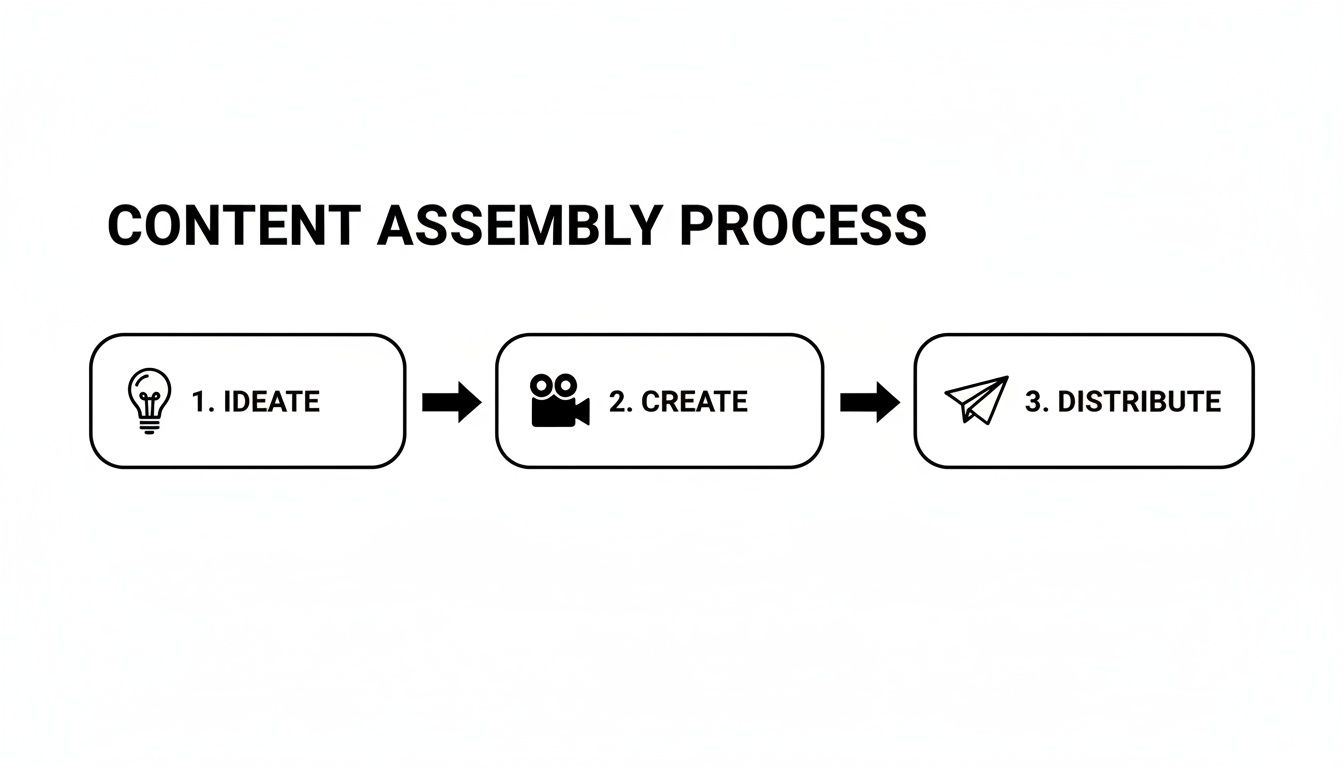
This process shows you exactly where technology can give you the most leverage to keep things moving smoothly and efficiently.
To get you started, here’s a breakdown of the tools that form the backbone of a scalable content system.
Choosing the right tools from each category will create a system that runs itself, giving you more time to focus on high-level strategy instead of day-to-day execution.
A few key tools are non-negotiable for me:
Your tech stack should serve your system, not the other way around. Choose tools that fit your established workflow and remove friction, rather than adding complexity.
To truly scale and kill off repetitive tasks, you'll want to look at dedicated content marketing automation tools. A powerful tech stack also unlocks one of the most effective scaling strategies out there: repurposing. With the right setup, you can see exactly how to repurpose content and multiply your reach, turning one pillar video or blog post into a week’s worth of assets across all your channels. That’s how you get more output without ever sacrificing the quality that built your brand in the first place.
Let's get one thing straight: you can't do it all yourself. And you shouldn't even try.
Once your systems are humming, the single biggest lever you can pull to scale your content is strategic delegation. This isn’t about just handing off tasks; it’s about multiplying your impact by building a small but mighty team that brings your vision to life.
Trying to be the strategist, writer, designer, and project manager is a one-way ticket to burnout. It also puts a hard ceiling on your growth. As a founder, your time is gold. It’s best spent on high-level strategy and being the face of the brand—the stuff only you can do.
The goal here is to assemble a lean team that frees you up to operate in your zone of genius.
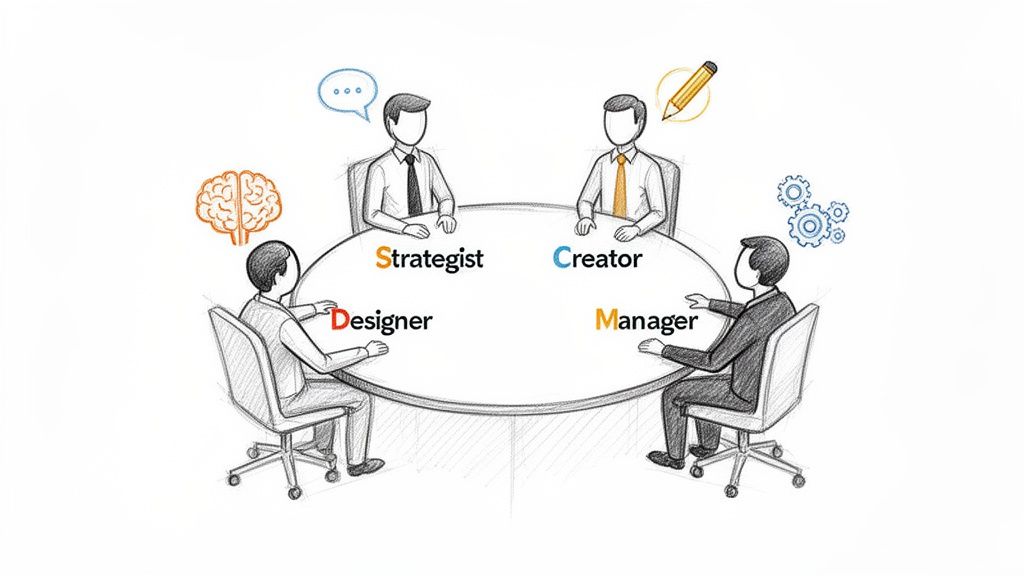
For most personal brands, a full-time marketing department is complete overkill. Instead, think in terms of roles, which can be filled by freelancers, part-time help, or even one killer, multi-talented hire. These four roles are the foundation of any scalable content engine.
The Strategist (The 'Brain'): This is probably you, the founder. You set the vision, define the content pillars, and know your audience inside and out. You're the source of the core ideas and stories.
The Creator (The 'Voice'): This is your writer or video editor. They’re skilled at taking your raw ideas, interview notes, or messy voice memos and transforming them into polished, engaging content that sounds exactly like you.
The Designer (The 'Look'): This person handles all the visuals. They create branded templates, slick social media graphics, and eye-catching video thumbnails. They make sure every single piece of content looks professional and is instantly recognizable.
The Manager (The 'Engine'): Think of this role as the operator. They handle the logistics—managing the content calendar, scheduling posts, coordinating with the team, and tracking what’s working. They keep the assembly line moving smoothly.
In the beginning, you might be wearing all these hats. The secret to scaling is to progressively hand them off, one by one.
The answer is brutally simple: hire for your biggest bottleneck.
Take an honest look at your content workflow. Where do things consistently grind to a halt?
Is it the writing? A skilled Creator can take your 30-minute brain dump and spin it into a week's worth of posts. Are you burning hours fumbling around in Canva? A freelance Designer can build you a library of templates that saves you that time, every single week. Is finished content just piling up because you never get around to scheduling it? A virtual assistant as your Manager solves that problem overnight.
Your first hire should solve your most painful, time-consuming problem. This frees up your energy and provides an immediate ROI, making it much easier to justify the next hire as you continue to grow.
Delegating isn't just about getting rid of tasks you hate. It's a strategic investment in reclaiming your time for founder-level work.
Platforms like Upwork, Fiverr Pro, and other specialized creative communities are absolute goldmines for talent—if you know how to use them. Vetting people correctly is everything.
Here are a few tips I've learned from building my own teams:
Look for Specialists, Not Generalists: Don't just hire a "social media manager." Hire a "LinkedIn ghostwriter for B2B founders" or a "short-form video editor for tech entrepreneurs." Specialists get better results, faster. Period.
Review Portfolios for Relevant Work: Generic testimonials mean nothing. Look for concrete examples in their portfolio that match the style and quality you're aiming for. If their past work doesn’t look like your desired future, they aren't the right fit.
Always, Always Do a Paid Test Project: Never hire someone based on a good conversation. Give your top 2-3 candidates a small, paid test project that mirrors a real task. This is the single best way to see their real skills, how they communicate, and if they can actually follow instructions.
Miscommunication is the number one killer of outsourcing relationships. A detailed project brief is your insurance policy. Before you hand off a single piece of work, give them a crystal-clear document outlining exactly what you need.
A great brief isn't complicated. It just needs:
This upfront clarity ensures your team can execute your vision from day one, turning delegation from a headache into a true force multiplier for your brand.
Let's be real. Moving from a one-person show to building a real content machine is a huge mental shift. It’s totally normal to have questions pop up as you start thinking about building systems and bringing on help.
Here are the most common hurdles I see founders face when they start to scale—and how to clear them.
One of the biggest fears? Losing your voice. How can it still sound like you when other people are writing, designing, or posting? It’s a good question. The answer isn't magic; it's in the systems you build. Your brand voice guide and content pillars become the instruction manual for your team, making sure your unique perspective and tone shine through, no matter who hits "publish."
You're still the brain behind the operation. The team is just there to amplify your genius, not replace it.
Trying to figure out when to make that first hire can feel like you're standing on the edge of a cliff. The simple answer? You hire when the pain of doing everything yourself is worse than the fear of letting go.
Look for the signs. Are you constantly blowing past your own deadlines? Is creating content eating up the hours you should be spending on sales calls or talking to clients?
If you've become the bottleneck in your own business, it's time. Your first hire should be a direct solution to your biggest headache, whether that’s a writer, a designer, or someone to just keep the trains running on time.
You're not just offloading tasks. You're buying back your time to focus on the visionary work that only you can do. That’s the real key to growth.
Keeping your content authentic is non-negotiable. The trick is to separate your role as the "source" from the team's role as the "producer."
You bring the fire—the unique insights, the personal stories, the expert takes. You can do this with quick brain dumps, voice notes on your phone, or even short interviews. That's the raw material.
Your team’s job is to take that raw material and, using your SOPs and brand guides, shape it into polished content for each specific platform.
Here’s how you keep your voice front and center:
Look, scaling your content takes time and money. You need to know you're getting a return on that investment. Don't get distracted by vanity metrics like likes and shares—they don't pay the bills.
Focus on the numbers that actually matter to your business goals.
Track metrics like these:
When you focus on these outcomes, you know your content engine isn't just making noise. It's building your brand and driving real, sustainable growth.
At Legacy Builder, we turn your expertise into a content engine that builds your influence and drives revenue. If you're ready to scale your personal brand the right way, let's connect.


You could – but most in-house teams struggle with the nuance of growing on specific platforms.
We partner with in-house teams all the time to help them grow on X, LI, and Email.
Consider us the special forces unit you call in to get the job done without anyone knowing (for a fraction of what you would pay).
Short answer – yes.
Long answer – yes because of our process.
We start with an in-depth interview that gives us the opportunity to learn more about you, your stories, and your vision.
We take that and craft your content then we ship it to you. You are then able to give us the final sign-off (and any adjustments to nail it 100%) before we schedule for posting.
No problem.
We have helped clients for years or for just a season.
All the content we create is yours and yours alone.
If you want to take it over or work on transitioning we will help ensure you are set up for success.
We want this to be a living breathing brand. We will give you best practices for posting and make sure you are set up to win – so post away.
Subscribe to our newsletter and get insights on how to grow your personal brand.
