.svg)
Subscribe to our newsletter and get insights on how to grow your personal brand.
Thank you! Your submission has been received!
Oops! Something went wrong while submitting the form.
.svg)


Most advice on how to get podcast interviews is weak because it tells you to pitch more shows, send more emails, and chase more appearances. That’s amateur thinking. Volume is not a strategy. If you show up on the wrong podcasts, with the wrong message, to the wrong audience, you don’t build authority. You create noise.
I want you to treat podcast guesting differently. A podcast interview is not a publicity hit. It’s a trust transfer. It’s one of the few formats where people will give you sustained attention, hear your voice, absorb your thinking, and decide whether you’re someone worth following, hiring, remembering, or introducing.
That’s why I push people to stop asking, “How do I get booked?” and start asking, “What kind of legacy am I building every time I speak?” That question changes everything. It changes which shows you target, how you pitch, what stories you tell, and what you do after the episode goes live.
The popular advice says to pitch everyone. I disagree.
A single appearance on a well-aligned podcast can do more for your reputation than dozens of random guest spots. The reason is simple. Podcasts build depth, not just reach. Social posts get glanced at. Podcast conversations get heard, processed, and remembered.
That matters because attention is scarce and trust is earned slowly. On a podcast, you’re not fighting an algorithm every few seconds. You’re inside someone’s headphones, often for a full conversation that lets your judgment, communication style, and values come through.
Interview-heavy podcasts work because listeners stay with them. More than 70% of listeners finish most episodes, and average weekly listening is over 9 hours, according to Riverside’s podcast statistics. This key insight is often overlooked. You’re not competing with a scroll. You’re participating in a format people commit to.
If you’re a founder, executive, consultant, or creator, that kind of attention is rare. It gives you room to explain your philosophy, defend your point of view, and tell stories with context. That’s where authority gets built.
Podcasts don’t just expose your name. They expose your thinking.
A good interview strips away the corporate veneer. People hear your cadence, your confidence, your hesitation, your humor, your standards. They get a read on whether you’re rehearsed or real.
That’s why I tell clients to stop obsessing over looking impressive and start sounding clear. Podcast audiences don’t reward empty polish. They reward coherence. If you can explain what you believe, why you believe it, and how you’ve earned that belief, people remember you.
Use podcasting as a brand amplifier, not a vanity metric. The right interview can strengthen your positioning in ways a feed full of short posts never will.
You don’t need to appear everywhere. You need to show up where your values, expertise, and audience overlap.
Think about the difference between a forgettable guest circuit and a deliberate body of work. One says, “I’m available.” The other says, “I stand for something.” If your goal is to build a personal brand with staying power, podcast guesting should support your long-term narrative.
That means every interview should answer three questions:
If you can’t answer those, don’t pitch yet.
It's common to start with outreach. I think that’s backwards.
Hosts don’t book pitches. They book people they can trust to carry a conversation, add value to the audience, and reflect well on the show. Before you send a single email, your digital footprint needs to make that decision easy.
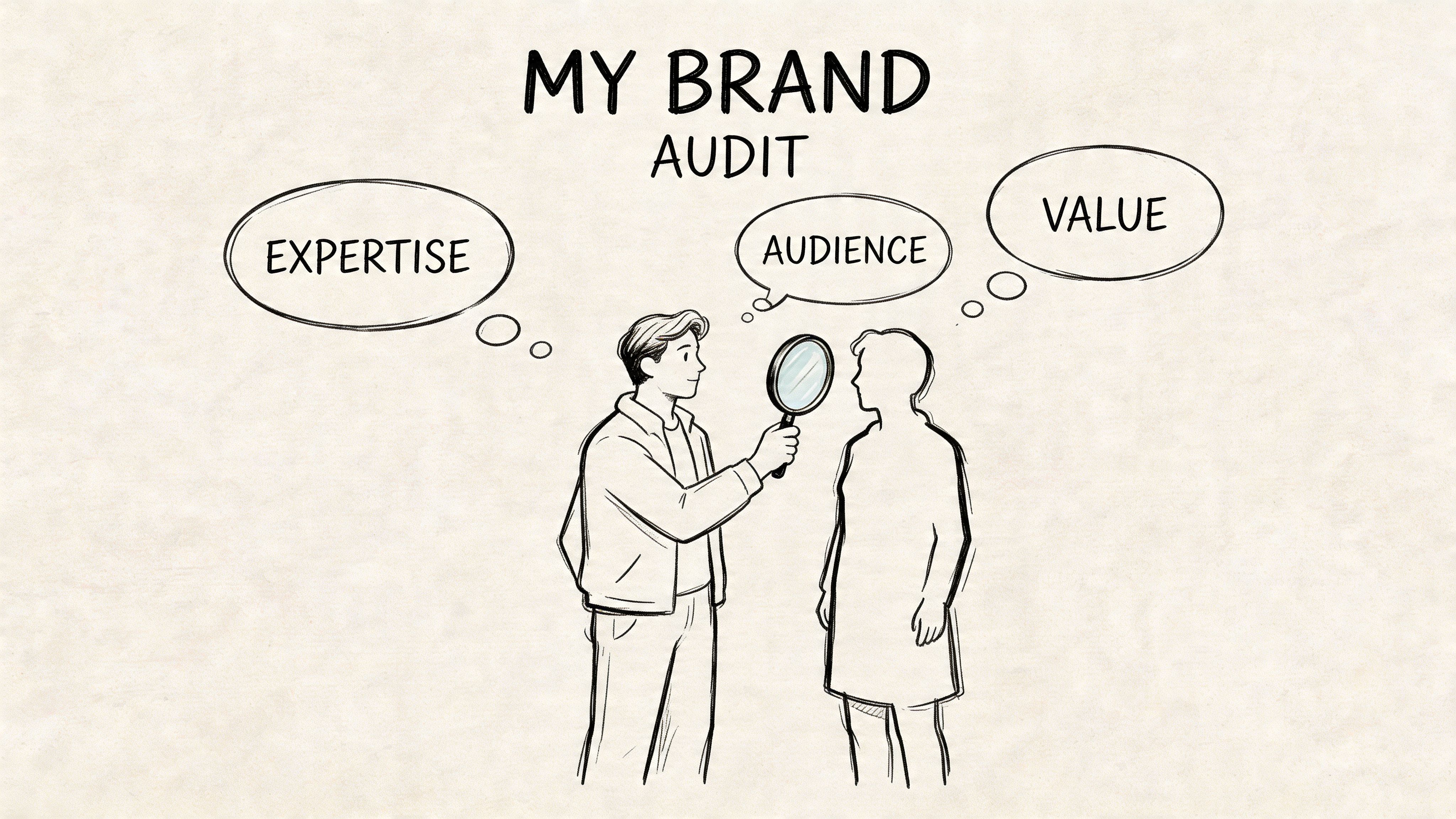
A host will usually check your LinkedIn profile, website, and recent content before replying. If those assets feel vague, outdated, or self-important, your pitch dies.
A weak profile says things like:
A guest-ready profile looks different:
Your profile should answer a host’s unspoken question: “Can this person make my episode better?”
Don’t review your presence like a proud founder. Review it like a skeptical host with limited time.
Use this checklist:
Headline clarity
Can someone understand your expertise in a few seconds?
Bio strength
Does your bio sound like a person worth interviewing, not a résumé in paragraph form?
Content trail
Have you published enough thoughtful material that a host can sample your perspective?
Topic ownership
Can you name a handful of subjects you can discuss with conviction?
Proof of communication
Do you come across clearly on video, audio, or writing?
Practical rule: If a host looked at your profile for one minute, they should leave with a clear sense of your point of view.
You need a small set of materials that remove friction.
Start with:
If you haven’t built one yet, this guide on how to create a media kit that gets you noticed is worth your time. It solves one of the most common booking problems. People make hosts dig for basic information.
A smart host cares about your ideas. A busy host also cares whether you can deliver those ideas without rambling.
That means your speaking ability is part of your brand. If you tend to bury the point, over-explain, or answer questions with jargon, fix that now. A practical way to do that is to enhance your public speaking skills before you start heavy outreach. Strong speaking doesn’t just help on air. It makes your pitch more credible because your existing clips and conversations sound sharper.
Don’t tell hosts you’re a great guest. Publish evidence.
A few strong formats work especially well:
The goal isn’t to flood the internet. The goal is to create enough proof that a host can verify your authority without guessing.
If your brand is ready, pitching feels lighter because you’re not trying to persuade from scratch. Your online presence does half the work for you.
Many individuals build a target list like they’re buying lottery tickets. They search a broad keyword, scrape a few names, and blast pitches. That approach wastes time because it ignores fit.
You need to build a list with discipline. I’d rather see you target a smaller set of aligned podcasts than chase every show that looks vaguely relevant. The right list supports your brand. The wrong one dilutes it.
A business podcast isn’t automatically right for you. A leadership show isn’t automatically useful. Categories are too broad.
Instead, ask:
That last question matters more than people think. If you’re building a personal legacy, every guest spot becomes part of your body of work.
Tools can speed up discovery. Use Listen Notes, Chartable, and Rephonic to surface podcasts in your niche and map where comparable guests have appeared. Then do the human work. Listen to recent episodes. Read episode titles. Review guest patterns. Look at how the host frames conversations.
I usually sort shows into three buckets:
| Podcast fit | What it means | Action |
|---|---|---|
| Strong fit | Audience, tone, and topics align tightly with your brand | Prioritize immediately |
| Possible fit | Some overlap, but positioning may need a custom angle | Keep on secondary list |
| Weak fit | Broad mismatch in audience, energy, or values | Skip it |
That simple filter saves a lot of wasted outreach.
Tiering matters. A podcast with 1,000 downloads per episode sits in the top 20% globally, and the top 1% average over 4,600 downloads, according to Marketing LTB’s podcast statistics. Those benchmarks help you stop guessing.
I’m not saying smaller shows have no value. I am saying you should know why you’re saying yes. Some smaller shows are excellent relationship plays. Some mid-tier shows are perfect authority builders. Some large shows are worth waiting for because one appearance can reposition you.
Use your list intentionally:
A good podcast list is not a media database. It’s a map of where your voice belongs.
A mediocre host can ruin a great opportunity. A strong host can amplify your message.
Pay attention to:
You’re not just borrowing audience attention. You’re choosing a collaborator. If the host doesn’t care about craft, your episode will sound disposable no matter how good your ideas are.
Don’t just collect names. Build a working sheet with:
That last part matters. A messy list leads to lazy follow-up and repeated mistakes. A clean list turns outreach into a system.
If you want to know how to get podcast interviews without sounding desperate, start here. Sharp targeting makes every later step easier.
A bad pitch talks about you. A good pitch talks about the audience. A great pitch makes the host feel understood.
Most outreach fails because people send polished spam. It looks professional, but it reads like they copied the same message to fifty shows before lunch. Hosts can smell that instantly.
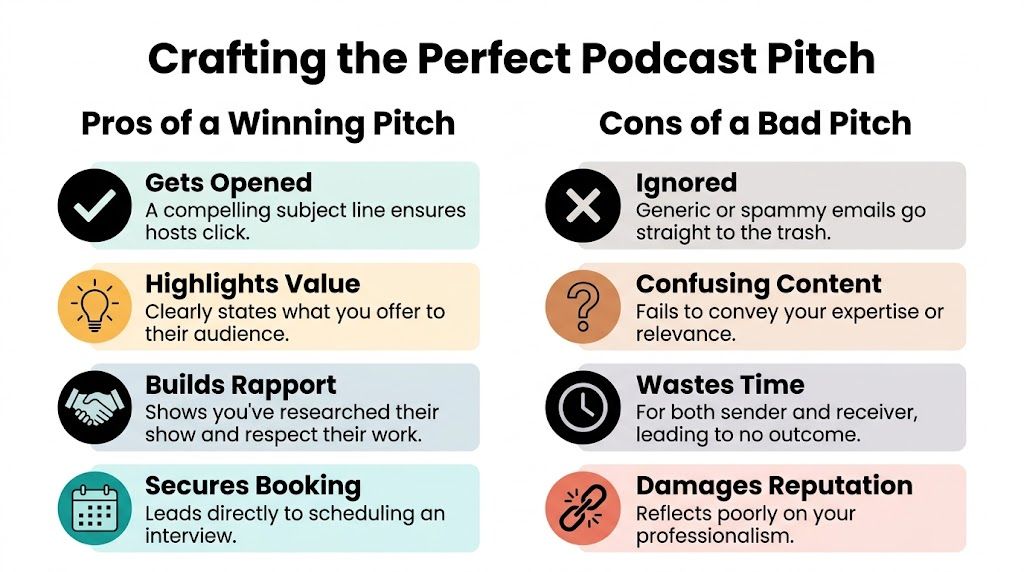
Cold pitching usually gets a 5-10% response rate, while a highly personalized pitch can reach a 15-25% success rate, with warm introductions performing even better, based on Come Alive Creative’s podcast planning guidance. That gap is the difference between random outreach and strategic outreach.
If you want replies, your pitch needs to show three things fast:
That’s it. Not your life story. Not your full company history. Not a bloated credential dump.
I like a pitch email to do five jobs in a short space.
Open with something specific from the show. Mention a recent episode, a recurring theme, or a question the host asked that connects to your expertise. Keep it real. Forced flattery is obvious.
Then pivot into what your appearance would give listeners. This is the center of the pitch. If you can’t explain the audience payoff in plain language, your topic isn’t ready.
Don’t make the host invent the episode for you. Suggest a few directions. Keep them crisp and usable.
Examples:
Mention a relevant credential, body of work, role, or prior conversation. Enough to establish confidence. Not so much that it turns into chest-beating.
Ask whether the topic fits their editorial calendar. Offer your media kit. Keep the ask easy.
Here’s a quick subject line comparison.
| Generic Subject Line (Low Impact) | Personalized Subject Line (High Impact) |
|---|---|
| Podcast Guest Request | Idea for your audience on founder-led personal branding |
| Interview Opportunity | Follow-up to your recent episode on leadership visibility |
| Would Love to Be on Your Show | Potential guest idea for your listeners navigating brand trust |
| Collaboration Inquiry | Topic suggestion on building authority without sounding scripted |
If you want to tighten your outreach style beyond podcasting, this resource on how to write cold emails that actually get replies is useful because the same principles apply. Relevance wins. Generic enthusiasm loses.
Bad podcast pitches usually have one of these problems:
If the host has to work to understand why you belong on the show, your pitch is already too weak.
A better approach is to write like a thoughtful future collaborator. Clear. Brief. Useful.
Here’s a video worth reviewing before you refine your outreach:
You don’t need to copy this. Study the logic.
Hi [Host Name],
I listened to your recent conversation about founder visibility and noticed your audience responds well to practical discussions around trust and authority.I’d love to propose an interview focused on why many leaders damage their personal brand by sounding overproduced, and how to build a public presence that still feels human. I think it would fit your listeners because the conversation moves beyond content tactics and into credibility.
A few angles that could work:
- how to publish consistently without losing your voice
- what audiences actually read as authentic online
- how founders can turn lived experience into a repeatable content strategy
I’ve spent years helping professionals clarify their public positioning and communicate their ideas in a way that feels sharp, not manufactured. Happy to send a media kit if helpful.
If this feels aligned, I’d be glad to suggest a few more tailored directions based on your recent episodes.
That works because it respects the host, frames the audience benefit, and shows you can carry an actual conversation.
Once your pitch is solid, don’t stop at email. High-value bookings usually come from stacked advantages, not one tactic.
The strongest operators build a pipeline. They combine warm introductions, competitive research, content proof, and selective outreach so each part reinforces the others. That’s how you move from occasional wins to a repeatable system.
Warm paths beat cold ones.
Look through your LinkedIn network, customer base, peer group, event contacts, and previous collaborators. You’re not always looking for a direct intro to the host. Sometimes the better move is an intro to a past guest, producer, or mutual industry contact who can make the recommendation credible.
Ask for introductions with precision. Don’t send, “Can you connect me?” Send a short note that explains the show, why your topic fits, and why the host’s audience would care. Make it easy for the other person to forward.
Many misunderstand how to use AI. They use it to mass-produce bland outreach. That’s a mistake. Its value lies in analysis.
Using AI tools such as Rephonic to analyze content gaps and tailor your pitch can improve booking rates by up to 30%, and AI-driven personalization can lift results from the typical 5-10% range to 25-40% according to the Rephonic-focused video guide. The takeaway isn’t “let AI write your pitch.” The takeaway is “use AI to find a smarter angle.”
Use AI tools to:
A smarter system beats harder grinding. Use AI to sharpen your relevance, not to impersonate sincerity.
One of my favorite tactics is competitor appearance mapping.
Find people with adjacent expertise who already appear on the shows you want. Study the topics they discussed. Then ask two questions:
That second question is your opening. Hosts don’t need a repeat guest with a different name. They need a fresh conversation that still fits their audience.
For example, if everyone in your space talks about “growth” in broad terms, maybe your opening is trust, reputation, hiring, positioning, or founder communication under pressure. Narrow beats generic every time.
Booking agencies, PR support, and podcast concierge services can help, but only if your positioning is already clear. If your message is muddy, paying someone to send more pitches just scales the problem.
Outside help makes sense when:
If those pieces aren’t ready, keep control in-house for now. Refine your message first.
A strong guesting strategy compounds.
One good interview can lead to:
That’s the game. Don’t treat each booking like an isolated win. Treat it like an asset that should make the next booking easier.
Getting booked is only half the job. I’ve seen people win the interview and waste the opportunity with weak prep, poor audio, forgettable answers, and zero follow-up.
If you want podcast guesting to build your brand, you need to perform well before, during, and after the recording. Hosts remember guests who make the process easy and the episode strong.

Preparation is not memorizing facts. It’s organizing stories.
Before the interview, I want you to know:
That last point matters. Memorable guests are not bland. They have a point of view.
Also research the host. Listen to at least a couple of episodes. Notice pacing, question style, and whether they prefer tactical answers, founder stories, or broad philosophy. Then adapt without losing yourself.
This part is not glamorous, but it matters. Up to 40% of potential guest bookings fail because of poor technical quality, and muffled audio is a primary cause of rejection. Also, 70% of repeat invitations come from guests who follow up and co-promote the episode, according to Rephonic’s guide to getting interviewed on podcasts.
That means your setup is part of your professionalism.
Use a simple checklist:
You don’t need a studio. You do need to sound like you respect the audience.
On air, your job is not to impress the host. Your job is to help the listener.
That means:
Don’t try to sound important. Try to sound clear.
One more thing. Leave room for tension. If the host pushes back, don’t retreat into generic talking points. Thoughtful disagreement often creates the most compelling moments in an episode.
At this point, most guests fumble the long game. They finish the interview, say thanks, and disappear.
Do the opposite:
If you want stronger follow-up discipline, this guide to building relationships in business that last is a good reminder that visibility without relationship-building is shallow. Podcast guesting works best when the host becomes part of your long-term network, not just a one-time distribution channel.
Don’t just post “I was on a podcast.”
Frame the conversation around a takeaway:
That gives the episode a second life. It also shows future hosts that you know how to support the content, not just benefit from it.
A good guest helps the host win. That’s the standard.
The people who win at podcast guesting don’t treat it like outreach admin. They treat it like identity work.
They know what they stand for. They prepare their brand before they pitch. They choose shows that fit their long-term reputation. They write emails that respect the host. They show up prepared. Then they turn one conversation into a relationship and a body of proof.
That’s the answer to how to get podcast interviews. Not more hustle. Better alignment.
If you want your appearances to matter, think beyond the booking. Think about the archive you’re building. Years from now, your interviews will still tell people how you think, what you value, and whether your message holds up under real conversation.
One practical way to get more value from each appearance is to organize your post-interview assets well. A resource like this podcast show notes template can help you capture key ideas, quotes, and distribution angles so your episode doesn’t disappear after launch.
You do not need a hundred interviews to build authority. You need the right conversations, delivered well, with a message worth hearing.
If you want help turning your ideas, story, and expertise into a brand that attracts the right interviews, Legacy Builder can help you build the positioning, content, and digital presence that make podcast hosts take you seriously.


You could – but most in-house teams struggle with the nuance of growing on specific platforms.
We partner with in-house teams all the time to help them grow on X, LI, and Email.
Consider us the special forces unit you call in to get the job done without anyone knowing (for a fraction of what you would pay).
Short answer – yes.
Long answer – yes because of our process.
We start with an in-depth interview that gives us the opportunity to learn more about you, your stories, and your vision.
We take that and craft your content then we ship it to you. You are then able to give us the final sign-off (and any adjustments to nail it 100%) before we schedule for posting.
No problem.
We have helped clients for years or for just a season.
All the content we create is yours and yours alone.
If you want to take it over or work on transitioning we will help ensure you are set up for success.
We want this to be a living breathing brand. We will give you best practices for posting and make sure you are set up to win – so post away.
Subscribe to our newsletter and get insights on how to grow your personal brand.
