.svg)
Subscribe to our newsletter and get insights on how to grow your personal brand.
Thank you! Your submission has been received!
Oops! Something went wrong while submitting the form.
.svg)



Let's be real—building relationships in business isn't about collecting contacts like they're Pokémon cards. It’s about creating a network built on actual trust, value, and a bit of your own personality.
This switch from old-school, transactional networking to making genuine connections is what really drives sustainable growth. It opens doors you didn't even know were there—partnerships, referrals, and people who will go to bat for you. The pros know that one solid relationship can completely change a company's trajectory.

So many people get this wrong. They write off relationship-building as a "soft skill"—nice to have, but not essential. That couldn't be further from the truth. In a world drowning in digital noise and robotic DMs, the ability to make a real human connection is your secret weapon.
It’s the foundation of a solid career and a business that can weather any storm.
We're talking about connections that go deeper than swapping business cards or a quick LinkedIn add. It's about building a legacy of trust, where your network knows you for who you are and the value you bring to the table, not just for what you sell.
The first move is all in your head. You have to stop thinking, "What can I get out of this?" and start asking, "How can I actually help this person?"
The goal isn't to rack up the biggest follower count. It's to build a community of people who trust you, believe in what you're doing, and are happy to support you because you've consistently supported them.
When you make that switch, every interaction changes. A comment on a LinkedIn post becomes a chance to add real insight, not just to get your name out there. An intro email is about a shared interest, not a thinly veiled sales pitch. People can feel that genuine desire to contribute, and it makes you stand out immediately.
And it's not just me saying this. Relationship-building is now one of the most in-demand skills in the workplace. Companies are finally realizing that trust and authentic connections are often more valuable than raw technical talent.
A recent report even showed that 88% of B2B marketers see it as vital for building confidence among decision-makers. In other words, people buy from people they know, like, and trust.
To really get good at this, you need to understand the fundamentals. Digging into the essential relationship building skills is a great place to start. From there, this framework will walk you through how to:
When you lean into this approach, you're not just building a network. You're building a legacy.

Before you even think about outreach, you have to get your own house in order. Building relationships in business isn’t about a clever opening line; it starts with a rock-solid, authentic personal brand. It’s the anchor for every single interaction you'll have.
Without it, your outreach feels random. Inconsistent. And worst of all, inauthentic.
Your personal brand isn't some corporate mask you wear from 9-to-5. It's the real you—the intersection of what you're good at, what you care about, and how you see the world. It’s what makes people remember you and trust you, long before you ever mention a product or service.
Think of it as your professional reputation, built on purpose. It's the reason the right people want to connect with you in the first place.
So, how do you actually build this thing? It starts with some honest introspection. You can't project a clear brand if you haven't defined it for yourself. The mission here is to nail down your unique value proposition (UVP)—the special sauce only you bring to the table.
Kick things off by asking yourself a few direct questions:
The answers you find are the raw material for your brand story. They’ll help you craft a narrative that naturally pulls in the right people—the ones who share your values and need your exact flavor of expertise. To go a bit deeper here, this guide to personal branding for entrepreneurs offers a great, structured way to tackle this.
Once you've got that clarity, it's time to bring it to life online. We're talking specifically about platforms like LinkedIn, where professional relationships are made or broken. Your digital footprint is your first handshake.
Your LinkedIn profile isn’t a resume; it's a landing page for your personal brand. It should tell a story, not just list your job history.
Start by tuning up your LinkedIn profile to reflect this newfound clarity. This isn't just about stuffing it with keywords; it's about injecting your personality and value into every corner of the page.
Actionable LinkedIn Brand Tune-Up:
Consistency is everything. Your vibe on LinkedIn should match your vibe everywhere else. For a masterclass on keeping it all cohesive, check out this ultimate social media branding guide.
Putting in this foundational work means that when you finally do start reaching out, you’re not just another name in a long list of connection requests. You’re a person with a clear identity and a purpose. And that’s someone worth knowing.
Let's be honest, making the first move in business can feel… awkward. The fear of sounding desperate or like you’re just after a sale stops most people dead in their tracks.
But here’s the secret: effective outreach has nothing to do with a perfect script. It's about a simple mindset shift. Stop thinking, "What can I get?" and start asking, "How can I give?"
That one change flips the entire dynamic. A cold message suddenly becomes the start of a real conversation. The goal isn't to book a meeting right away. It's to open a door with generosity, making the other person actually want to talk to you.
This is the golden rule. Before you even think about hitting "connect" or sending that first email, you need to show up on their radar in a positive, helpful way.
I call this the warm-up phase, and it’s completely non-negotiable if you want to build real relationships.
Go engage with their content—thoughtfully. A lame "great post" is a waste of everyone's time. A comment that adds a new perspective, asks a smart question, or shares a related insight? That shows you're paying attention. Do this consistently for a week or two, and you're no longer a stranger when you finally slide into their inbox.
Think of it like this:
This simple strategy immediately sets you apart from the 90% of people who just ask for something. You’ve already proven you're here to contribute, not just to take.
Okay, so you've warmed up the connection. Now what? Your first message has to be personal, short, and focused on them. Generic templates are the enemy of genuine connection—they scream "I'm lazy." Your message needs to prove you've done your homework.
The best outreach messages don't even feel like an introduction. They feel like a natural next step in a conversation you've already started. They're built on relevance and respect for the other person's time.
Here’s a simple framework I use that sidesteps the usual transactional BS:
Let's see this in action. Forget copy-pasting templates—adapt your approach to the situation.
Choosing how you reach out is just as important as what you say. Different platforms and methods have their own rules of engagement. Here's a quick breakdown of where to focus your energy.
Ultimately, the best strategy is the one you can execute consistently. A warm LinkedIn approach often has the highest ROI because it builds a real relationship asset over time.
Scenario 1: Reaching Out to a Peer on LinkedIn
Subject (for InMail): Loved your insights on the future of marketing
Message: "Hi [Name], I've been following your posts on AI in marketing and your recent article on predictive analytics really stood out. The point you made about data privacy being a brand differentiator was spot on. I’m also exploring this space and would love to connect and follow your work more closely. No agenda, just genuinely interested in your perspective."
This works because it’s specific, complimentary, and makes a simple request. It’s a great way to start building your network. If you need more ideas, check out these business networking conversation starters to get the ball rolling.
Scenario 2: Cold Email to a Potential Mentor
Subject: Quick question about your journey from [Previous Role] to CEO
Message: "Hi [Name], My name is [Your Name], and I'm a huge admirer of the work you've done at [Their Company]. I recently listened to your interview on the [Podcast Name] podcast and was inspired by your story about transitioning from a technical role into leadership. As someone on a similar path, I was wondering if you had just one piece of advice you wish you'd received early on? Appreciate any wisdom you can share."
This email lands because it respects their time, proves you've done your research, and asks a single, easy-to-answer question. You're not asking for a meeting; you're asking for a nugget of wisdom. The focus is entirely on their expertise, which dramatically increases your odds of getting a thoughtful response.
Making that first connection? That’s just the starting line. The real magic in building relationships in business happens after the handshake or the follow request. It’s the quiet, consistent effort that turns a new contact into a genuine advocate.
And your best tool for the job is strategic content.
Stop thinking of your content as a broadcast. It’s not. It's a way to have an ongoing, value-packed conversation with your entire network, all at once. It's how you build trust and stay top-of-mind without sliding into someone's DMs every single day.
We talked about building an authentic personal brand earlier. That wasn't just for your profile page—it's the DNA of your entire content strategy. Every single post, article, or video should feel like it comes from you.
The easiest way to do this is to define your core content pillars. Just pick three to five key themes you can talk about all day long. These should be a mix of your expertise, your passions, and what the people you want to connect with actually care about.
For a brand strategist, those pillars could look like this:
Once you have your pillars, the "what should I post today?" question disappears. You're no longer staring at a blinking cursor. You're just sharing what you know on a few topics you've already mastered. If you want to go deeper on this, check out our guide on building a thought leadership content strategy.
Posting every day, especially on a platform like LinkedIn, sounds like a grind. I get it. But it's a total game-changer for relationship building. It’s not about writing a masterpiece every single time. It's about showing up.
Think of each post as a small deposit in your network's trust bank. It's a signal that you're in the game, you're engaged, and you're actively thinking about the problems they face.
A daily content habit does more than just build your brand. It creates hundreds of tiny, passive touchpoints with the people who matter. They see your name, absorb your insights, and start to feel like they know you—long before you ever have a one-on-one call.
This rhythm keeps you present. When they finally have a need that matches your expertise, who do you think they'll call? It's the digital version of bumping into someone at the same coffee shop every morning. Familiarity builds trust, and trust builds opportunity.
The flow is simple, but it works.
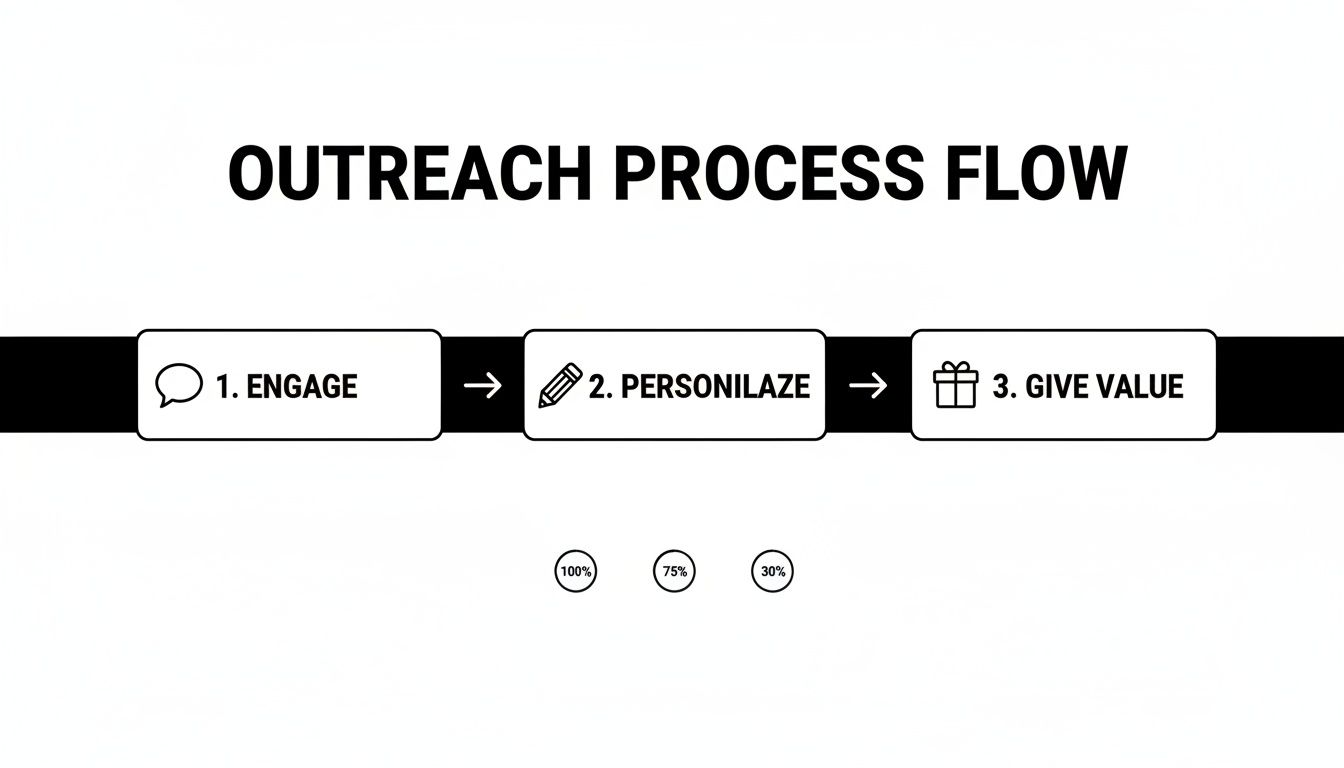
Every piece of content, every interaction, should be designed to engage people, feel personal, and give them something valuable.
So, what kind of content actually builds these deeper relationships? It's not about spitting out dry industry stats. The best content mixes value with a little bit of vulnerability. It shows off your expertise, but also your humanity.
Here are a few content types that just flat-out work for deepening rapport:
1. Share Your Point of View
Don't just regurgitate the news in your industry—have a take on it. Share your unique perspective on a new trend or a common frustration. A strong, well-reasoned opinion acts like a magnet for the right people and gets real conversations started in the comments.
2. Tell Personal Stories (With a Point)
Talk about a time you screwed up and what you learned. Share a client win that highlights one of your core values. Stories are how we're wired to connect, and they make your professional advice 22 times more memorable than just facts. They show the person behind the professional.
3. Publicly Celebrate Other People
Did someone in your network launch a podcast, get a promotion, or write a killer article? Create a post shouting them out. This simple act of generosity builds massive goodwill and strengthens your ties with both them and their network. It proves you're a giver, not just a taker.
4. Create "How-To" Content That Genuinely Helps
Break down a complicated process into a few simple steps. Share a checklist or a template that saves your audience time and headaches. This type of content positions you as a helpful expert who is genuinely invested in their success.
The trick is to mix it up. Don't be afraid to switch between short text posts, longer articles, quick videos, and even a simple poll. Different formats let different parts of your personality shine through, creating a personal brand that feels real and relatable. When you consistently show up with content that educates, inspires, and connects, you’re not just posting online—you’re actively building the relationships that will define your career.
Growing your network from a few dozen close contacts to hundreds—or even thousands—is when the real work begins. The big question is, how do you keep the authentic, personal touch that got you here in the first place? This is the pivot point where you stop just collecting connections and start building a powerful ecosystem of advocates.
The game is no longer one-to-one. It’s about scaling your influence without watering down your impact. You need systems that let you maintain strong ties, so no one valuable falls through the cracks just because you got busy. You're building a community where people feel seen, even as the numbers grow.
This is how you turn a simple list of names into a dynamic force for your business and career—a group of people who not only trust you but will go out of their way to champion your work.
Let's get real. To create true advocates, your relationships need to go way beyond polite professional exchanges. Research has shown that the strongest business connections—the ones that actually lead to warm referrals and game-changing partnerships—are built on three pillars.
It turns out strong relationships are the engine of B2B success. Brands that nail the trust factor make buyers 2.6 times more likely to recommend them. And affection—that feeling of being genuinely supported—drives a 3 times higher willingness to pay a premium and a 4.1 times greater perception of being a true partner. You can dive deeper into these findings in Mower's comprehensive study of decision-makers.
Here's how to build each pillar into your network.
Not everyone in your network is going to become a megaphone for your brand, and that's okay. Your job is to spot the people who are leaning in and give them a reason to shout from the rooftops.
Be on the lookout for these signals:
Once you spot these people, the goal isn't to hit them up for favors. It's to double down and invest in them even more.
You don't create advocates by asking for referrals. You create them by being so ridiculously helpful and supportive that they can't help but talk about you. Advocacy is the natural byproduct of a genuine, value-driven relationship.
Give them early access to a new project. Make a high-value introduction that helps them. Offer a free 30-minute call to jam on one of their challenges. When you pour value into your biggest supporters, you give them more reasons—and better stories—to share.
You can't improve what you don't measure. And while the ROI of building relationships in business isn't always a straight line, you can absolutely track indicators that connect your daily hustle to real-world results.
This isn’t about vanity metrics like your follower count. It’s about tracking the health and pulse of your ecosystem.
Key Relationship KPIs to Track
Start by tracking these weekly in a simple spreadsheet. It won’t take long to see patterns. You'll figure out which activities—like posting a certain type of content or engaging with a specific group—are driving the results that actually move the needle. This is how you scale intelligently, focusing your limited time on what truly builds the strongest, most impactful business relationships.
As you start getting more intentional about building relationships, you're going to have some real-world questions pop up. It's one thing to get the strategy, but it's another thing entirely to make it work day-to-day.
Let's tackle some of the most common hurdles I see professionals run into.
Forget about a magic number. The real secret is that consistency always beats intensity.
Don't try to block out a massive chunk of your calendar once a month—we both know that's the first thing to get canceled when things get busy. Instead, find 20-30 focused minutes every single day.
That small daily habit is what sticks. It's way more sustainable and, honestly, more effective. In that short window, you could easily:
The goal here is to weave this into your daily rhythm, not treat it like some extra chore you have to get to. If you're a leader or an entrepreneur, this is a core part of the job.
This is a delicate one. Reaching out to someone who has gone quiet requires a "value-first" approach, not a "me-first" one.
Whatever you do, avoid the generic "just checking in" message. It’s a dead end. It puts all the pressure on them to come up with a reason to talk.
Instead, find a genuine, specific reason to pop back into their inbox. Did you read an article that made you think of a conversation you had? Did their company just hit a big milestone you can congratulate them on?
My favorite play is to offer help with absolutely no strings attached.
Here’s a simple script you can adapt:
"Hey [Name], I saw your recent post about [Topic] and it reminded me of a resource that was a game-changer for me. Figured I'd pass it along in case it's helpful. Hope you're crushing it."
See what that does? It immediately gives value, removes any obligation to respond, and frames you as a helpful expert in their corner. It makes restarting the conversation feel natural, not needy.
This is probably the most important mindset shift you can make. It changes everything.
Networking is usually transactional. It’s short-term and all about what you can get. The driving question is, "Who can help me?" It's about collecting business cards (or LinkedIn connections).
Relationship building, on the other hand, is about the long game. It's focused on what you can give. The driving question is, "How can I help them?" It's about creating real, genuine connections.
Networking might get your foot in a few doors, but it's the authentic relationships that keep those doors open for good.
Real connections are what lead to the stuff that actually moves the needle: unsolicited referrals, people who champion you when you're not in the room, and opportunities for real collaboration. The entire framework in this guide is built for relationship building—creating a solid professional ecosystem that will support you for years to come.
At Legacy Builder, we specialize in turning your expertise and stories into the kind of strategic content that builds these lasting relationships. We help you show up consistently and authentically, turning your personal brand into your most powerful asset. Discover how we can help you build your legacy online.


You could – but most in-house teams struggle with the nuance of growing on specific platforms.
We partner with in-house teams all the time to help them grow on X, LI, and Email.
Consider us the special forces unit you call in to get the job done without anyone knowing (for a fraction of what you would pay).
Short answer – yes.
Long answer – yes because of our process.
We start with an in-depth interview that gives us the opportunity to learn more about you, your stories, and your vision.
We take that and craft your content then we ship it to you. You are then able to give us the final sign-off (and any adjustments to nail it 100%) before we schedule for posting.
No problem.
We have helped clients for years or for just a season.
All the content we create is yours and yours alone.
If you want to take it over or work on transitioning we will help ensure you are set up for success.
We want this to be a living breathing brand. We will give you best practices for posting and make sure you are set up to win – so post away.
Subscribe to our newsletter and get insights on how to grow your personal brand.
