.svg)
Subscribe to our newsletter and get insights on how to grow your personal brand.
Thank you! Your submission has been received!
Oops! Something went wrong while submitting the form.
.svg)


Let's be blunt: most cold emails are DOA—dead on arrival. They land in an inbox already overflowing with noise and get deleted in seconds.
The days of playing a pure numbers game, just blasting thousands of generic emails and hoping something sticks, are long gone. It’s not just ineffective; it’s lazy.
The hard truth is that a staggering 95% of cold emails fail to get any kind of reply. Across B2B, average response rates are stuck in a dismal 1% to 5% range. To make matters worse, about 17% of them never even make it to the inbox in the first place.
This chart paints a pretty clear picture of the battlefield.
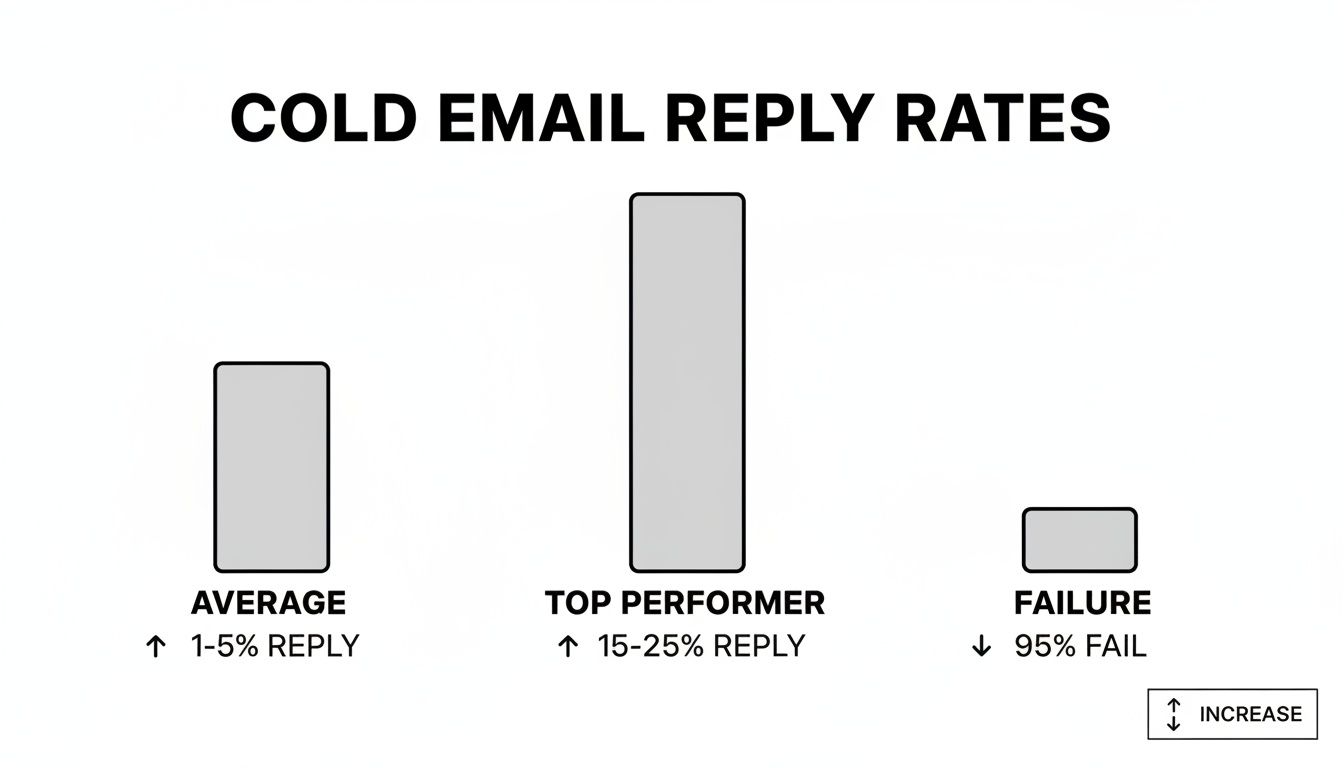
While most people are getting ignored, a small group of top performers are consistently hitting reply rates of 15-25%. That's not just a small improvement; it's a completely different league.
So, what’s their secret?
The gap between failure and success in cold email isn't a secret tool or a magic template. It's a fundamental shift in mindset.
This table breaks down the massive difference between average outreach and a well-executed strategy.
The numbers don't lie. Moving from the "Average" column to the "Top Performer" one is what this guide is all about. It's totally achievable with the right approach.
The difference boils down to one thing: you have to stop "blasting" and start "connecting." Your mission isn't to sell; it's to help.
The principles are simple but powerful:
The best cold emails don't feel cold at all. They read like a helpful note from a peer who understands your world and has an idea worth hearing.
To get there, you need to master how to write cold emails that get replies. This playbook will give you the practical steps and real-world examples to move from the 95% who get ignored to the elite few who start meaningful conversations and build real pipeline.
Let’s be honest: a great cold email never just happens.
It’s the result of sharp strategy and prep work that takes place long before your fingers ever hit the keyboard. Jumping straight into writing without this groundwork is like trying to build a house without a blueprint—it’s just not going to work.
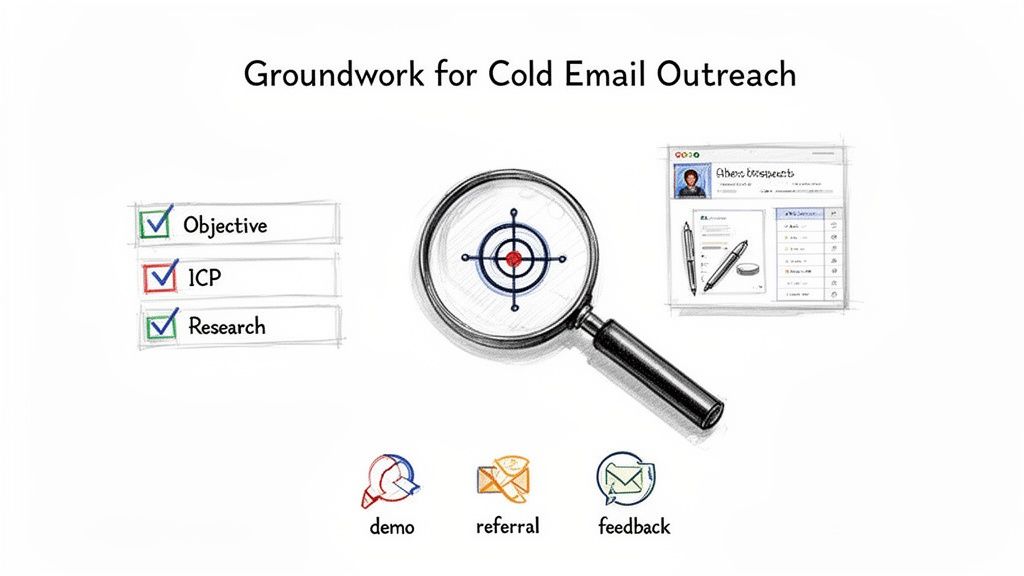
The whole thing starts with one simple, but incredibly powerful, question: What is the one action I want this person to take?
If you don't have a crystal-clear answer, your email will feel scattered and your call to action will fall flat. Fight the urge to ask for too much too soon. A 30-minute call is a massive commitment for a busy stranger. Instead, laser-focus on a single, low-friction objective.
The success of your entire campaign hangs on this single, measurable objective. This isn't about closing a deal on the first email; it's about starting a real conversation. Everything you write from here on out should be designed to gently guide the prospect toward this specific outcome.
What does a good starting goal look like?
Pick one. Just one. Trying to book a demo and get feedback in the same breath just creates confusion. It gives them an easy reason to say no to both. A single, clear goal makes your message direct, confident, and much more powerful.
Okay, you've got your goal. Now, who are you talking to?
Spraying and praying is a massive waste of time and, worse, it trashes your domain's reputation. The key is to get surgical and develop a razor-sharp Ideal Customer Profile (ICP).
An ICP isn't just about basic demographics like a job title or company size. It’s a detailed portrait of the person who feels the pain you solve most acutely. It digs into their goals, their daily frustrations, and the exact words they use to talk about them.
A solid ICP is the foundation for everything. It helps you find the right people and craft a message that actually resonates. For a deeper dive, check out our guide on how to find your target audience for a personal brand.
An effective ICP answers this question: "Who is losing sleep over the problem I solve?" Targeting anyone else is just a distraction.
Once your ICP is locked in, you can build a hyper-targeted list. Remember, quality always smokes quantity here. A hand-picked list of 50 perfect-fit prospects will outperform a generic, scraped list of 5,000 every single time.
Finally, you need a compelling "why now?" This is where a little bit of research becomes your secret weapon.
Your goal is to move beyond their LinkedIn title and find a genuine, timely reason to start a conversation. This is the raw material for the kind of personalization that makes your email feel like it was written just for them.
Spend a few minutes on each prospect. You're looking for a unique angle.
This isn’t about being a creep; it's about being relevant. Finding this connection shows you've done your homework and proves your email isn't just another automated blast. It’s the difference between being an intruder and being a welcome guest in their inbox. This is how you earn the right to their attention.
Alright, you've done the prep work. Now it's time to actually write the thing.
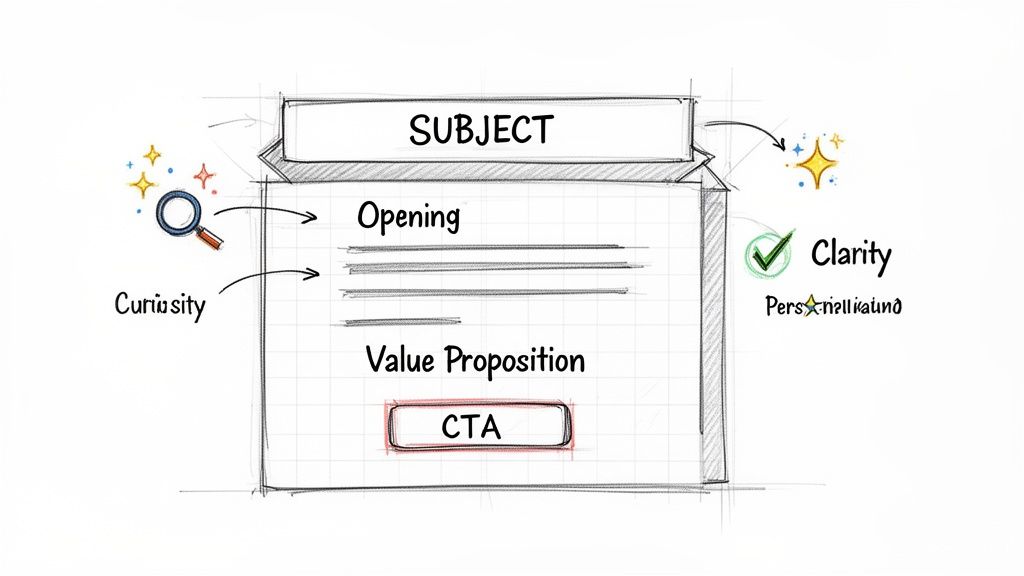
Think of a great cold email like a high-performance engine. It's not just one piece—it's a collection of critical parts working together. If one part fails, the whole thing sputters out. Your email is dead on arrival.
We're going to break down the four parts you absolutely have to get right: the subject line that gets the open, the first sentence that hooks them, the body that proves you're worth their time, and the call to action that actually gets a response. Get these four things right, and you're in business.
Let's be blunt: your subject line has one job. Just one. Get the email opened.
If it fails, nothing else matters. The most persuasive, well-researched email in the world is completely useless if it’s never read.
Forget the clickbait, the all-caps, and the cheesy exclamation points. They scream spam and get you deleted instantly. You're aiming for something that feels personal, relevant, and just intriguing enough to make them pause in their crowded inbox.
Try one of these angles:
To really master this, you need to stay on top of the latest email subject line best practices. And if you need more inspiration, check out our guide with 10 powerful email subject line examples to boost your open rates.
You’ve got about three seconds. That's it. Your first sentence determines whether they keep reading or hit delete. This is where all that research you did earlier pays off, big time. It's how you prove you're a human who's done their homework.
The opening line is always about them, never about you.
Find something specific and lead with it.
This isn't rocket science, but it immediately separates you from the 95% of lazy emails flooding their inbox. It shows you respect their time and have a real reason for reaching out.
Once you have their attention, get straight to the point. This isn't the place for your company's origin story or a laundry list of features. The body of your email is a short, sharp bridge connecting their problem to your solution.
Zero in on one powerful value prop. How are you going to make their job easier? Make their company more money? Make them look like a rockstar to their boss? Talk about benefits, not features.
A great value proposition doesn't sell a product; it sells an outcome. It answers the reader’s unspoken question: “What’s in this for me?”
Brevity is everything. Keep your emails under 200 words. The data doesn't lie: when people are getting around 15 cold pitches a week, short messages of just 6-8 sentences win. They see 42.67% open rates and 6.9% reply rates. It’s about respecting their time.
Finally, the call to action (CTA). This is where so many good emails fall apart. A vague CTA like "Let me know your thoughts" is a momentum killer. It puts all the work back on them, and busy people don't have time for that.
Be specific and make it ridiculously easy to say yes.
Ditch the high-commitment asks like, "Are you free for a 30-minute demo next week?" That’s too much, too soon. Instead, go for a low-friction, interest-based question.
We call this an "interest CTA." It's designed to start a conversation, not book a meeting. It’s a simple yes/no question they can answer in two seconds on their phone. If they say yes, you've earned the right to ask for a call. If it's a no, you get a clear answer and can move on without burning the bridge.
Let’s be real. Hitting "send" on that first email isn't the finish line; it’s just the starting gun. The hard truth about cold email is that most of your replies will come from the follow-up, not the initial pitch.
When you hear silence, it’s almost never a hard "no." It’s usually code for "I’m slammed," "I missed this," or "Not my priority right now." Your job is to stay on their radar with persistence that feels helpful, not annoying. This is where a smart follow-up sequence becomes your biggest asset.
I see it all the time: lazy follow-ups that just say, "Bumping this to the top of your inbox." It’s a wasted opportunity. It screams, "I have nothing else to offer, so do the work for me."
The golden rule is simple: every single message must add new value. Treat each follow-up as a new, bite-sized pitch. Give them a fresh reason to care. This approach respects their time and instantly positions you as a helpful resource, not just another salesperson.
Here are a few ways to add real value:
This turns your follow-up from a nagging chore into a multi-part story about how you can solve their problems. For a deeper dive, check out our guide on how to follow up after networking and build real connections.
So, how often should you follow up without becoming a pest? You need a rhythm that keeps you top-of-mind without flooding their inbox.
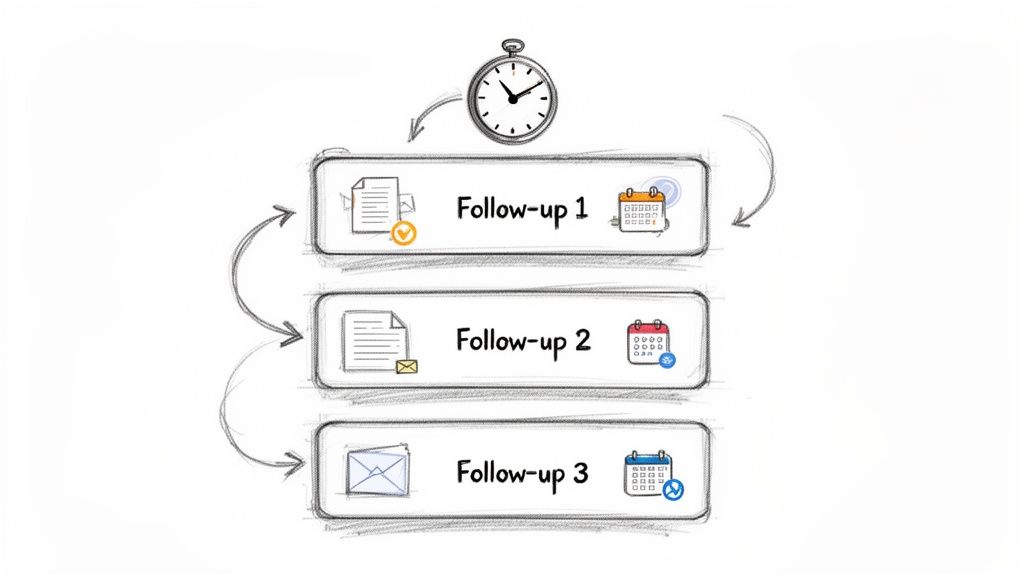
While there’s no single magic formula, a cadence I've seen work incredibly well is the "2-4-7" model. You send your follow-ups two days, then four days, and then seven days after the previous email. It’s a solid structure that starts with a quick nudge and then respectfully backs off over time.
The data doesn’t lie—persistence pays off, but only to a point. Take a look at how dramatically reply rates can increase with just a few thoughtful nudges.
As you can see, simply sending a few more value-driven emails can literally double your reply rate. However, pushing past four or five follow-ups often leads to diminishing returns and a higher risk of getting flagged for spam. The sweet spot is usually 3-4 follow-ups.
Look, not every prospect is a fit, and not every email will get a reply. That's okay. Part of a professional strategy is knowing when to graciously bow out. If you've sent three or four value-packed emails and all you hear is crickets, it’s time to move on.
This is where the "breakup" email comes in. It's a final, polite message that closes the loop and leaves the door open for the future. It’s low-pressure and shows you respect their time.
Here's a simple template:
Subject: Closing the loop
"Hi Alex,
I haven't heard back, so I'll assume improving [Specific Metric] isn't a priority right now. I won't reach out again, but please feel free to get in touch if that changes.
Best,"
You’d be surprised how often this email gets a reply. It cleans your pipeline of dead leads, maintains a positive impression, and sometimes even sparks a conversation with prospects who were just too busy to respond earlier. It's the pro move.
Theory is great, but putting it into practice is what gets results. You know the parts of a great cold email, but seeing it all come together is a different beast.
Here, I'm going to lay out a few adaptable frameworks—not rigid templates—for a couple of common scenarios. Think of them as blueprints showing how the principles we've covered click into place. I'll even break down why they work.
Then, we'll get brutally honest and look at the common mistakes that sink cold emails before they even get a chance. This is your final gut-check before hitting send.
Feel free to customize these. The whole point is to see how sharp personalization, a clear value prop, and a simple CTA can work together in the real world.
Subject: Question about [Company Name]'s recent launch
Body:
Hi [Founder Name],
Just saw the news about your [New Feature/Product] launch on TechCrunch—congrats to the team. Your point about solving [Specific Problem] for mid-market teams really stood out.
We recently helped a similar B2B SaaS company, [Competitor/Similar Company], reduce their customer onboarding time by 30% by integrating a similar workflow.
Is improving user retention a priority for you heading into Q3?
This works because it’s timely, specific, and leads with a powerful, relevant result. The question is a simple yes/no, making it dead simple to reply to.
A great cold email proves you understand the recipient's world. Referencing a launch or funding round shows you’ve done your homework, not just scraped a list of names.
Subject: Idea for [Executive's Department]
Body:
Hi [Executive Name],
Heard you on the [Podcast Name] podcast and was impressed with your approach to scaling your sales team.
My team works with VPs of Sales at companies like yours to automate lead qualification, often freeing up 10+ hours per sales rep each week.
Would you be open to seeing a one-page case study on how we did this for [Well-Known Company in their industry]?
Let's be real—executives are slammed. They care about outcomes, period. This email gets straight to the point, name-drops a relevant peer, and offers something valuable (a case study) instead of immediately asking for a meeting.
Knowing what not to do is just as important as knowing what to do. So many outreach campaigns fall flat because of simple, rookie errors. If you can just sidestep these pitfalls, you’ll already be ahead of 90% of the emails in their inbox.
Email providers have gotten incredibly smart. Certain words are immediate red flags that get your message tossed straight into the spam folder, never to be seen.
Here's the hard truth: your prospect doesn’t care about you or your company. Not yet, anyway. They only care about their own problems. Any email that kicks off with "My name is..." or "We are a leading provider of..." is getting deleted on sight.
Make the first sentence—and the whole email—about them.
A weak call to action kills all your momentum. "Let me know your thoughts" isn't a CTA; it's asking them to do work for you. And asking a complete stranger for a "30-minute demo" is a huge commitment.
You have to make it easy for them. Ask a simple, interest-based question. "Is this a priority for you?" or "Would you be open to learning more?" are low-commitment conversation starters.
This one is a silent killer. If you haven't properly set up your email authentication records like SPF and DKIM, your domain will look sketchy to email providers. This tanks your deliverability, meaning your perfectly crafted emails might not even land in the inbox.
It's a foundational step that so many people skip, kneecapping their entire effort before they even start.
Let's be real. You can write the perfect cold email, but if you aren't measuring what happens after you hit "send," you're just guessing. The real pros know that writing is only half the job—the other half is digging into the data to figure out what actually connects with people.
This means looking past the easy-to-track vanity metrics.
Sure, open rates are nice to glance at, but they’re not the whole story. With all the privacy updates and tracking pixels, they're becoming less reliable. Think of them as a quick pulse check on your subject lines and deliverability, but don't obsess over them.
The numbers that really move the needle are the ones that show someone took action.
If you want a crystal-clear view of how your campaigns are doing, you need to zero in on these metrics. This is what separates the amateurs from the pros.
You don't get better by accident. Improvement comes from systematically testing one thing at a time. It’s a simple, scientific way to stop guessing and start making decisions based on cold, hard data.
Optimization isn't about chasing some mythical "perfect" email. It's about making small, consistent tweaks that add up over time. Every send is a chance to learn something new.
Start with two versions of your email, A and B. Change only one thing between them—the subject line, the call-to-action, anything. Send each version to a decent-sized group from your list and see which one gets you more of what you want (replies, meetings, etc.).
Here are a few simple tests to get you started:
Don't forget about timing, either. It’s a bigger deal than most people think. For instance, some data shows that sending emails between 5-8 AM on Mondays can grab you 2.3% replies because you're catching people as they clear their inboxes for the week. You can dive deeper into how timing impacts response rates in this study.
Look at your data, make a smart change, and run the test again. This is the loop that turns good cold emailers into great ones.
Even with a solid game plan, you're going to hit a few roadblocks when you start sending cold emails. It happens to everyone. Let's tackle some of the most common questions that trip people up.
Look, sending just one email and hoping for the best is a losing strategy. The magic number is usually two to three follow-ups, each spaced a few days apart. We've seen a simple three-email sequence boost reply rates by over 90% compared to a single send.
Anything more than four messages starts to get annoying, and you risk getting flagged as spam. The key is to add new value with each touchpoint. Don't just "bump" your old message—offer a new insight, a different resource, or a fresh angle.
Short. Really short. Keep your emails tight and scannable, ideally somewhere between 50 and 200 words.
Think about it: your prospect is likely swiping through emails on their phone between meetings. You have seconds, not minutes, to get your point across. Stick to one core idea and a single, crystal-clear call to action. Ditch the wall of text.
The best approach is to create a solid framework, not a rigid template. This balances the efficiency you need with the genuine personalization required to earn a reply.
The honest answer? Neither.
Writing every single email from the ground up is a massive time-suck and just isn't scalable. But on the flip side, grabbing a generic, overused template that everyone else is sending is a surefire way to get ignored.
The winning move is a hybrid approach. Build a strong, repeatable structure for your value prop and CTA, but always—always—spend two or three minutes writing a completely unique opening based on your research for that specific person. It gives you the speed of a system with the impact of genuine personalization.
At Legacy Builder, we transform your expertise into content that builds authority and starts conversations. Ready to elevate your personal brand? Explore our services today.


You could – but most in-house teams struggle with the nuance of growing on specific platforms.
We partner with in-house teams all the time to help them grow on X, LI, and Email.
Consider us the special forces unit you call in to get the job done without anyone knowing (for a fraction of what you would pay).
Short answer – yes.
Long answer – yes because of our process.
We start with an in-depth interview that gives us the opportunity to learn more about you, your stories, and your vision.
We take that and craft your content then we ship it to you. You are then able to give us the final sign-off (and any adjustments to nail it 100%) before we schedule for posting.
No problem.
We have helped clients for years or for just a season.
All the content we create is yours and yours alone.
If you want to take it over or work on transitioning we will help ensure you are set up for success.
We want this to be a living breathing brand. We will give you best practices for posting and make sure you are set up to win – so post away.
Subscribe to our newsletter and get insights on how to grow your personal brand.
