.svg)
Subscribe to our newsletter and get insights on how to grow your personal brand.
Thank you! Your submission has been received!
Oops! Something went wrong while submitting the form.
.svg)



A polished LinkedIn profile can still produce nothing. That's the counterintuitive part. Profile completeness and search visibility are related, but visibility only matters when it reaches the right recruiter, buyer, or professional contact. LinkedIn profile data guidance associates professional photos with 21x more profile views and 9x more connection requests, while complete “All-Star” profiles can appear in 40x more searches than incomplete profiles, as summarized by LinkedIn profile statistics for 2026.
I've hired and delivered LinkedIn profile optimization services for more than 200 clients. My conclusion is straightforward: don't buy a profile rewrite because your headline “feels weak.” Buy the right level of strategy for the business outcome you need. Recruiter discovery, authority building, and client acquisition require different profiles, different proof, and different follow-through.
Treat LinkedIn profile optimization as a cosmetic project and you miss its commercial value. Many users update the photo, add a banner, expand the About section, and assume the job is finished. Your LinkedIn profile functions more like an indexed landing page than a digital business card.
LinkedIn's profile-data guidance and widely cited platform statistics connect structured profile improvements with discoverability. A professional photo is associated with 21x more profile views and 9x more connection requests, while complete “All-Star” profiles can appear in 40x more searches than incomplete ones, according to LinkedIn profile data and optimization statistics. Those figures don't mean every optimized profile will generate business. They show that a sparse profile creates a measurable visibility disadvantage.
The key question is not, “Does this profile look complete?” Ask instead:
A complete-looking profile can still fail in two ways. First, it may contain no deliberate keyword strategy, so it never surfaces for the searches that matter. Second, it may be stuffed with keywords and read like generic search-engine copy. The first profile is invisible. The second is visible but unconvincing.
Practical rule: Optimize for the person who needs to trust you, not for a completeness badge.
LinkedIn search appearances, profile views, and post impressions give you a way to observe whether changes are improving visibility. LinkedIn's profile analytics and search appearances guidance explains that search appearance data covers a rolling 90-day window, which makes headline and keyword testing more practical than a one-time rewrite.
If your positioning needs work beyond the profile itself, reviewing examples can help you find personal branding inspiration without copying someone else's voice. You can also use LinkedIn's guide to increasing profile views as a practical reference before paying a provider.
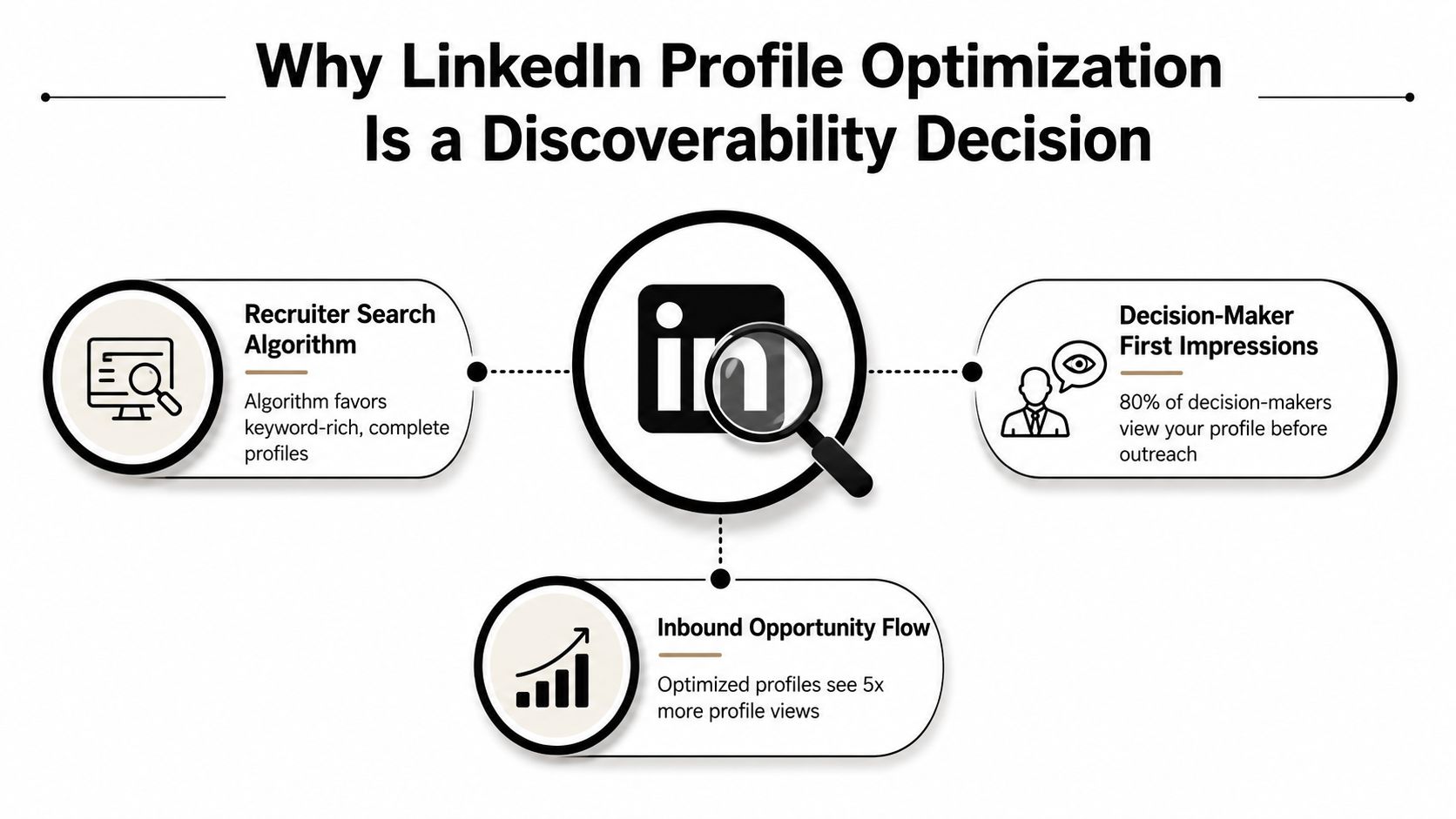
LinkedIn profile optimization services are paid engagements that audit, rewrite, restructure, and configure your profile for a defined audience. A legitimate provider should work across the headline, About section, experience entries, skills, Featured section, visual elements, and relevant profile settings.
The process usually starts with discovery. A strategist should ask what you want LinkedIn to do for you, who needs to find you, what language those people use, and what proof you can support. If the provider sends a generic questionnaire and never asks about your target audience, you're probably buying copy, not positioning.
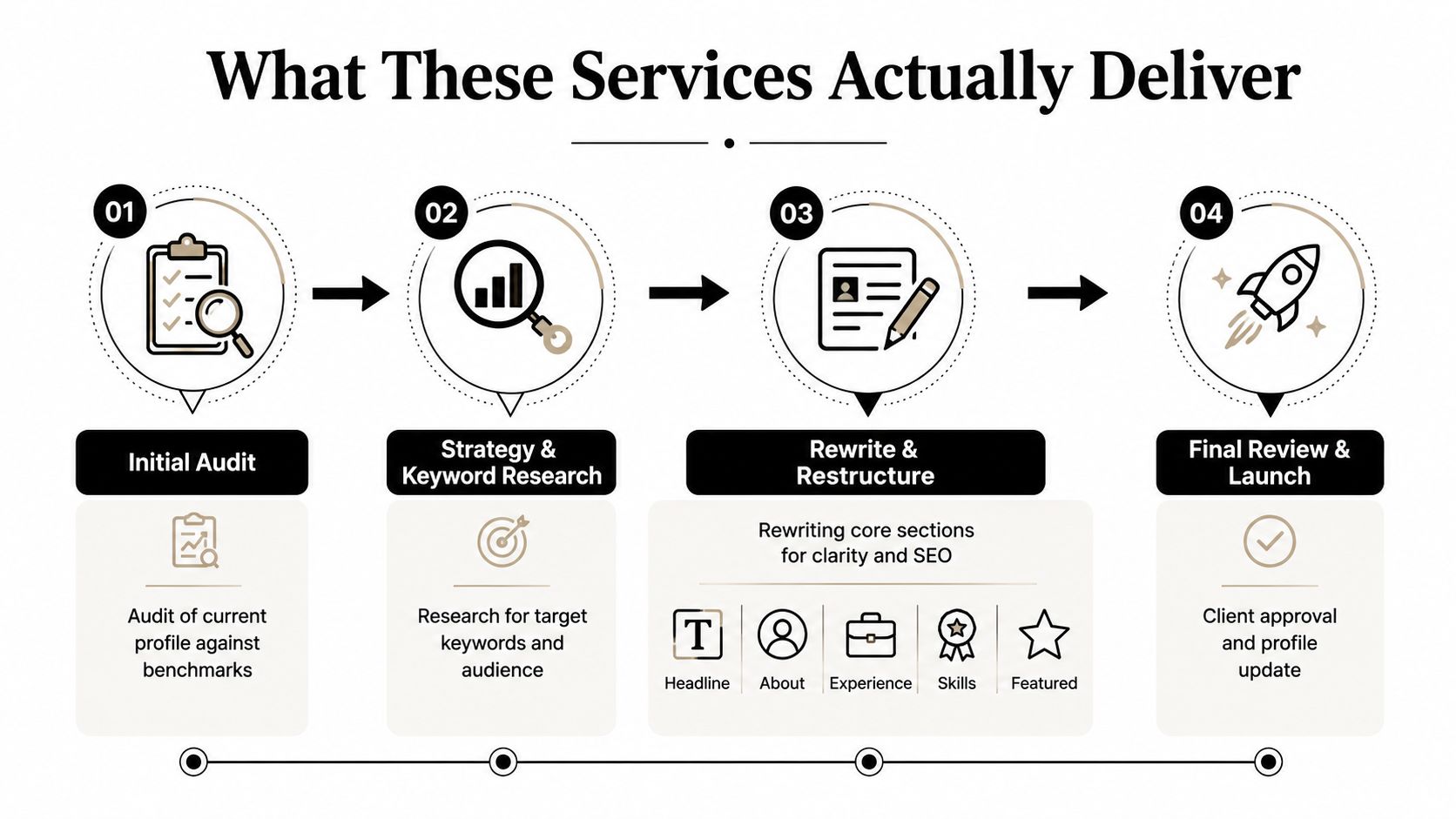
A typical engagement includes the following:
The critical distinction is between a one-time rewrite and an ongoing retainer. A one-time service changes the landing page. A retainer may add content planning, post writing, engagement support, analytics reviews, and positioning adjustments. Don't assume one includes the other.
Here's an example of the kind of instructional material a provider may use during the process:
Before signing, ask for the exact deliverables in writing. “Full optimization” can mean a carefully researched rewrite, or it can mean a template with a new headline. Those are different products.
The market generally separates into four tiers. The right choice depends less on ambition than on how much strategic input your situation requires.
| Tier | Typical Price | What Is Included | Best Fit |
|---|---|---|---|
| DIY or AI-assisted | Free to $50/month | Templates, checklists, prompts, keyword suggestions, and editing guidance | Founders and professionals comfortable writing and implementing changes |
| Freelancer or specialist | $150 to $300 | Profile rewrite, targeted sections, usually one revision, and limited strategy | Straightforward career profiles or focused recruiter discovery |
| Boutique or agency | $300 to $650 | Audit, positioning, keyword research, full rewrite, banner or Featured support, and sometimes a content starter kit | Leaders building authority or a buyer-facing profile |
| Executive or coach-led | $1,200 to $1,500+ | Strategy calls, deeper positioning, executive narrative, profile work, and often an initial content component | Senior leaders, founders, and high-value client acquisition |
These ranges are summarized in a comparison of LinkedIn profile optimization service pricing. Treat them as buying categories, not guarantees of quality.
DIY tools are useful when you already understand your audience and can distinguish a strong positioning statement from polished filler. They'll help you structure an About section or generate headline options. They won't reliably identify the most valuable market angle, select defensible proof, or challenge a vague offer.
A capable freelancer can produce excellent work when your goal is narrow. If you're changing roles and need recruiter-friendly language, this tier often makes sense. The limitation is depth. Most flat-fee rewrites don't include extensive interviews, market positioning, design, content, or post-launch measurement.
Boutique providers typically connect the headline, About section, Experience, skills, Featured content, and banner into one narrative. That's valuable for consultants, agency owners, and executives whose profile must explain a more complex offer. Content support may be limited or sold separately, so read the scope carefully.
Executive packages can include several strategy conversations, narrative development, leadership positioning, and early content direction. They're justified when a vague profile could weaken a major hiring, fundraising, sales, or reputation objective. They're wasteful when you only need clearer copy and a targeted keyword pass.
The tradeoff is simple: lower tiers prioritize speed and affordability, while higher tiers buy more strategic diagnosis and implementation support. Don't pay for executive coaching to fix a headline that a competent specialist can rewrite.
Your business goal should set the service tier. A long deliverables list does not tell you whether the provider can improve recruiter discovery, build authority, or generate client conversations. Choose the outcome first, then buy only the work that supports it.
| Service Tier | Recruiter Discovery | Authority Building | Client Acquisition |
|---|---|---|---|
| DIY or AI-assisted | Useful if you understand role keywords | Limited without content strategy | Usually too shallow for complex offers |
| Freelancer or specialist | Strong fit for focused role alignment | Adequate for a clear personal narrative | Works only when proof and CTA are already strong |
| Boutique or agency | Helpful for senior or complex profiles | Strong fit for narrative and visual cohesion | Good fit when Featured assets and conversion paths need work |
| Executive or coach-led | Appropriate for leadership searches | Strong for nuanced executive positioning | Best suited to high-value offers requiring deeper trust |
Pay for keyword alignment, a credible headline, a concise About section, and experience entries that make your level obvious. A strong freelancer or specialist is usually enough when recruiters need to find you for a defined role. Skip a content retainer if your immediate goal is being found and understood by the right hiring teams.
Measure relevant recruiter messages, better-fit conversations, and responses from target firms. Profile views and search appearances can show whether visibility changed after the rewrite, but general traffic is not qualified discovery. A profile that attracts the wrong audience has not solved the hiring problem.
Authority requires a profile that gives your ideas a credible home. A boutique service fits better because it can connect your narrative, banner, Featured assets, experience, and content themes. Visitors should understand what you know before they read a large body of posts.
Track engagement from relevant peers, along with saves, shares, and referrals. Pay for strategic narrative work before visual polish. A strong banner supports authority, but it cannot replace a clear point of view or a consistent publishing cadence.
Client acquisition demands buyer language, a specific problem, evidence of relevant work, useful Featured resources, and a next step that matches the buyer's decision path. That next step may be a guide, case study, consultation page, or contact route.
A profile should answer the buyer's silent question: “Why should I continue this conversation with you?”
Choose the tier that improves the metric your quarter depends on. The longest deliverable list isn't automatically the most valuable service. A polished profile can still produce no inbound if you never publish content that gives prospects a reason to return. Pay for profile strategy first, then add content support only when you can maintain the cadence.
You can eliminate many weak providers in fifteen minutes. Start by asking whether they diagnose before they quote. A serious strategist needs to understand your goal, audience, career or business context, existing proof, and current visibility before recommending a package.
Look for these green flags:
Be wary of these red flags:
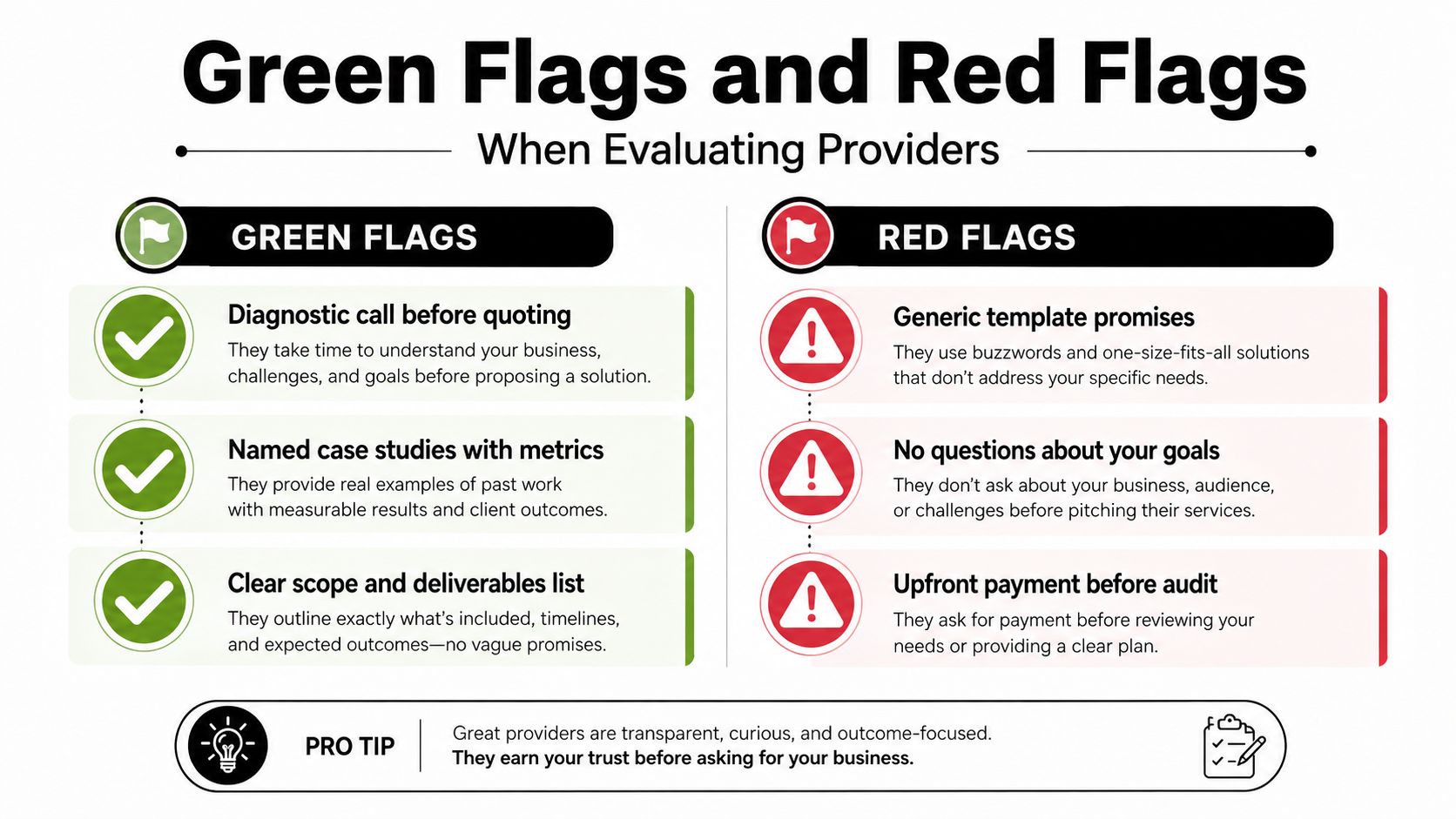
Ask these questions on the sales call:
A provider who can't answer those questions clearly will probably deliver surface-level copy.
A profile is the landing page. Content is the traffic source. If you optimize the landing page and stop creating reasons for people to visit, you've improved the destination without improving distribution.
Many LinkedIn profile optimization services fall short. They deliver a polished profile, then leave the client with no posting rhythm, no comment strategy, and no plan for refreshing Featured content. Recent 2025 and 2026 guidance emphasizes that two to three high-quality posts per week can outperform daily low-quality posting, and that knowledge-driven content is more useful than constant promotion, as discussed in recent LinkedIn optimization guidance.
A practical content engine has three parts:
Your profile also needs recent evidence of expertise. A buyer may read your About section, then check your posts and Featured area to decide whether your positioning reflects real work. A profile that says you understand a market but shows no meaningful activity creates doubt.
For content planning, a LinkedIn content calendar template can help turn broad ideas into a repeatable publishing system. If video is part of your authority strategy, compare video training platforms for learning and production workflows before choosing tools or outsourcing.
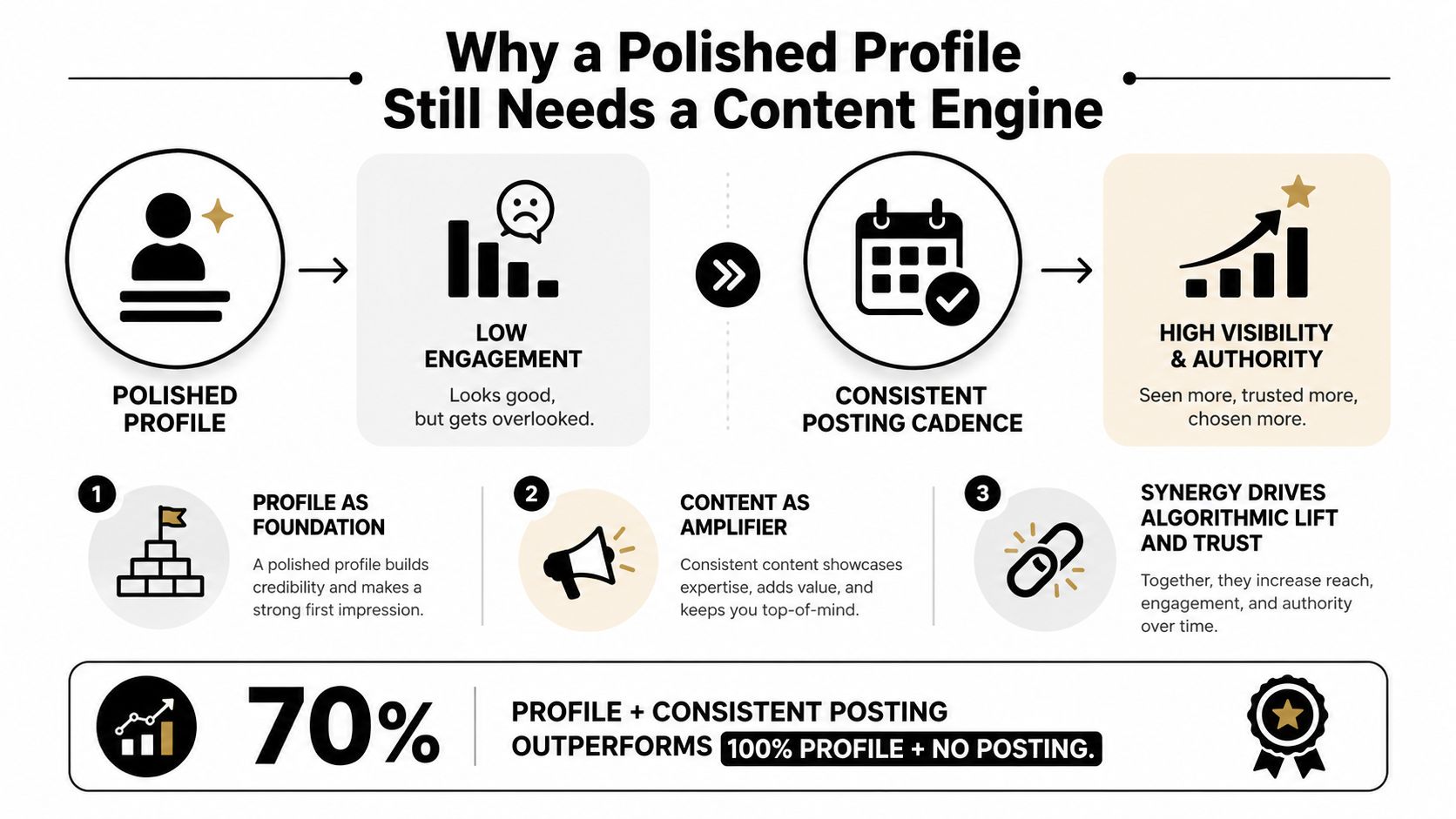
Start with a sustainable cadence you can maintain. The exact format matters less than consistency, relevance, and a clear connection between what you publish and what your profile promises.
Use a simple buying process. Request a sample audit, ask for the provider's methodology, confirm the business outcome, and review the contract for deliverables, revisions, implementation, ownership, and ongoing support. Don't sign because a portfolio looks attractive. Sign because the provider understands the audience you need to reach.
For context beyond LinkedIn, reviewing what hiring a resume writer costs can help you compare profile work with adjacent career-writing services. They overlap in writing skill, but a LinkedIn profile often needs a different conversion path because it may serve recruiters, buyers, peers, partners, and prospects.
A useful evaluation checklist includes:
You can also use this guide to online reputation management services when your LinkedIn profile is only one part of a broader public presence.
Should I choose DIY, a freelancer, or full-service support?
Choose DIY when you understand your positioning and only need structure. Choose a freelancer for a focused rewrite. Choose full-service support when your audience, offer, proof, visuals, and content need to work together.
How quickly should the work be completed?
Turnaround depends on interview depth, revisions, design, and implementation. Ask for a written schedule rather than accepting a vague promise of speed.
What should I prepare before hiring?
Bring your target audience, target roles or buyers, current profile, relevant keywords, proof, recommendations, portfolio links, service details, and preferred voice. The better your raw material, the less generic the final copy will be.
How should I measure the result after launch?
Establish a baseline for search appearances, profile views, relevant messages, connections, content response, and conversations. Review early signals after launch, then assess whether the profile is attracting the right people and supporting the outcome you selected.
Legacy Builder combines LinkedIn profile optimization with ongoing content creation, strategic distribution, and audience engagement for professionals who need more than a one-time rewrite. Visit Legacy Builder to explore a personal-brand system built around your story, positioning, and growth goals.


You could – but most in-house teams struggle with the nuance of growing on specific platforms.
We partner with in-house teams all the time to help them grow on X, LI, and Email.
Consider us the special forces unit you call in to get the job done without anyone knowing (for a fraction of what you would pay).
Short answer – yes.
Long answer – yes because of our process.
We start with an in-depth interview that gives us the opportunity to learn more about you, your stories, and your vision.
We take that and craft your content then we ship it to you. You are then able to give us the final sign-off (and any adjustments to nail it 100%) before we schedule for posting.
No problem.
We have helped clients for years or for just a season.
All the content we create is yours and yours alone.
If you want to take it over or work on transitioning we will help ensure you are set up for success.
We want this to be a living breathing brand. We will give you best practices for posting and make sure you are set up to win – so post away.
Subscribe to our newsletter and get insights on how to grow your personal brand.
