.svg)
Subscribe to our newsletter and get insights on how to grow your personal brand.
Thank you! Your submission has been received!
Oops! Something went wrong while submitting the form.
.svg)



Most founders hire LinkedIn ghostwriting services by reading three sample posts and asking, “Does this sound like me?” That test is necessary, but it's far too weak. A polished writer can mirror your vocabulary, sentence length, and favorite opinions while slipping in claims you can't defend when a prospect challenges them in the comments.
The stronger buying question is simple: can you stand behind every sentence? LinkedIn had more than 1 billion members across more than 200 countries and territories as of June 2025, according to LinkedIn's company overview. That makes your profile part of a global professional identity layer, not a casual publishing experiment. Your posts can reach buyers, employees, investors, partners, and competitors, and each audience can interpret a confident but unsupported statement as evidence about your judgment.
The right evaluation framework has four parts: authority capture, ownership boundaries, workflow controls, and measurement discipline. Voice is only one component. The rest determines whether the service produces durable credibility or a stream of plausible content that creates risk.
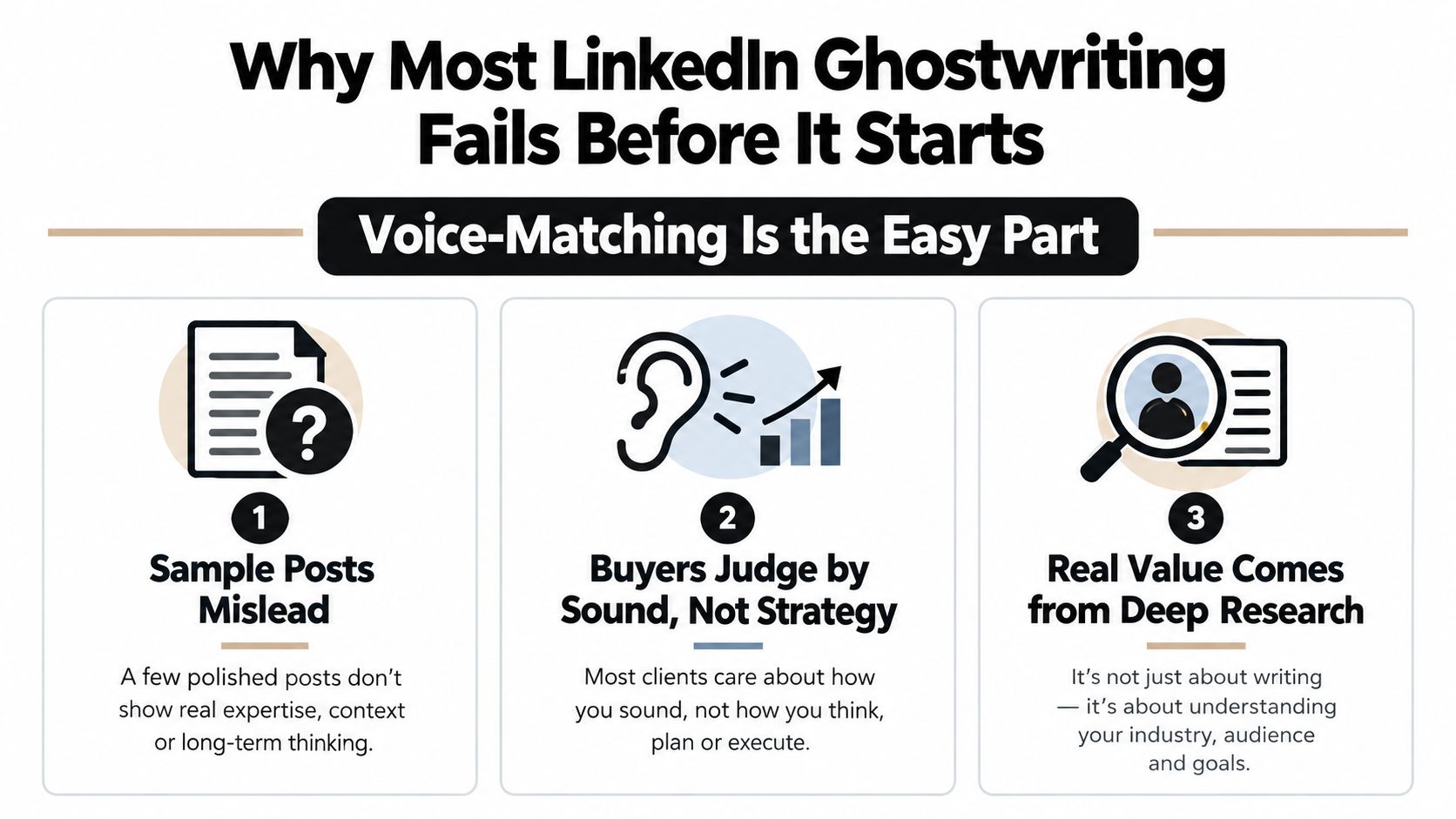
LinkedIn ghostwriting usually fails before publication because the buyer tests a sample post instead of the credibility system behind it. A sample shows that a writer can produce polished prose. It does not show whether they can extract original expertise, separate your experience from their assumptions, verify a technical claim, or prepare you to defend an argument in public.
Voice-mirroring is only the entry point. Defensible ghostwriting connects each strong statement to an identifiable source, a clear owner, and an approval decision. Without those controls, a post can sound exactly like you while attaching opinions, customer details, or product claims that you would never make yourself.
B2B thought leadership is crowded, and familiar formatting does not solve that problem. In the research cited by Edelman on breaking through the thought leadership glut, 71% of decision-makers said half or less of the content they consume provides valuable insights. Buyers need evidence, useful judgment, and ideas that challenge accepted assumptions.
Practical rule: If a writer can reproduce your tone but cannot explain where a claim came from, you hired a stylist, not a ghostwriter.
Authority capture measures whether the service can draw out thinking that belongs to you. Look for structured interviews, customer conversations, internal decisions, strong disagreements, and the language you use when explaining difficult problems. A questionnaire about content goals rarely reaches the material that makes an argument distinctive.
Ownership boundaries define what the writer may infer and what requires your approval. Lived experience, revenue claims, customer stories, product assertions, and sensitive opinions carry different risks. The provider should record who owns each claim and identify statements that cannot be published without your sign-off.
Workflow controls protect accuracy without turning every draft into a committee exercise. Assign responsibility for source verification, subject-matter review, voice calibration, and final approval. If content work depends on several handoffs, Fluidwave's AI project management assistant guide provides context for organizing that execution.
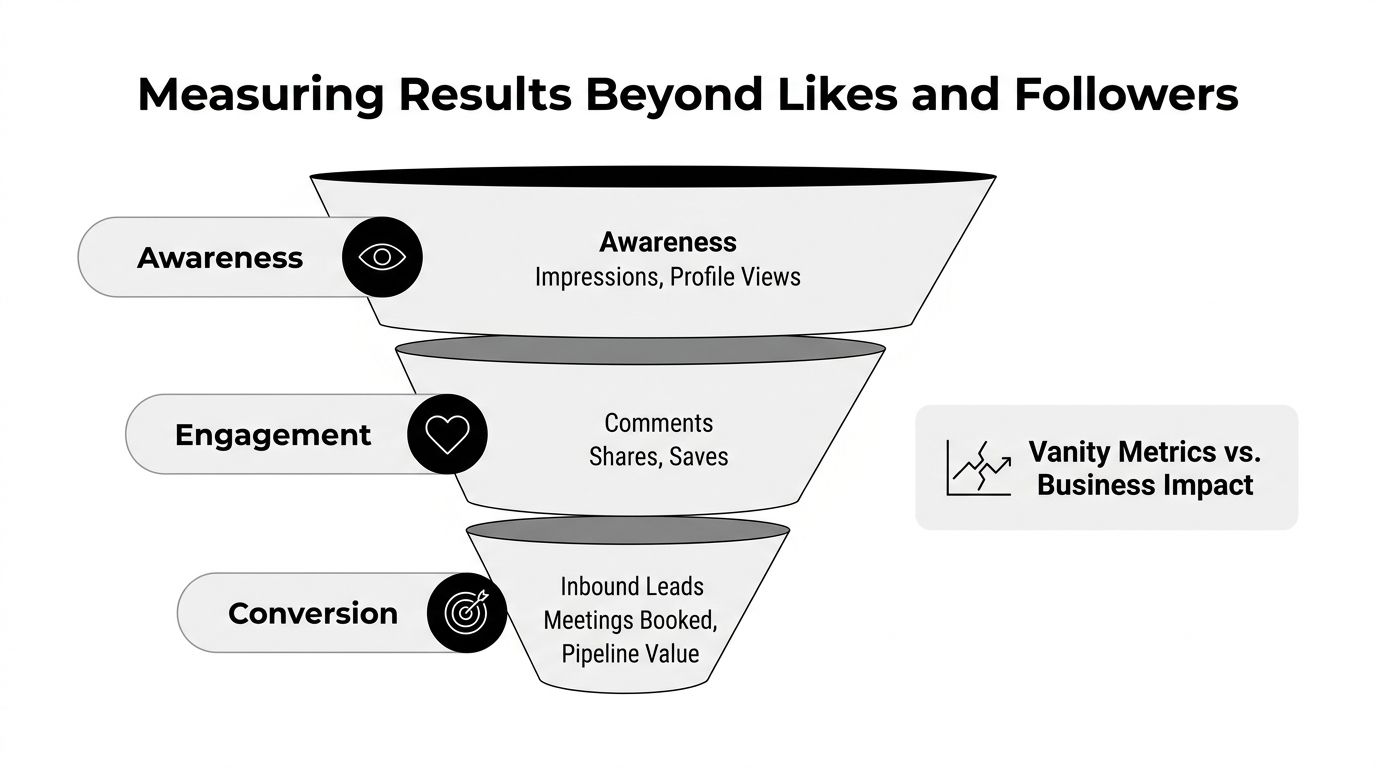
Measurement discipline ties the engagement to business outcomes. Impressions and follower growth can diagnose distribution, but they do not show whether the right people visited your profile, started a conversation, or influenced a buying decision. Ask for reporting that connects content activity with qualified visits, conversations, saves, and influenced opportunities.
| Lens | Buyer Question | What Good Looks Like | Red Flag |
|---|---|---|---|
| Authority capture | How will you extract ideas I actually own? | Interviews, source material, customer problems, and defined content pillars | A form followed by generic posts |
| Ownership boundaries | Who approves claims and personal experiences? | Written approval rules and clear final sign-off | “We'll handle everything” |
| Workflow controls | Who checks the draft, and in what order? | Source review, subject review, voice check, and approval routing | One writer self-approves |
| Measurement discipline | What will you report beyond reach? | Qualified visits, conversations, saves, and influenced opportunities | Monthly impressions only |
A founder once selected a vendor because the sample post sounded uncannily personal. The first month looked promising. Then a post stated a technical position the founder had never held. A prospect challenged it publicly, forcing the founder to explain that the wording was not his without making the ghostwriting relationship the story.
The vendor had matched the voice. It had not protected the person behind it.
The discovery channel matters less than the scrutiny that follows. You might find a specialist agency such as Legacy Builder, a vetted freelance marketplace, or an independent writer through your network. None of these routes proves that a candidate understands your market, can preserve your point of view, or will protect your reputation when reach contracts.
Start with an authority-extraction intake. Ask the candidate to demonstrate how they turn expertise into reusable source material, defensible claims, and a repeatable editorial system. A portfolio walkthrough shows finished posts. It does not show how the provider handles uncertainty, approval boundaries, or ideas that only the executive can supply.

A serious intake produces tangible artifacts: an interview record, a point-of-view inventory, content pillars, a source library, a voice guide, an approval rubric, and a list of claims requiring special handling. Ask to inspect examples of those artifacts, with confidential details removed. If a provider cannot explain how these controls work, a polished sample may reflect voice-mirroring rather than credible authorship.
For profile, audience, and positioning work, compare the writing process with a dedicated LinkedIn profile optimization guide. Profile positioning and post production support each other, but they should remain separate workstreams. A stronger headline cannot repair weak authority extraction, unclear ownership, or unsupported claims.
Pricing becomes difficult when vendors quote different scopes under similar labels. One provider may charge for writing only, while another includes interviews, strategy, visual assets, scheduling, comment support, and reporting. Comparing the monthly total without normalizing the deliverables is how founders overpay for production or underfund the work that makes production useful.
| Model | Typical Inclusions | Common Exclusions | Best Fit |
|---|---|---|---|
| Monthly retainer | Ongoing research, planned posts, a defined review process, and recurring reporting | Profile work, direct messages, comment management, design, or deeper analytics unless stated | Leaders who want continuity |
| Per-post | A draft for each commissioned post, usually with a defined review scope | Strategy, pillar development, performance analysis, and ongoing relationship work | Occasional publishing or a short pilot |
| Hybrid retainer | A recurring strategy and service fee with a capped number of posts or hours | Extra drafts, additional revisions, community management, and rush work | Buyers who need flexibility with budget control |
A monthly retainer usually buys availability and accumulated context, not merely a lower unit price. As the writer learns your customers, arguments, and boundaries, the extraction process can become more efficient. That value disappears if the provider assigns a new writer every month or treats every draft as an isolated transaction.
Per-post pricing gives you control when your needs are irregular, but it can encourage shallow commissioning. You may receive a clean post without the research, editorial planning, or post-publication review needed to understand whether the idea worked. It also makes it harder for a provider to reserve time for interviews and strategic refinement.
Hybrid arrangements can work well when you know your baseline needs but expect occasional launches, announcements, or executive responses. Put the cap in writing. Clarify whether unused capacity rolls over, whether additional posts have a fixed rate, and whether a revision counts as a new deliverable.
Ask each provider to state:
Don't assume LinkedIn activity includes outbound prospecting. If a vendor proposes direct outreach, ask them to explain the difference between publishing thought leadership and using LinkedIn InMail. Sift AI's explanation of what InMail is and how it works can help your team separate those functions before they appear in the same proposal.
The cheapest quote can be sensible for a narrow writing assignment. It becomes expensive when you later add strategy, fact-checking, engagement, and reporting as separate line items.
A credible approval system gives every handoff a named owner. The writer shouldn't be the only person deciding whether a claim is accurate, and the executive shouldn't have to rewrite every sentence to restore a natural voice.
A healthy first month often takes 5 to 10 business days from initial briefing to a stable publishing rhythm because the provider is still learning your language, evidence, and boundaries. Later cycles can move faster once the brief is reliable. Speed should come from better source material, not from removing review stages.
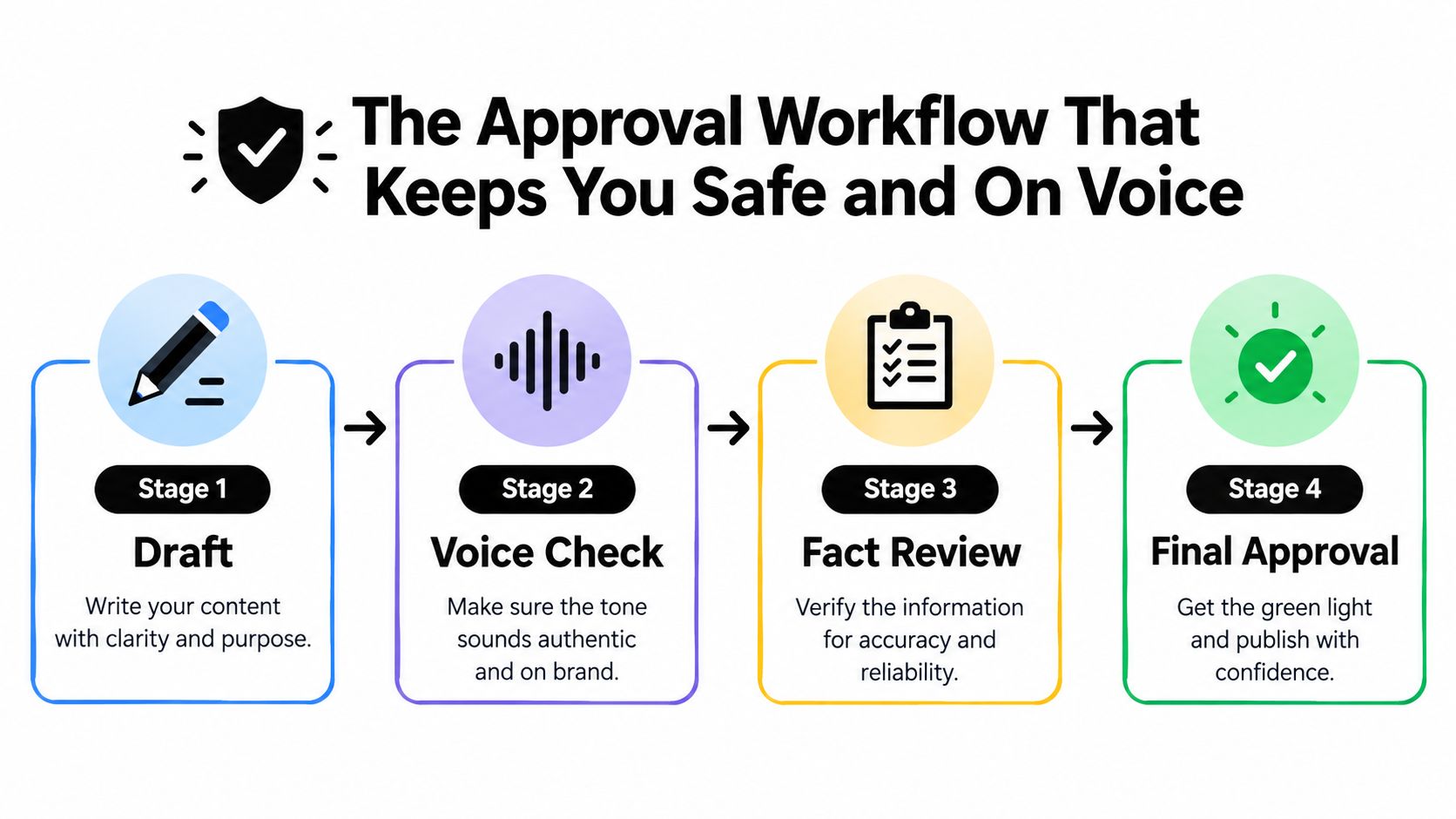
Stage one, source verification. The writer assembles the draft from interview notes, approved examples, internal material, and external sources. Any statistic, customer statement, product claim, or historical reference receives a source or a clear label as an opinion.
Stage two, subject-matter review. You or a delegated expert checks whether the argument is technically correct and commercially honest. At this point you catch a simplified explanation that would mislead a knowledgeable reader.
Stage three, voice calibration. The writer revises for your natural vocabulary, level of directness, rhythm, and point of view. Voice calibration shouldn't change the substance. It should make the approved substance sound like something you would say.
Stage four, final approval. You approve the final wording, accompanying visual, call to action, and publication timing. The person whose reputation is attached to the post retains the final decision.
A documented content approval workflow can make these responsibilities easier to implement across a team, particularly when a founder, marketing lead, legal reviewer, and subject-matter expert all touch the same draft.
Pause the draft when: the writer can't identify the source, the post implies experience you don't have, a customer story lacks permission, or the opinion is strategically attractive but not one you can defend.
Revenue statements, customer outcomes, named client stories, competitive claims, hiring opinions, and regulated topics deserve explicit approval. The writer should flag them rather than soften or strengthen them. A confident sentence is not a substitute for evidence.
Use a simple status system: verified, needs subject review, personal experience approved, or remove. Limit revisions to a defined number of rounds, but allow an immediate pause when a factual or reputational risk appears. Rewriting a risky claim several times won't make it safe.
A post can earn attention without moving a commercial conversation forward. It can also influence a buyer who never likes, comments, or identifies the post during a sales call. That makes single-post attribution unreliable and turns vanity metrics into a poor substitute for measurement.
Start with a 30-day baseline, then compare rolling 30-day cohorts by post format, topic, audience segment, and call to action. The point isn't to find one winning post. It's to learn which combinations attract the people you want and create useful next actions.
Use unique UTM parameters on relevant links and consistent CRM fields for source, first touch, assisted touch, and opportunity influence. If your team needs structured access to platform data, you can browse LinkedIn data API options, then confirm that the chosen setup supports your privacy, access, and reporting requirements.
The commercial case for thought leadership is real, but research findings aren't client guarantees. In a global survey of roughly 3,500 B2B decision-makers, 75% said a particular thought-leadership item led them to research a product or service they hadn't previously considered, and 23% of that group ultimately began buying from the publishing organization, as reported by Edelman's B2B buyer research. Treat those figures as population-level context, not a promised conversion rate.
A trustworthy provider reports the sample size behind its conclusions and, where the data supports it, confidence intervals. At minimum, it explains what changed, what was measured, and where attribution remains uncertain. The audience engagement metrics guide is useful for separating attention signals from outcomes that deserve commercial weight.
A reach decline doesn't automatically mean the writing got worse. Founders often respond by ordering more posts, which can multiply the waste if the underlying problem is distribution, audience fit, or a platform-wide reduction in organic exposure.
An analysis of 673,658 posts from 63,108 accounts found that personal profiles generated 63% more engagement than company pages, while other reporting cited a 50% decline in overall organic reach after an algorithm shift toward fewer, more relevant creators. The figures come from the Metricool and Favikon LinkedIn analysis, and they should be treated as market context rather than a forecast for your account.
Start with engagement per impression, not raw impressions. If impressions fall but meaningful interactions remain proportionate, distribution may be the main issue. If both impressions and interaction quality decline, inspect the audience, topic, and opening.
Then review distribution behavior:
Only after that audit the message. Review the mix of pillars, the specificity of the offer, the strength of the opening, and whether the post gives readers a reason to add their own experience. A quality upgrade can reduce superficial engagement if it becomes too cautious, abstract, or polished.
Sometimes the right decision is to publish less and spend more time on expert replies, relationship-building, and repurposing a strong argument into a different format. A quarterly content-and-distribution audit can reveal whether the writer should produce new drafts, refine the audience, or help the executive participate more actively after publication.
A reach problem isn't always a writing problem. Before commissioning another batch, identify whether the account has lost distribution, audience fit, interaction, or a distinctive point of view.
Use this checklist before signing:
Ask every candidate to show the rubric they use when a draft sounds personal but contains a questionable claim. That answer will tell you more than a portfolio walkthrough. LinkedIn ghostwriting services are worth hiring when the provider treats your credibility as the deliverable, not merely your voice.
Legacy Builder provides done-for-you LinkedIn ghostwriting for founders and executives, using interviews to capture stories, positioning, and content pillars before drafting posts for approval and scheduled publishing. If you want a documented process built around voice, defensibility, and consistent distribution, visit Legacy Builder to discuss the fit.


You could – but most in-house teams struggle with the nuance of growing on specific platforms.
We partner with in-house teams all the time to help them grow on X, LI, and Email.
Consider us the special forces unit you call in to get the job done without anyone knowing (for a fraction of what you would pay).
Short answer – yes.
Long answer – yes because of our process.
We start with an in-depth interview that gives us the opportunity to learn more about you, your stories, and your vision.
We take that and craft your content then we ship it to you. You are then able to give us the final sign-off (and any adjustments to nail it 100%) before we schedule for posting.
No problem.
We have helped clients for years or for just a season.
All the content we create is yours and yours alone.
If you want to take it over or work on transitioning we will help ensure you are set up for success.
We want this to be a living breathing brand. We will give you best practices for posting and make sure you are set up to win – so post away.
Subscribe to our newsletter and get insights on how to grow your personal brand.
