.svg)
Subscribe to our newsletter and get insights on how to grow your personal brand.
Thank you! Your submission has been received!
Oops! Something went wrong while submitting the form.
.svg)


Landing a job at Upworthy isn't like applying just anywhere. You're looking to join a media company that's all in on positive, mission-driven storytelling. They operate on a remote-first model and are laser-focused on content that actually creates social impact.
Before you even touch your resume, you need to ask yourself if your personal values actually line up with their core mission. That’s step zero.

Let's get one thing straight: the Upworthy you see today has evolved. A lot. They’ve moved way past the viral quizzes and click-heavy headlines that first put them on the map. After joining forces with GOOD, another brand rooted in social impact, their purpose got even clearer: create meaningful content that drives real, positive change.
This isn't just some fluffy mission statement on an "About Us" page; it's the lens they use to look at every single candidate. They're not just hiring people—they're looking for storytellers, strategists, and producers who are genuinely fired up about making the world a slightly better place. It takes a deep well of empathy and a real talent for finding the human angle in every story.
The media world is always in flux, and Upworthy has ridden those waves by making some smart, strategic pivots. Their team size has naturally shifted along with these changes. One of the most talked-about moments was in early 2016 when they laid off 14 staffers—about 14.4% of the team back then.
This wasn't a sign of trouble. It was a calculated move to double down on their fast-growing original video department. It showed they weren't afraid to adapt and pour resources into what was working. You can dig a bit deeper into their journey by reading up on Upworthy's company history.
These days, the culture at Upworthy is built on two pillars: remote collaboration and a shared sense of purpose. Since the whole team is distributed, you absolutely have to be a self-starter. Clear communication and accountability aren't just nice-to-haves; they're essential.
They're looking for people who can crush it on their own but also know how to connect and create with a team they might only ever see on a screen.
To figure out if you'd truly thrive there, get real with yourself and ask these questions:
Answering these honestly is the key to framing your entire application. If you need a hand getting clear on your own "why," our guide on creating a personal mission statement can help you define your purpose and values.
"We're creating a platform where all kinds of people can tell all kinds of stories related to mental illness in a way that's friendly, fun, inclusive, and non-judgmental." - Jenny Jaffe, Project UROK
This quote from a past project really gets to the heart of what Upworthy is trying to do across all its content. They need people who not only have the skills but also have the right heart for the work. Your ability to connect your professional history to this deeper mission is what will make you stand out when you apply.

If you're only checking Upworthy's main website for job openings, you're probably missing out. The real action happens on niche job boards—the ones that cater to remote work and the creative industry.
Upworthy is a fully distributed team. That means they’re casting a wide net for talent, and you’ll often find their listings on platforms specializing in remote roles. Keeping your finger on the pulse of these channels gives you a serious leg up on the competition who are just scrolling through LinkedIn.
Don't just camp out on one career page. You need to diversify your search and set up alerts on the platforms where mission-driven, remote-first media companies actually hang out.
Here are the places you should be monitoring:
This multi-pronged approach ensures you’re one of the first to spot an opportunity. After merging with GOOD in 2017, the company's growth just exploded, hitting over 33 million monthly visitors and 1.2 billion annual video views. They’ve been consistently hiring for 100% remote roles ever since, looking for storytellers from all walks of life. You can even check out their flexible job history on FlexJobs to see the kinds of positions they've offered.
Okay, you found a posting. Now the real work starts. Don’t just skim it. You need to read between the lines and figure out what they really care about.
A job description is more than a checklist; it's a window into the team's current challenges and aspirations. Your goal is to show how you are the solution.
Look for patterns in the language. Are they repeating words like "empathy," "impact," "collaboration," or "audience engagement"? Those are your clues. If a post mentions a specific social issue or a new platform they’re experimenting with, that’s a dead giveaway of the team’s current focus.
Mentally split the requirements into two buckets: "Must-Haves" and "Nice-to-Haves." "Must-haves" are the dealbreakers—things like proficiency in Adobe Premiere Pro for a video editor. "Nice-to-haves" are the bonus points, like "experience with animation," that can make you stand out. Be real with yourself about where you fit, and pour your energy into the roles where you nail every single must-have.
Your application for a job at Upworthy is your opening act. A generic resume just listing duties won’t cut it. You have to craft a narrative that proves you get their mission of positive, impactful storytelling.
This means reframing your accomplishments to spotlight results and picking portfolio pieces that align with their unique brand of content.
Instead of just saying what you did, you need to explain why it mattered. This simple shift from duties to impact is what grabs the attention of a mission-driven hiring manager.
Think about it: Upworthy built its name by mastering the art of the compelling narrative. Back in 2013, they became one of the fastest-growing media sites in history, hitting 30 million unique visitors in a single month. They did this by prioritizing meaningful content with headlines that demanded to be clicked. You can see how they turned storytelling into epic traffic wins on associationsnow.com.
This history isn't just a fun fact; it's a blueprint. It shows they value people who know how to connect with an audience on a deeply human level. Your application has to do the same.
Every single bullet point on your resume is a chance to tell a mini-story. You need to connect your past work directly to the qualities Upworthy lives and breathes: empathy, engagement, and social good. A killer resume is your foundation, and you can learn more about building one that gets noticed by reading this guide on How to Write a Resume That Wins Interviews.
Here’s a quick framework to get you started:
For example, a social media manager’s bullet point could go from "Managed brand's Instagram account" to something much more powerful: "Grew our Instagram community by 15K followers in six months by launching a series focused on user-submitted stories of resilience."
See the difference? The second version doesn't just list a task—it proves you can deliver results that matter to a company like Upworthy.
To really drive this home, let's look at how to reframe your experience.
This table shows you how to take your standard professional experience and spin it into a story that highlights the impact and values Upworthy is looking for.
The goal here isn't to stretch the truth, but to find the human story in your professional achievements.
Your resume should read less like a job description and more like a highlight reel of your greatest impacts. Each point should make the hiring manager think, "This person gets it."
Your portfolio is your most powerful tool. Don't just dump everything you've ever worked on in there. Be selective.
Pick your best 3-5 pieces that just scream "Upworthy." Look for work that shows you can handle sensitive topics with empathy, find the hopeful angle in a complex situation, or inspire people to act through a great narrative.
For a writer, this might be a profile on a local community hero. For a video editor, it could be a short film that pulls at the heartstrings. And don't just post the work—add a brief caption for each piece explaining the story behind the story and the impact it had. Context is everything. It shows you’re not just a creator, but a strategic storyteller.
A solid portfolio, paired with a sharp online presence, makes you a much stronger candidate. For more on that, check out our guide on how to optimize your LinkedIn profile for career growth.
Okay, you’ve made it past the application stage. Now for the real test: the interview. This is where your story, your passion, and your personality get to shine.
Don't expect a typical corporate grilling. Getting a job at Upworthy is less about regurgitating your resume and more about showing you get them. The process is usually a few stages, mixing in skills-based chats, maybe a collaborative call with people you'd actually be working with, and a big focus on whether you vibe with their culture.
Your main goal? Go beyond just answering questions. You need to show that you live and breathe their mission of positive, impactful storytelling. They're looking for someone who thinks, creates, and talks like they're already part of the team.
Think of your entire approach—from the first email to the final interview—like this:
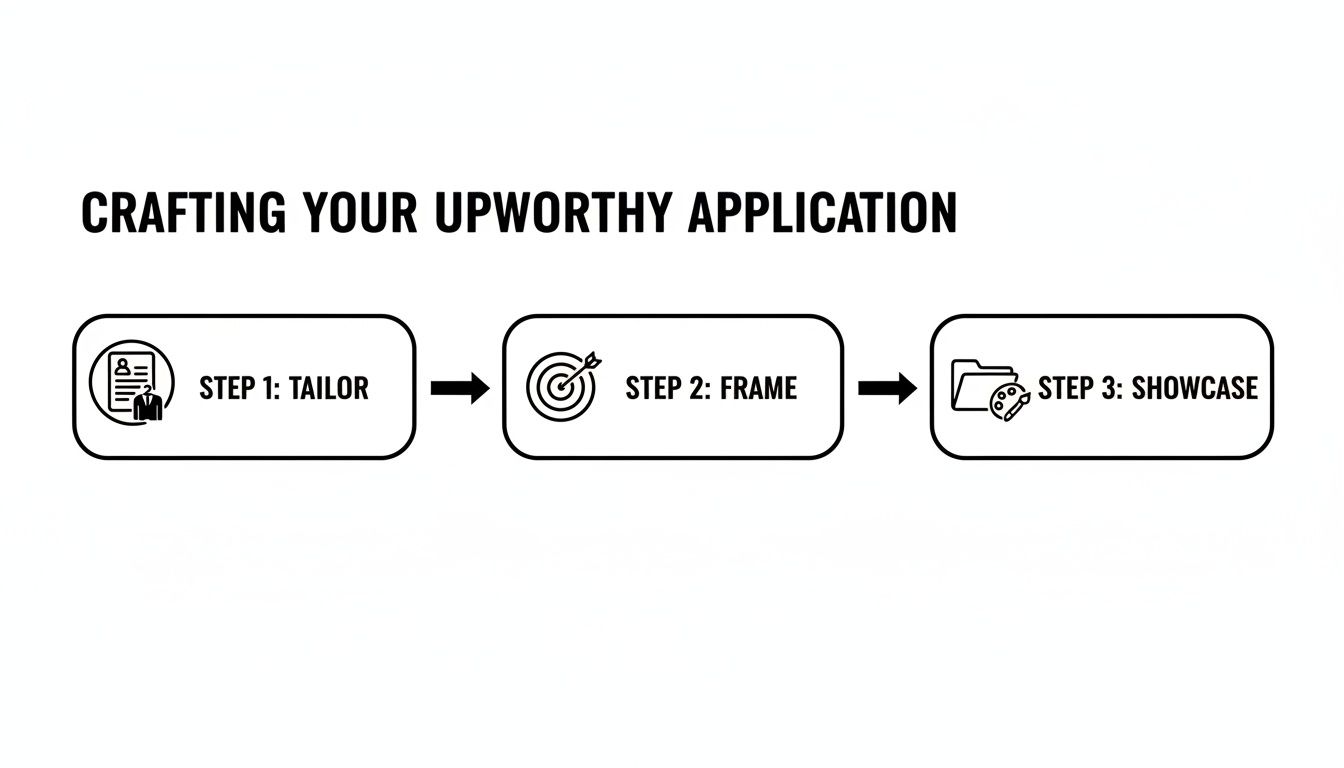
It’s all about tailoring your message, framing your skills through an impact lens, and showing off work that really hits home.
Upworthy's questions aren't just the cookie-cutter "tell me about a time..." prompts. They dig for your passion. They want to know why you do what you do. Be ready to talk less about the "what" and more about the "so what?" of your past work.
You can probably bet on questions like these:
The best way to nail these is to turn your answers into mini-stories. Set the scene, explain what you did, and—this is the most important part—end with the positive result or the lesson you learned. It’s a simple structure, but it’s incredibly effective.
This should be a given, but I’ll say it anyway: research is non-negotiable. Before you hop on that call, deep-dive into Upworthy’s website and social media. Don’t just skim the homepage. Read their latest articles, watch their newest videos, and get a real sense of their current vibe and content strategy.
Then, take it a step further and look up your interviewers on LinkedIn. What have they worked on? What do they post about? Finding a point of genuine connection can completely change the dynamic of the conversation.
The secret to a great interview is to stop trying to impress and start trying to connect. Get genuinely curious about them, their work, and the challenges they're trying to solve with this role.
Finally, come prepared with your own questions. Please, don't ask something you could have Googled in five seconds ("So, what does Upworthy do?"). Your questions are a chance to show you’re thinking strategically.
Killer Questions to Ask:
Asking questions like these signals that you’re not just looking for any paycheck. You’re specifically invested in the future of jobs at Upworthy. It shows you're already thinking like one of them, ready to roll up your sleeves and make a difference.

When a company like Upworthy operates remotely, your network isn't just a nice-to-have—it's your secret weapon. You can't just run into the hiring manager at a coffee shop, so getting strategic online is a must.
This isn’t about spamming people with connection requests. It’s about building real, genuine relationships long before a job opening even crosses your radar.
The whole point is to shift from being another random name in an applicant tracking system to a respected peer they already know. Start by finding current and former Upworthy folks on LinkedIn. Look for people in roles you’re eyeing—writers, video producers, social media managers—and start paying attention to what they’re doing.
Let's get one thing straight: your first message should never be, "Can you help me get a job?" That's the fastest way to get ignored. It feels transactional and lazy.
Instead, your goal is to show you're genuinely interested in them and what they do.
Before you even think about hitting that "connect" button, do your homework.
This simple shift in approach proves you've invested time and actually respect their work. It makes them way more likely to accept your request and, more importantly, remember your name down the line. If you want to get this right, it's worth learning more about how to follow up after networking and build real connections.
The best networking feels like a natural conversation between two people who are passionate about the same things. It’s about building a community, not just collecting contacts.
As you start connecting with people, you have to realize that your own online presence is being checked out, too. Your LinkedIn profile, your portfolio, even your public social media—it all needs to tell a consistent story. A story about your passion for social good and powerful storytelling.
Think of it as networking while you sleep.
When someone from Upworthy clicks on your profile, they should instantly get a sense that you get them. That you're on the same wavelength.
Share content that reflects your interest in social justice, positive news, or creative media. Write your own articles or posts that put your expertise and unique perspective on display. By consistently showing up and curating a brand that aligns with Upworthy's mission, you stop being a stranger.
When you finally apply for one of the jobs at Upworthy, your name will already ring a bell. They'll associate you with the exact qualities they're looking for. Trust me, that pre-built reputation can be the one thing that gets your application moved to the top of the pile.
Let's be real—navigating the job hunt for any company throws a ton of questions your way. But when it's a place like Upworthy, known for its unique mission and remote-first culture, you probably have some very specific things you want to know. Getting those answers sorted out is key to putting your best foot forward.
To save you the guesswork, I've pulled together some of the most common questions that come up from people just like you. Think of it as your insider's FAQ to landing a job on the Upworthy team.
Upworthy has built its reputation on supporting a healthy work-life balance, and that all starts with being remote-first. Honestly, that flexibility is a massive perk all on its own.
Beyond that, you can typically expect the standard stuff like competitive health insurance options and generous paid time off. But ask anyone who works there, and they'll probably tell you the biggest perk is the collaborative, mission-driven environment.
The real benefit is contributing to work that matters. The culture is built around a shared passion for positive storytelling, and that daily motivation is a powerful incentive for the right kind of candidate.
Short answer? Yep, the vast majority of roles are 100% remote.
Upworthy was a distributed team long before it was trendy, which lets them bring on top-tier talent from anywhere. You'll see their job postings are almost always remote-friendly for applicants across the U.S., and sometimes even internationally.
That said, always read the job description carefully. Some roles might need you to be available during specific time zones to keep the team running smoothly. If you want a feel for how other modern companies structure their opportunities, you can explore a typical company's careers page for comparison.
Upworthy is a lean media company, so don't expect a rigid corporate ladder. Growth here is more dynamic—it comes from stepping up, taking on more responsibility, and becoming the go-to expert in your field.
They really value a proactive, can-do attitude. If you're the kind of person who consistently shows initiative, contributes big ideas, and helps drive results, you'll be in a great position to advance. That could mean moving into a senior role or even carving out a brand-new specialty that plays to your strengths.
Sure, the skills on the job description matter. But Upworthy is really looking for people who are genuinely fired up about positive storytelling and making an impact.
They hunt for a specific set of qualities that can't always be taught:
They're known for hiring people from all sorts of backgrounds, often valuing a candidate's passion for the mission over a perfect, by-the-book resume.
At Legacy Builder, we specialize in transforming your professional journey into a powerful narrative that gets you noticed. If you're ready to build a personal brand that reflects your true impact and passion, we can help you create the content that opens doors.


You could – but most in-house teams struggle with the nuance of growing on specific platforms.
We partner with in-house teams all the time to help them grow on X, LI, and Email.
Consider us the special forces unit you call in to get the job done without anyone knowing (for a fraction of what you would pay).
Short answer – yes.
Long answer – yes because of our process.
We start with an in-depth interview that gives us the opportunity to learn more about you, your stories, and your vision.
We take that and craft your content then we ship it to you. You are then able to give us the final sign-off (and any adjustments to nail it 100%) before we schedule for posting.
No problem.
We have helped clients for years or for just a season.
All the content we create is yours and yours alone.
If you want to take it over or work on transitioning we will help ensure you are set up for success.
We want this to be a living breathing brand. We will give you best practices for posting and make sure you are set up to win – so post away.
Subscribe to our newsletter and get insights on how to grow your personal brand.
