.svg)
Subscribe to our newsletter and get insights on how to grow your personal brand.
Thank you! Your submission has been received!
Oops! Something went wrong while submitting the form.
.svg)


Let's be blunt: your email subject line is everything. It’s the single line of text that decides whether your hard work gets seen or gets sent straight to the trash. Master this, and you unlock the keys to your audience's attention.
You get one shot. That split-second glance in a crowded inbox is where you win or lose. For personal brands and founders, the entire value of your message hinges on those first few words. It's not just a headline—it's your digital handshake. It’s your one chance to cut through the noise.
Your audience isn’t scrolling through their inbox looking for emails to waste time on. They're looking for solutions, insights, or a genuine connection. A powerful subject line speaks directly to one of these needs. Think of it as the cover of a book; it has to be compelling enough to make someone need to see what’s inside.
The best subject lines aren't just clever; they tap into basic human psychology. I’ve found the most effective ones always nail a combination of three things:
The subject line is your digital first impression. It sets the tone, manages expectations, and ultimately determines whether your content gets the attention it deserves. Treat it as the most important copy you'll write.
This isn't just theory—the numbers don't lie. A staggering 47% of people open an email based on the subject line alone. Almost half your audience decides your fate before they even see your first sentence.
In competitive spaces like B2B tech, where open rates hover around 38.14%, every word is critical. To really dig into what makes these words so effective, you need to understand the essential email subject line best practices.
Even a small tweak can have a massive impact. Adding a touch of urgency with phrases like "still time" can boost read rates by over 25%. Other urgent language has been shown to lift open rates by 22%. This isn't just about vanity metrics; it’s about getting your message heard and driving real action.
To keep things simple, here’s a quick-glance table of what’s working right now.
As you can see, small, strategic choices in your subject lines can deliver significant returns. Don't just write what sounds good—write what is proven to work.
Let’s be honest. Hoping for a "flash of creative genius" to strike every time you need to write a subject line isn't a strategy—it’s a recipe for burnout.
If you want to consistently write subject lines that get your emails opened, you can't rely on guesswork. You need a repeatable system. This isn't about being some kind of "natural" writer. It's about having a process that turns your expertise into a one-liner that people can't ignore.
The best subject lines are almost never the first ones you think of. They’re engineered. Here’s how I do it.
Before you even think about the subject line, you need to be dead clear on one thing: what's the point of the email?
What is the one thing you want the reader to do, feel, or learn after they open it? Don't even start writing until you can answer that in a single sentence.
Is it to push people to your latest blog post? Announce a new service? Share a personal story? That core message is your anchor. When you forget it, your subject lines end up vague and weak.
For example, if your email is about a new case study, your goal isn't just "Get them to read my case study." It's something more specific, like: "Show founders how we helped a client double their leads in 60 days." See the difference? That clarity is the foundation for a killer subject line.
Once you know your goal, it's time to brainstorm. I want you to come up with at least five to ten potential subject lines without overthinking them. Just get ideas on the page. The goal here is volume, not perfection.
Think of it like looking at your message from a few different angles.
This simple step stops you from getting locked into your first, and often worst, idea. It also shows you which psychological triggers will hit the hardest.
This process is all about tapping into the core drivers that make people click: curiosity, urgency, and relevance.
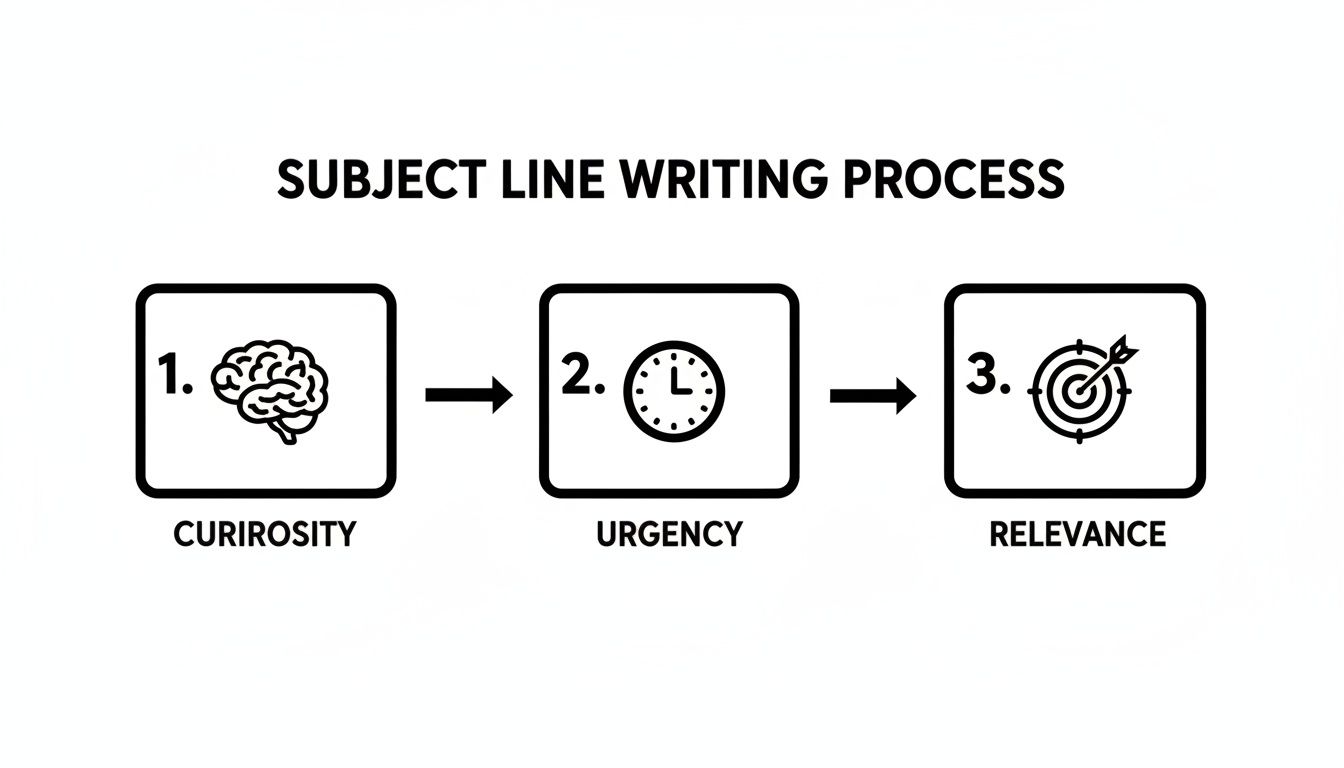
The best subject lines live at the intersection of these three. They don’t just state a fact; they create a reason to open the email right now.
Okay, now look at your list. Read each one out loud. Which one sounds like something you’d actually say? Which one would make you stop scrolling through a packed inbox?
This is where you sharpen the blade. Can you make it shorter? Swap a boring word for a powerful one? This is where you apply the technical stuff, like keeping it short for mobile and avoiding words that sound like spam.
Don’t be afraid to be direct. So many people get caught up trying to be clever, but clarity almost always wins. A simple subject line like, "Our new summer collection is here" will often crush a vague, mysterious one because it sets a clear expectation.
Your final choice should feel specific, valuable, and true to your brand.
Remember, the goal isn't just an open. It’s to start a real conversation. And once you have the perfect subject line, you have to make sure the email itself delivers on the promise. If you need help with that part, check out our guide on how to write email newsletters that people actually read.
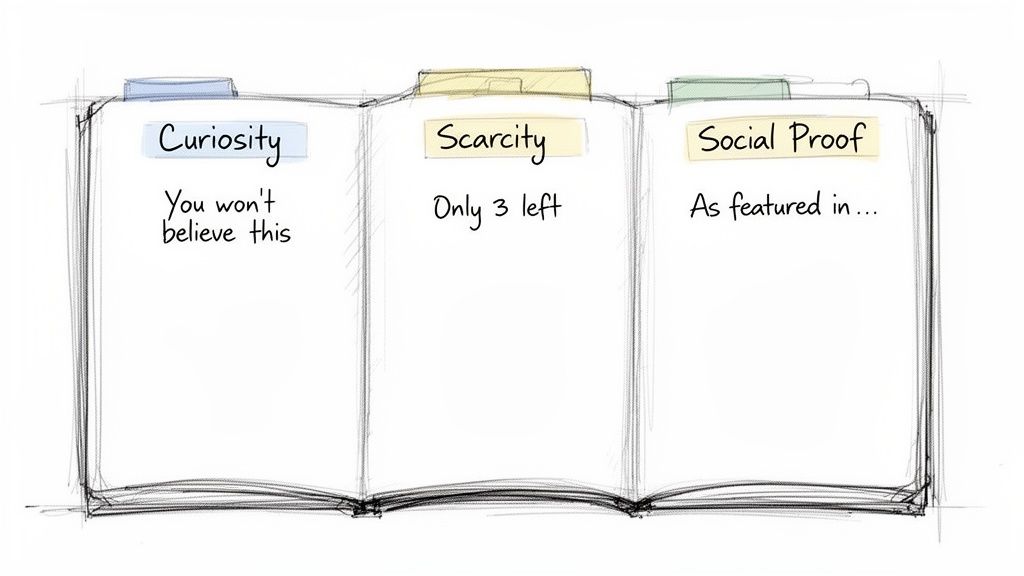
Staring at a blank subject line field is the worst. Why start from scratch when you can lean on proven structures that are already wired for engagement? Think of these formulas as a launchpad, not a crutch.
They’re built on the psychological triggers that make people click. Use them as a reliable starting point, then inject your own voice and brand personality. Let’s get into a few of the most effective ones I use myself.
Asking a question immediately pulls your reader into a conversation. It’s an invitation, not a lecture. This works because it sparks curiosity and gets them thinking about their own situation.
The first one is just a flat announcement. The second one forces a quick moment of self-doubt, making your reader need to know if they’re guilty. It’s a tiny shift that makes a massive difference in their urgency to open.
You can also try the "Did you know?" angle. Instead of "New Marketing Stats," go with "Did you know this about your customers?" It frames your email as a source of surprising, valuable intel.
This one is simple and powerful: tell them exactly what they’re going to get. In a sea of vague promises, clarity is your superpower. Don't hint at the value—state it outright. The trick is to focus on a tangible outcome.
The generic version is forgettable. The second one, however, promises a specific, manageable process with a clear payoff. People are way more likely to open an email when they know exactly what problem it will solve for them.
Quick heads-up: The promise you make in the subject line must be delivered in the email. Clickbait is the fastest way to destroy trust and rack up unsubscribes. Don't do it.
This is a classic copywriting move that works every time. You reveal just enough to make someone curious but not enough to satisfy them. You’re creating a "gap" between what they know and what they need to know.
This formula is killer for telling stories or sharing personal lessons.
That little detail—"failed startup"—adds a layer of intrigue and authenticity. It hints at a hard-won lesson from real-world experience, making it far more compelling than a generic story. It creates an itch that only opening your email can scratch.
Let's be honest, people are heavily influenced by the actions and opinions of others. You can use this to your advantage by name-dropping clients, well-known brands, or specific results in your subject line. If you're looking for more ways to do this, there are tons of proven email subject line formulas out there that can seriously boost your open rates.
Here are a few ways I put this into practice:
These formulas aren't magic, but they are powerful tools. Start with the structure, then layer in your brand’s voice and speak directly to your audience’s pain points. Test different approaches to see what lands, and you'll quickly get a feel for what gets your emails opened.
In an inbox overflowing with junk, personalization is your secret weapon. It’s the difference between being ignored and getting an immediate open.
But let's be clear—I’m not just talking about dropping in a [First Name] tag. That's the bare minimum.
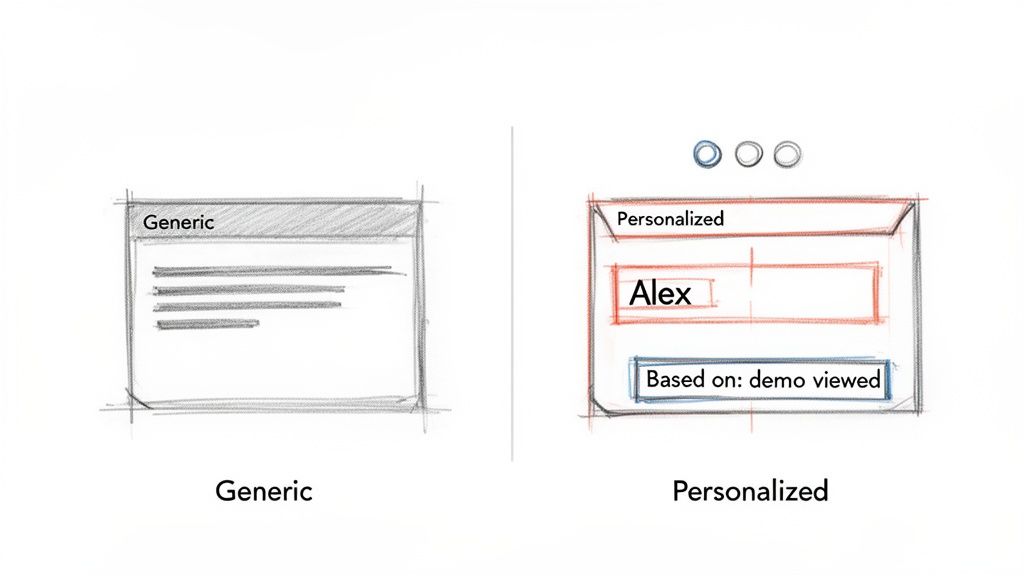
The data doesn't lie. Just adding a name can nudge open rates up from 15.70% to 18.30%. But the real magic happens when you get smarter about it. Advanced personalization can lead to 29% higher open rates and a massive 41% jump in click rates.
Here’s the crazy part: a shocking 90.33% of marketing emails don't even bother with it. This leaves a wide-open opportunity for anyone willing to do the work. You can dig into more of these numbers in this breakdown of subject line effectiveness statistics from mailmend.io.
Using a first name is table stakes in 2024. To actually stand out, you need to reference something specific to that person. This is where you connect their actions to your message, making your email feel less like a broadcast and more like a one-on-one conversation.
What data do you have? Think about it.
This is where the gold is. Instead of a generic blast, you can craft a subject line that feels like a genuine follow-up. This is the same principle we use when coaching clients on outreach, and you can see more on that in our guide on how to write cold emails that actually get replies.
Segmentation is the engine that drives all of this. Grouping your audience into smaller, targeted lists lets you write subject lines that hit home because they’re relevant.
Look at the difference this makes:
Segment 1: New Subscribers
Segment 2: Customers Who Bought "Course A"
Segment 3: People Who Attended Your Webinar
See how the personalized version proves you're paying attention? You're acknowledging their journey, which is how you start building a real community.
A personalized subject line is a powerful signal. It tells your reader, "I made this specifically for you," and shows you respect their time enough not to send them junk.
Look, you can't manually write a unique email for every single subscriber. That’s where dynamic content comes in. Most email platforms let you pull in specific data points for each person on your list—like their city, their company, or the last article they read.
This lets you build a subject line that adapts to the individual.
Or you can get even more specific based on their behavior:
This is how you scale authentic connection. It lets you create thousands of highly relevant subject lines from one template, all without losing that human touch that actually gets people to open and read.
Let’s be real. Writing a great subject line is half art, half science. You can follow all the formulas you want, but the only way to know what your audience wants is to test it.
This is how you turn a guessing game into a predictable system for getting more opens and clicks.
The best way to do this? A/B testing.
It's simple. You write two different subject lines for the same email. Your email provider sends version A to a small chunk of your list and version B to another. The winner—the one that gets more opens—is automatically sent to everyone else.
It’s like letting your audience vote on the best subject line with their clicks.
You don’t need a fancy lab for this. The trick is to be scientific and change only one thing at a time.
If you test a short, question-based subject line against a long, benefit-driven one, you have no idea what actually worked. Was it the length? The question? The benefit? You’ll never know.
Instead, isolate one specific idea for each test. Think of it like a head-to-head matchup.
When you isolate one change, you get clean, actionable data. You'll quickly learn whether your specific audience opens emails with questions, emojis, or straight-to-the-point statements.
The open rate is just the first step. It’s a vanity metric if it doesn’t lead to action.
A clickbait subject line might get a ton of opens, but if the email doesn't deliver on the promise, you’re just annoying people.
A high open rate with a low click-through rate is a huge red flag. It means your subject line wrote a check that your email content couldn’t cash. This destroys trust, fast.
To get the full picture, you need to track a few other numbers:
A winning subject line doesn't just get the email opened. It pulls in engaged readers who are ready to take the next step.
As you test, you’ll start seeing patterns. Maybe your audience loves data-heavy subject lines for webinar invites but prefers personal stories for your weekly newsletter. These are the golden nuggets you’re looking for.
For a deeper dive into using this data effectively, check out our guide on how to segment email lists for higher engagement, which builds on these exact principles.
Constant testing is the engine that drives growth. It’s the secret behind every high-performing email campaign.
Even with the best formulas, questions always pop up. Writing a killer subject line feels like walking a tightrope—you need to be creative but clear, urgent but not spammy.
Let's cut through the noise and tackle the questions I hear most often. Getting these details right is the difference between hitting "send" with confidence and second-guessing yourself.
There’s no magic number, but there is a sweet spot.
Keep it short. I always aim for 4 to 7 words, which usually lands between 25-40 characters. This is non-negotiable for mobile, where most of your emails will be opened anyway. Anything longer gets cut off, and your brilliant hook is lost forever.
But don’t ever sacrifice clarity for length. A slightly longer subject line that spells out a clear benefit will beat a short, vague one every single time.
My take: Write your perfect subject line first. Then, challenge yourself: "Can I say this with fewer words?" You’d be surprised how much fluff you can cut without losing the core message. Test longer, descriptive lines against short, punchy ones. Your audience will tell you what they prefer.
Yes, but don't get cute. A well-placed emoji can grab attention in a crowded inbox and add a flash of personality. It can make a good subject line great.
But it can also make a bad one worse. Using the wrong emoji—or just too many—looks unprofessional and can even get you flagged as spam.
A few ground rules I follow:
A single, relevant emoji can boost your open rates, but only if it feels authentic to you and your brand.
It matters—a lot. Your capitalization sets the tone before they even open the email. You really only have two good options.
There’s one style you must never, ever use:
ALL CAPS. WRITING LIKE THIS IS THE SAME AS SHOUTING IN SOMEONE'S FACE. It's aggressive, a pain to read, and a massive red flag for spam filters. You’ll get noticed, but for all the wrong reasons.
Spam filters are incredibly smart. They aren't just looking for a single "bad" word; they're looking for patterns of spammy behavior.
Here’s how to stay out of the junk folder:
The best way to avoid looking like spam? Don't act like a spammer. Be honest, offer real value, and write for a human being.
It happens. You’re staring at that blank subject line field, and the pressure to be clever is paralyzing.
Stop trying to force it. Instead, go back to the core message of your email. What is the one thing you need your reader to know or do? Write that down in the most boring way possible.
Seriously. Write "My newsletter for this week."
Now, start refining it. How can you make it more specific? How can you add a hook? How can you make it about them? Just getting something on the page is often all it takes to get the gears turning again.
At Legacy Builder, we believe that your authentic voice is your greatest asset. If you're tired of wrestling with content and want a dedicated team to help you build your personal brand, let's talk. Learn how we can transform your expertise into high-impact content at https://www.legacybuilder.co.


You could – but most in-house teams struggle with the nuance of growing on specific platforms.
We partner with in-house teams all the time to help them grow on X, LI, and Email.
Consider us the special forces unit you call in to get the job done without anyone knowing (for a fraction of what you would pay).
Short answer – yes.
Long answer – yes because of our process.
We start with an in-depth interview that gives us the opportunity to learn more about you, your stories, and your vision.
We take that and craft your content then we ship it to you. You are then able to give us the final sign-off (and any adjustments to nail it 100%) before we schedule for posting.
No problem.
We have helped clients for years or for just a season.
All the content we create is yours and yours alone.
If you want to take it over or work on transitioning we will help ensure you are set up for success.
We want this to be a living breathing brand. We will give you best practices for posting and make sure you are set up to win – so post away.
Subscribe to our newsletter and get insights on how to grow your personal brand.
