.svg)
Subscribe to our newsletter and get insights on how to grow your personal brand.
Thank you! Your submission has been received!
Oops! Something went wrong while submitting the form.
.svg)


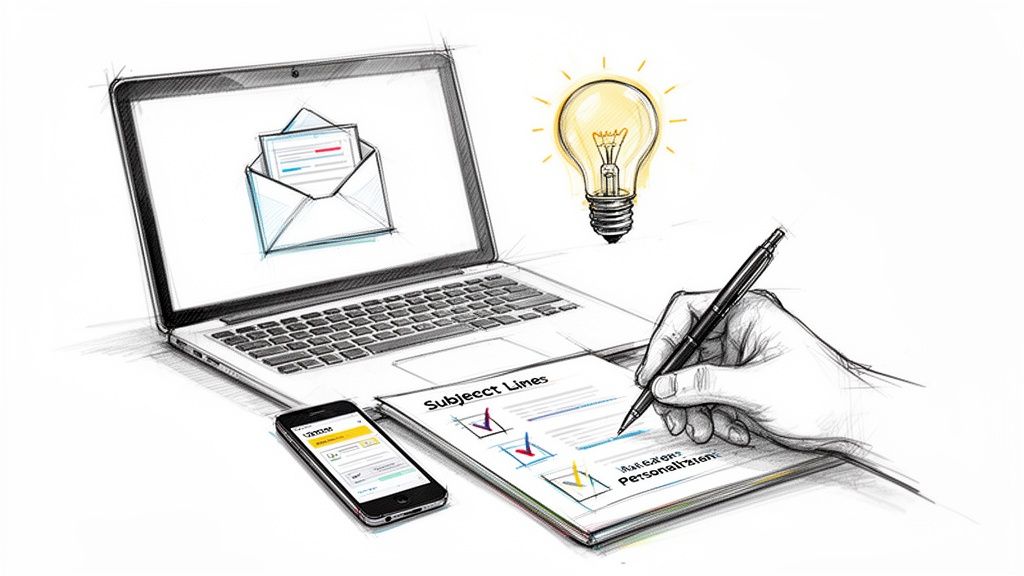
Writing a newsletter that actually connects with people isn't about just blasting out an email—it’s about starting a conversation. Nail this, and you’ll build a direct, authentic relationship with your audience.
The secret? Figure out your purpose, know who you're talking to, and consistently deliver something valuable. Get that right, and each email becomes a welcome message, not just another piece of marketing. Master this, and you'll create a loyal community that actually looks forward to hearing from you.
In a world run by social media algorithms and trends that die in a day, your newsletter is different. It’s a direct line to your audience—a channel you completely own. Don't think of it as another marketing task. It's your personal stage to share stories, insights, and your real point of view.
This is how you build genuine influence. A social post gets a glance, but a newsletter lands in a personal, focused space: their inbox. This is your shot to build a deeper relationship, establishing real trust and credibility over time. It’s how you turn casual followers into a true community.
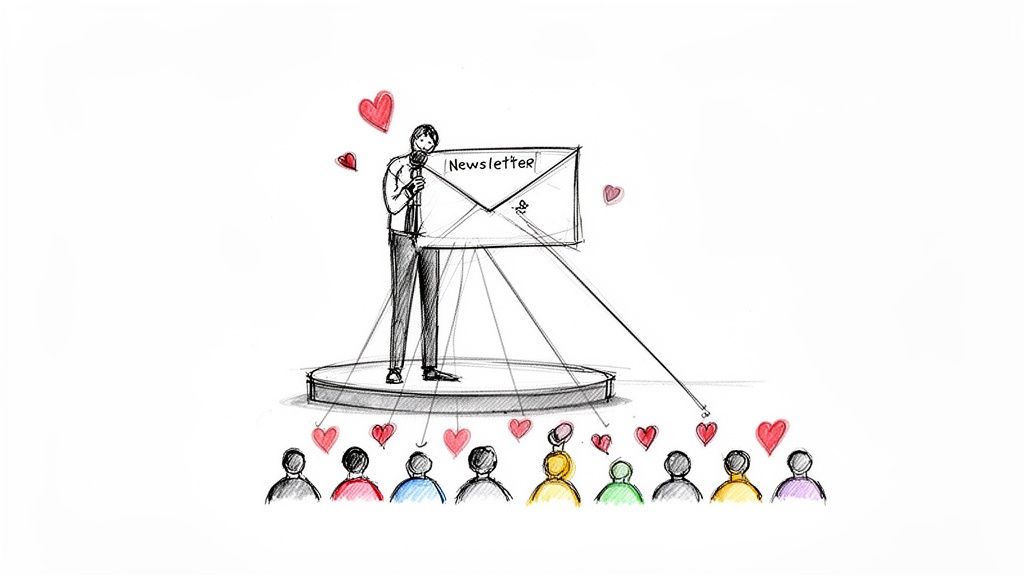
The real magic of a newsletter is that it's "owned media." Unlike your followers on Instagram or X, your email list is an asset you control. No algorithm changes can take it away from you. When you focus on growing this asset, you're investing in a long-term connection with people who have literally asked to hear from you.
Your newsletter is one of the few places online where you can speak directly to your audience without an algorithm getting in the way. It’s a space for real connection, built one email at a time.
As the digital world gets louder, this direct access is gold. Just look at the numbers—the newsletter industry is exploding. The number of newsletters on platforms like beehiiv nearly doubled from 26,911 in 2023 to 52,809 in 2024.
With an estimated 4.89 billion email users worldwide by 2027, it’s a no-brainer. Authentic email content is a straight line to business success and community building. You can explore more on the state of newsletters and see how creators are turning their words into real revenue.
I wrote this guide to give you a complete playbook—no fluff, just practical steps to build a newsletter that people actually open and read. We're going beyond the generic advice to help you build something that lasts.
Here’s a look at what’s ahead:
Before you ever write a single subject line, let's get one thing straight. Most newsletters don't fail because the writing is bad. They fail because they have no soul. They try to be everything to everyone and, in the end, they’re nothing to anyone.
Think of your newsletter's purpose as its North Star. It’s the one thing that guides every single word you write, ensuring every email delivers real, consistent value. This clarity is what turns a random email into something your audience actually looks forward to.
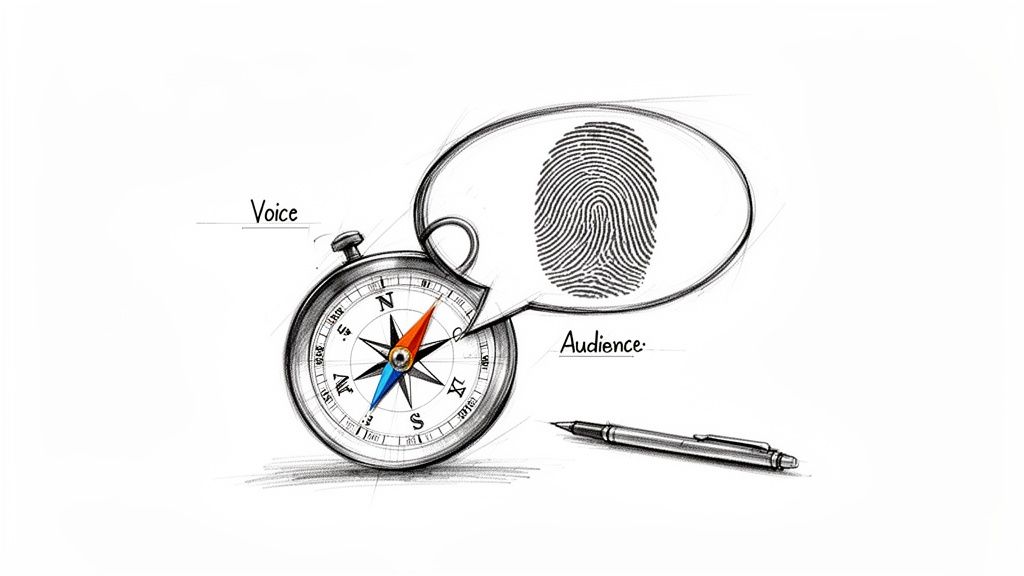
You can’t write a great newsletter if you don’t know who you’re talking to. Creating a "reader persona" isn't just some fluffy marketing exercise; it's about picturing a real person sitting across from you. This simple shift makes your writing more personal and way more effective.
Ask yourself a few questions to bring this person to life:
Stop writing for a faceless "audience" and start writing for "Sarah," the 35-year-old startup founder who’s drowning in leadership challenges. See the difference? Your content instantly gets a clear direction and a human touch.
When you write for one person, you connect with thousands. Specificity is the secret to creating content that feels personal and resonates deeply with your core readers.
This is how your newsletter becomes an indispensable resource, not just another email clogging up their inbox. It’s how you earn that coveted spot.
Okay, so you know who Sarah is. Now you need to define your unique value proposition (UVP). This is the promise you’re making to her every time you hit send. It answers the question: "Why should I read this newsletter over the thousand others out there?"
Your UVP needs to be sharp, concise, and compelling. It’s not just about the topics you cover; it’s about the unique angle that only you can bring. Maybe it's your personal journey, a contrarian take, or a killer curation style.
Here’s a simple framework to nail it down:
A leadership coach, for instance, might have a UVP like this: "I help new managers build confident teams by sharing one actionable lesson from my 20 years of experience every Tuesday." That’s specific. It promises tangible value.
Your newsletter's voice is its personality. Are you the witty expert? The empathetic mentor? The no-nonsense, data-driven analyst? Your voice has to be a genuine extension of you or your brand. People can spot a fake a mile away.
To get traction, your newsletter needs a personality that stands out. If you're still figuring yours out, it's worth digging into mastering different tones of voice for your brand to find a fit.
Consistency is what builds familiarity and trust over time, and storytelling is your secret weapon here. You can learn more about how to build your brand storytelling framework that wins hearts in our detailed guide.
Think about this: with 99% of users checking their email every single day, your newsletter has a direct line to becoming part of someone's daily routine. It’s a stable, powerful channel for building real engagement, far away from the chaotic noise of social media.
To help you get started, use this table to map out the foundational elements of your newsletter. It’s a simple framework to help you establish a clear identity and purpose before you write a single word.
Nailing these down from the start gives you an incredible amount of clarity. It ensures that every email you send is on-brand, on-purpose, and incredibly valuable to the right people.
Okay, you've laid the groundwork. Now comes the fun part: actually writing the thing. This is where you take all that strategy and turn it into words that grab people's attention the second your email hits their inbox.
And it all starts with the very first thing they see.
The subject line and its trusty sidekick, the preview text, are everything. A wild 33% of email recipients open an email based only on the subject line. Think about that. This isn't just a title—it’s your one shot to make someone stop scrolling through a sea of promotions and notifications.
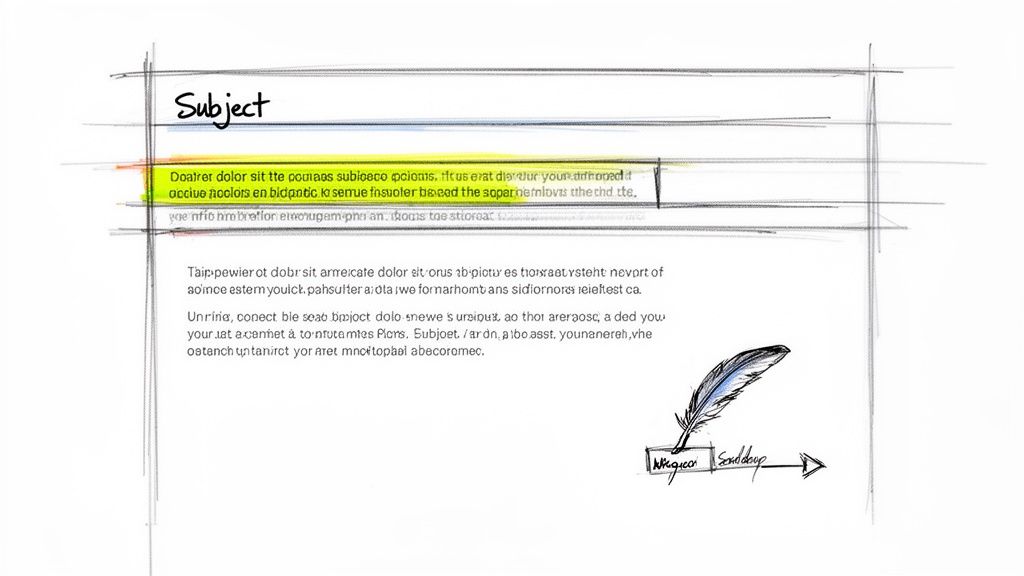
Your subject line has one job: earn the open. It needs to be interesting enough to spark curiosity but not so over-the-top that it feels like clickbait. It’s a delicate balance between being clear and being boring.
I’ve found that the best subject lines are short, specific, and feel personal. I try to keep mine under 50 characters because anything longer gets butchered on a phone screen.
Here are a few angles that consistently work for me:
Then you have the preview text—that little line of copy right next to the subject line. Don't waste it. So many people let it default to "View this email in your browser," which is a huge missed opportunity. Use that space to build on the promise of your subject line.
Subject Line: My Biggest Failure This Year
Preview Text: It taught me a lesson I wasn't expecting. Here's what I learned...
See how that works? It's a one-two punch that makes clicking almost irresistible. Getting good at email subject line best practices is a non-negotiable skill. If you want more ideas, check out these 10 powerful email subject line examples to boost your open rates in 2025.
Once they're in, your next battle is keeping them reading. Here’s a hard truth: people don’t read emails, they scan them. Your job is to make your content easy to skim, especially on a tiny phone screen.
This isn’t about fancy graphic design. It’s about using simple formatting to guide their eyes down the page.
Here’s the breakdown:
Think of it like a conversation. You wouldn't drone on in a long monologue. Your email's structure should have that same natural, easy-to-follow rhythm.
Now, let's talk about the meat of the newsletter. While the style can change, the best newsletters usually have a few core pieces that work together to provide value and build a real connection.
I think of them as building blocks you can arrange to fit your message.
This kind of structure makes your readers feel comfortable. They know what to expect, and it moves them smoothly from your opening line right to your final call to action.
The newsletters that really hit home feel like an email from a smart friend, not a memo from a corporation. The secret? A conversational tone.
Write like you talk.
Cut the jargon and formal fluff. Use simple words, ask questions, and let your personality show. A great trick is to read your copy out loud. If it sounds stiff or robotic, hit delete and try again.
Simple swaps make a huge difference:
This isn't about dumbing anything down. It’s about being human and accessible. A conversational tone makes your reader feel like they're on the inside, building a real community with every single send.
You could write the most brilliant newsletter in the world, but if it's a visual trainwreck or lands straight in the spam folder, none of it matters. Your hard work will never even get a chance to connect with your readers.
Think of it this way: a cluttered, hard-to-read email is like a store with messy aisles and no signs. No matter how great your products are, people will get frustrated and leave. Your job is to create a clean, simple, mobile-friendly experience that makes it dead simple for subscribers to get value from what you’ve written.
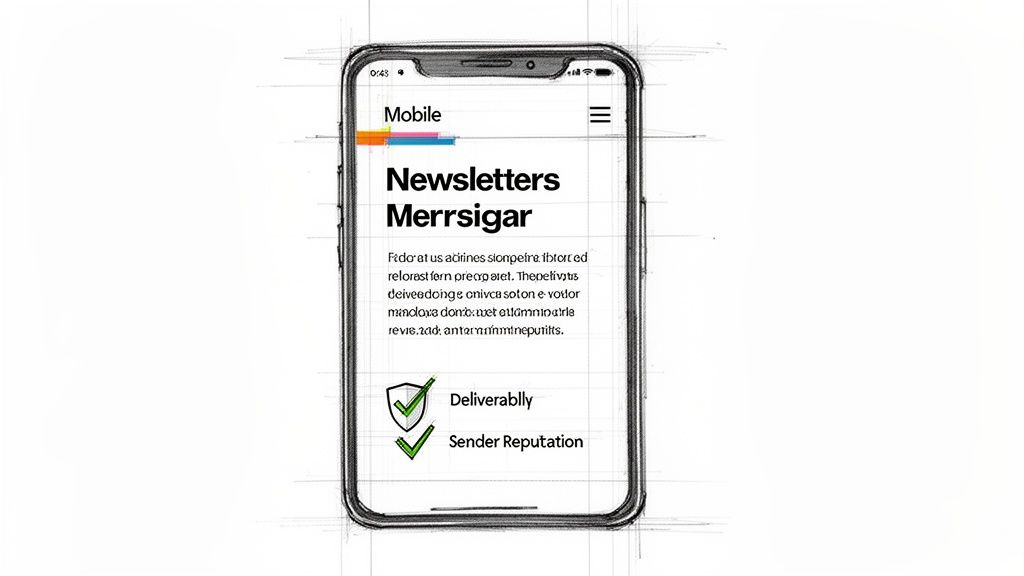
The best newsletter designs don’t scream for attention. They get out of the way and let your words do the talking. The goal is to reinforce your brand identity without ever distracting from your message.
A single-column layout is almost always your best bet. It’s naturally mobile-friendly and guides the reader's eye down the page without any confusion. And since over 60% of emails are opened on mobile devices these days, a non-responsive design is basically a death sentence.
Keep these core principles in mind for a clean design:
Your newsletter template is not a canvas for your inner artist. It's a functional framework to deliver a message. The best design is one your reader doesn't even notice.
Do yourself a favor and create a reusable template. Set up your header, footer, fonts, and colors once. This locks in your brand consistency and lets you focus entirely on writing great content for each issue.
Writing a killer newsletter is only half the battle. The other half is making sure it actually lands in the inbox. This is where email deliverability comes into play, and it’s all tied to your sender reputation.
Internet Service Providers (ISPs) like Gmail and Outlook are always watching. They see how recipients interact with your emails. If too many people mark you as spam, ignore your messages, or if your emails bounce, your reputation takes a nosedive. A bad reputation tells ISPs your content isn't wanted, and they’ll start sending your future newsletters straight to the spam folder.
To keep your deliverability high, you have to protect that reputation. Here's how:
Think of your sender reputation like a credit score. Every open and click builds it up. Every spam complaint and bounce tears it down. When you pair great content with clean design and healthy sending habits, you're making sure your hard work actually gets seen.
A brilliant newsletter is worthless if it dies after a few issues. Let’s be real—the biggest threat isn't a lack of good ideas; it’s burnout. The secret to making it past the first month is building a sustainable system that makes showing up every week feel manageable, not monumental.
This is all about ditching the last-minute scramble. When you have a solid framework in place, you free up your brain to focus on what actually matters: creating killer content that connects with your readers. Forget the hustle mindset. It's time to build a machine.
An editorial calendar is your best friend. It's your single greatest weapon against the panic of staring at a blinking cursor on a blank page.
This isn’t about creating rigid, unchangeable plans. It's about sketching out a simple roadmap for your content so you’re never, ever starting from scratch. It lets you batch your work—you can brainstorm a month's worth of topics in one sitting, outline a few issues in an afternoon, and even get ahead on writing.
Suddenly, your newsletter becomes a predictable part of your week, not a chaotic fire drill.
Here is a simple template to get you started. Think of it as a way to plan your content a month in advance, ensuring you’re always consistent and on-point.
See how that works? It turns a daunting task into a simple fill-in-the-blanks exercise. More importantly, it ensures every single email has a clear purpose.
Your content system is only half the battle. The other half is getting a steady stream of the right people to read it. Forget about aggressive, paid growth for now. The smart move is to start with organic, high-intent strategies that attract people who genuinely want to hear from you.
Organic growth might be slower, but it builds a rock-solid foundation. These subscribers are way more engaged because they found you through a trusted source or a piece of content that resonated, not some random ad.
Here are a few dead-simple ways to attract the right subscribers:
The best way to grow your newsletter is to write a newsletter worth sharing. When your content is so good that current readers become your marketers, you've created a sustainable growth engine.
Every interaction is an opportunity to invite someone into your world. By making it easy and compelling for people to join, you create a steady stream of new subscribers who are actually excited to be there. This is how you build a loyal community that lasts.
So, you hit “send.” Job done, right? Not even close.
Sending your newsletter is only half the battle. The real growth, the kind that builds a loyal audience, happens when you start listening to what your readers are telling you with their actions. Analytics aren't just a bunch of numbers on a dashboard; they’re direct feedback showing you what’s hitting the mark and what’s falling flat.
Think of it as a conversation. Every open, click, and reply is a signal. Your job is to read those signals and make your next newsletter even better. This is the feedback loop where good newsletters become great ones.
It’s way too easy to get lost in a sea of data. Don't. Instead of trying to track every little thing, just focus on the few metrics that tell the real story of your newsletter's health and the connection you have with your readers.
Here are the big ones:
Your goal isn't just to get opens and clicks; it's to start conversations. Treat your analytics as a guide to creating content that people feel compelled to engage with on a deeper level.
Data is completely useless if you don't do anything with it. You have to use what you learn to run small experiments and constantly tweak your approach. It’s this iterative process, this cycle of learning and refining, that builds newsletters people can’t wait to open.
Start small by testing just one thing at a time to see what moves the needle. For instance, try an A/B test on two different subject lines. Did a question work better than a statement? Did a more personal tone get more opens?
Let your CTR guide your content strategy. If you notice links to your case studies are always getting the most clicks, it's a no-brainer—feature more of them. If nobody is clicking on that curated news section you spend hours on, maybe it's time to ditch it for something else.
This process of listening and adapting is everything. It ensures your newsletter evolves with your audience, making it an indispensable part of their inbox.
Look, even with the best playbook in hand, you're going to have questions. It's just part of the process. I get asked the same handful of things all the time, so let's tackle them head-on.
My answer is always the same: consistency is king.
For most people, a weekly send is the sweet spot. It keeps you on your audience's radar without flooding their inbox.
But let’s be real. If you can only commit to a genuinely valuable, well-written email every two weeks, do that. It’s a thousand times better than shipping a rushed, half-baked email just to hit a weekly deadline.
Pick a schedule you can own for the long run. People will start to expect your email on a certain day, and that's when it becomes a habit for them—and a huge win for you.
You'll see industry benchmarks floating around 21%, but I want you to ignore them. A "good" open rate is completely relative to your list and your niche.
Think about it: a small, hyper-engaged list of 500 subscribers with a 45% open rate is infinitely more valuable than a bloated list of 5,000 people who barely open, giving you a 15% rate. The first list has real fans; the second has vanity metrics.
Stop chasing industry averages and start tracking your own progress. Is your open rate climbing month over month? That’s the only number that tells you if you have a healthy, engaged audience.
There’s no magic word count. The perfect length is whatever it takes to deliver on your promise—and not a single word more.
Some of the most powerful newsletters I've seen are just a few paragraphs long, built around one killer insight.
The real trick is to make it scannable. Use short paragraphs, clear subheadings, and bullet points. Your reader should be able to get the core idea in 30 seconds. If you nail that, they’ll stick around for the details.
Ready to stop guessing and start building an authentic brand that connects? Legacy Builder turns your unique expertise into high-impact content that grows your influence. Learn how we can build your legacy together.


You could – but most in-house teams struggle with the nuance of growing on specific platforms.
We partner with in-house teams all the time to help them grow on X, LI, and Email.
Consider us the special forces unit you call in to get the job done without anyone knowing (for a fraction of what you would pay).
Short answer – yes.
Long answer – yes because of our process.
We start with an in-depth interview that gives us the opportunity to learn more about you, your stories, and your vision.
We take that and craft your content then we ship it to you. You are then able to give us the final sign-off (and any adjustments to nail it 100%) before we schedule for posting.
No problem.
We have helped clients for years or for just a season.
All the content we create is yours and yours alone.
If you want to take it over or work on transitioning we will help ensure you are set up for success.
We want this to be a living breathing brand. We will give you best practices for posting and make sure you are set up to win – so post away.
Subscribe to our newsletter and get insights on how to grow your personal brand.
