.svg)
Subscribe to our newsletter and get insights on how to grow your personal brand.
Thank you! Your submission has been received!
Oops! Something went wrong while submitting the form.
.svg)


If you want to tell your story the right way, stop just listing accomplishments. That's a resume, not a narrative.
The best stories—the ones that actually build a following and attract opportunities—are about connecting your experiences to a deeper purpose. It's about showing the vulnerability, the lessons learned, and the why that drives you. This is how you turn your professional journey into your single greatest asset for building trust and authority.

In a sea of look-alike content and AI-generated noise, your personal story is the one thing that can’t be copied, automated, or faked. It’s uniquely yours.
I’ve seen it time and time again: the most successful leaders and founders are ditching the sterile, corporate voice. Instead, they’re leaning into real stories that build genuine influence. This isn't just about fluffy self-promotion; it’s about human connection that gets real-world results. People follow people, not faceless logos.
Your story is the bridge between your expertise and your audience's trust. It's how you prove you understand their journey because you've walked a similar path yourself.
Think about it. Your online presence can be your 24/7 advocate, walking into rooms you're not even in. The data backs this up—personal branding has become a serious driver for business. In fact, new research shows that 57% of consumers are more likely to buy from a company whose leadership is visible and authentic. You can dig into the full personal branding report from WeAreTenet.com to see the numbers for yourself.
Sharing your real journey, from the gritty startup failures to the hard-won breakthroughs, builds credibility faster than any perfectly polished pitch ever could. Your experiences, your challenges, and your wins are the raw material for stories that pull in opportunities and establish you as a go-to authority.
For anyone serious about their professional growth in 2026, understanding the power of a personal narrative isn't optional. It's the core of modern branding. Here's a quick breakdown of why this matters so much.
| Key Benefit | Impact on Your Brand | Supporting Statistic |
|---|---|---|
| Builds Unshakeable Trust | Moves you from a vendor to a trusted advisor by showing your values and motivations. | 81% of consumers say they need to trust a brand to buy from them. |
| Creates True Differentiation | Your unique journey is the one thing competitors can't replicate. It's your ultimate moat. | Companies with strong, authentic brands see 33% higher revenue growth. |
| Attracts Ideal Opportunities | Aligned clients, partners, and employers find you based on shared values. | 72% of recruiters use social media to find candidates with a strong personal brand. |
| Establishes Authority | Sharing insights from experience proves your expertise more than a title ever could. | Content marketing leaders see 7.8x more site traffic than non-leaders. |
Simply put, a well-crafted story doesn't just tell people what you do; it shows them who you are and why they should care. That's the foundation of any powerful personal brand.
A great story can directly land you a client or make you an influential voice in your space.
Think about the consultant who shares a story about a past project that failed and the tough lesson it taught them. That moment of vulnerability doesn't signal weakness—it screams resilience and hard-earned expertise. It makes them far more relatable and trustworthy than the person who only ever posts about their wins.
Or what about a founder looking for funding? A slide deck full of financial projections is expected. But a story about the personal mission that sparked the entire company? That’s what grabs an investor’s heart and opens their checkbook.
Here’s why putting in the time to craft your narrative really pays off:

Here's a hard truth: the most powerful parts of your personal brand story aren't invented in a boardroom. You can't fake them.
They’re buried in your real-life experiences, waiting to be uncovered. This is where we stop talking theory and start digging for the moments that actually matter.
Forget the generic, surface-level questions like "What are your strengths?" We need to go deeper. This isn't about creating some polished persona. It's about finding the real, relatable, and sometimes messy parts of your journey that connect with other humans.
Your career isn’t just a timeline on a resume. It's a series of chapters, each with its own highs, lows, and critical lessons. The first step is to identify these chapters and pull out the core themes.
These aren't just nice-to-have anecdotes. They are strategic assets. They show the "why" behind what you do, prove your resilience, and give context to your expertise.
These three pillars give your story a backbone. They move it from a boring biography to a narrative that pulls people in.
Alright, let's get practical. Block off some time, be brutally honest with yourself, and use these prompts to start digging. Don't censor anything—just write.
For Your Origin Story:
For Defining Setbacks and Lessons:
Don't just list what happened. The value is in the reflection. For every failure, ask yourself: "What did I learn from this that I now use to help my clients?" That’s how you turn a mistake into a story of earned wisdom.
For Your Future Vision:
As you work through these, you'll start to see patterns. You’ll connect the dots between an early passion, a hard lesson, and your vision for what's next. Those connections are the golden threads.
This is the foundational work. If you want to go even deeper, our guide on how to build a powerful brand narrative will show you how to weave these threads into a story that truly connects. This is how you learn to tell your story with conviction.
Let's be clear: a random collection of your wins, losses, and memories isn't a story. It’s just raw material.
If you want to tell a story that actually connects and gets people to listen, you need structure. Structure is what turns that pile of facts into a narrative that sticks.
It’s not about just being heard—it's about being understood and remembered. This is how you stop listing your resume and start framing your experiences to show your real value and authority.
This visual breaks it down perfectly. It shows how you take your raw experiences, apply a structure, and turn them into powerful content.
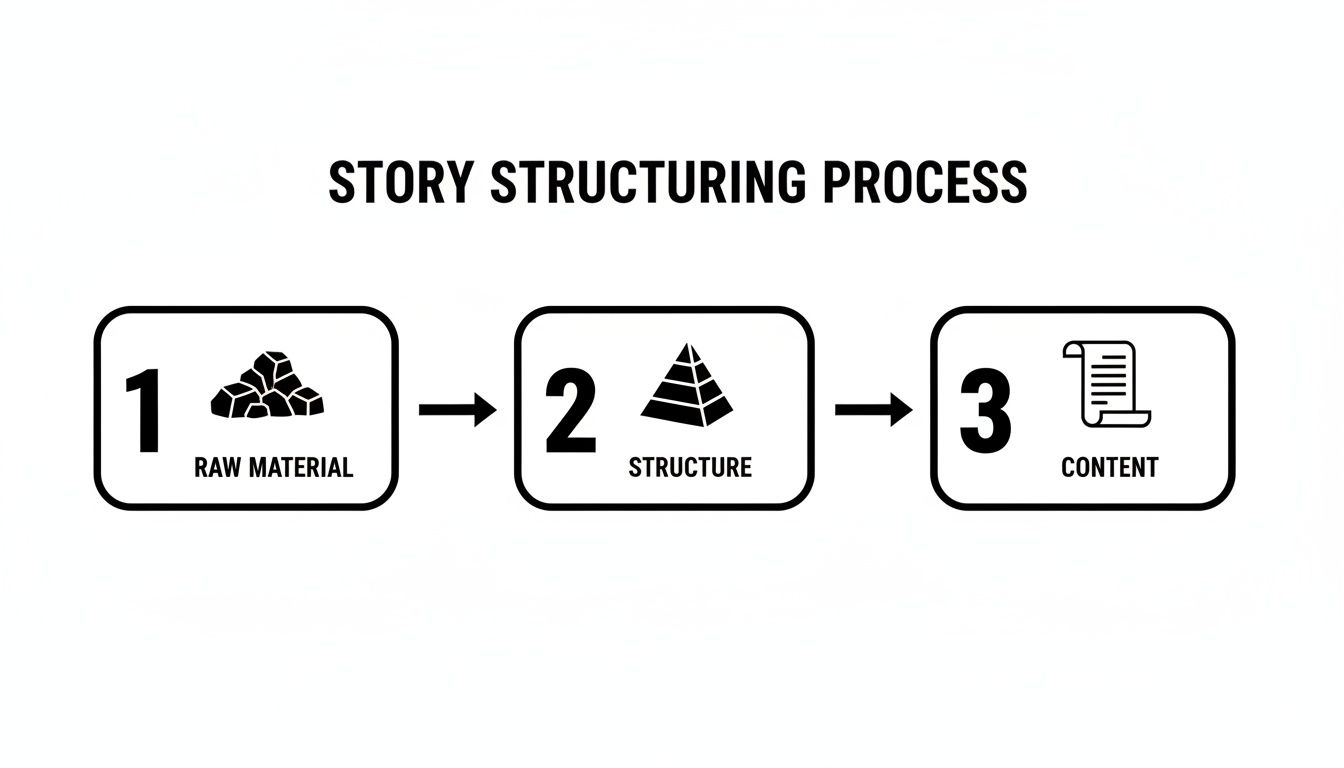
The idea is simple but so many people miss it: your unfiltered life is just the starting point. The framework is what organizes those moments into something clear and compelling.
The classic "Hero's Journey" isn't just for Hollywood blockbusters. It's an incredible tool for professional storytelling. But you're not slaying dragons—you're solving real-world problems for your clients and your industry.
Here's the twist: in this version, you are not the hero. Your audience is.
You are the guide. The mentor. The one who's already walked the path and can show them the way.
Your story only becomes powerful when it's framed around the challenges your audience is facing. Your past struggles and wins are only relevant because they prove you have the expertise to guide them through their problems.
Don't tell a story about how great you are. Tell a story about how you learned to solve a problem that your ideal client is facing right now. This shift in focus is everything.
This approach flips the entire script. It moves you from "look at what I did" to "let me help you do the same." It makes your story an act of service, not an ego trip.
You don't have to reinvent the wheel every time you create content. Proven narrative frameworks give your stories a familiar rhythm that keeps people hooked. Think of them as the skeleton—your personal experiences are the flesh and blood.
Here are 3 foundational frameworks you can start using today:
These frameworks give you a reliable starting point. To see how to build these into a bigger brand message, check out our guide on how to build a brand storytelling framework that wins hearts.
Once you have a structure, you can spin your core stories into content for weeks. It’s all about knowing how to shape the same experience for different channels.
Let's take a story about a major professional lesson you learned. Here's how you could adapt it across different platforms:
| Content Format | Structural Approach | Example Angle |
|---|---|---|
| LinkedIn Post | Use the Challenge-Choice-Outcome arc. Keep it tight and start with a hook that grabs attention. | "I almost lost our biggest client. Here’s the 1 sentence that saved the relationship." |
| Blog Article | Go deep with the Problem/Agitate/Solve framework. Dedicate a section to each part of the story. | "The Hidden Communication Gaps Killing Your Client Retention (And How to Fix Them)" |
| Short-Form Video | Use the Before-After-Bridge model for a quick, high-impact visual. The contrast is key here. | A video with text overlay: "My client onboarding was a mess..." transitioning to "...until I built this 1 system." |
The secret is matching the story's depth and structure to what people expect on that platform. A LinkedIn reader wants a quick, professional lesson. A blog reader is there for a more detailed, instructional narrative.
Master a few core structures, and you'll have the flexibility to tell your story effectively, anywhere you want.
You’ve done the hard work of digging up a powerful story. Now what?
Throwing that story onto every platform without a second thought is a rookie mistake. It’s like telling an incredible joke to an empty room—the impact just fizzles out.

Every social media platform has its own vibe, its own rhythm, and its own audience. A story that absolutely crushes it as a detailed blog post will fall flat as a 30-second video if you just copy and paste.
The real goal isn't just being everywhere. It’s about being effective everywhere. That means learning to translate your core message so it feels like it belongs on each channel.
Let's get practical. Take one of your core stories—maybe that "Defining Setback" that taught you a game-changing lesson. That single event can fuel an entire multi-platform content series.
You just need to match the format to the audience's mindset.
For a LinkedIn post, frame it as a professional lesson. Hit them with a sharp hook, walk through the challenge and what you learned, and keep it tight—under 200 words. The aim is a quick, valuable insight for a business-focused crowd.
For an X (formerly Twitter) thread, you’ll break it down. Unpack the story into a series of short, punchy tweets. Your first tweet is the hook, and each one after builds on the last, pulling the reader along until the final takeaway.
For Instagram or TikTok, it’s all about the video. Focus on the emotional shift—the "before" (the mess) and the "after" (the breakthrough). Use quick on-screen text and trending audio to stop the scroll.
For your blog or newsletter, you finally get to go deep. This is where you write the full, detailed account. You can explore the nuances, give all the context, and link to other resources to really establish your authority.
This is the essence of working smarter, not harder. If you want to multiply your reach without burning yourself out, we’ve got a full guide on how to repurpose content effectively.
As you start adapting your content, don't sleep on video. It’s one of the most powerful tools for building a real human connection. Think about vlogging as modern-day storytelling through video—it lets you show emotion and tone in ways that text just can't match.
Authenticity isn't a buzzword; it's a business strategy. Your ability to show up genuinely across platforms is what separates memorable brands from forgettable ones.
And this isn't just a hunch. A staggering 84% of consumers say a brand's authenticity directly impacts whether they’ll buy from them. Generic, one-size-fits-all content simply doesn't build the trust you need to stand out.
To make this dead simple, I put together a blueprint. Use this table as your guide for reshaping a single story to make sure it hits the mark every time, on every platform.
| Platform | Format & Length | Key Focus | Call to Action Example |
|---|---|---|---|
| Text Post (150-250 words) | Professional lesson and a sharp takeaway. Use a strong opening line to stop the scroll. | "What was the biggest lesson you learned from a recent setback? Share in the comments." | |
| X (Twitter) | Thread (5-7 tweets) | A fast-paced narrative arc. Each tweet builds on the last, creating suspense and engagement. | "If this story resonated, give it a retweet. Let's help others avoid the same mistake." |
| TikTok/Reels | Video (15-60 seconds) | High-energy, emotional contrast. Focus on a single "aha" moment or tip derived from the story. | "Follow me for more daily tips on navigating [your industry]." |
| Blog/Newsletter | Article (800+ words) | In-depth analysis and actionable advice. Go deep into the "how" and "why" behind the story. | "Subscribe to get detailed guides like this one delivered straight to your inbox." |
Once you get the hang of this adaptive approach, your personal brand becomes both consistent and dynamic. Your core story stays the same, but the way you tell it is perfectly tuned to connect with people, wherever they happen to be.
This is how you stop just posting content and start building a real, multi-dimensional brand.
Telling your story isn't just a creative project to make you feel good. It’s a hard-nosed business move.
And like any move you make in business, you have to know if it’s actually paying off.
The first mistake most people make is obsessing over vanity metrics. Likes, views, new followers—they feel great, but they don't pay the bills. They don't tell you if your story is actually working.
To figure that out, you have to measure content marketing ROI like a pro.
This is about tying your story directly to tangible results. Are you getting more qualified DMs? Are people clicking the link to your website? Is your calendar filling up with discovery calls? These are the signals that tell you your story isn't just being heard—it's driving action.
Before you can track anything, you need to know what winning looks like for you. Your Key Performance Indicators (KPIs) have to be bolted directly to your goals. Are you here to generate leads, expand your network, or become the go-to expert in your space?
Each goal has its own scorecard. If you’re hunting for leads, the only thing that matters is how many people book a call or fill out your contact form after reading your story.
Here are the core KPIs I tell my clients to focus on, broken down by objective:
When you focus on these numbers, you stop guessing. You start making decisions based on what your audience is actually telling you with their actions.
You don't need a complicated analytics suite to track this stuff. A simple dashboard is your best friend for monitoring progress without getting lost in the weeds. Seriously, a basic spreadsheet is all you need.
It gives you a clean, at-a-glance view of how your storytelling is performing.
Set up a table with these columns to get started:
| KPI | Platform | Target (Monthly) | Actual (Monthly) | Notes & Insights |
|---|---|---|---|---|
| New Subscribers | Newsletter | 50 | 65 | The "Defining Failure" story drove the most sign-ups this month. |
| Inbound DMs | 10 | 12 | Received 3 messages asking about consulting after the post on project management. | |
| Website Clicks | X (Twitter) | 200 | 185 | Clicks were lower. Need to test different calls-to-action in threads. |
Your dashboard isn't just for tracking numbers; it's for finding patterns. It helps you answer the crucial question: "Which parts of my story are driving the most valuable actions?"
This data-driven approach changes the game. You stop throwing spaghetti at the wall and start making strategic moves based on real feedback. You’ll see which stories hit hardest, which platforms are worth your time, and how your narrative is directly fueling your growth.
This is how you turn your personal story into your most powerful business asset.
Let’s cut to the chase. You know you need to tell your story, but a dozen questions are holding you back. It’s the same stuff I hear from founders every single day.
Let's bust these myths one by one so you can get out of your own way and start building.
Everyone’s terrified of oversharing. They’re worried they’ll look unprofessional or, worse, weak. It’s a valid fear, but it’s completely manageable.
The key is vulnerability with a purpose. You're not writing a diary entry; you're sharing lessons that help your audience.
Here’s a rule I tell all my clients: share the scar, not the open wound.
A story about a past failure that taught you a hard lesson? That shows resilience. Gold. Talking about a raw, ongoing crisis? That just makes people uncomfortable and makes you look unstable, not experienced.
For example, don’t post about how stressed you are right now with a nightmare client. Instead, tell the story of a difficult client from two years ago and the bulletproof communication system you built because of it. You turn a past negative into a present positive that provides real value.
This is the biggest lie holding people back. You don’t need some Hollywood-level drama to connect with your audience. Honestly, the most relatable, everyday struggles often perform way better.
The power isn't in the drama; it's in the authenticity of the experience and the clarity of the lesson. People don't want a superhero. They want a real person who has solved a problem they're currently facing.
Your story doesn't need to be extraordinary; it just needs to be yours. The most compelling narratives often come from small turning points, 'aha' moments, or a specific, nagging problem you finally figured out how to solve.
Think a story about streamlining a weekly report is boring? For the hundreds of other managers wasting hours on that same task, your story is a godsend. It proves you get it.
Nobody wants to listen to an egomaniac. The fear of sounding arrogant is real, but there's a simple fix: shift the focus from your accomplishments to the process and the value.
It's the difference between "Look how great I am" and "Let me show you how to do this."
Frame your wins as the result of a framework, a team effort, or a lesson learned. This makes you a helpful guide, not a braggart.
See the difference? You're still showcasing a massive win, but you're teaching, not just boasting.
Let me be blunt: this is a marathon, not a sprint. If you're looking for an overnight success story, you're in the wrong game.
The real results—a steady flow of inbound leads, speaking gigs, and partnership offers—come from consistency. You'll start seeing a real impact after 6 to 12 months of showing up consistently.
The first few months are about laying the foundation. You're building a library of content that proves your expertise and earns trust. The long-term goal? To become so well-known for your perspective that the opportunities start finding you.
Don't get discouraged if your first posts don't go viral. Play the long game. The ROI will come.
Building a brand that truly reflects your journey takes more than just a few posts. At Legacy Builder, we specialize in transforming your unique experiences into a consistent stream of high-impact content that builds real authority. Learn how we can help you tell your story and build your legacy.


You could – but most in-house teams struggle with the nuance of growing on specific platforms.
We partner with in-house teams all the time to help them grow on X, LI, and Email.
Consider us the special forces unit you call in to get the job done without anyone knowing (for a fraction of what you would pay).
Short answer – yes.
Long answer – yes because of our process.
We start with an in-depth interview that gives us the opportunity to learn more about you, your stories, and your vision.
We take that and craft your content then we ship it to you. You are then able to give us the final sign-off (and any adjustments to nail it 100%) before we schedule for posting.
No problem.
We have helped clients for years or for just a season.
All the content we create is yours and yours alone.
If you want to take it over or work on transitioning we will help ensure you are set up for success.
We want this to be a living breathing brand. We will give you best practices for posting and make sure you are set up to win – so post away.
Subscribe to our newsletter and get insights on how to grow your personal brand.
