.svg)
Subscribe to our newsletter and get insights on how to grow your personal brand.
Thank you! Your submission has been received!
Oops! Something went wrong while submitting the form.
.svg)



More demand isn't the same as a scalable business. In many founder-led companies, new clients expose weak handoffs, inconsistent delivery, delayed invoicing, and decisions that still require the founder's approval. Sales can fill the pipeline while cash reserves shrink and the team works longer hours to keep promises.
The practical answer to how to scale your business is less glamorous than another growth hack. You need a reliable offer, documented operating system, disciplined cash management, and a distribution channel that can keep working when you aren't personally involved in every task. The businesses that scale well don't just produce more. They make more of the right work repeatable.
The popular advice says to increase demand first and solve capacity later. That sequence can work briefly, but it creates expensive problems when delivery depends on improvisation. McKinsey reports that 78% of companies that have built a product and found product-market fit still fail to scale successfully (McKinsey's analysis of the scale-up conundrum). Product-market fit proves that customers want something. It doesn't prove that your company can deliver it repeatedly, profitably, and without founder intervention.
That distinction matters for service businesses. A founder may close every sale, customize every proposal, review every deliverable, answer every escalation, and still call the business successful. The model becomes fragile when demand rises because each new client adds complexity instead of fitting into a known operating pattern.
Practical rule: Treat scaling as an operating-model decision, not a sales target.
The first hidden constraint is cash timing. You may need to pay contractors, employees, software vendors, and suppliers before customers pay you. If revenue grows but collection cycles lengthen, growth can increase financial pressure rather than relieve it. Startup Genome reported that 74% of high-growth internet startups failed because of premature scaling (Startup Genome's report on why startups fail). The lesson isn't to avoid investment. It's to invest after demand, margins, and delivery capacity are sufficiently repeatable.
The second constraint is administrative load. More clients create more onboarding, scheduling, approvals, support requests, reporting, contract work, and payment follow-up. Founders often notice the sales increase before they notice that their calendar has become the company's central operating system.
Look for these conditions before adding another acquisition channel:
Established companies face the same problem in a different form. McKinsey found that only one in five incumbents successfully scale a new business after initial success, showing that existing resources don't automatically create execution capability (McKinsey's research on scaling new businesses). For a founder entering a new region, that includes compliance, contracts, tax planning, and local operating requirements. A resource on legal setup for GCC expansion is useful when geographic growth introduces obligations that a domestic workflow never had to handle.
Before pursuing growth, ask a harder question: If demand doubled next month, which promise would fail first? The answer identifies the system you need to repair before you buy more attention.
An offer is scale-ready when increased volume produces more predictable work, not merely more activity. That requires testing four areas together: delivery consistency, economics, acquisition repeatability, and founder independence.
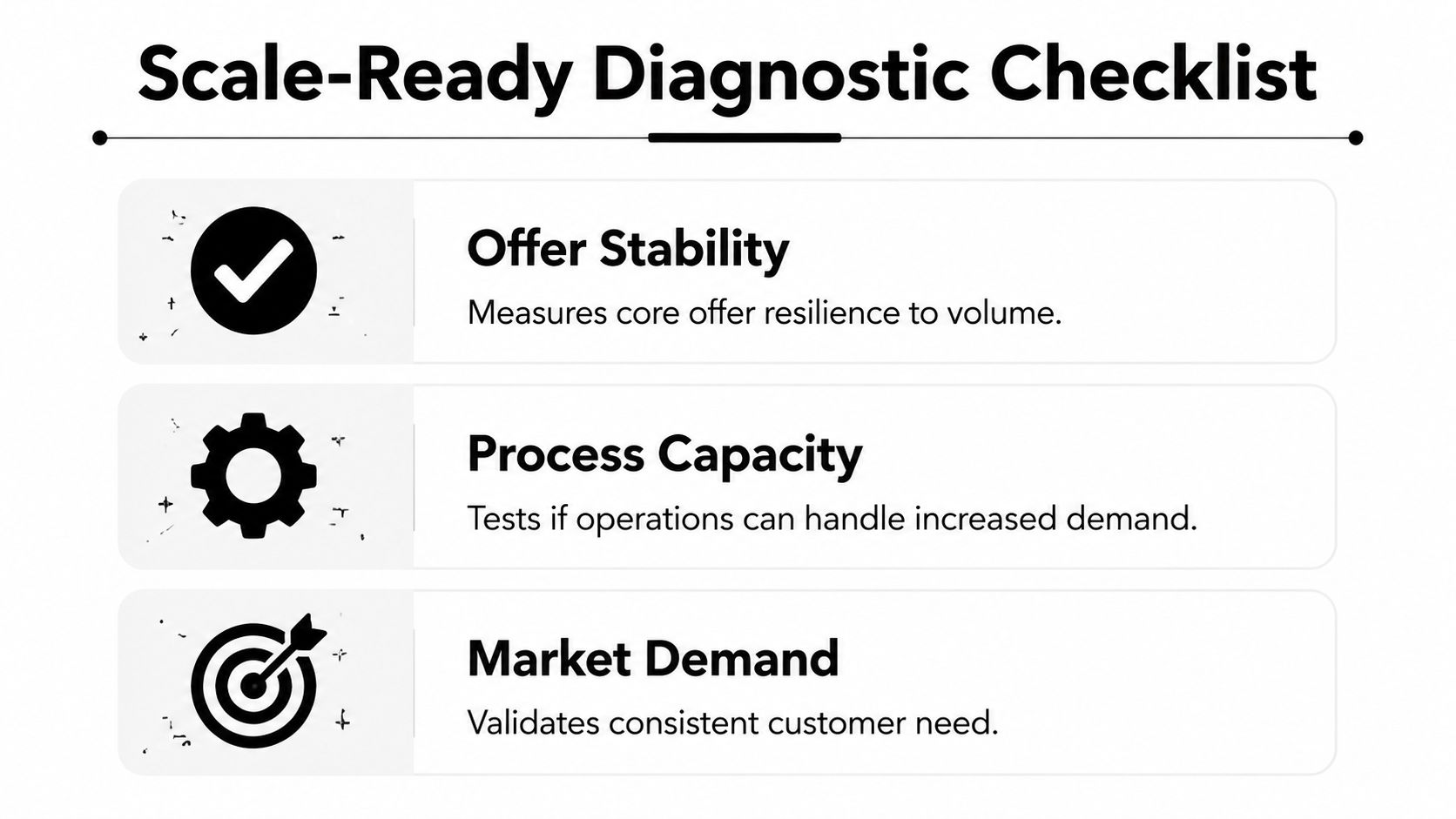
Start with offer stability. Write down exactly what the customer buys, what they receive, what isn't included, how long delivery takes, and which inputs you need from them. If every proposal creates a new scope, your sales team may be selling bespoke labor rather than a repeatable offer. Customization can remain part of the service, but it needs defined boundaries.
A useful validation exercise is to review recent projects and mark each activity as standard, optional, or exceptional. Standard work belongs in the core delivery process. Optional work should have a clear approval and pricing rule. Exceptional work should trigger a review, because repeated exceptions often reveal that the offer itself needs redesign. For an earlier-stage diagnostic, use this quick guide to validating a business idea.
Revenue alone won't tell you whether scaling makes sense. Examine what happens to margin when volume rises:
Pedowitz Group recommends using stage-specific benchmarks, segmented by factors such as ACV, sales cycle, region, and channel mix, then converting targets into floor, plan, and aspire ranges with explicit CAC, payback, margin, and Net Revenue Retention thresholds (its guidance on evolving benchmarks with business growth). That approach is more useful than copying a benchmark from a company with a different business model.
Capacity is not the same as demand. You might have a full pipeline because of one referral source, one seasonal event, or the founder's personal network. Ask whether customers arrive through more than one dependable path and whether the sales message attracts the kind of work your delivery team can handle.
Then run a controlled volume test. Increase one part of the workflow without changing everything else. For a content service, that might mean onboarding several clients into the same brief, review, approval, and publishing process. Track where work queues, which decisions repeat, and which handoffs create rework.
A clear no-go decision is valuable. If the offer becomes unprofitable, quality falls, or every project needs founder rescue, fix the constraint first. Scaling a broken workflow only makes the breakdown harder to reverse.
The founder is often the least visible bottleneck because their effort looks like commitment. You answer the difficult message, rewrite the draft, approve the exception, and solve the delivery issue. Customers stay happy, but the business learns that it can't function without you.
The replacement system starts with knowledge capture. For two weeks, record the decisions and actions you repeat, including the small ones. Don't document abstract values such as “deliver excellent work.” Document observable instructions, such as what information a client must provide before kickoff, who checks a draft, and what happens when feedback arrives late.
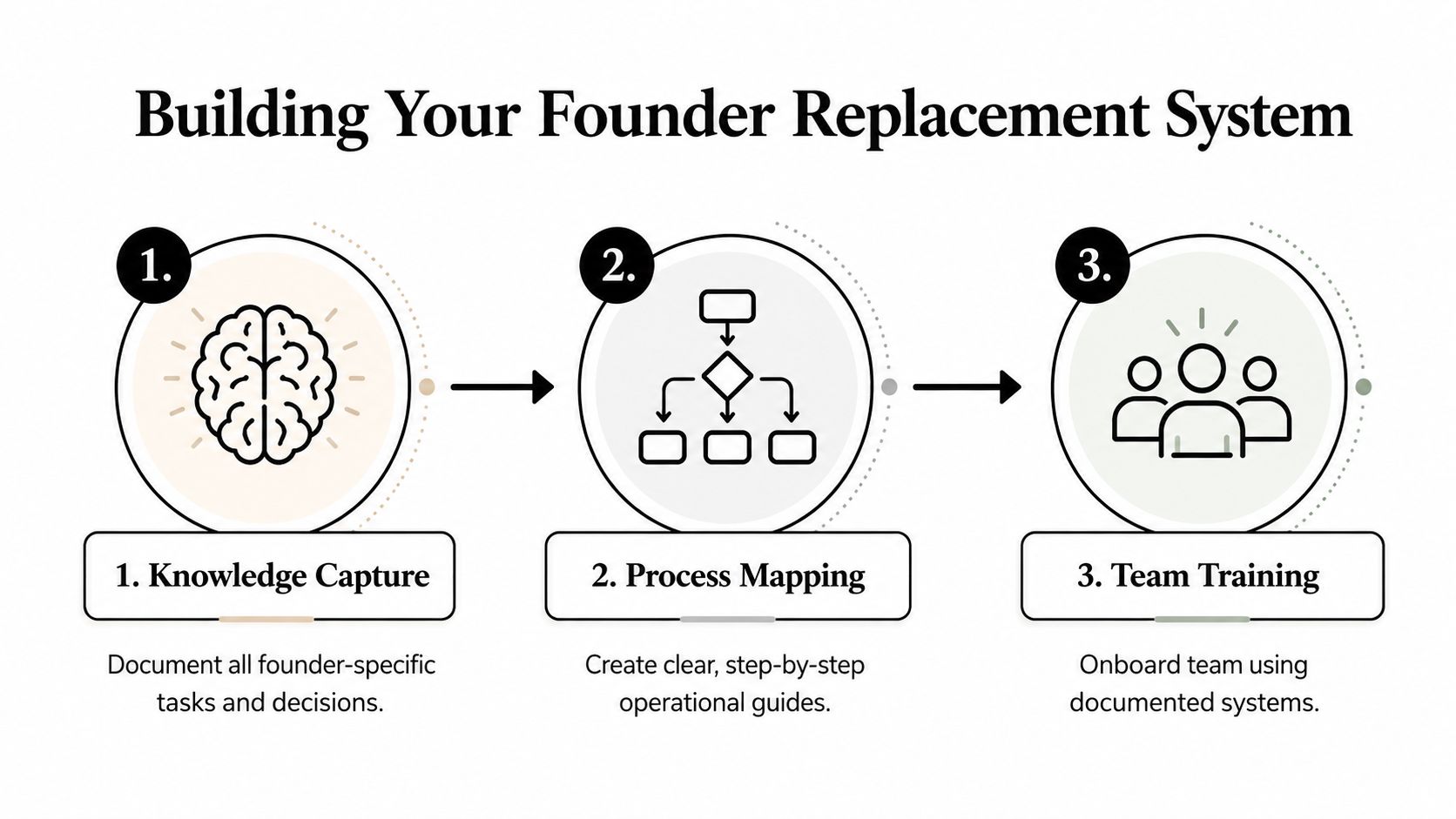
Prioritize processes according to the damage caused by inconsistency, not according to what feels easiest to write down.
A standard operating procedure should help a competent person complete the task without asking you to translate it. Include the purpose, trigger, owner, inputs, steps, output, quality criteria, and failure response. Loom can help you capture a screen-based walkthrough, while Notion, ClickUp, or Asana can turn recurring work into assigned checklists.
A process isn't finished when it's written. It's finished when another person can use it and produce the expected result.
Not every task deserves rigid instructions. Use strict procedures for compliance, billing, customer promises, and quality gates. Use flexible guidelines for creative judgment, relationship building, and strategic recommendations. Over-documenting creative work can produce lifeless output. Under-documenting financial or client-facing work creates avoidable risk.
Ask the person using the process where they hesitated, what information was missing, and which step created unnecessary work. Update the document after real use, then keep a simple change log so the team knows what changed and why.
Delegation also requires authority. If someone owns client onboarding but can't resolve a missing input, reschedule a meeting, or reject an incomplete brief, you've transferred tasks without transferring responsibility. This practical guide to delegating tasks effectively for teams provides a useful reference for matching ownership with decision rights.
The goal isn't to remove the founder from every valuable activity. It's to remove the founder from routine coordination so their time goes toward positioning, key relationships, product decisions, and leadership.
Hiring should follow a capacity diagnosis, not a revenue milestone. A new employee can solve a genuine constraint, but they can also lock the business into a fixed cost before the workflow, demand, and management structure are ready.
A safer sequence is simplify, automate, outsource, then hire. First remove unnecessary steps and clarify the offer. Next automate predictable actions, such as scheduling, reminders, task creation, and basic reporting. Then use contractors or specialist partners for variable workloads. Hire a permanent role when the need is recurring, the responsibilities are documented, and the business can support the commitment through ordinary cash fluctuations.
If the founder spends hours formatting content, a production specialist may create more capacity than another salesperson. If projects stall because nobody coordinates approvals, an operations coordinator may be the better first move. If the founder is still the only person who can sell, a sales hire may multiply an unclear proposition.
For service businesses, separate production capacity from management capacity. A larger delivery team can increase output while making the founder responsible for more scheduling, coaching, quality control, and conflict resolution. Build a layer of team leadership before the number of direct reports becomes unmanageable.
Contractors work well when demand varies, expertise is narrow, or you need to test a function. Full-time employees make more sense when the work is continuous, central to the customer experience, and dependent on accumulated company knowledge. Neither choice is automatically cheaper. Compare total cost, reliability, supervision, rework, and the time required from the founder.
A 2026 small-business survey found that 57% of owners reported flat or declining revenue, 87% were funding operations from personal pockets, and 45% had less than three months of cash reserve (Simply Business's 2026 Small Business Growth Gap Report). Those figures make resilience part of the hiring decision. If a role depends on personal funding during a slow collection period, the business may need a smaller experiment, staged hours, or a process improvement before a permanent hire.
Don't hire a vague “all-rounder” to compensate for unclear ownership. Define the outcome, recurring responsibilities, required judgment, success measures, and decisions the person controls. Then identify which work can be handled by technology and which work needs human context.
Recent UK SME reporting says 63% of SMEs identify employee taxes as a growth barrier and 46% report understaffing, while Irish SMEs report significant skills gaps across areas including sales, marketing, finance, and leadership (the UK SME survey on the growth paradox). The practical response is to build capability before complexity arrives, through training, documented playbooks, and targeted specialist support.
If administrative work is consuming the founder's day, a practical guide to hiring a VA can help you define the role and delegate routine responsibilities without prematurely building a large internal department.
Paid advertising buys attention quickly, but the attention stops when spending stops. That makes ads useful for testing an offer, filling a known funnel, or reaching a defined audience, yet risky as the only growth engine for a founder-led business.
Strategic content works differently. A clear point of view can attract prospects, partners, candidates, and referrals over time. It also gives buyers evidence of how you think before they enter a sales conversation. For consultants, agency owners, executives, and specialists, that trust is part of the product.
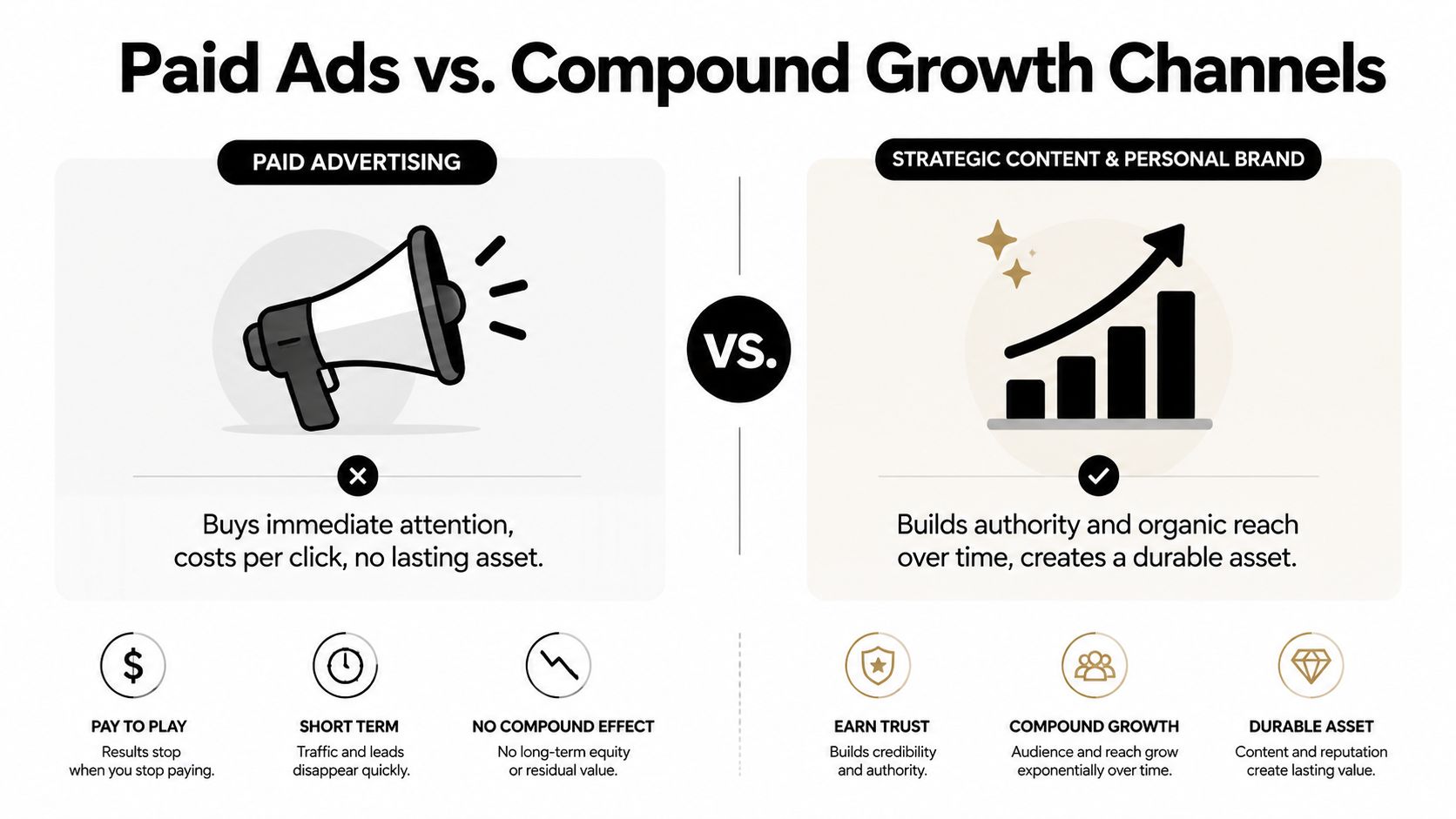
The trade-off is consistency. Content demands a usable editorial system, a repeatable source of ideas, a defined audience, and a distribution process. Publishing occasionally from inspiration won't create a dependable channel. Neither will outsourcing generic posts that sound unlike the founder.
Choose a primary platform based on where your buyers already pay attention and where your expertise is easiest to demonstrate. Then create a small set of recurring themes:
Batching helps, but authenticity requires founder input. The founder can supply voice notes, examples, opinions, and raw stories. A strategist can shape themes, a writer can draft, a designer can package the idea, and a success manager can coordinate approvals and distribution. That division protects the founder's perspective without requiring the founder to perform every production task.
Paid media rents distribution. Useful content builds a distribution asset you can keep improving.
Measure channel quality, not vanity activity. Review qualified conversations, sales-cycle fit, referral patterns, audience relevance, and the questions prospects ask after consuming your content. Use this guide to calculating marketing ROI to connect marketing activity with commercial outcomes rather than counting impressions alone.
A founder-brand service such as Legacy Builder can support this operating model by coordinating daily content, video, newsletters, profile optimization, and audience interaction around the founder's story and expertise. It belongs inside a broader distribution system, not as a substitute for a clear offer or reliable delivery.
The following video adds another perspective on building a durable business growth engine.
A scaling plan should produce evidence before it creates commitments. Use the first phase to locate the constraint, the second to transfer capacity, and the third to test one growth channel with clear review points.
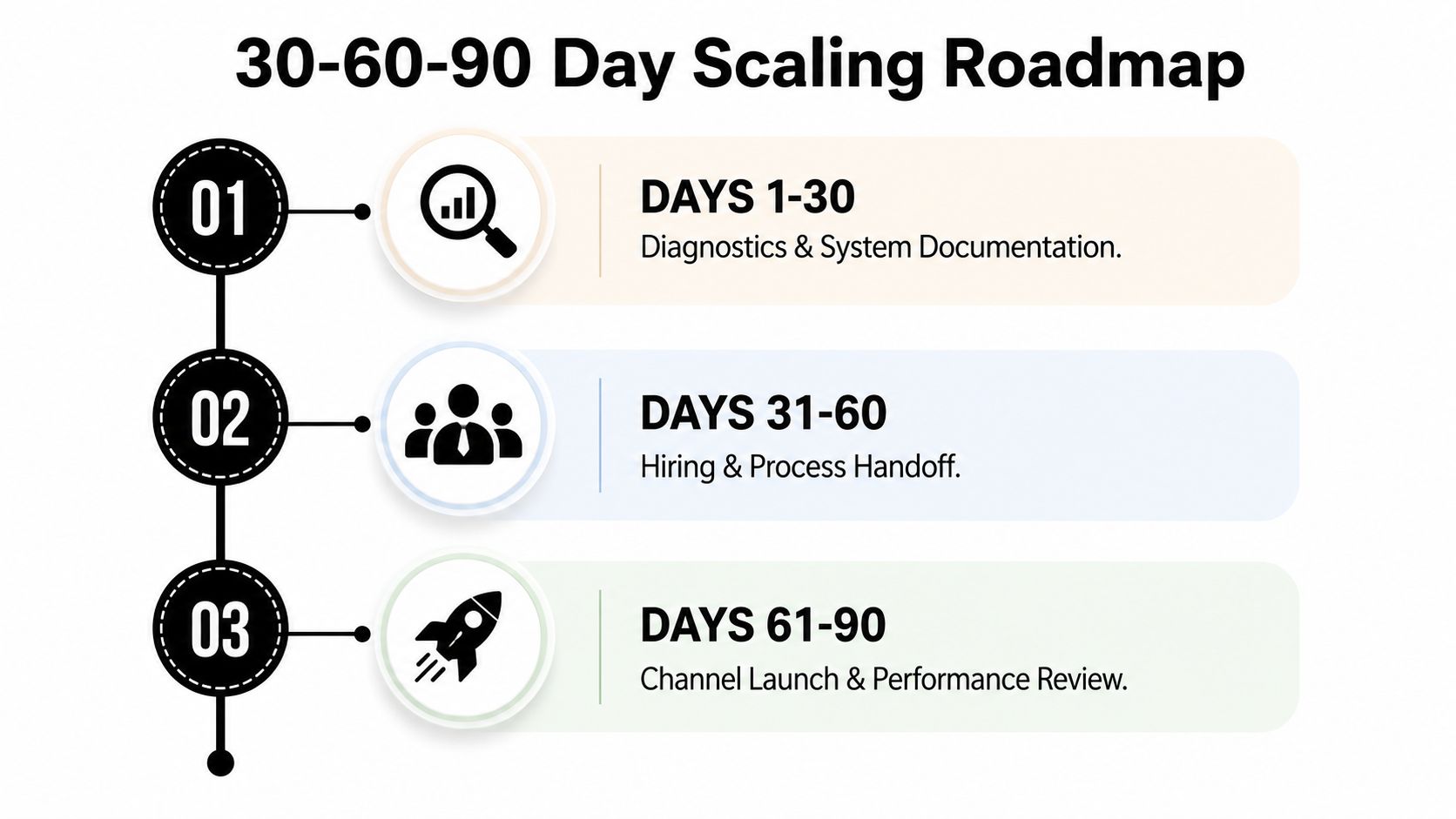
Audit the offer, delivery workflow, cash commitments, receivables, and founder-dependent decisions. Interview the people doing the work, not only the person who designed it. Document high-risk processes, define quality checks, and identify the constraint most likely to fail under additional demand.
End the phase with a decision. Continue only when the offer is clear, delivery ownership is visible, and financial exposure is understood. Otherwise, fix the bottleneck before adding acquisition spend.
Assign owners to documented workflows and run real handoffs. Automate reminders, scheduling, status updates, and task creation only when automation reduces coordination. It should not conceal a broken process. A contractor or part-time specialist can test capacity before you commit to a permanent role.
Review exceptions weekly. Repeated questions reaching the founder usually indicate a weak decision framework or insufficient authority for the process owner. Fix the rule, then transfer the decision.
Choose one primary content or acquisition channel. Define its audience, themes, publishing workflow, approval process, and commercial outcome. Launch at a sustainable cadence, then review qualified opportunities, delivery capacity, cash timing, and customer fit instead of reach alone.
Refresh benchmark assumptions as the business changes. The stage-specific method described by Pedowitz Group calls for monthly variance reviews and quarterly benchmark refreshes, as noted in its benchmark guidance. This keeps outdated assumptions from directing new spending.
Separate financing strategy from operating readiness if expansion requires outside capital or an acquisition. A resource on business acquisition loans can clarify one financing path, but borrowed capital will not repair unclear ownership, weak margins, or founder dependency.
The workable plan protects cash and quality while the team executes it. Measure the constraint, fix the process behind it, and make the next commitment only when the evidence supports it.
Legacy Builder helps founders turn expertise and personal stories into consistent content, video, newsletters, profile optimization, and audience engagement while the operating team scales. Visit Legacy Builder to explore a founder-led content system built around your voice, offer, and growth priorities.


You could – but most in-house teams struggle with the nuance of growing on specific platforms.
We partner with in-house teams all the time to help them grow on X, LI, and Email.
Consider us the special forces unit you call in to get the job done without anyone knowing (for a fraction of what you would pay).
Short answer – yes.
Long answer – yes because of our process.
We start with an in-depth interview that gives us the opportunity to learn more about you, your stories, and your vision.
We take that and craft your content then we ship it to you. You are then able to give us the final sign-off (and any adjustments to nail it 100%) before we schedule for posting.
No problem.
We have helped clients for years or for just a season.
All the content we create is yours and yours alone.
If you want to take it over or work on transitioning we will help ensure you are set up for success.
We want this to be a living breathing brand. We will give you best practices for posting and make sure you are set up to win – so post away.
Subscribe to our newsletter and get insights on how to grow your personal brand.
