.svg)
Subscribe to our newsletter and get insights on how to grow your personal brand.
Thank you! Your submission has been received!
Oops! Something went wrong while submitting the form.
.svg)



You have a business idea. You're convinced it's the next big thing.
But here’s the hard truth I’ve learned from years in the trenches: a great idea, on its own, is basically worthless. What matters is proving that people actually want it and are willing to pay for it.
Validation is how you do that. It’s the process of systematically stress-testing your assumptions to find out if you have a real business or just a cool project. It's about moving from "I think this will work" to "I have cold, hard evidence that this solves a problem people will pay to fix."
Every founder starts out buzzing with excitement. They see the perfect product, a line of happy customers, and hockey-stick growth charts. But the startup graveyard is overflowing with brilliant concepts that never got off the ground.
The market is the ultimate judge, and it doesn't care about your passion.
This is where validation becomes your secret weapon. It’s not about getting friends to tell you your idea is amazing. It's about getting brutally honest feedback and real-world data before you sink your life savings into building something nobody needs.
Many of the sharpest founders I know live by the principles of the Lean Startup methodology. It’s a game-changer because it forces you to stop obsessing over your solution and start obsessing over your customer's problem.
It’s easy to point fingers at running out of money or getting crushed by a competitor. But those are usually just symptoms of a much bigger, more fundamental problem.
The data doesn't lie: up to 90% of startups ultimately fail. And the #1 reason, cited in a staggering 42% of those failures, is building something with no market need.
Think about that. Nearly half of all failed startups die because they built a solution to a problem that wasn't real, wasn't painful enough, or wasn't something people would actually pay for.
Validation is your insurance policy against becoming one of those statistics. It’s a structured way to answer the most critical questions before you write a single line of code.
"Your most important task as a founder isn't to build a product; it's to build a machine to learn. Validation is the engine of that machine, turning assumptions into facts and ideas into evidence."
This playbook will walk you through exactly how to do it. It’s a step-by-step journey to test your assumptions, get meaningful feedback, and make decisions backed by data, not just gut feelings.
The core workflow is simple, as you can see here:
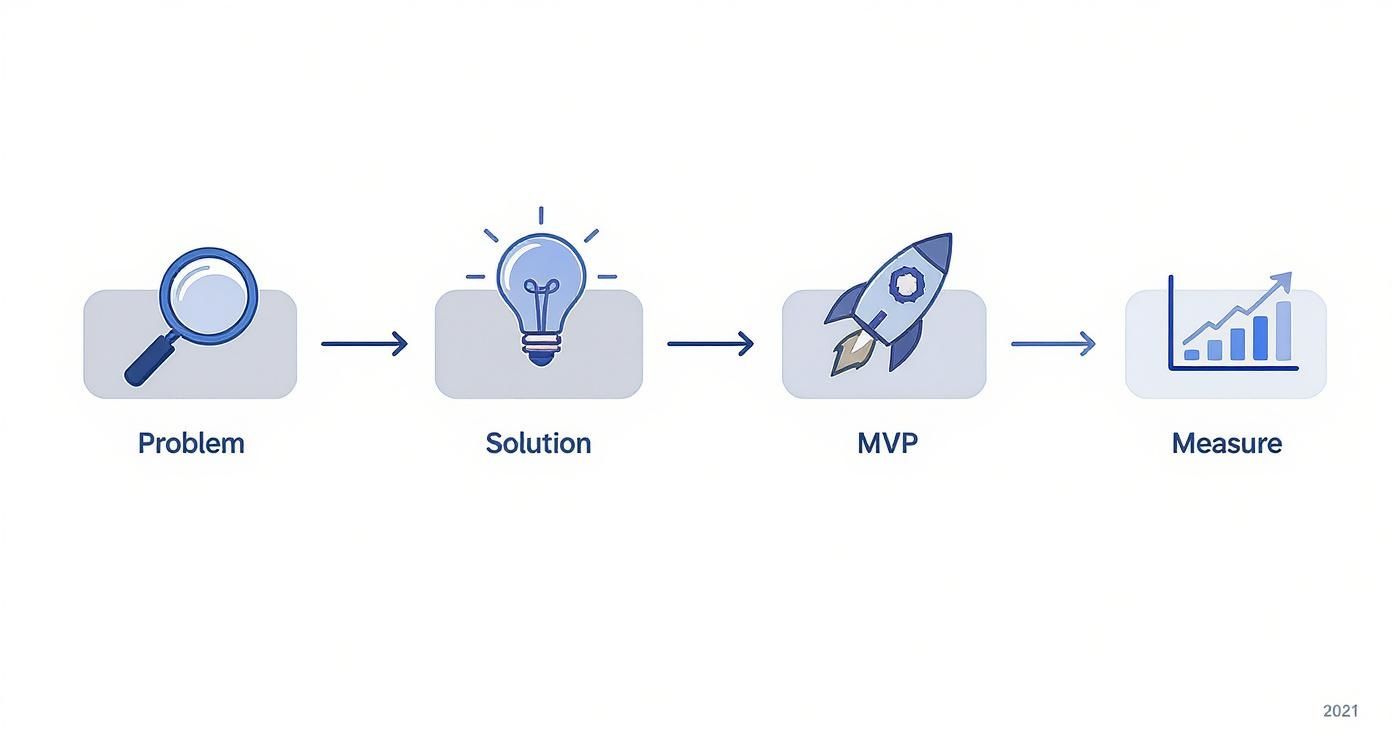
You start with the problem, develop a potential solution, test it with a bare-bones version (your MVP), and measure the results. Each step informs the next, so you’re constantly learning and adjusting before you bet the farm.
At its heart, this process is about adopting a scientific mindset. Forget blind passion for a minute. Your job is to be a detective, hunting for clues and evidence in the real world.
To help frame this, I think about validation in four distinct stages. Each one is designed to answer a crucial question before you move on to the next.
This table lays out the entire journey. By following these pillars, you de-risk your idea at every turn.
Here's a quick rundown of what that looks like in practice:
By taking this approach, you transform your startup idea from a high-stakes gamble into a series of calculated experiments. And that, right there, is how you dramatically stack the odds of success in your favor.
Let's get one thing straight: great businesses aren't built on cool ideas. They're built on solving painful, frustrating problems for a specific group of people.
Your first job isn't to build a product. It's to become a detective. You need to dig deep into the real-world frustrations people are already dealing with. This whole stage is about listening, not pitching.

The goal here is simple: find hard evidence that you're tackling something people are actively trying to fix right now. It has to be what we call a "hair-on-fire" problem, not just a minor annoyance. If they aren't already cobbling together weird workarounds or googling for solutions, they probably won't pay for yours.
You can't solve a problem for everyone. I've seen so many founders make this mistake, and it always leads to a generic product that gets ignored. The first real step is deciding exactly who you’re solving this for.
And I mean hyper-specific. Forget broad labels like "small business owners." Get granular. What industry? What's their role? What does their day-to-day actually look like? This detailed snapshot is your Ideal Customer Profile (ICP), and it's your North Star.
Nailing down your ICP helps you:
Think about it. "Freelancers" is way too broad. But "solo graphic designers juggling 3-5 client projects who lose track of feedback and deadlines"? Now you've got a real person. You know exactly who you need to find and talk to.
Once you know who you're looking for, it’s time to talk to them. But this isn't a sales call. It's not a focus group. It's a problem interview, and its only purpose is to learn about their world.
You shouldn't even mention your idea. Seriously.
Your goal is to understand their past behavior, not their future predictions. People are terrible at predicting what they would do, but they're experts on what they have done.
Your mission is to get them telling stories about their real struggles. Ask open-ended questions and listen. The insights you pull from these conversations are the bedrock of your entire business. And this isn't just fluff—a Nielsen Consumer Insights study found that listening and adapting based on audience needs can improve product-market fit by up to 38%.
Generic questions get you useless, generic answers. You need questions that prompt stories, not just a "yes" or "no." Dig into past actions and the emotions tied to them.
Here are a few of my go-to questions to get the ball rolling:
See the pattern? No "Would you use an app that did X?" We're digging into real-world behavior. If someone tells you they haven't tried anything to solve the problem, that’s a massive red flag. It means the pain just isn't there.
After you've done 10-15 of these interviews, you'll start to see patterns. You're not looking for someone to say, "Yes, your idea is brilliant!" You're listening for recurring themes of genuine frustration.
Go through your notes and organize them. You're looking for clear answers to these four questions:
If you're getting a resounding "yes" across the board, congratulations. You've likely found a problem that's actually worth solving. This is the green light you need to start thinking about a solution.
Alright, you’ve confirmed you’ve found a "hair-on-fire" problem people desperately want solved. Now what?
The next move is to package your solution into a message that makes your ideal customer stop scrolling and say, "That's exactly what I need." This is your Unique Value Proposition (UVP). It's not a fluffy marketing slogan; it's a dead-simple promise that answers the one question everyone has: Why you?
Your UVP needs to hit hard and fast. It should instantly tell someone what you do, who you do it for, and what makes you the only real choice.
Don't get bogged down trying to write the perfect sentence. The goal here is clarity, not poetry. Just get something on paper that you can start testing.
A fantastic place to start is Geoffrey Moore's classic formula:
For [your target customer] who [has a specific need or problem], our [product/service name] is a [product category] that [provides a key benefit]. Unlike [the main competitor or alternative], we [provide a key differentiator].
This little template forces you to get specific. It makes you define your audience, their problem, and your secret sauce. It’s a core piece of your strategy, much like what you'd map out with these business model canvas examples to inspire your strategy.
Another one I love for its simplicity is from Steve Blank: "We help X do Y by doing Z." It cuts right to the chase. For example: "We help solo graphic designers (X) finally tame client feedback (Y) by giving them a single portal for all project communication (Z)."
Nailing the words is just the beginning. The real test is seeing if that promise actually makes people move. You have to find out if your UVP is compelling enough to get them to take action, even a small one.
This is where you shift from talking to people to running actual experiments. You’re looking for early signs of real interest without sinking time and money into building a full product. These low-cost tests are all designed to measure one thing: desire.
Here are a few proven ways to test your value prop:
Every one of these tests spits out data—your first real signals from the market. If you get a 15% sign-up rate on your landing page, you’re onto something big. If it’s less than 2%, your message is off, and it's time to go back to the drawing board.
Forrester research shows that companies who actually listen to their audience can see conversion rates jump by as much as 30%. That’s what you’re doing here, but with clicks and emails instead of sales.
Key Takeaway: You’re not trying to be perfect on the first shot. You’re trying to learn. If the first UVP bombs, don't sweat it. Tweak the language, try highlighting a different benefit, and run the test again. This rapid cycle of testing and learning is what separates the founders who make it from those who build something nobody wants.
Forget about writing code. Seriously. The next step isn't about building a perfect product; it's about building just enough to learn—and not a single pixel more. This is where the low-fidelity Minimum Viable Product (MVP) comes in. It’s the fastest, cheapest way to see how real people actually interact with your solution.
You’re making a critical shift here. You’re moving from asking people what they would do to watching what they actually do. It’s all about getting a bare-bones version of your solution into your customers' hands to see how they behave. This isn't just about saving cash; it's about learning quickly and efficiently.
Dropbox is the classic example of this. Before building their complex tech, the founders just made a simple explainer video showing how their file-syncing idea would work. They dropped it on a basic landing page with a sign-up form. The result? An insane 70,000 signups overnight. They proved massive demand before a single line of code for the actual product was written.
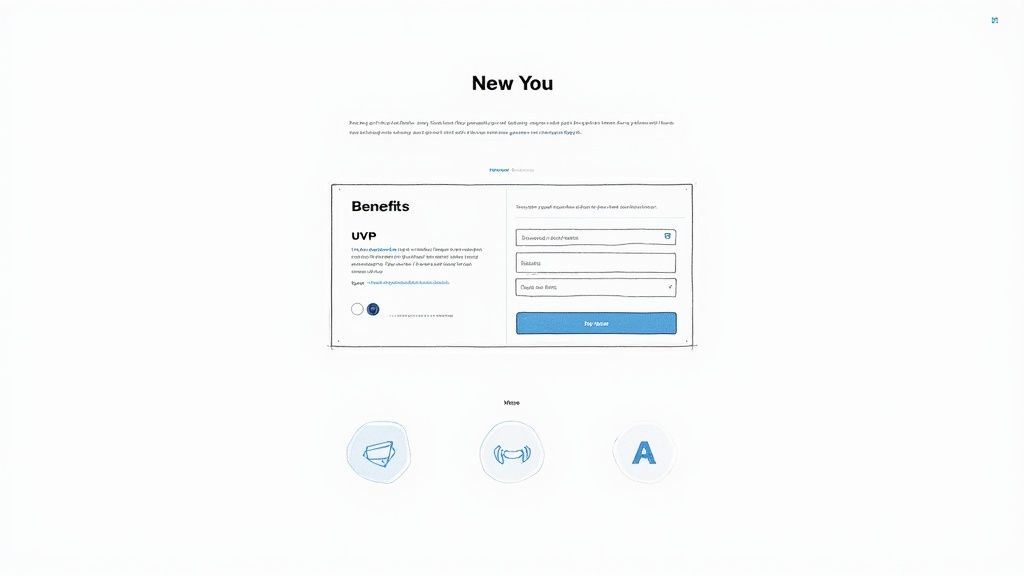
Not all MVPs are created equal, and you absolutely don’t need a developer for your first one. The whole point is to simulate the core function of your product and see if it actually delivers on its promise. To do this right, you need to master iterative development models—it’s a fancy way of saying you build, measure, and learn in super-fast cycles.
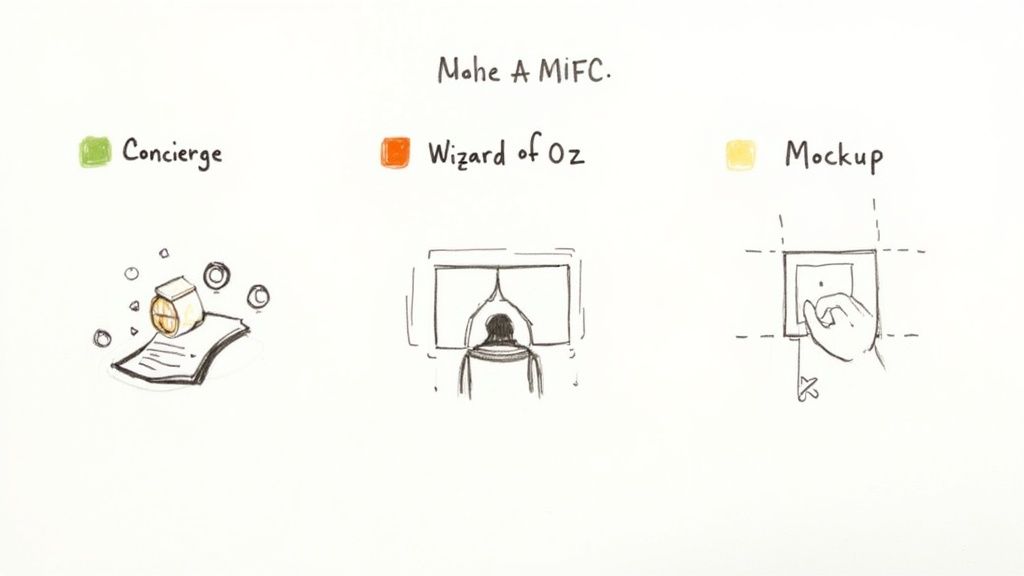
Here are three powerful low-fi MVPs you can build this week:
Expert Tip: Stop asking users, "Do you like it?" Instead, give them a goal. Say, "Show me how you would add a new client to this dashboard." Their actions will tell you a hell of a lot more than their opinions ever will.
It’s easy to get lost in the weeds here, so let's be clear. Your low-fi MVP is an experiment. You aren't testing code; you're testing fundamental assumptions about how people behave and what they value.
Here’s what you’re trying to validate:
This stage gives you the richest data you've had so far. A landing page tests interest, but an MVP tests action. If you need some help setting up the pre-sale or sign-up part of your MVP, our guide on building an effective landing page has you covered.
The insights you get here will tell you what to build next and, more importantly, confirm whether you're sitting on a real business or just a clever idea.
Alright, the qualitative feedback you've gathered from interviews is your foundation. But now it's time to back it up with hard data. This is where we move from conversations to conversions, looking for the quantitative signals that prove your idea has real legs.
It's easy to get lost in vanity metrics like social media likes. Forget those. We're looking for tangible actions—proof that people are willing to give you something valuable, like their email address or, even better, their credit card number.
Complexity is your enemy at this stage. You don't need a massive analytics dashboard. You just need a few key numbers that directly answer one question: "Do people actually want this?"
Your most important metrics will probably fall into one of these buckets:
These simple numbers give you an objective look at interest so you can make decisions based on data, not just feelings. If you're running ads or promotions to get people to your page, you’ll need a solid strategy. A strong B2B social media strategy is key for finding and engaging your target audience.
So, what are you aiming for? The numbers can vary by industry, but there are some solid rules of thumb when you're just starting out. You're not chasing perfection; you're looking for a strong signal.
From what I've seen, a conversion rate above 20% on an early landing page is a fantastic sign. It tells you you're hitting the right people with a message that clicks. For pre-launch campaigns with really good incentives, I've seen that number climb toward 35%, which is a massive indicator of high demand.
If your conversion rate is down in the 2-5% range, don't panic. It doesn't mean your idea is dead. It means your messaging isn't landing or you're talking to the wrong people. This isn't failure—it's feedback showing you exactly where you need to pivot.
Setting up a system to track these numbers doesn't need to be complicated or expensive. The goal is to get a test up and running fast so you can start learning.
Here’s a simple, low-cost stack to get you started:
Let your experiment run for a week or two, and you’ll have hard data. This is what turns validation from guesswork into a science. It gives you the confidence to either push forward, pivot based on what you've learned, or pause and rethink things.
Let’s get into the nitty-gritty. You have the playbook, but actually getting out there and doing the work always brings up some real-world questions. I get these all the time from founders, so I'm laying out the straight-up answers to the most common hurdles you'll face.
Here’s the best part: almost nothing. The entire point of validation is to learn as much as possible while spending as little as possible. Your costs can be anywhere from zero to a few hundred bucks, depending on how you play it.
Your first moves are basically free. Customer interviews? That just costs your time. You can spin up surveys with tools like Google Forms without spending a dime. The goal here is to collect all that rich, qualitative feedback before you even think about opening your wallet.
Once you start moving into real-world testing, you might need to spend a little bit.
Think of it this way: you're spending a few hundred dollars now to potentially save yourself hundreds of thousands—and years of your life—building a product nobody actually wants. It's the smartest investment you can make.
Finding the right people to talk to is way easier than most founders think, but you have to get out of your own bubble. Seriously, stop asking your mom and your best friend for feedback. They love you, but their opinions are biased and pretty much worthless at this stage. You need to talk to real, potential customers.
First, figure out where your ideal customers hang out, both online and off.
If you’re building a B2B product, a short, personalized, and direct message on LinkedIn works wonders. Frame your request as wanting to learn from their expertise, not as a sales pitch.
First off, pop a bottle of champagne. No, I'm not kidding. This isn't failure—it's a massive win. You just dodged a bullet and saved yourself an insane amount of time, money, and heartache.
This is the most valuable data you can possibly get. It's a clear signal to stop before you become another statistic—one of the 42% of startups that fail because there was no market need.
Now you have a choice to make, and it's an informed one. Dig into why nobody cared.
The answers give you two clear paths. You can pivot—tweak the idea, the audience, or the value prop based on the feedback. Or, you can kill the idea and move on to the next one, now that you have a proven system for testing it.
There isn't a magic number, but the keyword here is momentum. You need to move fast enough to get answers before you get stuck in "analysis paralysis." If you let this drag on for months, your feedback will be stale and you’ll lose all your energy.
A solid target is to run a full validation cycle in 4 to 8 weeks.
Here’s what that could look like:
This isn't a one-and-done deal. It's a series of quick sprints designed to turn your assumptions into facts. Set deadlines for each stage. Hold yourself accountable. Keep moving.
Ready to stop guessing and start building an authentic personal brand that truly connects? At Legacy Builder, we transform your unique story into powerful content that engages your ideal audience and establishes your influence. Let's build your legacy together.


You could – but most in-house teams struggle with the nuance of growing on specific platforms.
We partner with in-house teams all the time to help them grow on X, LI, and Email.
Consider us the special forces unit you call in to get the job done without anyone knowing (for a fraction of what you would pay).
Short answer – yes.
Long answer – yes because of our process.
We start with an in-depth interview that gives us the opportunity to learn more about you, your stories, and your vision.
We take that and craft your content then we ship it to you. You are then able to give us the final sign-off (and any adjustments to nail it 100%) before we schedule for posting.
No problem.
We have helped clients for years or for just a season.
All the content we create is yours and yours alone.
If you want to take it over or work on transitioning we will help ensure you are set up for success.
We want this to be a living breathing brand. We will give you best practices for posting and make sure you are set up to win – so post away.
Subscribe to our newsletter and get insights on how to grow your personal brand.
