.svg)
Subscribe to our newsletter and get insights on how to grow your personal brand.
Thank you! Your submission has been received!
Oops! Something went wrong while submitting the form.
.svg)


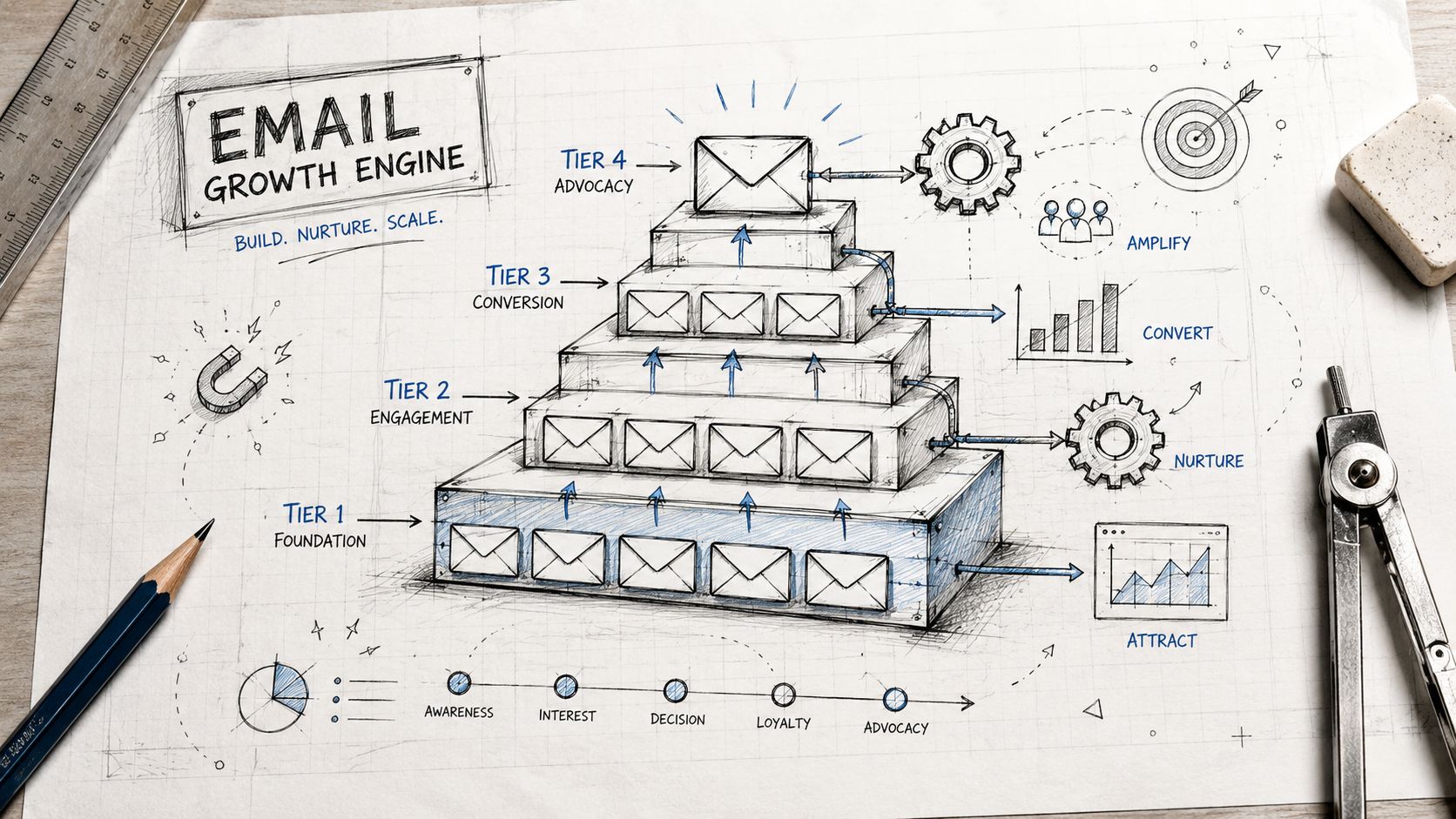
Most advice on how to scale email marketing is wrong at the starting line. It treats scale like a volume problem. Send more newsletters. increase frequency. build a bigger list. automate harder.
That's not scale. That's multiplication of mediocrity.
If you're a founder, executive, creator, or expert, email isn't just a sales channel. It's your private room. It's where trust compounds, reputation deepens, and high-value opportunities take root before they ever show up as revenue, referrals, speaking invitations, partnerships, or clients. The people on your list are not impressions. They're future buyers, advocates, peers, and introducers.
The lazy version of scale says more email equals more growth. It doesn't. More irrelevant email just teaches people to ignore you faster.
Email deserves better than that because it's still one of the strongest direct-response channels available. According to HubSpot's marketing statistics, email delivers an average return of $36–$42 for every $1 spent in 2026, compared with around $2 for paid search and roughly $1.60 for display advertising. That gap matters. It tells you email isn't some support channel sitting behind social media. It's an owned asset with serious economic advantage.
For personal brands, the core scaling challenge is different. You're not trying to push more messages into the market. You're trying to build more relevant touchpoints without diluting trust.
Batch-and-blast thinking comes from a retail mindset where the list is treated like inventory. That approach breaks down fast for service businesses, advisory brands, coaches, consultants, and category experts because your buyer isn't making an impulse purchase. They're evaluating judgment, credibility, and consistency.
A generic broadcast does three bad things at once:
Scale in email means preserving intimacy while removing repetition.
Real scale is a system that lets you stay personal after your audience grows. That system rests on a few hard truths:
If you want email to become a business asset instead of a weekly chore, stop asking, “How do I send more?” Start asking, “How do I build more trust per send, with less manual effort?”
That's how email stops being content distribution and starts becoming legacy infrastructure.
Most list growth advice is vanity dressed up as strategy. Get more leads. lower friction. maximize signups. None of that helps if the wrong people join, ignore you, and drag down your sender reputation.
The foundation of scalable email is boring, manual, and absolutely essential. You need a clean list, clear audience definition, and a signup process that attracts people who want what you sell. This part feels unscalable because it requires judgment. That's precisely why it works.
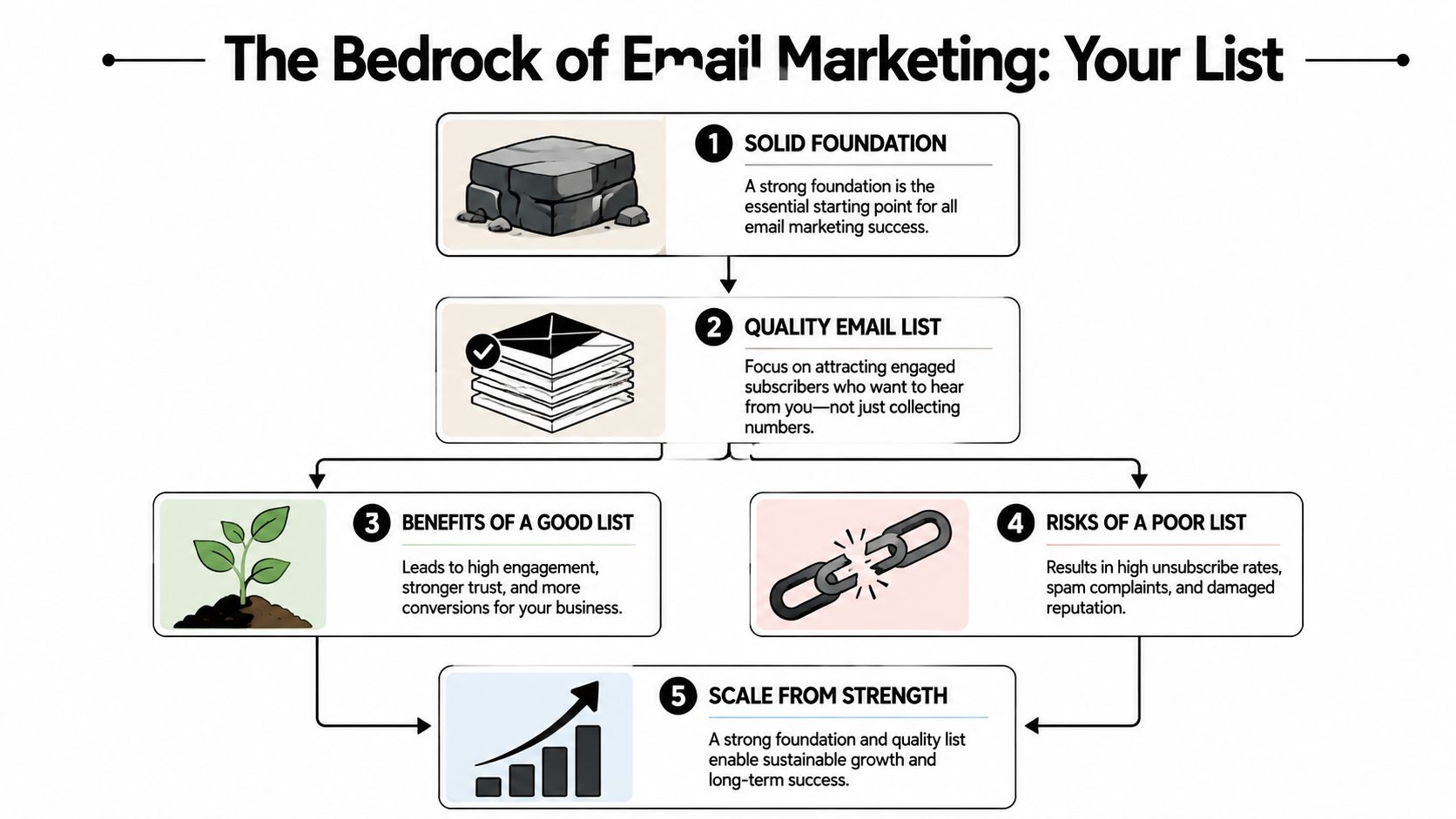
A bloated list gives weak operators emotional comfort. It doesn't give you an advantage.
For a personal brand, the wrong subscriber is expensive. They lower engagement, muddy your data, distort your tests, and make your message feel weaker than it is. A smaller list of aligned readers is far more useful than a large list of passive strangers.
Build around fit, not volume.
The best acquisition strategy is simple. Offer something specific enough that it filters. A generic “join my newsletter” pitch attracts curiosity. A sharp promise attracts intent.
Good acquisition sources for a personal brand usually come from existing trust assets:
Bad acquisition usually looks like forced giveaways, irrelevant freebies, or broad promises that pull in people who won't care once the incentive is gone.
Don't collect a pile of data just because your form software lets you. Collect only what helps you personalize, qualify, or route someone into the right conversation.
A practical rule set:
That last point matters. A subscriber from a webinar behaves differently from someone who joined through a founder story or a lead magnet about pricing strategy. If you don't know where they came from, your follow-up gets blunt fast.
Practical rule: Every opt-in should answer two questions clearly. Why should this person join, and what should happen next?
A neglected list turns into a silent tax. You keep paying your ESP to send to disengaged contacts, and mailbox providers keep learning that fewer people care about your messages.
A healthy program needs ongoing hygiene:
You don't need a giant operation to do this. You need discipline.
Founders love overcomplication here. They create eight personas, fifteen subsegments, and a messaging map nobody uses. Keep it tight.
For most personal brands, three or four personas at most is enough. Usually they fall into a pattern like this:
| Persona type | What they want | What your email should do |
|---|---|---|
| Problem aware prospect | Clarity and confidence | Teach, diagnose, and reframe |
| Warm evaluator | Proof and fit | Show method, results logic, and objections handled |
| Client or customer | Momentum | Support execution and deepen trust |
| Peer or advocate | Perspective | Share ideas worth forwarding and discussing |
If you can't name the distinct problem, desire, and buying context for a segment, it's not a real segment. It's just a label.
The unscalable work is the essential work. Define the right people. attract them genuinely. clean the list aggressively. Then scale.
If I had to pick one lever that separates amateur email marketing from serious revenue generation, it's segmentation.
Not “Hi {{first_name}}.” Not swapping a headline. Not adding a dynamic block and calling it personalization. Real segmentation means your emails change because the subscriber's behavior changed. That's where relevance starts and where revenue follows.
According to Digital Applied's email marketing statistics, segmented campaigns generate 760% more revenue than non-segmented sends, and hyper-segmented micro-audiences of 500–2,000 contacts can outperform broader segments by 3.4x on conversion rate. That should end the debate. Broad blasts are not efficient. They're lazy.
Demographics can help with tone. They rarely tell you intent.
Behavior tells you what someone is trying to solve, how close they are to action, and whether they trust you enough to keep listening. That's what you need if you want to know how to scale email marketing without turning your list into a generic content dump.
Start with signals like these:
If someone clicks every email you send about authority building, don't keep sending them your general newsletter as if they're a stranger. Route them into a deeper conversation about that topic.
Good segmentation is operational. It should make better sending decisions easy.
Three high-value segments for a personal brand are usually enough to start:
These are your insiders. They open often, click often, and usually respond well to direct invitations. Send them sharper opinions, early invitations, and stronger calls to action.
These people show intent. They read sales-adjacent content, visit key pages, or consume material tied to your offer. They need proof, decision support, and a clear next step.
Don't keep treating silence like interest. If someone has gone cold, they need a re-engagement path, a reduced cadence, or an exit.
For marketers who want a broader strategic framework, The AI CMO's complete guide is a useful resource for thinking through segmentation models without getting trapped in theory.
The goal isn't to create dozens of segments. It's to create a few segments that change what you send.
Basic merge tags personalize surface details. Behavioral segmentation personalizes meaning.
That means:
A founder exploring keynote speaking, a consultant comparing service providers, and a former client considering a second engagement should never receive the same message sequence.
There's a trap here. Marketers discover segmentation, then build a mess. Too many personas. Too many tags. Too many edge cases. Nobody knows which segment overrides which, and the system becomes impossible to maintain.
Keep it simple enough to run every week.
A good test is this: if your team can't explain why a subscriber received a message in one sentence, your segmentation model is too complicated.
For personal brands, segmentation isn't just a conversion tactic. It's respect. It tells people you're paying attention. And in a market full of automated noise, that alone creates advantage.
Automation is where your expertise stops depending on your calendar. If you want to know how to scale email marketing without becoming a full-time sender, this is the engine.
Behavior-based workflows outperform generic broadcasts because they respond to moments, not schedules. As noted earlier, automated campaigns built around behavior signals post stronger engagement than typical sends. That makes sense. Timely email feels personal, even when it's automated.
Start with this visual blueprint.
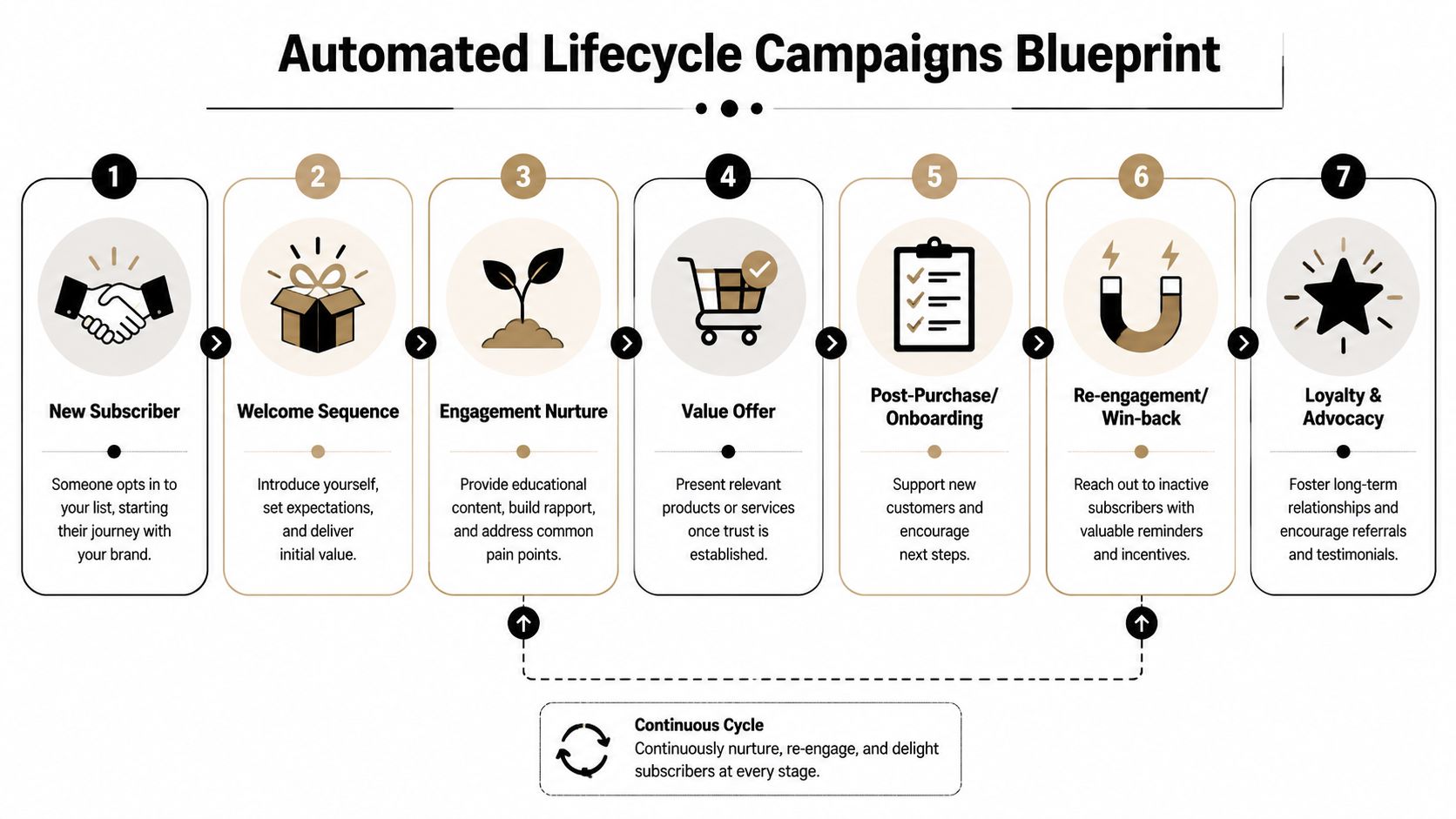
Most personal brands don't need a maze of automations. They need three sequences that do their job well.
Your welcome sequence sets the tone for the entire relationship. This opportunity is often wasted on a thank-you email and a generic brand story. That's a miss.
A strong welcome flow should do four things in order:
Deliver the promised value
Give them the lead magnet, resource, or next step immediately. Don't make them hunt for it.
Establish your point of view
Explain what you believe that others in your market get wrong. This is how people remember you.
Train the reader
Show them what kind of emails you send, how often you send them, and why staying subscribed matters.
Invite a lightweight action
Ask them to reply, click into a key article, choose a preference, or consume one foundational piece of content.
For example, a leadership advisor might send: resource delivery, a note on their leadership philosophy, a breakdown of a common executive communication mistake, then an invitation to reply with their biggest team challenge.
That sequence doesn't just onboard a subscriber. It starts a relationship.
A practical reference point is this collection of email drip campaign examples, which is useful for seeing how different sequence structures can translate into real campaigns.
Nurture email is not a holding pattern. It should move someone from passive interest to informed intent.
That means each email needs a job. One email reframes the problem. Another teaches your method. Another handles skepticism. Another shows what execution looks like. Another presents the invitation.
A simple nurture structure for a service-based personal brand looks like this:
| Email type | Purpose | Example angle |
|---|---|---|
| Belief shift | Challenge old assumptions | Why more content isn't fixing your positioning |
| Method email | Teach your process | The system behind consistent authority building |
| Proof email | Show credibility | What strong personal brands do differently |
| Objection email | Reduce friction | Why this isn't about becoming an influencer |
| Offer email | Ask clearly | Book a strategy call or apply for the program |
The best nurture emails don't sound like marketing copy. They sound like sharp thinking delivered consistently.
Here's a useful walkthrough if you want to see automation strategy discussed in a more visual format.
Every list accumulates quiet subscribers. Don't keep sending as if nothing changed.
A re-engagement campaign should feel respectful, not desperate. Good options include:
If someone stops engaging, your first job isn't persuasion. It's clarification.
For personal brands, automation isn't about impersonality. It's the opposite. It preserves your voice and judgment at moments when a manual follow-up would never happen. That's a significant advantage.
Automation without content is an empty machine. You can build beautiful workflows in Kit, ConvertKit, ActiveCampaign, Mailchimp, or HubSpot, but if the emails are thin, repetitive, or forgettable, scale stalls.
Most founders think email content requires constant new creation. It doesn't. It requires smart repurposing and a clear point of view.
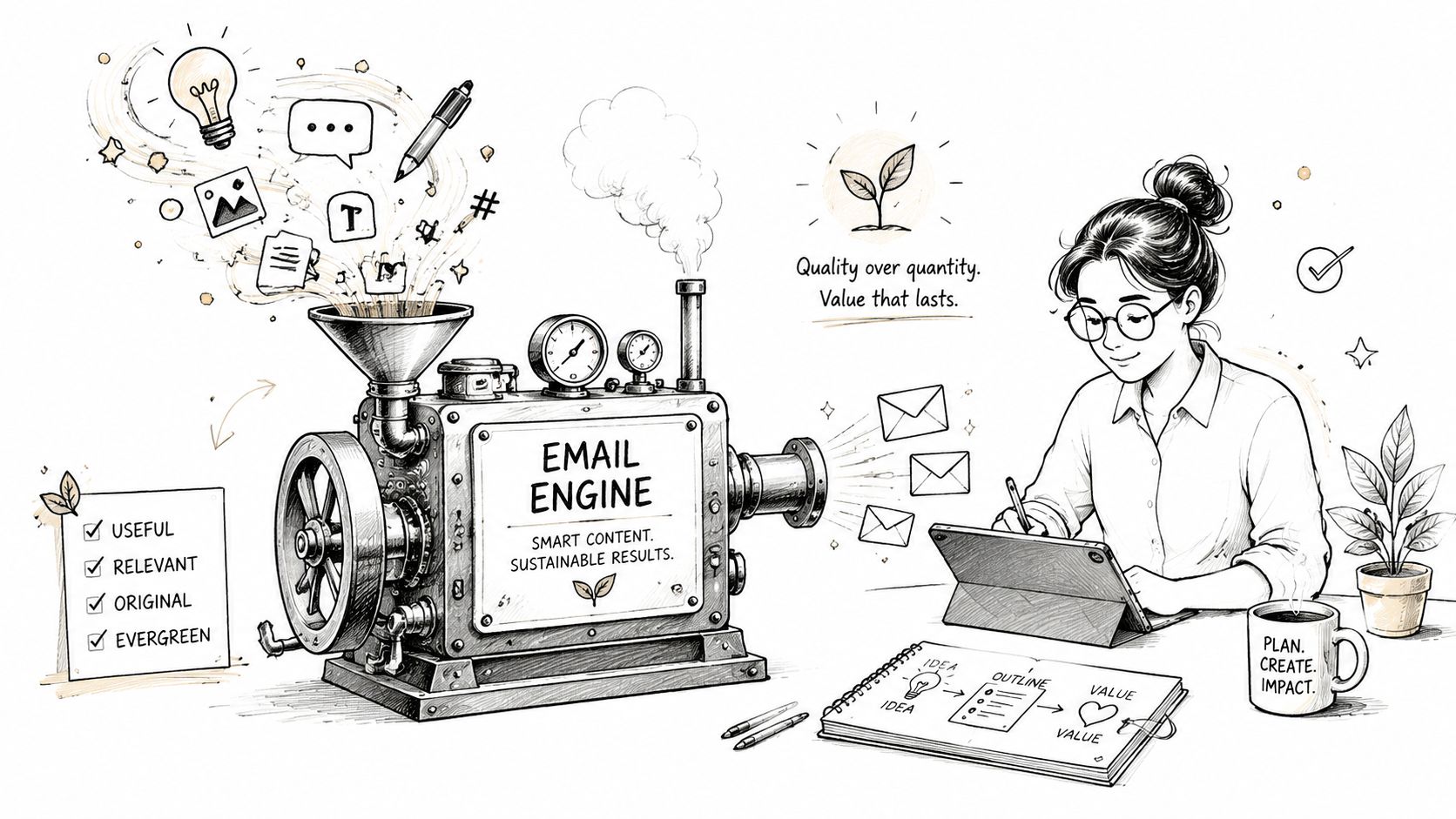
Your best email content usually starts somewhere else. A keynote, a client conversation, a podcast episode, a strong LinkedIn post, a webinar Q&A, a blog article. That's the hub.
Then you turn that single source into multiple email-native angles:
This keeps your message consistent without repeating yourself word for word.
A blog post and an email are not the same format. One can be broader and structured for search. The other needs immediacy.
When you repurpose into email, strip the content down to one idea and one action. Lead with tension. Keep the body tight. Give the reader a reason to care now.
If you need idea prompts, this list of email marketing content ideas is useful for turning broad topics into recurring email formats.
The easiest way to stay consistent is to stop inventing a new email style every week. Use a handful of repeatable formats and rotate them.
Examples:
Take a piece of common advice and challenge it. Great for authority and reply generation.
Break down a common mistake you see in the market and explain the better move. Good for pre-selling your expertise.
Share something you learned from a call, project, speech, or conversation. This format feels human and grounded.
A direct ask tied to context. No fluff. Useful when promoting a call, offer, webinar, or resource.
This is also where managed content support can help. Some operators use in-house writers. Others use consultants or content teams. Legacy Builder is one example of a service that helps professionals turn their ideas, stories, and brand positioning into consistent content across channels, including email.
More content only works when relevance stays high. Bloomreach's guide to targeted email marketing makes the right point here: scaling today means preserving relevance while increasing volume, using tactics like AI-powered personalization, dynamic content, and frequency adjusted by engagement level.
That means your hottest readers can handle more touchpoints. Quiet subscribers usually need less. Treating both groups the same is one of the fastest ways to create fatigue.
Your content strategy should make email easier to sustain, not harder to survive.
For a personal brand, email content isn't filler between launches. It's the long game. Each good email deepens familiarity. Over time, that becomes an advantage you can't buy with ads.
You can write exceptional emails and still lose if they don't land in the inbox.
Deliverability is where a lot of personal brands get exposed. They focus on copy, offers, and automation while ignoring the technical layer that determines whether any of that work gets seen. Once your list grows, mailbox providers start judging your behavior much more closely.
Sender reputation is your trust score with inbox providers. It's shaped by how people interact with your emails and by how responsibly you send them.
If subscribers ignore you, mark you as spam, or unsubscribe in clusters after irrelevant campaigns, your reputation suffers. If your list is clean, your targeting is disciplined, and your emails get healthy engagement, inbox placement improves.
That's why scaling email marketing without list quality is a dead end. Volume doesn't overcome distrust.
You don't need to become a deliverability consultant, but you do need your foundation in order.
At minimum, make sure your setup includes:
If your current ESP makes these basics hard to manage, that's a platform problem.
Not every email platform is built for growth. Some are fine for early newsletters and weak once segmentation, automation, and reporting get more serious.
A scalable ESP should make these jobs easy:
| Capability | Why it matters |
|---|---|
| Behavior-based automation | You need triggers based on actions, not just dates |
| Dynamic segmentation | Static lists create manual work and stale targeting |
| Deliverability visibility | You need to monitor complaints, unsubscribes, and delivery issues |
| Template control | Clean, reusable templates speed execution |
| Analytics integration | You need to trace email performance into business outcomes |
If you're fighting the tool every week, upgrade. Technical drag is expensive.
You don't need a huge dashboard. You need a short list you review.
Monitor these consistently:
If one segment starts pulling poor engagement or higher complaints, don't shrug and keep sending. Investigate the acquisition source, message fit, frequency, and recent changes in targeting.
Technical infrastructure isn't glamorous, but it protects every other part of your email strategy. When inbox placement slips, even strong campaigns look broken. Keep the pipes clean.
If you scale email while measuring the wrong things, you'll get better at producing noise.
A lot of operators still obsess over opens because opens feel immediate. But opens don't tell you enough about business impact, especially when your goal is to build a high-value personal brand. You need a hierarchy that connects attention to action, and action to revenue, relationships, and long-term client value.
Klaviyo's guidance is clear. Test one variable at a time and evaluate performance against a core metric set that includes open rate, click-to-open rate, and unsubscribe rate. That discipline matters because it keeps your conclusions clean and your optimization useful. You can review that approach in Klaviyo's email marketing process guide.
But don't stop there.
Use channel metrics to diagnose. Use business metrics to decide. That means tracking things like:
If your opens are high but the list isn't producing qualified conversations, the channel isn't healthy. It's just getting attention.
For a more complete view of what to monitor, this breakdown of email campaign performance metrics is a useful operational reference.

Many teams ruin testing by changing too much at once. Subject line changed. CTA changed. send time changed. design changed. Then they act like they learned something.
They didn't.
A disciplined testing loop looks like this:
Establish a baseline
Know your current performance before making changes.
Choose one lever
Pick one variable that matches one business question.
Test on a controlled audience
Don't mix segments with very different intent.
Measure the right metric
Subject line tests can inform opens. Offer tests should be judged by downstream action.
Document and reuse the winner
Turn insights into templates, defaults, or automation rules.
Operator's note: A test that improves opens while increasing unsubscribes is not a win.
Here's a straightforward way to execute without turning this into a six-month strategy exercise.
Audit your current list, signup paths, automations, and reporting. Tighten your opt-ins. Define your core personas. Suppress inactive contacts you shouldn't still be emailing. Confirm your domain and platform setup are stable.
Primary focus: relevance and list health.
Build or rebuild your welcome sequence, nurture flow, and re-engagement campaign. Create your core behavior-based segments. Tag subscribers by source and stage. Set clear rules for who gets what and when.
Primary focus: timely communication without manual effort.
Start single-variable testing. Review click quality, conversion patterns, and unsubscribe signals by segment. Adjust frequency for engaged versus quiet audiences. Keep what works. remove what doesn't.
Primary focus: turning the system into a repeatable growth asset.
A good roadmap is boring in the right way. It gives you fewer moving parts, better data, and stronger decisions. That's how to scale email marketing without losing the thing that made your brand valuable in the first place.
If your brand has strong ideas but weak follow-through, Legacy Builder helps professionals turn their expertise into consistent content systems that support audience growth, email nurturing, and long-term brand authority.


You could – but most in-house teams struggle with the nuance of growing on specific platforms.
We partner with in-house teams all the time to help them grow on X, LI, and Email.
Consider us the special forces unit you call in to get the job done without anyone knowing (for a fraction of what you would pay).
Short answer – yes.
Long answer – yes because of our process.
We start with an in-depth interview that gives us the opportunity to learn more about you, your stories, and your vision.
We take that and craft your content then we ship it to you. You are then able to give us the final sign-off (and any adjustments to nail it 100%) before we schedule for posting.
No problem.
We have helped clients for years or for just a season.
All the content we create is yours and yours alone.
If you want to take it over or work on transitioning we will help ensure you are set up for success.
We want this to be a living breathing brand. We will give you best practices for posting and make sure you are set up to win – so post away.
Subscribe to our newsletter and get insights on how to grow your personal brand.
