.svg)
Subscribe to our newsletter and get insights on how to grow your personal brand.
Thank you! Your submission has been received!
Oops! Something went wrong while submitting the form.
.svg)


Beyond the Welcome Email: What Are You Really Saying?
Is your email list just a graveyard of good intentions?
You collected subscribers. You promised yourself you’d send something useful every week. Then the cursor started blinking, and suddenly every idea felt thin, repetitive, or too self-promotional to send. So you defaulted to safe emails. A few tips. A link round-up. A recycled social post. Nothing terrible. Nothing memorable either.
This shows a common gap in how email marketing content ideas are approached. They treat email like a distribution chore instead of a brand asset. They ask, “What should I send this week?” when the better question is, “What should people believe about me after reading my emails for six months?”
Email still deserves that level of attention. In 2025, nearly 4.5 billion people worldwide use email, and daily volume exceeds 376 billion emails sent and received, according to this roundup of email marketing stats. That scale is exactly why bland email disappears so fast. The inbox is crowded. Generic advice gets buried. Safe messaging gets ignored.
I’d fix the problem by changing the job your emails perform.
Your emails shouldn’t just “nurture.” They should define your perspective, reveal your standards, and build familiarity with how you think. That’s what turns an inbox presence into trust. And trust is what creates replies, referrals, partnerships, sales conversations, and long-term attention.
If you also want to sharpen your first touchpoint, study these effective welcome email strategies. Then build the rest of your email system with more intention.
Below are 10 frameworks I’d use if I wanted an email list that strengthened a personal brand instead of decaying in my ESP.
Most founders tell their story once, usually on an About page, and then wonder why nobody remembers it.
That’s the mistake. Your story works better as a sequence.
A story arc email series lets you unfold your background in chapters. One email covers the early struggle. Another covers the wrong turn. Another shows the moment your current philosophy clicked. Done right, readers don’t feel like they’re reading a bio. They feel like they’re following a person.
I’d structure these emails around moments, not milestones.
Gary Vaynerchuk often ties his messaging back to the family wine business. Pat Flynn built trust by sharing failures and pivots, not just wins. Oprah has long made key life moments central to her voice and philosophy. The common thread is simple. They don’t dump a résumé into people’s inboxes. They reveal what shaped them.
Use details that make the story tangible. Mention the year. Mention the setting. Mention the specific decision you regret or the one conversation that changed your direction. Vague inspiration doesn’t land. Specific memory does.
Practical rule: Every story email needs one clear lesson that connects your past to the problem your audience has right now.
That final part matters. If your email ends as a diary entry, it may be interesting but weak. If it ends by connecting your experience to the reader’s current challenge, it becomes brand-building.
Here’s a simple sequence I’d use:
If you need help shaping those emails, study these personal narrative writing examples for brand building.
Close each email with a current action. Invite a reply, point to a service, or ask readers which chapter resonated most. Don’t tell your story just to fill space. Tell it to make your positioning stick.
What are you sending when you do not have a launch, a sale, or a major announcement?
Strategic email content starts to separate serious brands from noisy inbox filler. An insights email gives you a repeatable way to publish useful thinking, sharpen your point of view, and train readers to look to you for clarity. You are not filling a newsletter slot. You are building authority one lesson at a time.
Seth Godin has built trust through short, pointed observations. Naval Ravikant is known for compressed, high-signal ideas. Ramit Sethi turns behavioral insight into practical advice people can use fast. The common thread is not frequency alone. It is disciplined thinking, packaged clearly.
I keep these emails brutally simple because simple gets read.
That structure works because it forces you to move past clever commentary. Readers do not need another vague observation. They need a conclusion they can apply.
Here is a strong example. You notice that your best client engagements start when the client brings a clear point of view, not a random stack of tactics. The implication is obvious. Positioning drives better outcomes than constant activity. The action is practical. Tell readers to write down three beliefs they want the market to associate with their name before they publish another month of content.
That is not just a decent email. It is a brand-building framework. It teaches. It signals standards. It shows how you think.
The best lessons come from friction.
If you were wrong, say it plainly. If a campaign underperformed because your assumption was weak, explain the assumption. If you changed your process after a bad result, show readers what changed and why. That is how you earn credibility without sounding performative.
I also want you to avoid the polished expert trap. Clean writing is good. Sanitized writing is forgettable. Lesson emails work because they make your judgment visible. Over time, that is what builds a personal brand people trust. Readers start to understand your standards, your filters, and the decisions you make under pressure.
A strong lesson email gives the reader one sentence worth repeating.
Use that as your test.
If the email contains seven ideas, cut six. If it needs twelve links to feel useful, it is not focused enough. Send one lesson. Give it a subject line with a clear promise. Make the reader smarter in three minutes, then get out of the way.
That is how you turn casual subscribers into people who remember your name.
Polished branding creates distance if you never show your process.
Behind-the-scenes emails fix that. They let people see how you think when things are unfinished, inconvenient, or uncertain. That’s where credibility often gets built.
Use them to show the workbench, not just the showroom.
Here’s a visual that fits this style of email content planning:
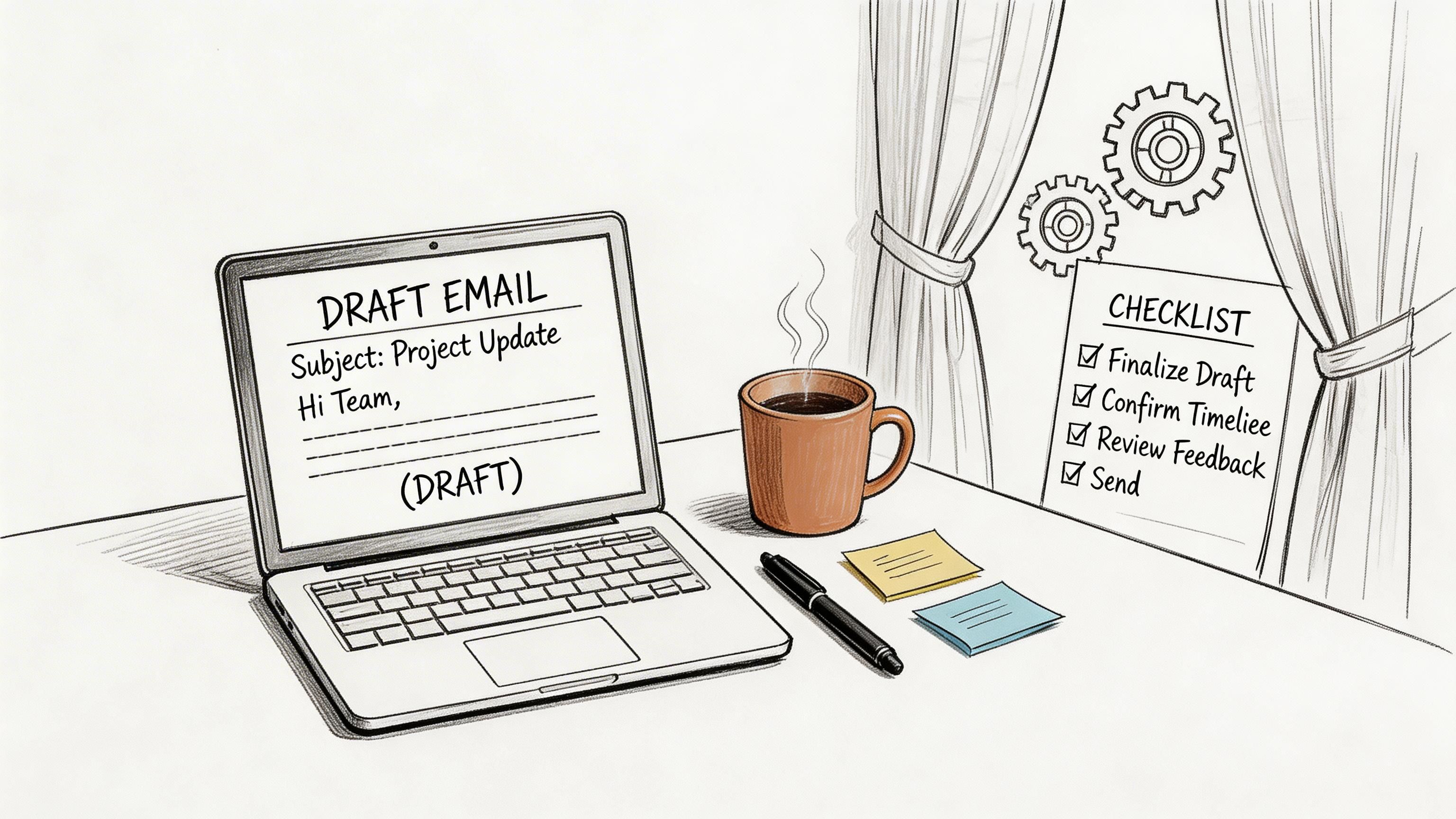
Basecamp has long shared internal thinking about company choices and culture. Buffer became known for transparency around operations and compensation. Tony Stubblebine has written openly about criticism and product building. Stripe founder communication has often stood out because it explains decisions, not just outcomes.
Emails are typically sent only after the story is fully complete and polished. I’d do the opposite.
Send the email when you’re testing a new offer and still debating the structure. Send the email when a content workflow broke. Send the email when you killed a good-looking idea because it didn’t align with your standards.
That kind of transparency builds trust because it proves there’s a real operator behind the brand.
A few angles that work well:
Transparency without reflection becomes oversharing. The fix is simple. Attach every behind-the-scenes email to a principle.
If you reveal a rough draft process, explain what quality standard you’re protecting. If you discuss a failed campaign, explain the decision rule you’ll use next time. Readers don’t just want access. They want interpretation.
Here’s a useful format to borrow when you need a stronger visual rhythm in these emails:
You can also invite readers into the process. Ask which version they’d choose. Ask what they’d cut. Ask what they’re struggling to make consistent in their own business. That turns transparency into conversation, and conversation is what keeps a list alive.
What makes someone worth reading in a crowded inbox? Judgment.
Curated analysis emails work because they help readers decide what matters. I’m not talking about a roundup of links with a vague sentence under each one. I mean a point of view. Your job is to examine what happened in your industry, explain the consequence, and tell your audience what to do with that information.
That is how you turn a newsletter from content into reputation.
Benedict Evans built authority by explaining the implications behind major shifts. Ben Thompson did the same with Stratechery. Marketing Brew earns attention because it applies an editorial filter instead of recycling headlines. Readers already have access to information. They subscribe because they want someone credible to sort signal from noise.
Your commentary needs a consistent frame. Otherwise, every email feels disposable.
I’d choose one lens and use it repeatedly. Filter trends through customer trust. Filter them through operational reality. Filter them through what a small team can execute this quarter. The specific lens matters less than consistency. When readers know how you think, they start to trust your judgment, not just your curation.
That trust is what builds a personal brand. It also separates you from generic “top stories” newsletters that never say anything memorable.
A weak email says, “Here are three articles I read this week.”
A strong email says, “Three shifts matter right now. One affects pricing. One changes how you create demand. One is noise, and I’ll tell you why.”
Use a structure that forces clarity:
That third step is where authority gets built. If you stop at summary, you sound informed. If you recommend a response, you sound useful.
Commentary emails fail when the writer acts like a curator instead of an advisor.
You should also be willing to disagree with the market. If everyone in your space is praising more automation, write the email explaining where automation creates weaker trust and worse customer experience. If the trend is more reach at any cost, argue for depth, precision, and audience fit.
Do that well and readers start looking to you for interpretation, not updates.
That shift matters. It means your email is no longer filler for the content calendar. It becomes a strategic brand asset that sharpens your position every time you hit send.
If you want to connect this style of analysis to proof and outcomes later in your funnel, study business case studies that convert.
Want readers to believe you can deliver, or keep hoping they infer it from your positioning?
Case study emails do the hard job. They turn claims into proof. They also do something generic newsletter ideas never do. They show how you think under pressure, how you make decisions, and what it feels like to hire you.
Use one project per email. Keep the scope narrow. The goal is not to dump a full client story into the inbox. The goal is to give your audience a clear, persuasive decision trail they can follow in three minutes.
Here’s a visual that can support a before-and-after case study style email:
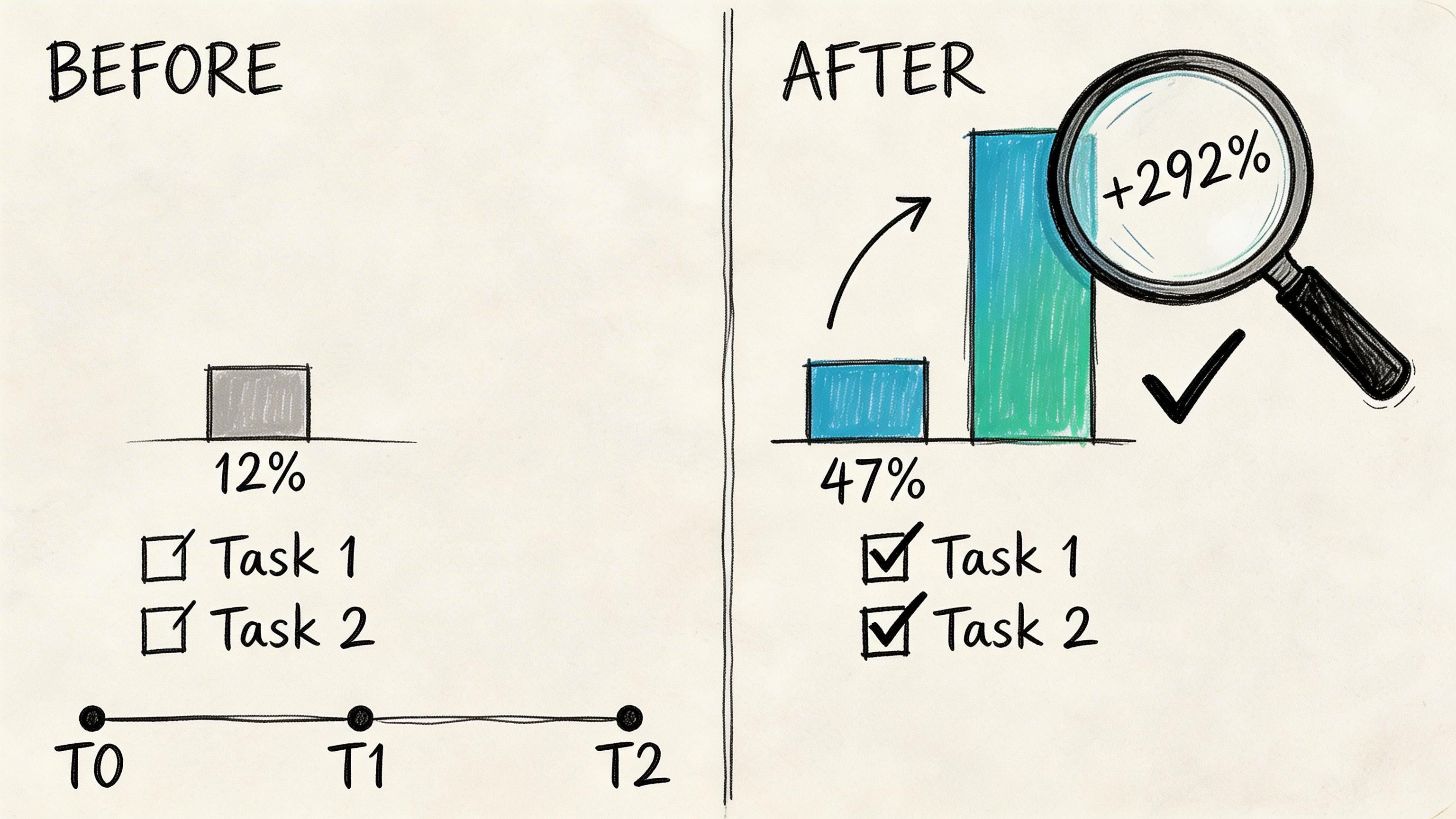
A weak case study email reads like a highlight reel. A strong one explains the judgment behind the work.
That difference matters. Buyers are not only evaluating the outcome. They are evaluating your standards, your process, and whether your approach fits the kind of problems they have.
I’d structure the email like this:
That final piece is what makes this format strategic. You are not filling a content slot. You are building thought leadership through evidence.
Good case study emails create demand because they are useful on their own.
If you helped a founder improve a newsletter, explain the editorial decision that changed the trajectory. Maybe you cut broad educational topics and replaced them with sharper opinion-led emails. Maybe you simplified the send setup by using a real sender name instead of a vague brand label. That kind of operational detail gives the reader something concrete to test, even if they never buy from you.
I also like this format because one project can feed multiple assets. The email becomes the short version. The longer breakdown can become a post, a sales asset, a founder story, or part of your authority content system. If you want to extend the value of each project, study these powerful content repurposing strategies.
If you want a better structure for this format, this guide on how to write business case studies that convert is worth keeping open while you draft.
A strong case study email answers the buyer’s real question. How do you think, what is it like to work with you, and can you apply that same level of judgment to my business? Answer that well and the email does far more than report a win. It strengthens your brand every time you send it.
What happens to your best ideas when they’re scattered across LinkedIn posts, podcast clips, comments, and half-finished notes? They get missed.
That is why I like digest emails. They turn fragmented output into a repeatable editorial product people can rely on. This format is not just a catch-up email. Done well, it becomes a brand-building framework that trains readers to look to you for signal, not noise.
The job of a digest is simple. Collect the sharpest pieces of your thinking, add context, and publish them in a format that respects the reader’s time.
I recommend this format if you publish in multiple places or tend to develop ideas in public before you turn them into a full argument.
A strong digest usually includes four parts:
That last piece is what separates a useful digest from a lazy roundup.
If you only paste links, readers can skip you and get the same information elsewhere. If you add judgment, synthesis, and one fresh idea, the email starts doing bigger work. It strengthens your voice, sharpens your positioning, and gives subscribers a reason to stay close to your thinking.
Good repurposing is editorial judgment.
The same core idea should change shape based on the channel. A social post can be fast and pointed. A podcast segment can wander a bit. The email should be the clearest and most useful version because it lands in the one place your audience still treats like a personal space.
If your workflow is messy, fix it. Start with one weekly theme, publish fragments across channels, then use the digest to pull everything into one coherent argument. If you need a tighter system, study these powerful content repurposing strategies.
Send a digest on a predictable schedule if you want readers to remember your voice.
That consistency matters because habit matters. A digest does more than collect content. It teaches your audience what kind of thinking to expect from you, how often to expect it, and why your perspective is worth opening. That is how a simple roundup becomes part of your personal brand system, not just another item on the content calendar.
If your list never replies, you’re not building a relationship. You’re running a one-way feed.
Q&A emails fix that fast.
Tim Ferriss has used audience questions to shape content for years. Ann Handley-style reader prompts work because they make the audience part of the editorial process. Even occasional founder Q&As can sharpen your positioning because they reveal what people associate with your expertise.
You don’t need a giant list for this.
Ask one simple question at the end of a normal email. What are you stuck on right now? What are you trying to figure out this quarter? What part of your content strategy feels heavy? Then answer one strong question in your next send.
That does three things at once. It gives you relevant material. It tells readers you’re listening. It reveals recurring objections and pain points you can address across your business.
A few Q&A prompts I’d use:
The tone matters here. Don’t answer like a help center article.
Write like you’re replying to a thoughtful person. Use their language. If needed, anonymize identifying details, but keep the question concrete. Then answer directly.
This is also where personalization matters. In 2026, 63% of marketers are using AI in their email campaigns, according to this 2026 email marketing data roundup. I wouldn’t use that as an excuse to automate voice. I’d use AI to organize themes, draft variants, or segment readers by the questions they ask, then keep the final answer human.
Q&A emails often become your best content mine. One reader asks about inconsistent posting. Another asks how to sound more authoritative without sounding fake. Another asks what to send when they have nothing to promote. Those aren’t side questions. They’re editorial gold.
Use them.
People don’t need more options. They need a trusted filter.
That’s why recommendation emails work. When done well, they position you as someone who has tested enough tools, books, and frameworks to save the reader time.
Here’s a visual metaphor that fits this kind of curation email:
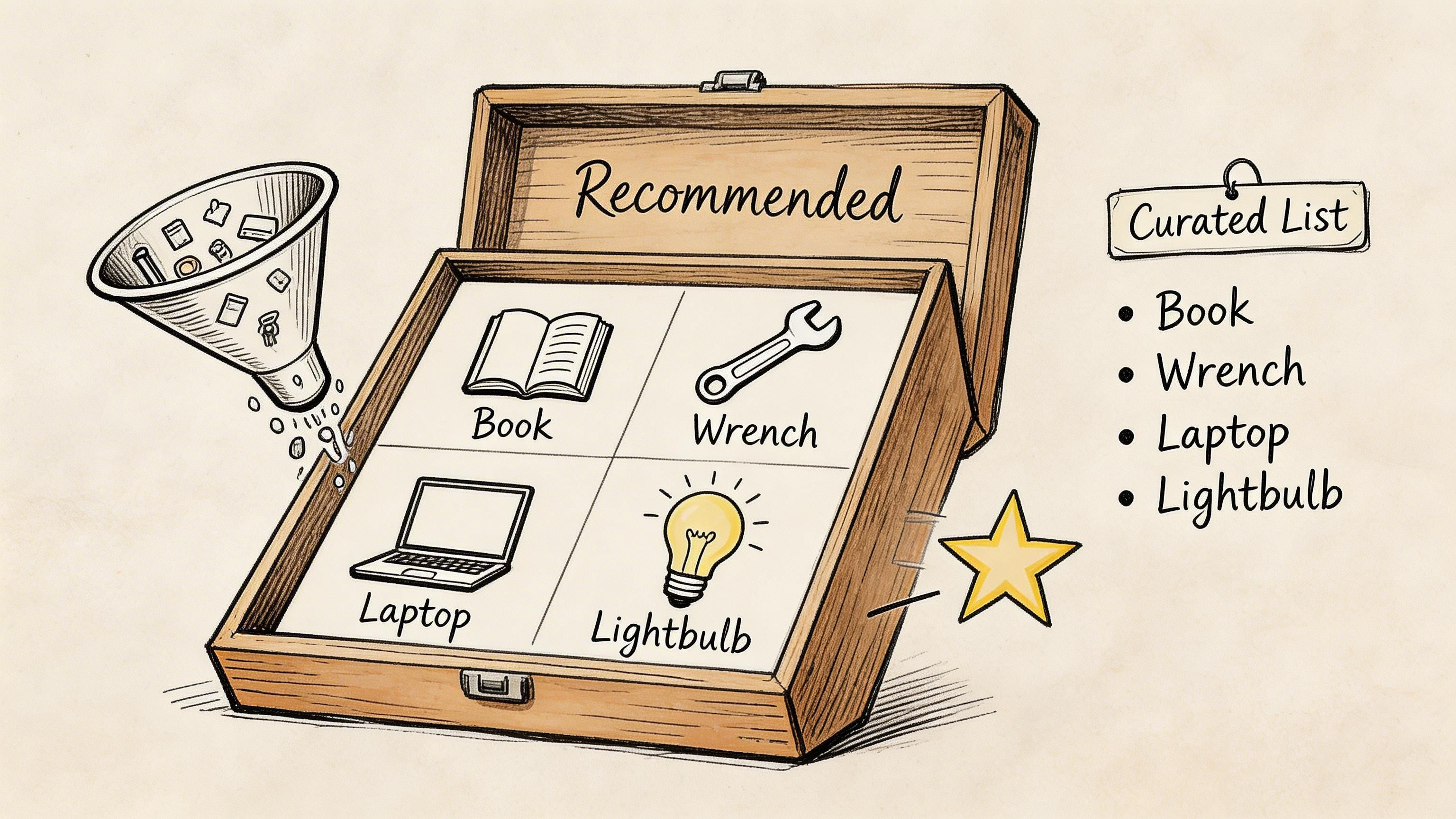
Tim Ferriss built a lot of trust through recommendation-driven content. Naval Ravikant’s reading and tool suggestions carry weight because they reflect a clear worldview. Marc Andreessen-style reading lists work for the same reason. The recommendation itself matters less than the judgment behind it.
Never send a tool email built from research alone.
If you recommend Notion, explain exactly what you use it for. If you recommend Kit, explain why it fits your email workflow. If you recommend a book, tell the reader what decision it changed for you.
That personal context is what separates useful curation from affiliate sludge.
I’d keep these emails focused. One framework. Three tools. Five books for one problem. Don’t dump a giant list and call it value.
Strong recommendation emails segment implicitly.
A founder with no team needs different advice than a marketing lead with an established stack. A creator trying to send one clean weekly email needs something different from a B2B operator building multi-step flows.
Try structuring the email like this:
That format lets readers self-select without needing a complicated quiz.
Be transparent if there’s an affiliate relationship. Include pricing if it helps with decision-making. Most of all, be selective. The point of recommendation emails isn’t to prove how much you know. It’s to reduce noise for the reader.
If your list starts thinking, “If you recommend it, I’ll at least look at it,” you’ve built trust that extends far beyond the inbox.
Why should anyone stay on your list if your emails repeat what they already saw on LinkedIn?
They should not.
If you want email to strengthen your personal brand instead of just echo your public content, give subscribers access to your thinking in its best form or its earliest form. That is what makes this framework work. You are not filling a content slot. You are creating a private layer of trust.
I treat email as the channel for material that would lose its value if posted publicly first. That includes unfinished ideas, sharper analysis, decision-making notes, and early access to what I am building. Public platforms are for reach. Email is for closeness.
A strong subscriber-only email usually does one of four things:
That last point matters more than people admit. If readers can shape what comes next, they stop acting like passive subscribers and start acting like insiders.
Use that deliberately.
Send the draft framework before you publish the final version. Share the argument you are still testing. Ask subscribers which objection you missed. If you are building a serious authority play, study how exclusive distribution fits into a broader thought leadership content creation strategy.
Here is the standard I use. Missing your email should feel like missing something useful, timely, or revealing.
Recurring subscriber-only formats help. A Friday memo with one hard-earned insight. A monthly "before this goes public" note. A private teardown of a trend you will not discuss on social. Consistency turns exclusivity into expectation.
That expectation drives retention. It gives your list a reason to care about your emails as their own product, not as a copy of your public feed.
The strongest personal brands don’t just share information. They define a worldview.
That’s what belief-system emails do.
Seth Godin has spent years reinforcing clear ideas about marketing, status, and resistance. Ryan Holiday consistently ties modern decisions back to Stoic philosophy. Marie Forleo-style manifesto messaging works because readers know where she stands. You don’t need to be polarizing for sport. You need to be legible.
A lot of professionals hide their philosophy because they’re afraid of turning people off.
Good. Some people should be turned off.
If you believe shallow content weakens trust, say that. If you believe most personal branding fails because it copies tone instead of revealing thought, say that. If you believe authority comes from clarity, not volume, say that too.
Your best readers want to know how you think. Your worst-fit prospects need to know they’re not your people.
One underserved angle in this space is authentic personal branding in B2B email. In-box notes that 91% of B2B buyers want personalized content reflecting their challenges, while only 33% of marketers personalize emails effectively in the trend cited within these email marketing ideas. That gap is exactly where belief-led email can stand out. Emails often convey generic professionalism. Very few are sending conviction.
Your beliefs shouldn’t live in one manifesto email and then disappear. They should shape the whole list.
Write emails that explain:
If you want to sharpen this style, use this guide to thought leadership content creation.
A strong belief email doesn’t need to argue every point to death. It needs to make your perspective unmistakable. Once readers understand your philosophy, they stop judging each email in isolation. They start seeing a body of work. That’s how thought partnership forms.
| Email Format | Implementation Complexity 🔄 | Resource Requirements ⚡ | Expected Outcomes ⭐📊 | Ideal Use Cases | Key Advantages 💡 |
|---|---|---|---|---|---|
| Personal Brand Story Arc Emails | High, multi-email narrative, careful sequencing | Moderate–High, writing time, visuals, editing | Strong ⭐📊, deeper trust, higher opens & shareability | CEOs, Founders, Entrepreneurs building thought leadership | Differentiates via authenticity; memorable emotional bonds |
| Insights & Lessons Learned Emails | Medium, ongoing original thought and framing | Moderate, research, examples, occasional data | High ⭐📊, authority, actionable engagement, repeat opens | Leaders, Emerging Entrepreneurs, SaaS Founders | Rapid authority building; highly repurposable content |
| Behind-the-Scenes & Transparency Emails | Medium, real-time documentation, boundary setting | Low–Moderate, capture media, honest narration | Very High ⭐📊, deep trust, parasocial relationships | Founders, Emerging Entrepreneurs, Content Creators | Radical transparency; credibility through process visibility |
| Curated Industry Analysis & Commentary Emails | High, constant monitoring and original synthesis | High, research, data visualization, trend tracking | High ⭐📊, thought leadership; attracts ambitious audience | CEOs, Professionals in Leadership, SaaS Founders | Positions you as curator/strategist; market influence |
| Case Study & Results-Focused Project Emails | Medium–High, permissions, accurate methodology | High, metrics collection, visuals, stakeholder quotes | Very High ⭐📊, strong social proof and demonstrated ROI | Founders, CEOs, Professionals proving outcomes | Hard-to-dispute credibility; produces replicable frameworks |
| Micro-Content Aggregation & Daily Digest Emails | Low–Medium, regular curation and formatting | Low, link curation, short edits, consistent template | Moderate ⭐📊, habit-forming engagement; drives platform traffic | Email Marketers, Content Creators, Network Builders | Low production overhead; keeps audience updated efficiently |
| Question & Answer / Reader Response Emails | Medium, manages submissions and selection fairness | Low–Moderate, community management, curation | High ⭐📊, increases engagement, loyalty, and reply rates | Leaders, Content Creators, Founders fostering community | Audience-driven topics; reduces writer's block; builds belonging |
| Resource, Tool & Framework Recommendation Emails | Low, curated recommendations with context | Moderate, testing, verification, periodic updates | Moderate–High ⭐📊, immediate utility, trust, monetization potential | Entrepreneurs, Leaders, SaaS Founders seeking tooling | Helps decisions; potential affiliate revenue if transparent |
| Exclusive Insights & "Subscriber-Only" Content Emails | Medium, maintain exclusivity & extra value | Moderate–High, premium content creation, access control | Very High ⭐📊, stronger retention, VIP engagement, higher opens | Content Creators, Email Marketers, Network Expanders | Creates scarcity and loyalty; ideal for testing ideas pre-launch |
| Thought Partnership & Belief System Definition Emails | Medium, requires clarity and consistent messaging | Low–Moderate, articulation, examples, manifesto work | High ⭐📊, attracts aligned audience; filters misaligned ones | Founders, Leaders, Content Creators defining position | Strong positioning; builds long-term trust and alignment |
A strong email presence isn’t built by chasing endless newsletter prompts. It’s built by deciding what role your emails play in your brand.
That’s the difference between a list that gets occasional opens and a list that compounds trust. One sends updates. The other creates recognition. Readers begin to understand your standards, your judgment, your voice, and your way of solving problems. That’s when email stops being a marketing task and starts becoming an asset.
I’d treat these 10 frameworks as a working system, not a menu you sample once.
A Personal Brand Story Arc email gives people context for who you are. An Insights & Lessons Learned email shows how you think today. A Behind-the-Scenes email proves there’s substance behind the polished version of your brand. A Case Study email shows your work in action. A Belief System email explains why you make the choices you make. Stack those together over time, and your audience starts to see a coherent person instead of a stream of disconnected content.
That coherence matters because inbox competition is brutal. Subject lines still do an enormous amount of work. In the CodeCrew roundup, 47% of recipients open emails based solely on the subject line, and over 60% of opens occur on mobile, which is why concise subject lines under 70 characters matter in practice when you’re trying to earn the click from a distracted reader on a phone. You can’t afford weak framing. Even your best idea won’t help if the email feels skippable at first glance.
You also can’t afford generic messaging inside the email. Personalization and segmentation keep proving their value. In the same CodeCrew roundup, 80% of professionals report improved performance from personalization tactics, and segmentation is associated there with a 90% boost. That doesn’t mean you need a bloated automation maze. It means your readers should feel like you understand what stage they’re in, what pressure they’re under, and what kind of message they need.
And yes, this channel is still worth the effort. Oberlo notes that 75% of professionals plan to maintain or increase email investment in 2026 in its email marketing statistics roundup. That tells you something important. Serious operators aren’t abandoning email. They’re doubling down on it because direct audience access still matters.
So don’t overcomplicate your next step.
Pick one framework from this list. Draft one email. Make it specific. Make it honest. Make it useful. Then send it before you can over-polish it into something lifeless.
If I were starting today, I wouldn’t ask, “How do I come up with more email marketing content ideas?” I’d ask, “Which of these frameworks helps my audience understand me better?” That question leads to better emails, stronger positioning, and far more durable trust.
Your inbox can become a quiet archive of generic sends no one remembers. Or it can become the place where your reputation gets built, one message at a time.
The choice is in the next draft.
If you want help turning your expertise, stories, and point of view into a consistent email engine, work with Legacy Builder. We help founders, executives, and experts turn scattered ideas into authentic content that builds authority and lasting brand equity.


You could – but most in-house teams struggle with the nuance of growing on specific platforms.
We partner with in-house teams all the time to help them grow on X, LI, and Email.
Consider us the special forces unit you call in to get the job done without anyone knowing (for a fraction of what you would pay).
Short answer – yes.
Long answer – yes because of our process.
We start with an in-depth interview that gives us the opportunity to learn more about you, your stories, and your vision.
We take that and craft your content then we ship it to you. You are then able to give us the final sign-off (and any adjustments to nail it 100%) before we schedule for posting.
No problem.
We have helped clients for years or for just a season.
All the content we create is yours and yours alone.
If you want to take it over or work on transitioning we will help ensure you are set up for success.
We want this to be a living breathing brand. We will give you best practices for posting and make sure you are set up to win – so post away.
Subscribe to our newsletter and get insights on how to grow your personal brand.
