The Top 10 Email Campaign Performance Metrics to Master in 2026

Written by

The Top 10 Email Campaign Performance Metrics to Master in 2026

In the world of personal branding, your email list is your most valuable asset. But sending emails into the void isn't enough. True influence comes from understanding what resonates, what drives action, and what builds a loyal audience. Many founders and professionals get stuck on surface-level numbers like open rates, missing the deeper story their data is telling them. This isn't just about tracking numbers; it's about translating data into strategy.

To build an authentic brand that converts, you need to master the full spectrum of email campaign performance metrics. This guide breaks down the 10 most critical metrics, moving beyond simple definitions to give you the formulas, benchmarks, and actionable strategies needed to turn your email marketing from a guessing game into a predictable growth engine. While B2B contexts have their own specific nuances, the principles of measuring engagement remain universal. To gain a deeper understanding of the various indicators of success, explore this comprehensive ultimate guide to B2B newsletter performance metrics.

This article will show you exactly how to interpret and improve the metrics that matter. You will learn not just what to track, but why it's important and how to use that information to refine your approach. We will cover everything from foundational metrics like click-through and unsubscribe rates to more advanced indicators such as email ROI and list growth rate. Each section provides practical steps to turn insights into measurable improvements for your personal brand or business, ensuring every email you send is a strategic move toward greater impact and tangible results. Let’s dive into the numbers that truly define your success.

1. Open Rate

The open rate is one of the most fundamental email campaign performance metrics, measuring the percentage of recipients who opened your email. It serves as the first gateway to subscriber engagement, directly reflecting the effectiveness of your subject line, the trust you've built through your sender name, and the initial relevance of your message to your audience. For founders and personal brands, a strong open rate signals that your content is cutting through the noise and successfully capturing attention.
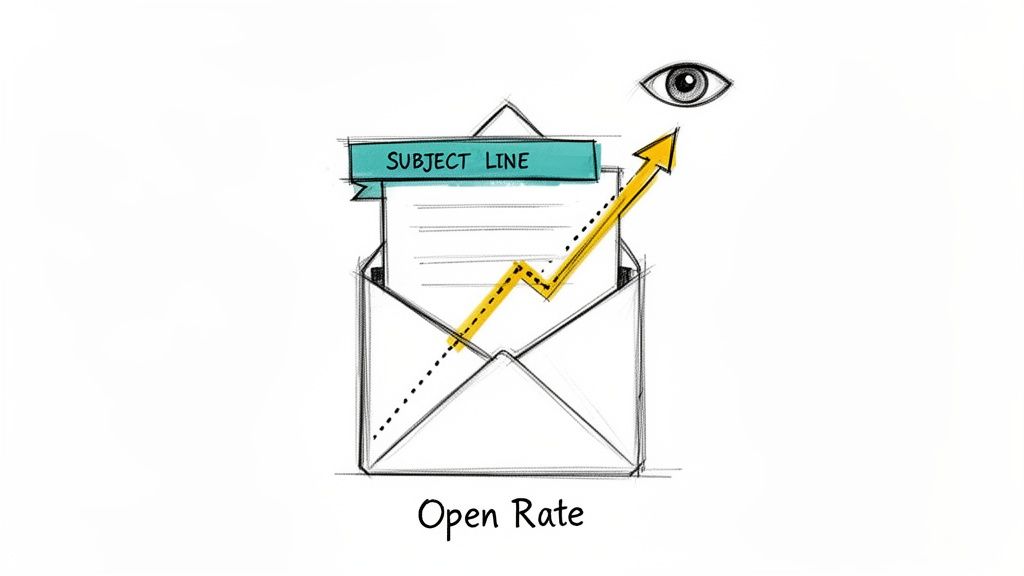
Subject line influences email open rate, with an eye symbolizing viewing an email and an upward trend.

Calculating Open Rate

The formula is straightforward and highlights the relationship between delivery and engagement.

  • Formula: (Number of Unique Opens / Number of Delivered Emails) * 100
  • Example: If you send an email to 1,000 subscribers, 980 are successfully delivered, and 245 people open it, your open rate is (245 / 980) * 100 = 25%.

Key Insight: A low open rate is an immediate red flag. It tells you that your message failed at the first hurdle, regardless of how valuable the content inside might be. Focus on fixing this metric before optimizing others.

Actionable Strategies to Improve Open Rate

Improving your open rate requires a focus on the elements your subscribers see before they ever click.

  • A/B Test Subject Lines: Experiment with different approaches. Test questions ("Ready for a Q3 reset?") against statements ("My 3-step plan for a Q3 reset"). Pit urgency ("Last chance for early access") against curiosity ("This is what they're not telling you").
  • Optimize Sender Name: Use a recognizable personal name (e.g., "Alex from Legacy Builder") instead of a generic company name ("Marketing Dept."). This builds a human connection.
  • Master the Preview Text: This snippet of text follows the subject line in most inboxes. Use it to provide more context and create intrigue that the subject line can't convey alone.
  • Segment and Personalize: A founder sending a weekly newsletter saw their open rate jump from 18% to 28% by adding the subscriber's first name and referencing their industry in the subject line. For more powerful subject line strategies, explore these 10 powerful email subject line examples to help boost your results.

2. Click-Through Rate (CTR)

While open rate shows who is paying attention, the click-through rate (CTR) reveals who is taking action. This metric measures the percentage of email recipients who clicked on one or more links inside your message. For founders and personal brands, a strong CTR is one of the most important email campaign performance metrics because it directly signals that your content is not just interesting, but compelling enough to prompt engagement. It's the bridge between passive consumption and active interest.
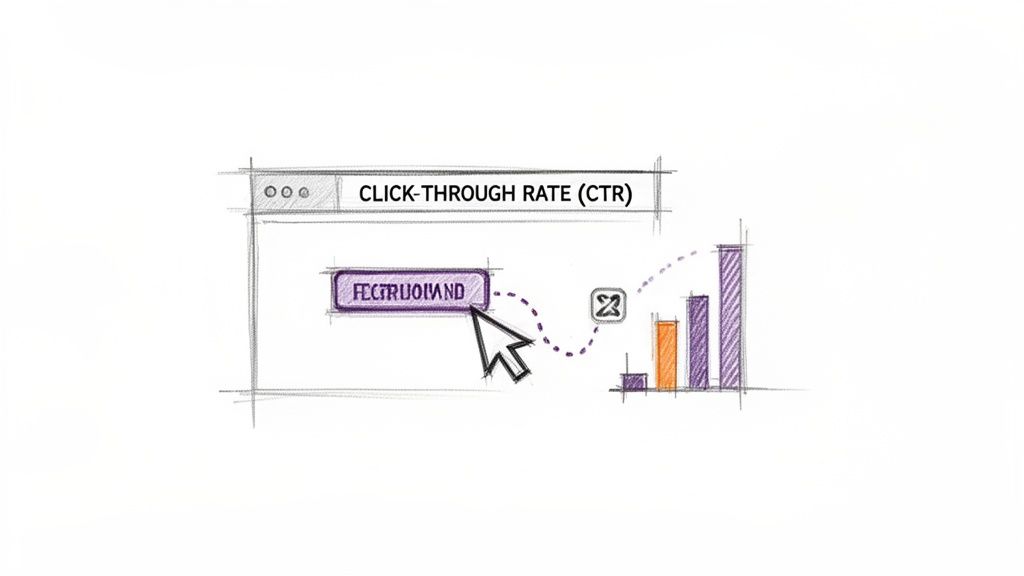
Hand-drawn illustration of click-through rate (CTR) showing a mouse click leading to a rising bar chart.

Calculating Click-Through Rate

The formula pinpoints the effectiveness of your email’s content and calls-to-action (CTAs) relative to the audience that actually received it.

  • Formula: (Total Unique Clicks / Number of Delivered Emails) * 100
  • Example: Using the previous scenario, if 980 emails were delivered and 49 people clicked a link, your CTR is (49 / 980) * 100 = 5%.

Key Insight: A high open rate with a low CTR indicates a disconnect. Your subject line made a promise that the email body didn't fulfill, or your call-to-action was unclear, unappealing, or buried. This metric tells you if your message truly resonates.

Actionable Strategies to Improve CTR

Improving your CTR is about optimizing the content inside your email to guide subscribers toward a specific action.

  • Place the Primary CTA Above the Fold: Your main call-to-action should be visible without any scrolling. This respects your reader's time and captures immediate interest.
  • Use Clear, Contrasting Buttons: Make your CTA buttons stand out from the rest of the email with a bold, contrasting color. The text should be action-oriented (e.g., "Get the Framework" vs. "Learn More").
  • Limit Your Asks: Avoid decision paralysis by focusing on 1-3 clear CTAs. A founder's newsletter with a single, clear CTA to their personal website can achieve a high 6% CTR, while a campaign with too many choices might see a lower 2.8% CTR.
  • Ensure Link Relevancy: The destination of your link must match the expectation set by the link text or button. A mismatch erodes trust and discourages future clicks.
  • Test CTA Formats and Placement: Experiment with different formats. Test a prominent button against a simple text link or a clickable image to see what your specific audience responds to best.

3. Conversion Rate

While open and click-through rates measure interest, the conversion rate measures action. This is one of the most commercially significant email campaign performance metrics, calculating the percentage of recipients who completed a specific, desired action after clicking through your email. For founders and personal brands, this metric directly connects email marketing efforts to tangible business outcomes like revenue, leads, and customer acquisition. A high conversion rate proves your message is not just engaging but also persuasive.
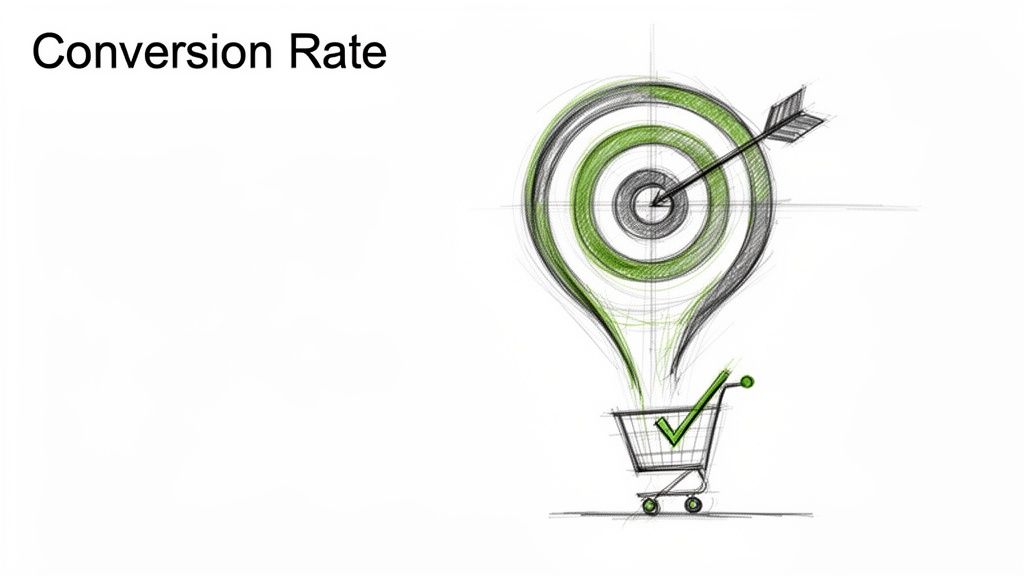
A sketch illustration showing a target hit by an arrow, leading to a shopping cart with a green checkmark, alongside the text 'Conversion Rate'.

Calculating Conversion Rate

The formula ties your email recipients directly to a valuable business goal.

  • Formula: (Number of Conversions / Number of Delivered Emails) * 100
  • Example: You send a product launch email to 5,000 subscribers, all of which are delivered. After clicking the link in the email, 125 people make a purchase. Your conversion rate is (125 / 5,000) * 100 = 2.5%.

Key Insight: The conversion rate is the ultimate test of your campaign's effectiveness. It answers the question, "Did our email drive the action we wanted?" A low conversion rate, even with high clicks, indicates a disconnect between your email promise and your landing page experience.

Actionable Strategies to Improve Conversion Rate

Boosting conversions requires a seamless journey from the inbox to the final action.

  • Define a Clear Goal: Before you hit send, know exactly what a "conversion" is for that specific campaign. Is it a purchase? A free trial signup? A consultation booking? Every element of the email should support this single goal.
  • Use UTM Parameters: Track conversions accurately by tagging your email links with UTM parameters (e.g., utm_source=email, utm_medium=newsletter, utm_campaign=q3-launch). This tells your analytics software exactly where the conversion came from.
  • Align Email and Landing Page: The message, tone, and offer in your email must match the landing page perfectly. If your email promises a "50% off discount," that discount should be the first thing a user sees on the page they land on.
  • Segment for Stronger CTAs: Tailor your calls-to-action (CTAs) based on subscriber behavior. A SaaS founder could send one email to engaged free users with a CTA to "Upgrade Now" and another to less active users with a CTA to "Watch a Demo," driving conversions from both segments.

4. Unsubscribe Rate

While it can feel disheartening, the unsubscribe rate is a critical email campaign performance metric that measures the percentage of recipients who opted out of your list. It's a direct signal of audience satisfaction, relevance, and list health. For founders and personal brands, a low unsubscribe rate validates that your content consistently meets audience expectations and maintains genuine interest. It’s an honest, unfiltered piece of feedback on your value proposition.

Calculating Unsubscribe Rate

The formula is a direct measure of audience churn against your delivered emails.

  • Formula: (Number of Unsubscribes / Number of Delivered Emails) * 100
  • Example: If you send an email that is delivered to 9,800 subscribers and 25 of them unsubscribe, your unsubscribe rate is (25 / 9,800) * 100 ≈ 0.25%.

Key Insight: Unsubscribes are not always a failure. They represent a natural form of list hygiene, removing disengaged contacts who would otherwise hurt your open and click-through rates. A sudden spike, however, is a clear warning sign that your content strategy or send frequency is misaligned with audience expectations.

Actionable Strategies to Manage Unsubscribe Rate

Managing your unsubscribe rate is about retaining the right subscribers, not just preventing all unsubscribes.

  • Review Unsubscribe Feedback: Many email service providers allow you to ask for a reason upon unsubscribe. Analyze this data for patterns. Are people leaving because of frequency, content irrelevance, or something else? Use this direct feedback to improve.
  • Offer a Preference Center: Instead of a single "unsubscribe" link, offer a "manage preferences" option. This allows subscribers to reduce email frequency (e.g., from weekly to monthly) or opt out of specific topics, keeping them on your list.
  • Segment for Relevance: A founder who saw their unsubscribe rate spike to 1.2% after increasing email frequency could segment their list. They could send daily emails to a "high-engagement" segment and weekly summaries to everyone else, reducing churn.
  • Set Clear Expectations: From the moment someone signs up, be clear about what content you'll send and how often. A mismatch between expectations and reality is a primary driver of unsubscribes.

5. Bounce Rate

Bounce rate is one of the most critical email campaign performance metrics for list health and sender reputation. It measures the percentage of your sent emails that were not successfully delivered to a recipient's inbox. This metric directly reflects the quality and hygiene of your email list. For founders and personal brands, a low bounce rate is a strong indicator of a healthy, engaged audience and helps ensure your messages actually reach their intended destination.

Calculating Bounce Rate

The formula for bounce rate is simple, highlighting the gap between what you sent and what couldn't be delivered.

  • Formula: (Total Number of Bounced Emails / Number of Emails Sent) * 100
  • Example: If you send a campaign to 5,000 subscribers and 150 emails bounce, your bounce rate is (150 / 5,000) * 100 = 3%.

Key Insight: Bounces are split into two types. Hard bounces are permanent failures (invalid email address), while soft bounces are temporary (full inbox, server down). High hard bounce rates are especially damaging to your sender reputation with providers like Gmail and Outlook.

Actionable Strategies to Improve Bounce Rate

Lowering your bounce rate is about proactive list management and maintaining high-quality data.

  • Use Double Opt-In: When a new subscriber signs up, send a confirmation email they must click to be added to your list. This verifies the address is valid and owned by a real person, drastically reducing initial bounces.
  • Implement Regular List Cleaning: At least quarterly, remove subscribers who haven't engaged in months and scrub hard bounces immediately after every campaign. A professional network that validates its list quarterly maintains a bounce rate below 1.5%.
  • Use an Email Validation Service: Before sending a major campaign to a new or old list segment, run it through a validation tool like ZeroBounce or BriteVerify. This preemptively identifies and removes invalid addresses.
  • Monitor Bounce Reports: After each send, check your report to identify the cause of bounces. A sudden spike in soft bounces could signal that your own sending authentication (SPF, DKIM) has an issue, making you look like a spammer to receiving servers.

6. List Growth Rate

While most metrics focus on a single campaign's performance, the list growth rate measures the long-term health and sustainability of your entire email marketing program. It calculates the net increase in your audience over time, showing whether your brand is attracting new followers faster than it's losing them. For founders and personal brands, a steady list growth rate is direct validation that your content and message are resonating enough to turn casual observers into engaged subscribers.

Calculating List Growth Rate

This formula provides a clear picture of your audience's expansion, factoring in both new additions and natural attrition.

  • Formula: ([(Number of New Subscribers - Number of Unsubscribes) / Total List Size] * 100)
  • Example: If you start the month with 5,000 subscribers, gain 300 new ones, and lose 50 to unsubscribes, your monthly growth rate is ([(300 - 50) / 5,000] * 100) = 5%.

Key Insight: A stagnant or negative list growth rate is a serious warning sign. It suggests your audience acquisition channels have dried up or your content is no longer valuable enough to retain subscribers, threatening the future viability of your email efforts.

Actionable Strategies to Improve List Growth Rate

Improving your list growth rate involves creating compelling reasons for people to join your community and making it easy for them to do so.

  • Create High-Value Lead Magnets: Offer exclusive guides, templates, or checklists that solve a specific problem for your target audience. A CEO, for instance, could achieve 3.8% monthly growth by offering gated thought leadership content.
  • Embed Signup Forms Everywhere: Don't make people search for your signup form. Add it to your LinkedIn profile, website footer, blog posts, and social media bios.
  • Encourage Referrals: Ask your most engaged subscribers to share your newsletter with friends or colleagues who would find it valuable. A simple referral program can lead to steady, organic growth.
  • Partner with Complementary Creators: Collaborate on a webinar or content swap with another founder whose audience overlaps with yours. This cross-promotion introduces your brand to a new, relevant group of potential subscribers. For a deeper dive into audience building, explore these 10 proven email list building strategies for 2026 to accelerate your results.

7. Engagement Rate

While metrics like open rate and click-through rate measure single actions, the engagement rate offers a more complete picture of your campaign's health. It's a composite metric that bundles opens, clicks, forwards, and even replies to measure the total percentage of recipients who actively interacted with your email. For founders and personal brands, a high engagement rate confirms that your content is not just being seen, but is truly resonating and building a strong connection with your audience.

Calculating Engagement Rate

The calculation combines multiple forms of interaction to provide a holistic score of subscriber interest.

  • Formula: (Total Unique Engagements [Opens + Clicks + Forwards + Replies] / Number of Delivered Emails) * 100
  • Example: You send an email to 5,000 subscribers, and it’s delivered to 4,950. You get 1,500 opens, 400 clicks, 50 forwards, and 25 replies. Your total unique engaged users would be counted (avoiding double-counting someone who opened and clicked). If this number is 1,732, your engagement rate is (1,732 / 4,950) * 100 = 35%.

Key Insight: Engagement rate is one of the most honest email campaign performance metrics. It prevents you from being misled by a high open rate with low clicks, revealing whether your entire message-from subject line to call to action-is working in harmony.

Actionable Strategies to Improve Engagement Rate

Boosting overall engagement requires a focus on creating value and inviting interaction.

  • Vary Your Content Formats: Don't get stuck in a rut. Alternate between personal stories, practical tip-based lists, interviews with experts, and Q&A sessions to keep your content fresh and interesting.
  • Ask Questions to Encourage Replies: End your emails with a direct question that invites your audience to hit "reply." This simple act makes your email a two-way conversation, not a one-way broadcast. A leadership coach saw her engagement rate hit 45% simply by using a more conversational tone and asking for reader feedback.
  • Create Genuinely Shareable Content: Before you hit send, ask yourself: "Is this so valuable that someone would forward it to a friend or colleague?" Focus on creating content that provides unique insights, solves a specific problem, or tells a compelling story.
  • Segment Based on Past Engagement: Reward your most active subscribers with exclusive content or early access. For those whose engagement has dropped, send a targeted re-engagement campaign. To get started, you can explore proven methods for how to segment email lists for higher engagement and better results.

8. Email ROI (Return on Investment)

Email ROI is the ultimate business-focused metric, measuring the total revenue generated from your email campaigns in relation to their cost. While metrics like opens and clicks gauge engagement, ROI directly answers the question: "Is my email marketing profitable?" For founders and personal brands, a strong Email ROI provides undeniable proof that building an audience and nurturing relationships translates directly to financial returns, making it one of the most critical email campaign performance metrics to track.

Calculating Email ROI

The formula connects your marketing spend directly to the revenue it produces, providing a clear picture of profitability.

  • Formula: ((Total Revenue from Email - Total Email Marketing Costs) / Total Email Marketing Costs) * 100
  • Example: A consultant invests $3,500 in their email marketing efforts (software, design, copy) over a quarter. This generates $120,000 in new client contracts directly attributable to those campaigns. Their ROI is (($120,000 - $3,500) / $3,500) * 100 = 3,328%, or a 33:1 return.

Key Insight: ROI contextualizes all other metrics. A campaign with a low open rate might still have a fantastic ROI if it reaches a small, high-intent segment that converts. It’s the metric that speaks loudest to stakeholders and justifies budget allocation.

Actionable Strategies to Improve Email ROI

Boosting your ROI involves both increasing revenue and managing costs, with a sharp focus on tracking and attribution.

  • Implement Robust Tracking: Use UTM parameters in your email links to track user journeys in your analytics platform. For e-commerce, create unique discount codes for specific campaigns to directly attribute sales.
  • Account for All Costs: To get an accurate ROI, include all associated expenses: email service provider (ESP) fees, a portion of salaries for staff involved, freelance costs for design or copywriting, and any stock imagery or template purchases.
  • Focus on Subscriber Lifetime Value: Instead of just looking at the return from a single purchase, consider the long-term value of a subscriber. To truly gauge the financial return of your email campaigns, it's essential to analyze metrics like the LTV CAC ratio for email campaigns. This helps you understand the sustainable profitability of your list.
  • Calculate ROI by Segment: Analyze the ROI for different audience segments. You may find that a small group of loyal customers generates 80% of your email revenue, allowing you to focus your efforts more effectively.

9. Deliverability Rate

Deliverability rate is arguably the most foundational of all email campaign performance metrics. It measures the percentage of your emails that successfully reached a recipient's server, not just their inbox. This metric is the bedrock upon which all others are built; if your emails don't get delivered, they can't be opened, clicked, or converted. For founders and personal brands, a high deliverability rate is a direct reflection of a healthy sender reputation and a clean, engaged list.

Calculating Deliverability Rate

This calculation shows how many of your sent emails actually made it to an inbox server.

  • Formula: ((Number of Emails Sent - Number of Bounces) / Number of Emails Sent) * 100
  • Example: You send a campaign to 5,000 subscribers and 150 of those emails bounce. Your deliverability rate is ((5,000 - 150) / 5,000) * 100 = 97%.

Key Insight: Deliverability is not the same as inbox placement. An email can be "delivered" to a server but get filtered into the spam folder. High deliverability is the first step, while inbox placement is the ultimate goal. Poor deliverability signals serious technical or reputation issues.

Actionable Strategies to Improve Deliverability Rate

Improving your deliverability requires a focus on both technical setup and list management.

  • Implement Email Authentication: Set up SPF, DKIM, and DMARC for your sending domain. These protocols prove to inbox providers that you are a legitimate sender, not a spoofer. A service provider improved their rate from 92% to 97% just by correcting their authentication records.
  • Maintain List Hygiene: Regularly remove hard bounces, soft bounces, and unengaged subscribers from your list. Sending to inactive addresses hurts your sender reputation.
  • Warm Up Your IP Address: If you are using a new sending IP, don't send to your entire list at once. Start with your most engaged segments and gradually increase volume over several weeks to build a positive sending history.
  • Monitor Your Reputation: Use tools to check if your sending domain or IP is on any blacklists. Also, monitor feedback loops provided by ISPs to see how many recipients are marking your emails as spam.

10. Email Sharing/Forward Rate

The email sharing or forward rate is a powerful metric that tracks the percentage of recipients who forwarded your email to someone else. It's a direct measure of audience endorsement and a key indicator of your content's inherent value. When a subscriber shares your email, they are putting their own reputation on the line to recommend your message, making this one of the most meaningful engagement signals for founders and personal brands.

Calculating Email Sharing/Forward Rate

This calculation reveals how well your content inspires word-of-mouth marketing.

  • Formula: (Number of Shares or Forwards / Number of Delivered Emails) * 100
  • Example: You send a newsletter to 5,000 subscribers and it's successfully delivered. Your email service provider tracks 140 forwards. Your sharing rate is (140 / 5,000) * 100 = 2.8%.

Key Insight: Unlike clicks or opens, a share is an active act of advocacy. A high share rate proves your content is not just consumed but is seen as a valuable asset worth spreading, a concept popularized by thought leaders like Seth Godin.

Actionable Strategies to Improve Sharing/Forward Rate

To increase shares, you must create content that people feel compelled to pass along.

  • Create Provocative or Highly Valuable Content: A CEO sharing a controversial take on a business trend might see a 5.1% forward rate because it sparks debate. Likewise, a career coach's email detailing a proven framework to ask for a raise is inherently useful and shareable.
  • Make Sharing Obvious: Don't assume people will find the forward button. Include a clear, well-placed "Forward to a friend" or "Share with your network" link directly within your email body.
  • Include a Direct Ask: Sometimes the simplest solution is the most effective. End your email with a clear call-to-action: "If you found this valuable, please share it with a colleague who could benefit."
  • Feature Share-Worthy Stories: Customer success stories, compelling case studies, or unique industry insights provide social proof and are often forwarded to teams and decision-makers. Explore these 7 email marketing examples from top personal brands to see how they create content that encourages sharing.

Top 10 Email Metrics Comparison

Metric🔄 Implementation complexity⚡ Resource requirements📊 Expected outcomes💡 Ideal use cases⭐ Key advantages
Open RateLow 🔄: pixel tracking + subject-line testsLow ⚡: email platform + basic analyticsShows subject-line resonance and initial engagementSubject-line optimization, send-time testing, personal-brand reachEasy to measure; fast feedback for A/B tests ⭐
Click-Through Rate (CTR)Medium 🔄: link tracking & CTA experimentsMedium ⚡: CTA design, link tracking, analyticsIndicates active interest and intent to actDriving traffic, resource downloads, CTA performance testingBetter signal of engagement than opens; ties to action ⭐⭐
Conversion RateHigh 🔄: attribution, UTMs, landing-page alignmentHigh ⚡: analytics, CRO, landing pages, attribution toolsMeasures completed goals (sales, signups); direct business impactPurchase funnels, signups, trial conversions, bookingsDirectly correlates with revenue and ROI ⭐⭐⭐
Unsubscribe RateLow 🔄: standard unsubscribe trackingLow ⚡: list management, feedback captureSignals dissatisfaction, fatigue, or misalignmentMonitoring list health, frequency/content adjustmentsEarly warning for content issues; protects reputation ⭐
Bounce RateMedium 🔄: distinguish hard/soft bounces and remediationMedium ⚡: validation tools, list cleaning, auth setupReveals data quality and deliverability riskOnboarding verification, regular list hygiene, deliverability auditsIdentifies invalid addresses; preserves deliverability ⭐
List Growth RateMedium 🔄: track sources, net subscriber mathMedium ⚡: lead magnets, promotions, trackingShows audience expansion and sustainabilityAudience building, lead-gen campaigns, launch growth trackingValidates demand and long-term reach growth ⭐
Engagement RateHigh 🔄: aggregate opens/clicks/replies/forwardsHigh ⚡: multi-metric analytics, segmentationHolistic indicator of list health and conversion likelihoodRelationship-building, deliverability optimization, content resonanceComprehensive view of audience connection; strong predictor ⭐⭐
Email ROI (Return on Investment)High 🔄: revenue attribution and cost accountingHigh ⚡: CRM, finance tracking, UTM attributionQuantifies profitability and justifies spendBudget allocation, stakeholder reporting, channel comparisonDemonstrates financial impact; prioritizes investment decisions ⭐⭐⭐
Deliverability RateHigh 🔄: SPF/DKIM/DMARC, IP/domain reputation managementHigh ⚡: auth implementation, monitoring, warmup, hygieneEnsures inbox placement; foundational for all other metricsNew domain warmup, deliverability troubleshooting, pre-send checksCritical foundation for reach; impacts all downstream metrics ⭐⭐⭐
Email Sharing / Forward RateMedium 🔄: tracking is inconsistent across providersMedium ⚡: high-quality content, share CTAs, social buttonsIndicates advocacy, organic reach, and social proofViral content, referral growth, newsletter advocacy programsDrives organic referrals and credibility; signals high-value content ⭐⭐

From Data to Legacy: Building a Brand That Resonates

Throughout this detailed guide, we've dissected the ten fundamental email campaign performance metrics that every founder, creator, and leader must master. We moved beyond surface-level definitions, providing formulas for calculation, industry benchmarks for context, and, most importantly, actionable strategies for improvement. The journey from a simple Open Rate to a sophisticated Email ROI calculation is not merely an academic exercise; it is the blueprint for building a resilient, responsive, and profitable brand.

You now have a framework for understanding not just what your audience is doing, but why. A high Click-Through Rate paired with a low Conversion Rate isn't a failure; it's a specific signal that your message is compelling but your offer is misaligned. Similarly, a rising Unsubscribe Rate after a sales campaign isn't just attrition; it's direct feedback on your messaging frequency and value proposition. Each metric, from Deliverability to Engagement Rate, tells a piece of your brand's story.

Weaving Metrics into Your Brand Narrative

The true power of this data emerges when you stop viewing these metrics in isolation. A successful email strategy is a balanced ecosystem where each component influences the others.

  • The Engagement Loop: A high Engagement Rate and strong Click-Through Rate directly influence your Deliverability Rate. Mailbox providers see that people want your emails and are less likely to flag them as spam.
  • The Value Exchange: A healthy List Growth Rate combined with a low Unsubscribe Rate demonstrates you are consistently attracting the right people and delivering on your promises. This is the foundation of community.
  • The Profitability Engine: The ultimate goal is a positive Email ROI. This is the direct result of optimizing your Conversion Rate while maintaining a healthy, engaged list. Every other metric serves this final, business-critical outcome.

Think of it this way: your email list isn't a static asset. It’s a living focus group that provides constant, quantifiable feedback on your brand's direction, voice, and value. The numbers are the language they use to communicate with you. Learning to interpret this language is the most critical skill for any personal brand or founder-led business.

Your Actionable Path Forward

To translate this knowledge into tangible results, your next steps should be clear and methodical. Don't try to fix everything at once. Instead, adopt a diagnostic approach.

  1. Establish Your Baseline: Before you can improve, you must know where you stand. Go back through your last 3-5 campaigns and calculate all ten metrics. Create a simple dashboard in a spreadsheet to track them.
  2. Identify Your Biggest Opportunity: Where is the most significant gap between your performance and industry benchmarks? Is your Open Rate lagging? Is your Conversion Rate near zero? Pick the one metric that, if improved, would have the largest positive impact on your goals.
  3. Implement One Strategic Change: Based on the article's advice for that specific metric, implement one targeted change. If you're tackling Open Rates, focus entirely on crafting five different subject lines for your next A/B test. If you're focused on conversions, redesign your landing page CTA.
  4. Measure, Analyze, Repeat: After your next campaign, measure the impact of your change. Did the metric improve? Why or why not? This iterative cycle of hypothesis, action, and analysis is the engine of sustained growth.

Mastering these email campaign performance metrics is about more than just sending better emails. It's about listening more closely, understanding more deeply, and serving your audience more effectively. It’s how you transform a simple mailing list into a powerful community and a personal brand into a lasting legacy.


Are you ready to turn these numbers into a narrative that builds your brand? The expert strategists at Legacy Builder specialize in helping founders and creators translate complex email campaign performance metrics into actionable growth plans. We help you find the story in the data so your authentic voice can build the community you deserve.

Discover how Legacy Builder can amplify your impact.

Logo

We’re ready to turn you into an authority today. Are you?

Became a Leader

Common Questions

Why shouldn’t I just hire an in-house team?

You could – but most in-house teams struggle with the nuance of growing on specific platforms.


We partner with in-house teams all the time to help them grow on X, LI, and Email.

Consider us the special forces unit you call in to get the job done without anyone knowing (for a fraction of what you would pay).

Can you really match my voice?

Short answer – yes.

Long answer – yes because of our process.

We start with an in-depth interview that gives us the opportunity to learn more about you, your stories, and your vision.

We take that and craft your content then we ship it to you. You are then able to give us the final sign-off (and any adjustments to nail it 100%) before we schedule for posting.

What if I eventually want to take it over?

No problem.

We have helped clients for years or for just a season.

All the content we create is yours and yours alone.

If you want to take it over or work on transitioning we will help ensure you are set up for success.


What if I want to post myself (on top of what Legacy Builder does)?

We want this to be a living breathing brand. We will give you best practices for posting and make sure you are set up to win – so post away.