.svg)
Subscribe to our newsletter and get insights on how to grow your personal brand.
Thank you! Your submission has been received!
Oops! Something went wrong while submitting the form.
.svg)


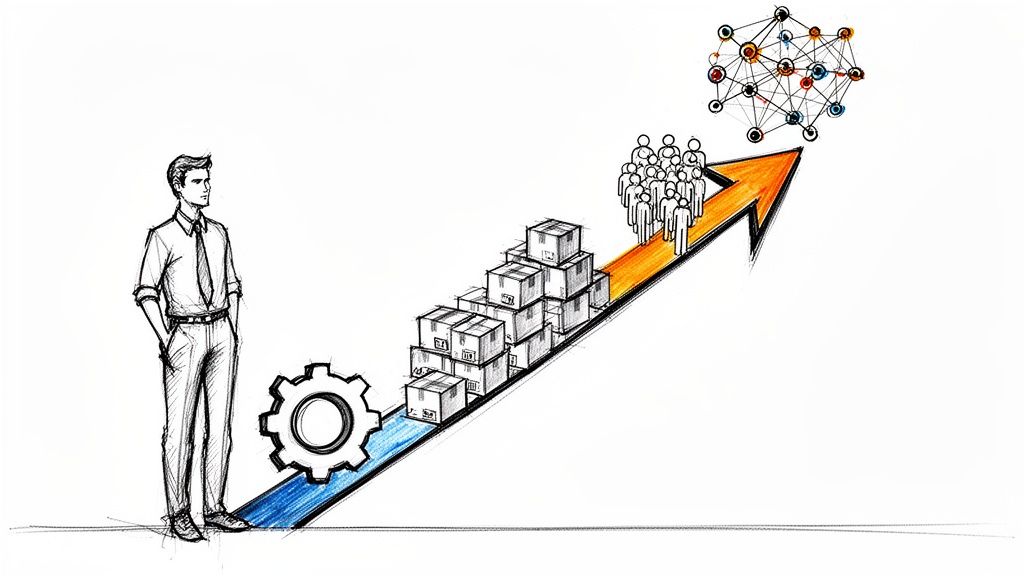
If you want to scale your service business, you have to stop trading your time for money. Period.
The only way out is to shift from a one-to-one delivery model to a one-to-many system. This means turning your core service into a standardized, repeatable package with a fixed scope and a clear price tag. It's the first real step to shattering the income ceiling that keeps so many founders stuck.
The classic service model—where every single project is a custom job—is the biggest thing holding you back. Sure, bespoke work can fetch a high price, but it’s forever chained to the number of hours you have in a day.
Every new client means a new proposal, a new strategy, and your direct involvement. You end up on a hamster wheel of custom work that you can never get off of. Real scale only happens when you decide to break that model for good.
The goal is to stop selling your time and start selling a solution. That mental shift is everything. You're no longer just a consultant for hire; you're the creator of a proven system that delivers a specific, valuable outcome.
Take a hard look at your past client work. Where did you create the most value? What problems are you solving over and over again? The answer to that question is your scalable service, hiding in plain sight.
For example, a marketing consultant who keeps building "custom content strategies" can package that expertise into something like a "90-Day Content Accelerator."
This new offer would have clearly defined deliverables, like:
See the difference? This isn’t just about being more efficient. It immediately positions you as an expert with a signature method. It also makes your sales process a thousand times easier because the value is crystal clear to the client.
Building this kind of authority is crucial for attracting high-value clients, who would much rather buy a proven system than another custom project.
"The moment you productize your service, you stop being a freelancer and start being a business owner. You're no longer selling hours; you're selling a predictable result, and that is infinitely more scalable."
To really understand this shift, let's break down the "before" and "after" of moving from a bespoke to a productized model.
This table lays it all out. On the left, you have a demanding job. On the right, you have a scalable business asset.
This isn't just a random idea; it's a massive market trend. The "Everything-as-a-Service" (XaaS) market is set to explode from around $700 billion to over $3.22 trillion by 2030.
This trend shows that buyers are getting more and more comfortable with subscription-style, standardized services that deliver consistent value. When you package your expertise into a product, you’re tapping directly into that powerful shift in buyer behavior.
Ultimately, moving from one-to-one to one-to-many is about building a business that can grow without you being the bottleneck. It’s the foundation that makes everything else—hiring, marketing automation, and building systems—actually possible.
Without a scalable offer, you’re not building a business. You’re just building yourself a more demanding job.
Okay, so you’ve got a killer, productized offer. Nice. Now the real work begins. Your focus has to shift from inventing cool stuff for each client to replicating amazing results, over and over again.
The challenge is no longer what you do, but how you can deliver that same incredible outcome every single time—without you having to be in the weeds on every task. This is where you build the operational backbone of your business.
Right now, your expertise, your gut feelings, and your unique way of doing things are your biggest asset. But they're also your biggest bottleneck. To truly scale, you have to pull that genius out of your head and forge it into a documented, trainable system.
That's what building a delivery playbook is all about.
Think of it as a comprehensive set of documents—Standard Operating Procedures (SOPs), checklists, and templates—that maps out every single step of how you deliver your service. It covers the entire client journey, from the moment they sign the contract to the final handoff.
This is how you move from being a bespoke freelancer to a scalable business owner.

The journey is clear: you start with custom work, move to a repeatable productized system, and then you’re finally ready for massive growth.
First things first, map out a typical client project from a 30,000-foot view. What are the big milestones? This could be something like client onboarding, discovery and strategy, the execution phase, reviews and feedback, and finally, project completion.
Once you have that skeleton, start filling in the details for each phase. And I mean all the details. Don't skip the small stuff. Documenting tasks that seem obvious is critical, because what's second nature to you is completely new to a future team member.
The goal? Your documentation should be so clear that any competent person could follow it and get the job done to an 80% perfect standard without ever having to ask you a question.
For a content marketing agency, an onboarding SOP might look like this:
This level of detail eliminates guesswork and ensures every client gets that same polished, professional experience from day one.
While SOPs explain how to do something, checklists make sure it gets done right, every time. Turn your documented processes into simple, actionable checklists for all your recurring tasks. A project kickoff checklist, a quality assurance checklist, or a client offboarding checklist ensures no critical step is ever missed.
Templates are your other secret weapon for getting things done efficiently. Create them for everything you possibly can:
This isn't optional. Building these systems is non-negotiable. At the end of the day, successfully scaling with systems is what allows for sustainable growth without you being the one to manually do all the work.
These resources do more than just save you time—they become the core of your training materials for new hires. By documenting all of this, you’re creating a tangible company asset. If you're serious about building a truly valuable business, you need to understand how this playbook contributes to your overall digital asset portfolio.
Your delivery playbook is what transforms your business from something that depends on you into a self-sustaining operation that can actually grow. It’s how you clone your best work without having to clone yourself.
Once you've nailed down your productized offer and mapped out your delivery playbook, it's time to get your tech right. Let's be honest: manual processes are the single greatest enemy of scale.
Every minute you or your team spends on repetitive admin work is a minute you're not spending on billable tasks or thinking about growth. Building a smart tech stack isn't about collecting shiny new software. It’s about creating a system that automates the boring stuff, keeps your workflows smooth, and makes the whole experience seamless for both your team and your clients.
The right tech is a force multiplier for the systems you’ve already designed.
For most service businesses I've seen, a truly scalable tech stack rests on three pillars. These tools are the operational hub that connects your clients, your team, and your processes. Get this foundation right, and everything else gets easier.
Here's the secret, though: integration. Your CRM needs to talk to your project management tool, which should plug into your client portal. That seamless flow of information is what crushes the friction that holds businesses back.
The real magic happens when you start automating. The goal is simple: identify every repetitive, low-value task in your day and find a tool to do it for you. This frees up your team’s brainpower for the creative, high-touch work that clients actually pay for.
Think about your client onboarding. Manually, you're sending welcome emails, creating folders, scheduling kickoff calls, and nagging people with reminders. It can take hours and it's so easy to drop the ball.
An automated workflow is a completely different world:
Here’s a simple way to visualize how your CRM becomes the brain of your operations.

When your systems are connected like this, you create an engine that drives efficiency and consistency across the board.
This isn't just about saving time—it's a direct investment in your profit margins. Every task you automate lowers your cost to serve a client, letting you take on more work without having to hire more people.
The business software market is blowing up. Global revenue hit around $658.4 billion in 2024 and is expected to keep climbing. That kind of money tells you one thing: tech is no longer optional for scaling. You can read more about the growth of business software platforms and see how the top firms are using it to pull away from the pack.
When you’re picking your tools, always start with the problem you're trying to solve. Don't grab a tool just because it’s popular; choose it because it fixes a real bottleneck in your delivery process. If you’re thoughtful about this, you’ll build a tech stack that makes your business not just more efficient, but truly built to scale.

Let's be real: you can't do this alone.
At some point, you'll have brilliant systems and a perfectly tuned tech stack, but you'll still be the one pulling all the levers. This is the final bottleneck. Breaking through it means learning to trust other people to execute the vision you've so carefully built.
Here’s where most founders get it wrong. Hiring for a process-driven business is a totally different game than just finding someone with a nice resume. You're not looking for a jack-of-all-trades to "figure things out." You’re hiring specific operators to run specific, well-documented systems.
That shift in mindset changes everything.
Suddenly, your delivery playbook and SOPs aren't just internal documents—they become your most powerful hiring and training tools. They give you the blueprint to replicate your best work through other people, making sure quality stays high as you grow.
I’ve seen so many founders make this mistake. They create a role around a person they like or someone’s perceived strengths. It feels great until that person leaves, and then the whole system collapses. Chaos.
The scalable way? Define roles based on the systems you've already built.
Crack open your delivery playbook and break it down into distinct functions. You probably don’t need a full-time "Marketing Manager" just yet. But you definitely need someone to execute your "Content Distribution Checklist" every single week.
When you define roles this way, you create crystal-clear responsibilities and outcomes you can actually measure.
For example:
This kind of clarity makes everything easier—writing job descriptions, screening candidates, and setting expectations from day one. You're hiring someone to run a system, not to invent one on the fly.
The whole "contractors versus employees" debate is usually framed the wrong way. For a service business that's scaling up, the smartest strategy is to use both—but for very different reasons. Outsourcing is almost always the most cost-effective way to get the ball rolling.
Contractors and freelancers are perfect for battle-testing your systems. You can bring them on for specific, well-defined tasks without the overhead and commitment of a full-time employee. This is your chance to see if your SOPs are actually clear enough for someone else to follow.
A detailed process for bringing on talent is a huge advantage here; this step-by-step playbook for hiring a virtual assistant is a fantastic starting point.
Use this flexible talent for things like:
Once a role becomes absolutely essential to your core service and demands 30+ hours a week of consistent work, that’s your signal. It’s time to think about a full-time hire. These people become the guardians of your operational quality.
The single most dangerous trap in scaling is hiring people before you've documented your processes. You're basically forcing your new hire to reinvent the wheel, which leads to inconsistent quality and a ton of frustration for everyone. Systemize first, then hire.
Your playbook is the key to training that doesn't suck up all your time. Instead of having a new hire shadow you for weeks, their first real task is to learn and master your documented systems.
This turns training from a time-consuming art into a repeatable science. You can build training modules straight from your SOPs, making sure every single person on your team learns the "right way" from the very beginning.
Alright, you’ve documented your systems and your team is ready to go. But what good is a perfectly tuned delivery machine if you have no fuel? In business, that fuel is a steady stream of high-quality leads.
If you’re still stuck in the feast-or-famine cycle of referrals and networking, you don’t have a scalable business. You have a hustle.
To truly scale, you need a sales and marketing engine that works for you around the clock, consistently attracting and converting your ideal clients. We're not talking about random tactics here. We're talking about building long-term assets that generate inbound interest, even while you sleep. The goal is to turn your business into a magnet for the exact people you want to work with.
When you have a predictable engine, you stop chasing every opportunity. Instead, you get to be selective, choosing only the clients who are a perfect fit for your productized service. This is the shift from hoping for leads to manufacturing them.
Paid ads have a time and a place, but the most durable, scalable marketing strategies are built on assets you actually own. These are resources that dig into your audience's biggest problems, building your authority and establishing trust long before they ever think about buying from you.
This is content marketing at its core.
You create valuable, in-depth content that answers the exact questions your ideal clients are typing into Google. Over time, these pieces start to rank, attract organic traffic, and position you as the only logical choice in your niche.
Your key marketing assets should include:
These assets are your 24/7 sales team, attracting prospects and pre-selling them on your expertise. This approach is fundamental to keeping your pipeline full, a core part of our philosophy on how to consistently generate high-quality leads.
With a productized service, your sales process needs to be just as standardized as your delivery. If you're still writing lengthy, custom proposals for every single lead, you're killing your own growth. That's a massive time-suck that just doesn't scale.
Your sales process should be a simple, efficient funnel designed to qualify leads and move them to a decision—fast.
Since your offer, scope, and pricing are already set in stone, the conversation isn't about negotiation. It’s about fit.
A scalable sales process isn’t about high-pressure tactics. It’s about clarity. The client knows exactly what they’re getting, and you know exactly how to deliver it. This eliminates guesswork and shortens the sales cycle from weeks to days.
The market is rewarding this kind of clarity. The global professional services market was valued at about USD 1.08 trillion in 2024 and is projected to hit roughly USD 2.44 trillion by 2032. This insane growth means there's a massive opportunity for firms that can standardize and scale. If you want to dig deeper, you can explore more data about the growth of the business services market and see where the biggest opportunities are hiding.
Let's be real: not all marketing channels are built for scale. Some require constant manual effort (I'm looking at you, direct outreach), while others can be systematized to run almost on autopilot. The key is to put your energy where you'll get the most long-term leverage.
To make it simple, let's break down the most common options.
Here’s a quick look at how different channels stack up when you’re trying to build a system that scales without you having to be involved every single day.
Looking at this, the path becomes pretty clear. For a scaling service business, the winning combination is almost always the one-two punch of SEO-driven content and a solid email marketing strategy.
This combo creates a sustainable system where you attract organic traffic, capture leads onto an email list you own, and nurture them toward a sale automatically. This is the engine that separates businesses that grow predictably from those that constantly hit a wall.
Stepping into the world of scaling can feel like you're flying blind. It's totally normal to have a ton of questions as you shift from being the hands-on "doer" to the architect of a real, growing company. This section is here to tackle the most common questions and roadblocks that pop up along the way.
Think of this as your personal cheat sheet for the tough stuff. I'm going to give you straight-up, no-fluff answers to help you dodge the common bullets and scale with confidence.
Nailing the timing is just as important as knowing the "how." Jump the gun, and you'll stretch your resources thin and risk your reputation. Wait too long, and you’re just leaving money on the table and heading straight for burnout. The trick is to look for a few clear signals that your business is ready to level up.
The most obvious sign? Consistent client demand that's way more than you can handle yourself. If you’re turning away clients you’d love to work with simply because you don’t have the hours, that’s a massive green light. It’s proof that the market wants what you’re selling.
Another huge signal is having a process that just plain works, every single time. You’re not just winging it anymore; you're solving the same problems in a repeatable way for multiple clients, and they're getting predictable results. That’s the foundation of your delivery playbook.
Finally, you need healthy profit margins and stable cash flow. Scaling costs money—for new tools, new systems, and new people. You have to have enough financial breathing room to make those investments without putting your core business on life support.
The right time to scale is when you're forced to say "no" to ideal clients, not because they're a bad fit, but because you're out of capacity. That pain is your signal to start building a machine, not just fulfilling orders.
I see this all the time. The single biggest mistake founders make is hiring people before they've created and documented their systems. It’s a classic move, and it comes from a good place. You're drowning in work, so you think the answer is to just throw another person at the problem.
This almost always blows up in your face. You end up dropping a new hire into a chaotic mess with zero clear instructions. They're either bugging you with questions every five minutes or, even worse, making up their own process on the fly. This leads to inconsistent quality, a frustrated team, and unhappy clients.
The order of operations here is non-negotiable if you want to grow without breaking everything:
This way, you ensure quality control from day one. It makes training a breeze and sets your new hires—and your entire business—up for success. You’re handing them a playbook, not a puzzle.
This is the big one. It's the fear that keeps so many talented founders stuck. They believe their personal touch is the "secret sauce" and that quality is guaranteed to nosedive once they're not involved in every single project.
Here's the truth: you can absolutely maintain—and even improve—quality as you scale. But it requires a laser focus on your systems. The whole game is about deconstructing your unique genius into a process that other smart, talented people can follow.
Your delivery playbook is your best friend here. Use detailed checklists for every single stage of a project to make sure no critical steps get missed. You should also build in a mandatory QC step where a senior team member (or you, at first) reviews all work before a client ever sees it.
Technology is also your ally. Use client portals to keep communication transparent and set up automated check-ins to maintain that high-touch feel without all the manual work. And finally, get obsessed with feedback. Use tools like Net Promoter Score (NPS) surveys to catch any dips in quality before they become a real problem.
The "freelancer vs. employee" debate isn't an either/or thing. It’s about using the right talent for the right job at the right time. For most scaling service businesses, a hybrid model is the smartest way to go.
Freelancers and contractors are perfect for:
Full-time employees are a better fit for:
Here’s a smart way to approach it: start by outsourcing the non-essential stuff to contractors. As your revenue gets more predictable and you find a role consistently requires 20-30+ hours a week, that’s when you start thinking about bringing that function in-house with a dedicated, full-time hire.
At Legacy Builder, we specialize in helping founders and professionals build influential personal brands by turning their expertise into high-impact content. If you're ready to scale your influence and attract your ideal clients, let's talk. Learn more about how we can build your legacy at https://www.legacybuilder.co.


You could – but most in-house teams struggle with the nuance of growing on specific platforms.
We partner with in-house teams all the time to help them grow on X, LI, and Email.
Consider us the special forces unit you call in to get the job done without anyone knowing (for a fraction of what you would pay).
Short answer – yes.
Long answer – yes because of our process.
We start with an in-depth interview that gives us the opportunity to learn more about you, your stories, and your vision.
We take that and craft your content then we ship it to you. You are then able to give us the final sign-off (and any adjustments to nail it 100%) before we schedule for posting.
No problem.
We have helped clients for years or for just a season.
All the content we create is yours and yours alone.
If you want to take it over or work on transitioning we will help ensure you are set up for success.
We want this to be a living breathing brand. We will give you best practices for posting and make sure you are set up to win – so post away.
Subscribe to our newsletter and get insights on how to grow your personal brand.
