.svg)
Subscribe to our newsletter and get insights on how to grow your personal brand.
Thank you! Your submission has been received!
Oops! Something went wrong while submitting the form.
.svg)


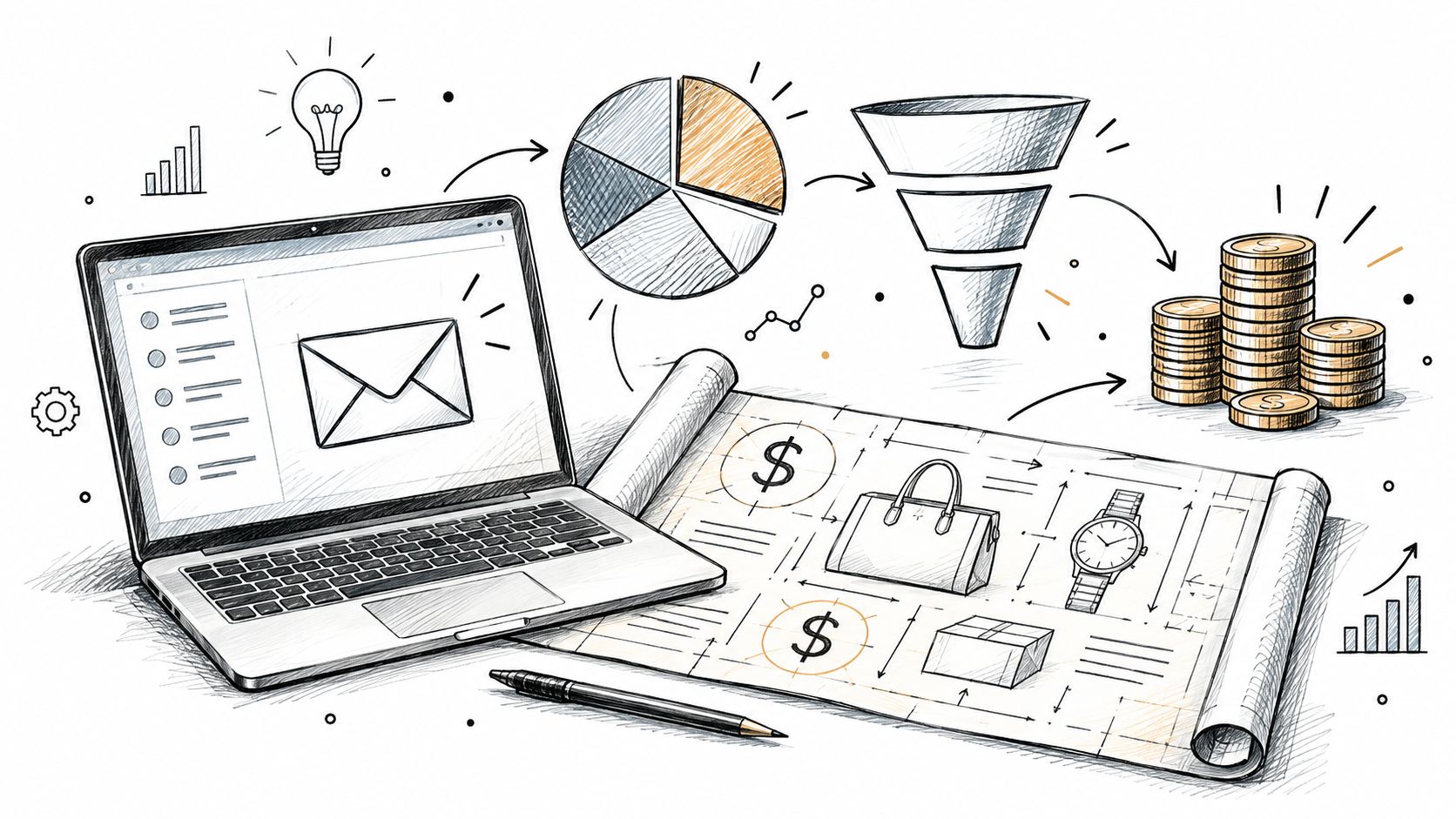
An engaged 5,000-subscriber niche list can outperform a much larger audience that rarely opens or clicks. The practical answer to how to monetize an email list is to increase revenue per recipient through targeted offers, automated sequences, relevant partnerships, and disciplined trust management.
The popular advice says to grow your list as fast as possible, then monetize once the subscriber count looks impressive. That advice confuses audience size with audience value. A large database of unresponsive contacts creates sending costs, deliverability risk, and false confidence. A smaller audience that recognizes your expertise, opens consistently, and trusts your recommendations gives you a much stronger commercial foundation.
Email monetization works when you build a system around engaged reach, not when you wait for a vanity milestone. Your list should help the right people make better decisions, and your offers should feel like a useful next step rather than an interruption.
Subscriber count is a poor proxy for commercial value. It appears in dashboards and sales decks, yet it does not show how many contacts receive your message, trust it, or act on it. A smaller niche audience with strong intent can produce more revenue than a larger general-interest list that rarely engages.
Track revenue per reachable recipient instead. Industry benchmarks place average email marketing return at roughly $36 to $42 for every $1 spent, with some organizations reaching a 70:1 return, according to email marketing benchmark data from Charle Agency. Those results reflect relevant campaigns, automated flows, and well-matched offers. Subscriber volume alone does not create them.
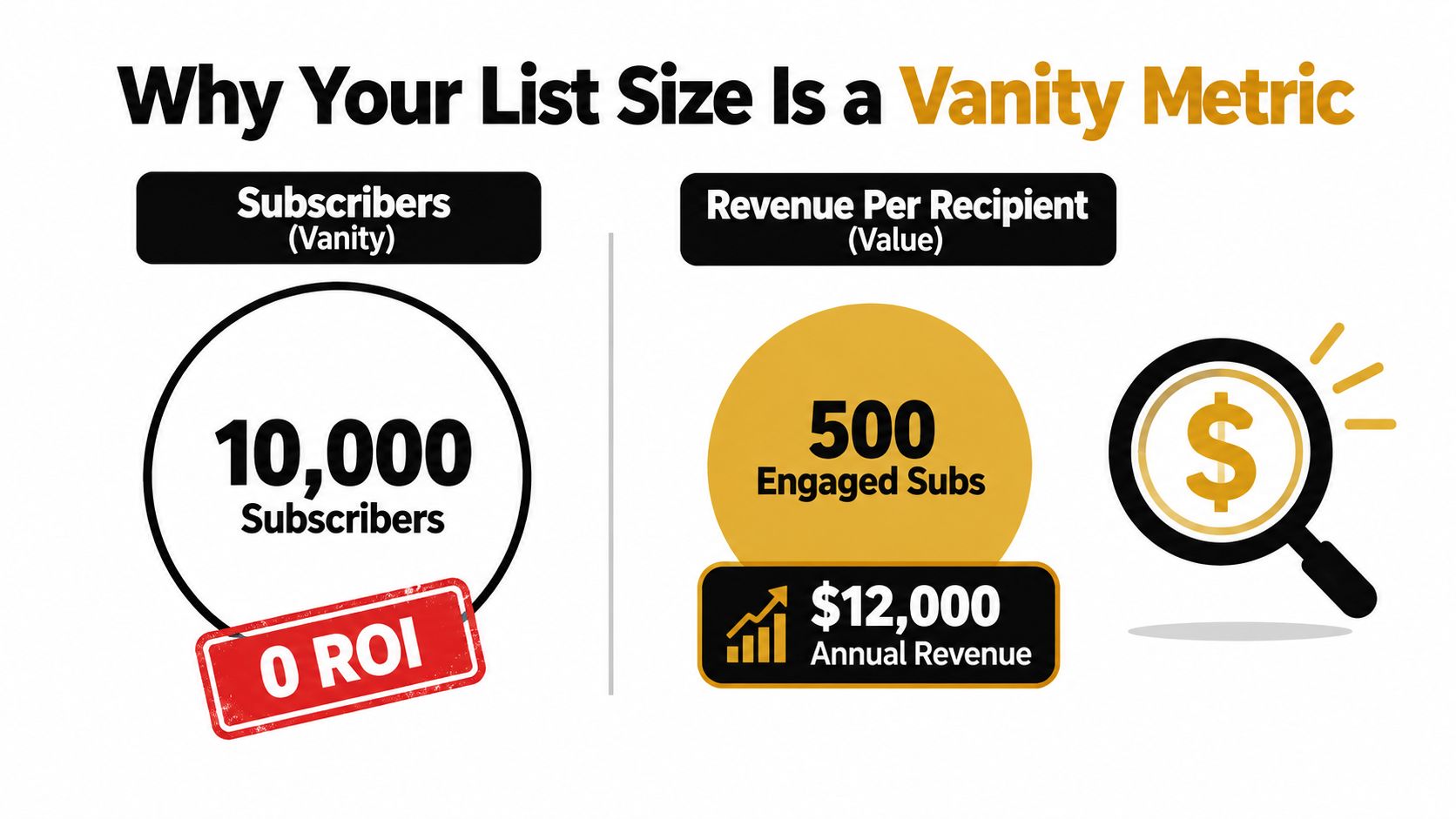
A general-interest list may contain people who joined for one free download and never found a reason to return. A niche list attracts subscribers around a clearer problem, which can create stronger intent and trust. That difference affects what you can sell, which partners fit, and how often you can present an offer without causing fatigue.
Revenue per recipient connects each campaign to a business outcome. Opens and clicks still help diagnose delivery and interest, but they do not show whether the campaign produced worthwhile returns. Use this guide to calculating marketing ROI that actually means something to distinguish activity from commercial performance.
Automations show why a system often outperforms improvised broadcasts. Automated emails have historically represented about 2% of sends while generating around 30% of email-driven revenue, as noted in the benchmark data above. A welcome sequence, product education flow, or abandoned-cart message responds to subscriber behavior. A bulk newsletter asks the entire list to care about the same offer at the same time.
Practical rule: Give a small, high-intent list better segmentation and better offers before sending more traffic to it.
Trust also depends on how you recover missed conversions. If someone leaves without subscribing or buying, an exit-intent message can offer a relevant second chance without repeating the same pitch to every visitor. Receiver's conversion recovery tips offer practical guidance for designing that handoff. Protect the relationship first, because short-term conversion gains are not worth training subscribers to ignore you.
The right monetization model depends on what your audience already expects from you. A consultant's list may respond to a diagnostic service, while a creator's audience may want templates, tools, or a paid community. The mistake isn't choosing one model. The mistake is choosing a model because it looks easy rather than because it fits the relationship.
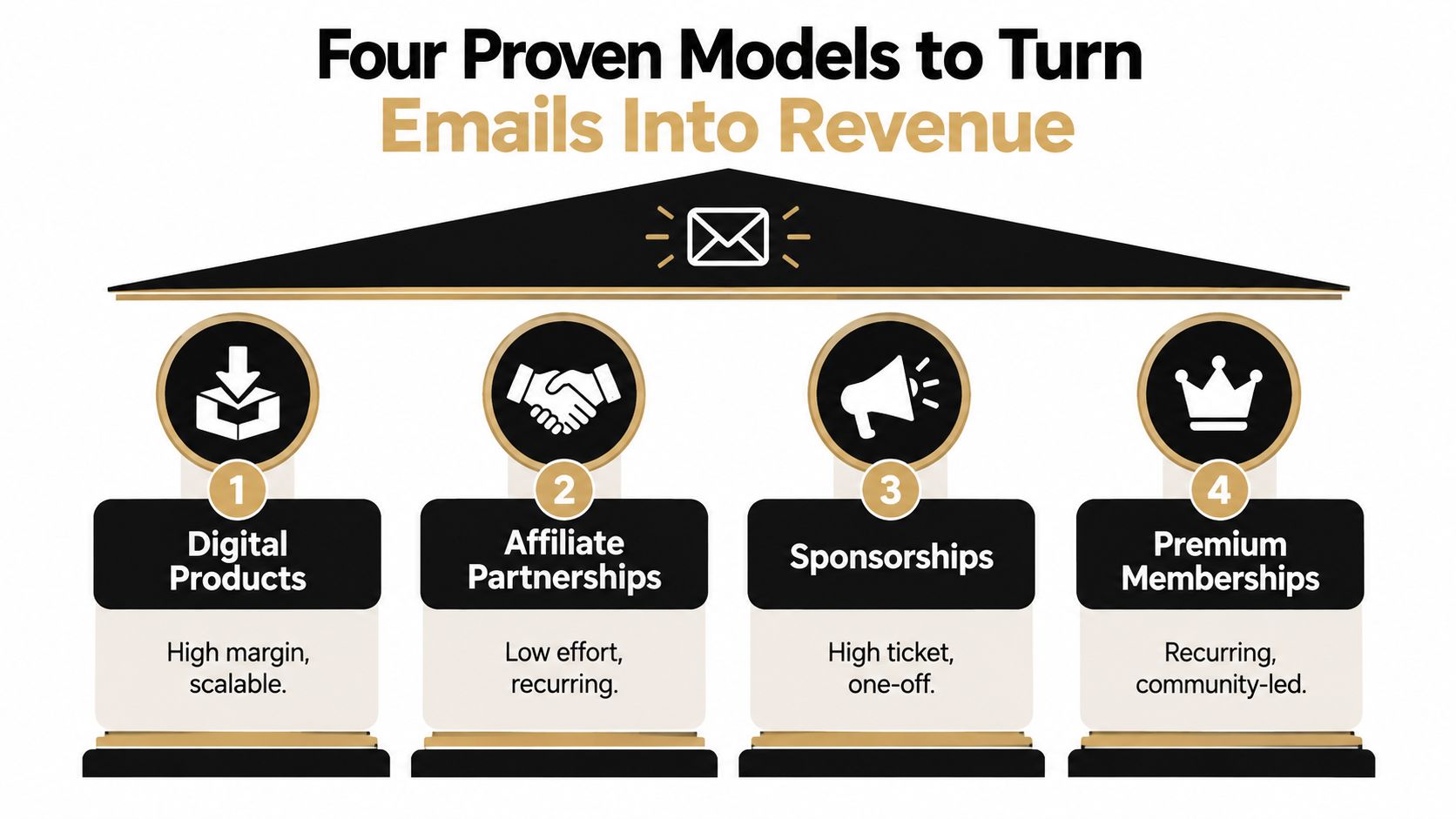
A digital product turns your repeatable knowledge into an asset you can sell more than once. Templates, playbooks, workshops, paid reports, and courses work best when subscribers already ask similar questions and need a structured solution.
The product should remove a specific obstacle. “A complete business course” is vague. “A content calendar for founders who publish weekly” gives the buyer a clear job to complete. Your emails can validate the problem, demonstrate the method, and offer the product as the organized implementation path.
Affiliate revenue suits audiences that already need software, education, equipment, or services. The model creates less product-development work, but it puts your reputation beside another company's performance. Recommend only tools you can explain candidly, disclose the commercial relationship, and describe who should not buy.
A practical affiliate program can support product development. Revenue from relevant recommendations may help fund research, design, and customer support for your own offer, but only if the recommendations remain useful without the commission.
Sponsorships sell access to a trusted audience. They can generate faster cash flow than building a product, but the sponsor must fit your editorial context. A random advertisement may pay once and weaken future response. A well-matched sponsor can add utility to the newsletter and preserve the reader's reason to stay subscribed.
Before approaching sponsors, document audience profile, engagement quality, placements, and content standards. Sending practices also affect your commercial credibility, so review resources such as Mailwarm's guide to the best email warmup tools when you need to understand preparation and sending discipline.
Memberships create recurring revenue through ongoing access, community, live sessions, or premium resources. They demand consistent delivery and clear retention value. A paid tier doesn't work solely because subscribers like your free content. Members need a continuing reason to remain enrolled.
Choose memberships when the audience values interaction, accountability, or fresh material. Choose a product when they need a defined transformation. Choose sponsorships when your reach and editorial environment matter more than direct implementation.
A full-list blast is convenient for the sender and often irrelevant to the recipient. Good monetization starts by making the list legible. You need to know why each subscriber joined, what they engaged with, what they bought, and what they appear ready to consider next.
Highly segmented sends can produce 16.17% open rates versus 9.95% for unsegmented sends, with more than three times the revenue per recipient, according to email list segmentation and monetization data from EarnifyHub. The numbers matter because revenue per recipient connects targeting to business value, not merely attention.
Start with source. Tag subscribers according to the page, lead magnet, webinar, referral, or campaign that brought them in. Acquisition context gives you the first signal about their problem and helps you avoid promoting an unrelated offer.
Next, add behavior. Record meaningful actions such as clicking a topic, visiting a product page, attending an event, replying to an email, or ignoring messages over time. Don't treat every open as buying intent. A click on a pricing page carries a different meaning from a passive newsletter open.
Then add commercial history:
A subscriber who joined through an insurance topic shouldn't receive the same promotion as someone who downloaded a content strategy template. Context improves relevance, and relevance protects trust. Publishers serving specialized audiences can also study examples such as insurance agency content from NewsletterAsAService to see how a focused industry angle can shape ongoing email communication.
Keep the segments operational. If your team can't explain why a subscriber belongs in a group, the group is probably too complicated. Start with a few meaningful distinctions, test the offers, and refine based on downstream revenue, unsubscribes, replies, and customer quality.
Building your own product gives you control over the promise, pricing, customer experience, and future distribution. Partnerships let you monetize sooner with less operational work. Neither path is automatically superior. They solve different constraints.
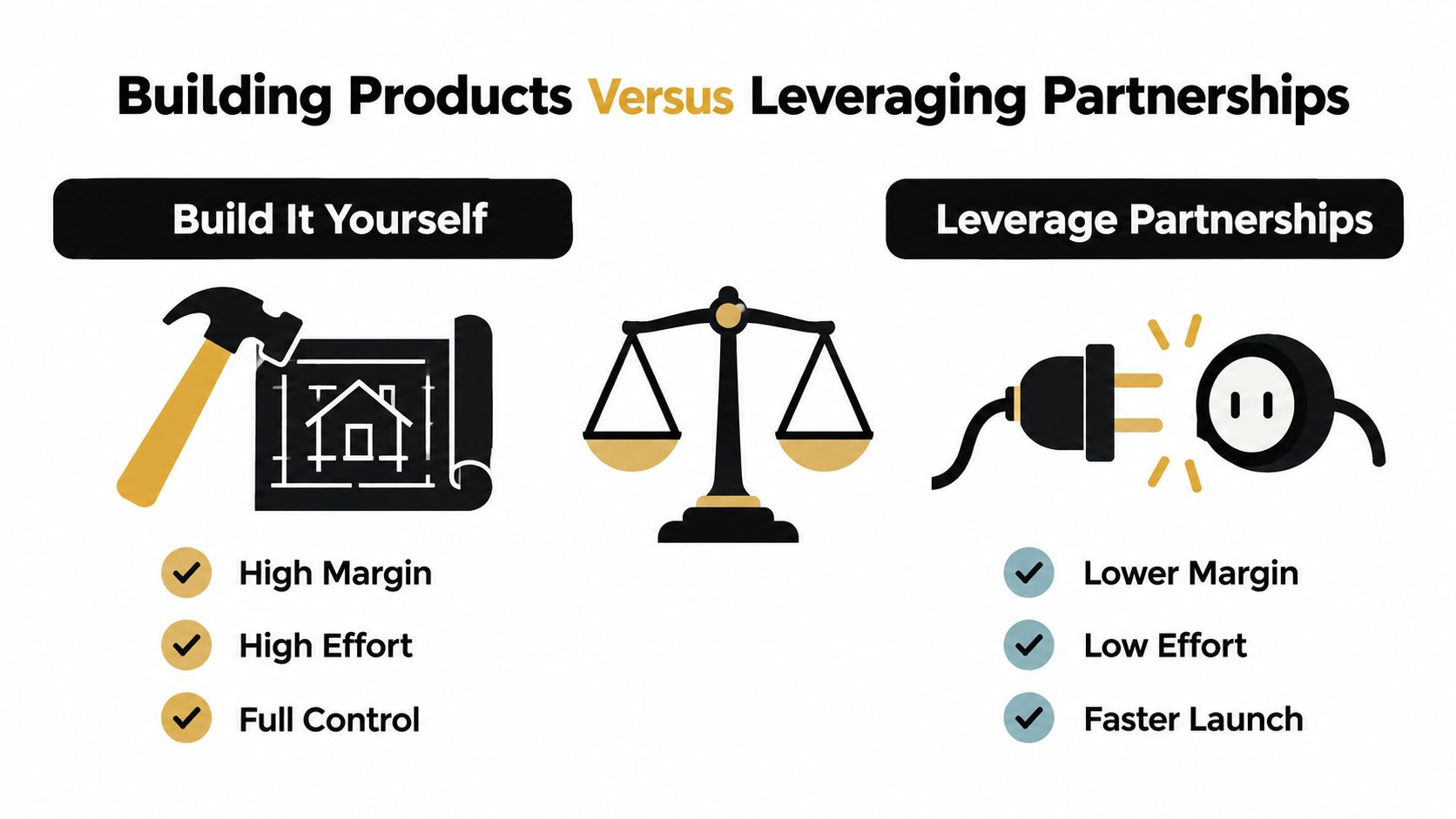
| Path | Main advantage | Main risk | Best fit |
|---|---|---|---|
| Build it yourself | Higher control and stronger margins | Requires research, production, support, and refinement | You have repeatable expertise and a defined problem |
| Leverage partnerships | Faster launch and lower creation burden | Less control over fulfillment and customer experience | Your audience already needs trusted third-party solutions |
A proprietary product takes time before the first sale. You need a clear promise, useful materials, a checkout experience, customer support, and a way to learn whether buyers get the intended result. The upside is strategic. Each sale improves your understanding of the audience, and the asset can become the center of future campaigns.
Partnerships provide speed, but speed can hide quality problems. Affiliate offers should earn their place through relevance and demonstrated usefulness. Sponsorships require even more editorial judgment because the sponsor's message appears directly inside your relationship with the reader.
Sponsorship pricing depends heavily on niche and engagement. Market guidance places sponsorship CPMs at roughly $15 to $35 for consumer and lifestyle lists, compared with $50 to $150 or more for specialized B2B, finance, and technology segments, according to newsletter sponsorship rate data. Treat those figures as market context, not an automatic rate card. Your actual proposal should explain the audience, placement, editorial fit, and what the sponsor receives.
A hybrid model often gives founders better control. Use relevant partnerships to learn which problems attract clicks and replies. Turn the strongest recurring problem into your own product, then keep only partnerships that complement rather than compete with it.
Your first monetization model should teach you about the audience, not just extract money from it.
A monetization funnel is a sequence of decisions, not a collection of promotional emails. The subscriber should understand the problem, see your method, assess the fit, and know what happens after purchase. If an email asks for a sale before it has established relevance, the offer feels abrupt.
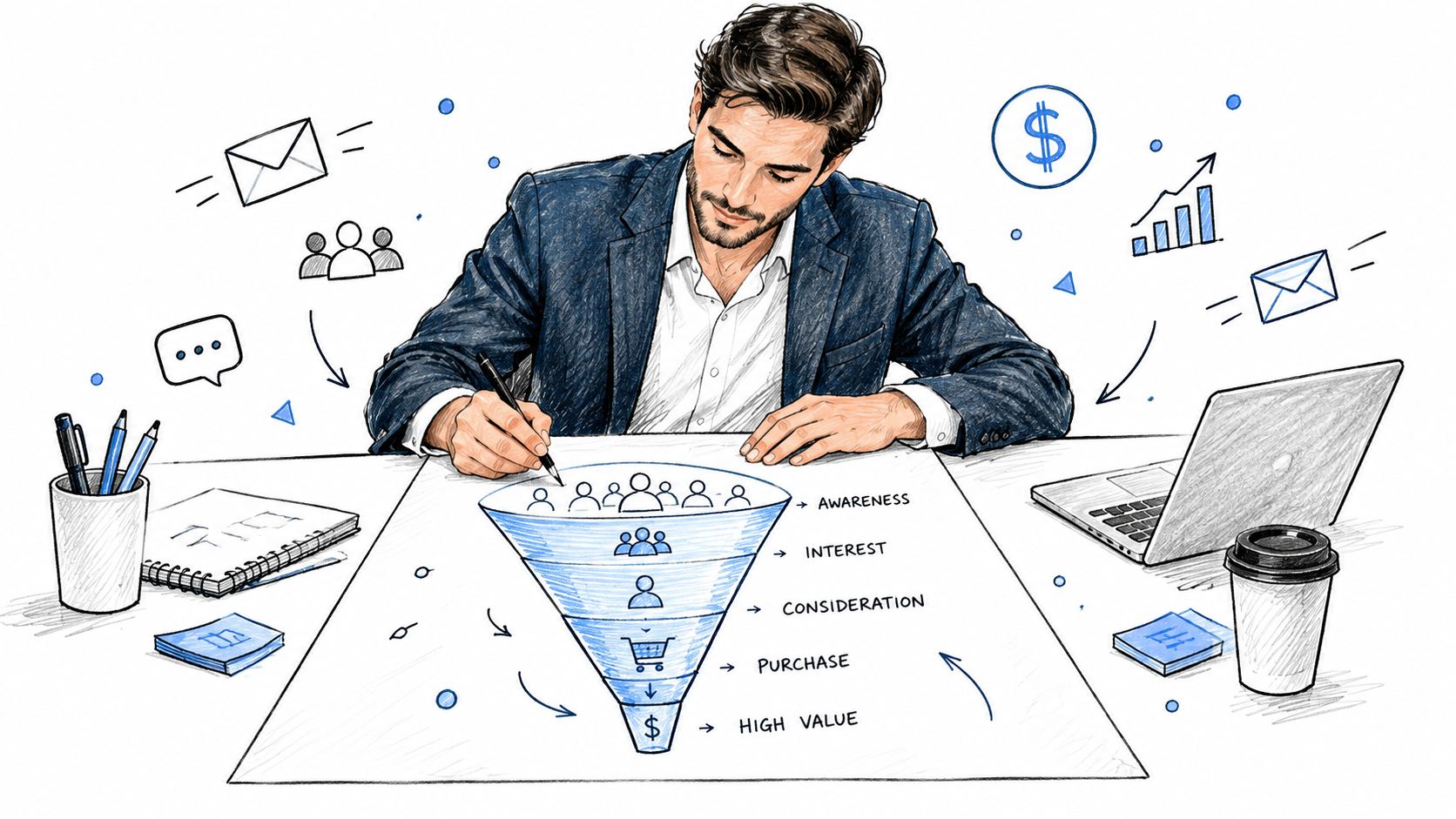
A practical sequence can begin with a welcome message that sets expectations and points to your most useful resource. Follow with an email that names a costly or frustrating problem, then one that teaches a small part of your method. After that, show the complete solution, answer objections, and present the offer with a clear next step.
The sequence should also reflect the subscriber's behavior. Someone who clicks the product explanation can receive a deeper demonstration. Someone who ignores the topic can remain in education rather than receiving repeated sales pressure. Automation makes this possible, and the benchmark evidence on automated revenue shows why behavior-based flows deserve priority.
Pricing isn't just a revenue lever. It tells the buyer what kind of commitment the offer requires. A low-friction template or short workshop can help a new subscriber experience your method. A more involved service, cohort, or implementation package should explain the depth of support and the outcome it addresses.
Avoid adding tiers merely to appear polished. Each option should serve a distinct buyer situation. If the differences aren't obvious in one reading, the pricing page creates work instead of confidence.
Use your funnel to make the offer increasingly specific:
You can use this structure alongside a deeper guide to selling digital products through content funnels, especially when your newsletter is connected to an owned content library.
A funnel fails if the emails never reach the inbox. Roughly one in six legitimate marketing emails fails to reach the inbox, while recent benchmarks place global inbox placement around 83.1% to 84%, according to Mailgun's state of deliverability takeaways. Permission-based acquisition, clean lists, suppression of hard bounces, sensible sending frequency, and active spam monitoring protect the audience you worked to earn.
Don't monetize every message. Establish a rhythm where most emails deliver useful insight, some introduce relevant solutions, and direct promotions arrive with clear context. Trust grows when subscribers can predict that your recommendations will respect their time and interests.
A monetization dashboard should show whether revenue is growing without hiding audience damage. Opens and clicks help diagnose message performance, but they don't tell you whether the campaign created profitable customers or trained subscribers to ignore your emails.
Track revenue per recipient for each campaign and segment. Track conversion rate by offer, customer quality, refund or support patterns, unsubscribe movement after promotions, and the performance of automated flows. For memberships, include retention and churn. For sponsorships, record the quality of the advertiser fit and whether readers continue engaging afterward.
The most useful dashboard connects four layers:
A campaign can produce revenue and still be a bad campaign if it attracts poor-fit customers, increases complaints, or weakens future response. Review results by segment rather than relying only on the list-wide average. A strong overall number can conceal a valuable niche cohort and a damaged general audience.
Use this email campaign performance metrics guide to build a reporting routine that connects each send to a business decision. Then run a focused operating cycle: clean inactive contacts, review the best-performing segment, improve one automated flow, test one offer, and document the trust impact.
Long-term list value comes from making more relevant offers to the right people, not from sending more offers to everyone.
The durable answer to how to monetize an email list is disciplined repetition. Build trust, capture intent, segment behavior, automate the obvious moments, and measure the money created per reachable recipient. Scale acquisition only after the system can turn attention into a useful customer experience.
Legacy Builder helps founders and professionals develop authentic personal brands through strategic content creation, distribution, and email content designed to grow an owned audience. If you want a consistent content system that supports trust-based list growth and monetization, visit Legacy Builder to explore the service and start a conversation.


You could – but most in-house teams struggle with the nuance of growing on specific platforms.
We partner with in-house teams all the time to help them grow on X, LI, and Email.
Consider us the special forces unit you call in to get the job done without anyone knowing (for a fraction of what you would pay).
Short answer – yes.
Long answer – yes because of our process.
We start with an in-depth interview that gives us the opportunity to learn more about you, your stories, and your vision.
We take that and craft your content then we ship it to you. You are then able to give us the final sign-off (and any adjustments to nail it 100%) before we schedule for posting.
No problem.
We have helped clients for years or for just a season.
All the content we create is yours and yours alone.
If you want to take it over or work on transitioning we will help ensure you are set up for success.
We want this to be a living breathing brand. We will give you best practices for posting and make sure you are set up to win – so post away.
Subscribe to our newsletter and get insights on how to grow your personal brand.
