.svg)
Subscribe to our newsletter and get insights on how to grow your personal brand.
Thank you! Your submission has been received!
Oops! Something went wrong while submitting the form.
.svg)


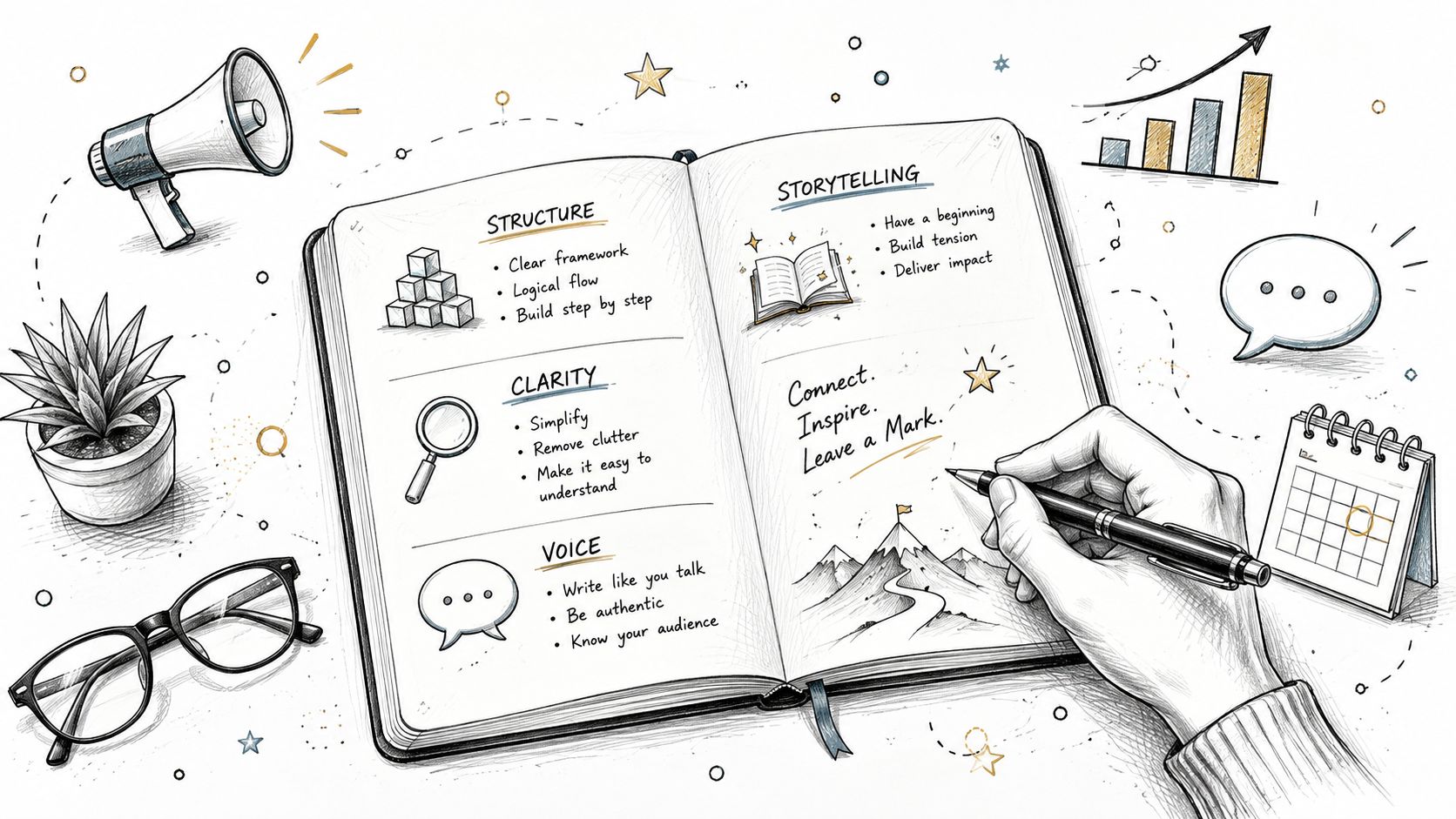
Most advice on how to improve writing skills starts with grammar. Learn more vocabulary. Fix your commas. Shorten your sentences. Those exercises have value, but they rarely solve the problem that holds professionals back.
A clean sentence can still deliver a weak idea. A grammatically correct article can wander, sound interchangeable, or leave the reader unsure what to remember. In content campaigns, the advantage comes from structure, voice, judgment, and the ability to develop an argument. Those skills turn writing from a task into a compounding brand asset.
I've built content systems for more than 200 clients and still write daily. The pattern is consistent: writers improve fastest when they create a repeatable practice around planning, drafting, feedback, and revision. A major meta-analysis reviewed 115 documents and found that nearly every writing intervention improved performance, with especially strong results from strategy instruction and self-regulation, not grammar drills alone. The full review also identified gains from prewriting, peer assistance, product goals, word processing, and additional writing.
That means improvement isn't a hack you can apply to one draft. It's a system that makes each piece teach you something. The payoff arrives gradually, then shows up everywhere, in clearer proposals, sharper LinkedIn posts, stronger sales pages, and a reputation for having something worth saying.
Grammar is the floor, not the differentiator. Correct sentences still fail when the argument lacks a clear destination, the examples arrive in the wrong order, or the writer gives readers no reason to care.
Higher-order writing ability determines those outcomes. It means identifying the question beneath the brief, arranging information around that question, making a defensible point, and developing a voice that sounds like a person rather than a content template. Sentence polish supports the work. It does not make those decisions for you.
Practical rule: Edit sentences only after you know what the piece should make the reader think, feel, or do.
Professionals often lose quality through their process, too. They wait for a large block of uninterrupted time, then attempt a perfect article in one sitting. Pressure encourages premature editing and separates writing from the brand's ongoing conversations.
A repeatable publishing rhythm creates better learning. Each finished observation gives you evidence about which openings attract thoughtful replies, where explanations confuse readers, and which ideas keep resurfacing in customer conversations. A short published point can therefore teach more than an abandoned polished draft.
A 2024 best-evidence review analyzed 148 independent treatment-control comparisons involving 22,838 students and found a positive overall effect for writing instruction, with a reported effect size of 0.38. Self-Regulated Strategy Development produced the strongest result in that review, reaching 0.84, while other strategy instruction reached 0.51. Read the evidence review for comparisons covering strategy instruction, feedback, goal setting, prewriting, digital tools, and model texts.
For a personal brand, quality compounds through accumulation. One useful post may introduce your thinking, another may reinforce it later, and a longer article may give the idea more depth. Consistent clarity and point of view across those pieces create recognition, while weak or generic writing leaves each publication starting from zero.
Use SEO for distribution, not for judgment. Strong actionable content SEO advice can help match search intent, organize a page, and improve discoverability. An optimization checklist cannot provide the insight readers will associate with your name.
Skill grows from actions you repeat when motivation is ordinary. A founder with a full calendar doesn't need an elaborate writing retreat. They need a small stack that fits between meetings and survives busy weeks.
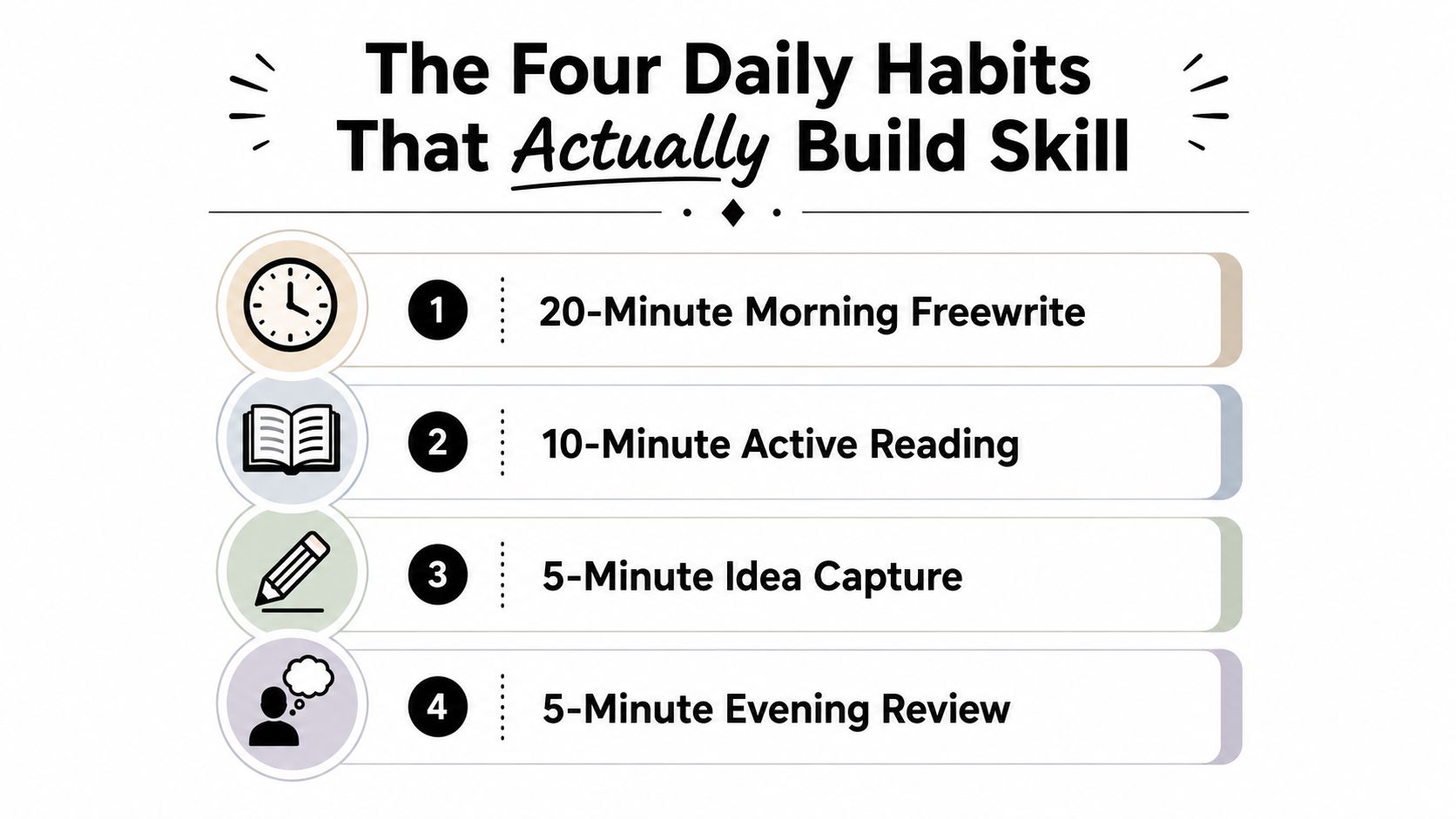
Spend 20 minutes in the morning writing without editing. Use a notebook, Google Docs, or a plain text file. Begin with a question your customers ask, a disagreement you had, or an observation from yesterday's work.
Don't turn this into a polished post. The purpose is fluency. Perfectionism is the failure mode here, so keep your hands moving and mark uncertain passages rather than stopping to repair them.
Give 10 minutes to a strong article, essay, email, or post. Read outside your industry when possible, then record what you notice:
A busy executive can do this while drinking coffee or waiting for a flight. The danger is passive consumption. If you read without taking notes, you may enjoy the piece without learning how it works.
Set aside 5 minutes to write down one idea in a form you could develop later. It might be a customer objection, a lesson from a failed launch, or a sentence that reframes a familiar problem.
Avoid vague entries such as “write about leadership.” Use a working angle instead: “Most leadership advice ignores the handoff between a decision and its execution.” Specific notes reduce the friction of starting.
Use 5 minutes for an evening review. Write two lines:
This habit converts experience into instruction. Without review, you can produce a great deal and repeat the same weaknesses. With review, each session leaves behind a usable lesson.
The sequence matters. Freewriting creates volume, reading sharpens your eye, idea capture protects original material, and review turns activity into learning. Add public publishing when you have a piece worth sharing, but don't confuse a posting streak with craft development. The quality of your attention determines what the repetition teaches you.
Daily habits create repetitions. Deliberate exercises determine what those repetitions improve. Use the following sequence across a working week, moving from the architecture of an idea toward the experience it creates for a reader.
Before drafting, write the central claim in one sentence. Then list the evidence, example, objection, and implication that support it. If you can't explain the order in plain language, the draft will probably wander.
After publishing, reverse-outline the piece. Write one sentence beside each paragraph describing its job. A paragraph that has no clear job is either unfinished, misplaced, or unnecessary.
Time: 15 minutes before drafting, 10 minutes after.
Success signal: You can summarize the piece without listing disconnected topics.
Take one paragraph each day and cut it to its shortest true form. Replace abstract nouns with concrete verbs, remove repeated qualifications, and explain specialist language as if you're speaking to an intelligent newcomer.
For example, “Our process facilitates the optimization of content distribution” becomes “We help teams distribute content more effectively.” The second sentence isn't clever. It's easier to understand, which is the point.
Time: 10 minutes.
Success signal: A reader can identify the actor, action, and consequence without rereading.
Write the same short story in three registers: formal, conversational, and provocative. Keep the facts stable while changing the rhythm, vocabulary, level of directness, and emotional temperature.
A founder might describe a failed launch formally for an investor update, conversationally for LinkedIn, and provocatively for an opinion post. Comparing the versions shows which choices feel natural and which sound borrowed.
For a more complete process, use these brand voice guidelines that actually stick to turn personal preferences into repeatable decisions.
Time: 20 minutes.
Success signal: Readers can recognize the same person across different formats without every piece sounding identical.
For one week, record the first sentence of everything you choose to read. Don't copy the wording. Label the function instead. Does it create tension, state a surprising claim, introduce a person, name a problem, or promise a useful answer?
Then use one of those structural patterns with your own material. Storytelling improves when you understand how a writer creates curiosity and consequence, not when you imitate surface style.
Time: 10 minutes per reading session.
Success signal: Your openings establish a clear reason to continue without relying on exaggerated promises.
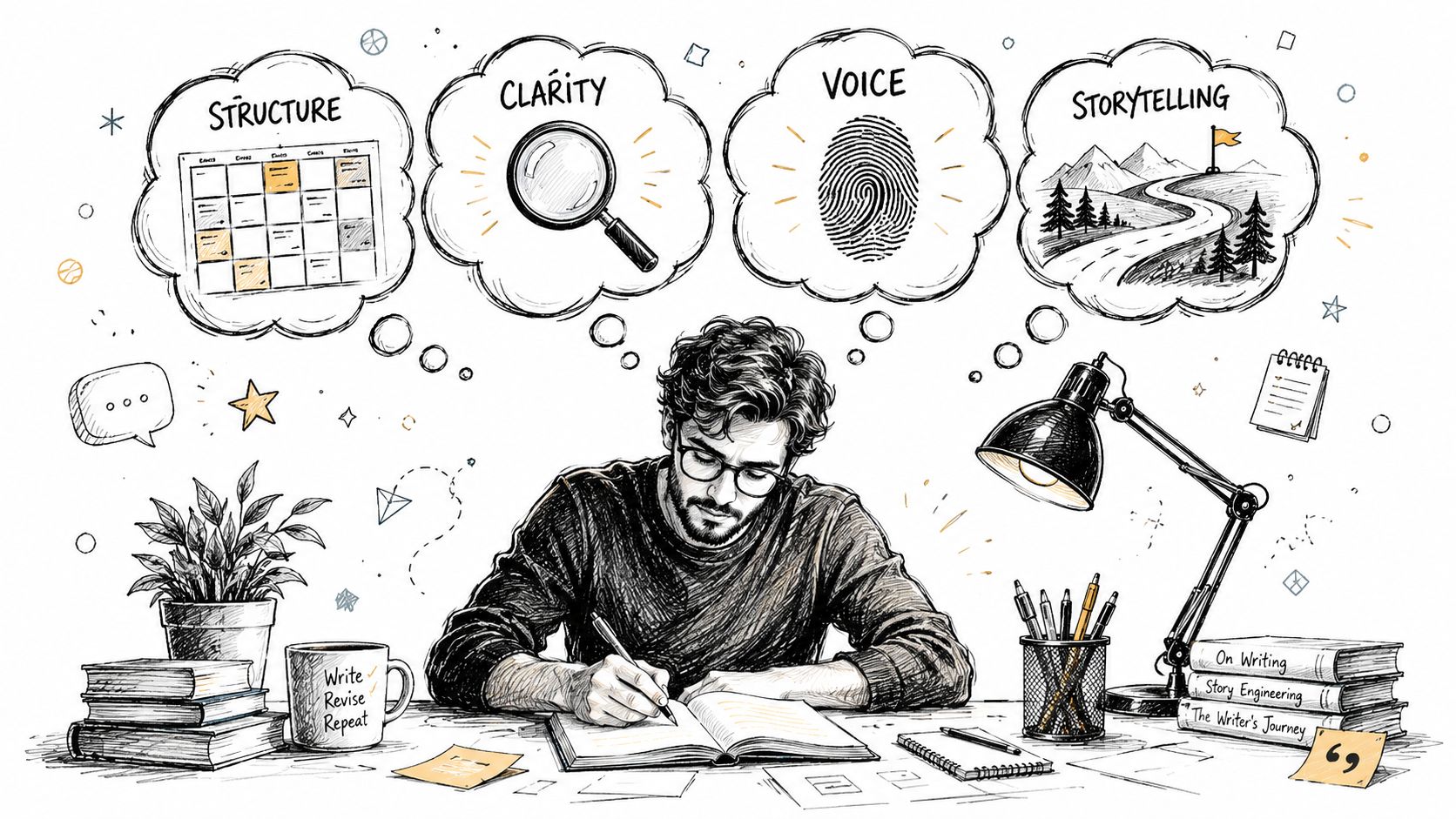
These exercises build different forms of judgment. Structure decides what belongs where. Clarity removes friction. Voice creates recognition. Storytelling gives the reader a reason to care about the sequence of ideas.
Use the video as a prompt for noticing choices, not as a replacement for practice. Watch how an opening establishes context, how examples create movement, and how the ending changes the meaning of what came before.
Revision isn't a punishment for a bad draft. It's where the writing becomes usable. Writers often struggle because they ask one vague question, “Does this sound good?” A stronger process separates the decisions, so each pass has a specific job.
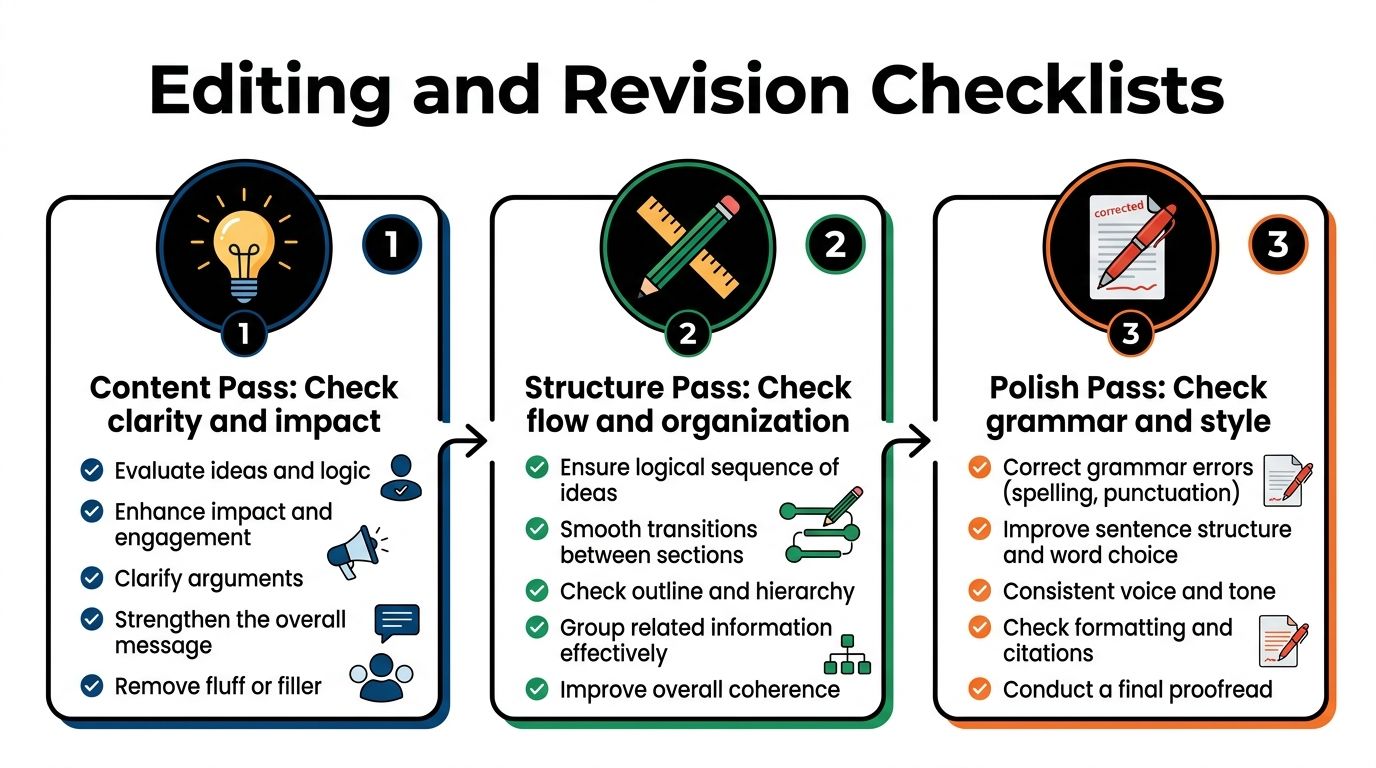
Read only the headline, subheadings, first sentences, and conclusion. They should form a coherent summary. Then ask:
If the structure fails, don't polish sentences yet. Move, combine, or remove sections until the argument works.
Every paragraph should earn its place. The first sentence should orient the reader, the middle should develop the point, and the final sentence should either resolve it or create a clean path forward.
Watch for paragraphs that contain several unrelated claims. Split them by function. Then read the final sentence of one paragraph beside the first sentence of the next. Awkward transitions usually reveal a missing idea, not a punctuation problem.
Now examine the prose. Replace weak verb phrases, vary sentence length, remove duplicate ideas, and cut introductions that delay the point. Keep some short sentences for emphasis, but don't make every sentence the same length.
Read the draft aloud after the mechanical pass. Your ear catches stiffness, accidental repetition, and places where the rhythm doesn't match the idea. Screen-based editing often misses those problems because your eyes supply meaning that the reader won't have.
Revision principle: Fix the largest communication problem first. A perfect sentence inside a confused section is still a failed sentence.
External tools can help with narrow tasks. Grammarly, Hemingway Editor, and Microsoft Editor can flag possible grammar, readability, or usage issues. Treat their suggestions as prompts, not verdicts. A tool doesn't know whether your unusual sentence expresses your voice or whether a technical term is necessary for your audience.
AI feedback needs the same restraint. Ask it to identify assumptions, summarize your argument, or point out where a reader might lose the thread. Then decide which feedback is valid. The durable gain comes from making the decision yourself.
Keep a personal style guide with preferred spellings, recurring terms, sentence tendencies, audience definitions, and examples of your strongest work. It turns revision from a mood-based activity into a consistent quality check.
You can't improve writing that nobody sees. Private drafts help you practice, but public or peer feedback reveals whether your intended meaning reached another person.
Ask for feedback that can produce a decision. “What do you think?” invites politeness. “Where did the argument become unclear?” or “Which section would you cut?” gives the reviewer a defined task. Request feedback from people who understand the audience, not just people who enjoy your writing.
Track responses for patterns rather than chasing every reaction. Saves can indicate usefulness, replies can reveal disagreement or resonance, and direct messages can show that a piece created enough relevance for someone to continue the conversation. None of these signals proves quality by itself. Your job is to compare the response with the purpose of the piece.
A durable accountability system can be simple:
AI adds speed, but speed isn't the same as skill. A 2026 systematic review of 23 peer-reviewed studies found that AI tools consistently improved surface-level quality while contributing little to coherence and critical thinking, and a 2025 comparative study found stronger results for organization and critical thinking when AI feedback was combined with human input. Review the cited evidence before treating automated polish as proof of writing development.
A separate 2025 randomized trial found that AI-generated content improved undergraduate writing, particularly organization and content development. Yet a 2025 Oregon State study reported that AI could increase creativity when instructors taught students how to use it, while unsupported use could flatten creativity for stronger writers. A 2026 meta-analysis across 46 studies found a medium overall effect on writing performance, which points to the question: under what conditions does AI help you become more capable rather than more dependent? The trial and related evidence are summarized here.
Use AI as a demanding training partner. Ask for objections, alternative structures, missing assumptions, or questions a skeptical buyer would ask. Draft the answer yourself, compare your reasoning with the tool's response, and keep your final judgment human.
For operational ideas, AI repurposing for social media can help you explore how a finished idea might travel across formats. If you want a deeper framework for using assistance without losing authorship, see AI-assisted content creation for scaling your brand authentically.
A strong long-form piece contains more than one publishable idea. The mistake is copying the same paragraph into different channels. Effective repurposing changes the entry point, format, and reader task while keeping the central insight consistent.
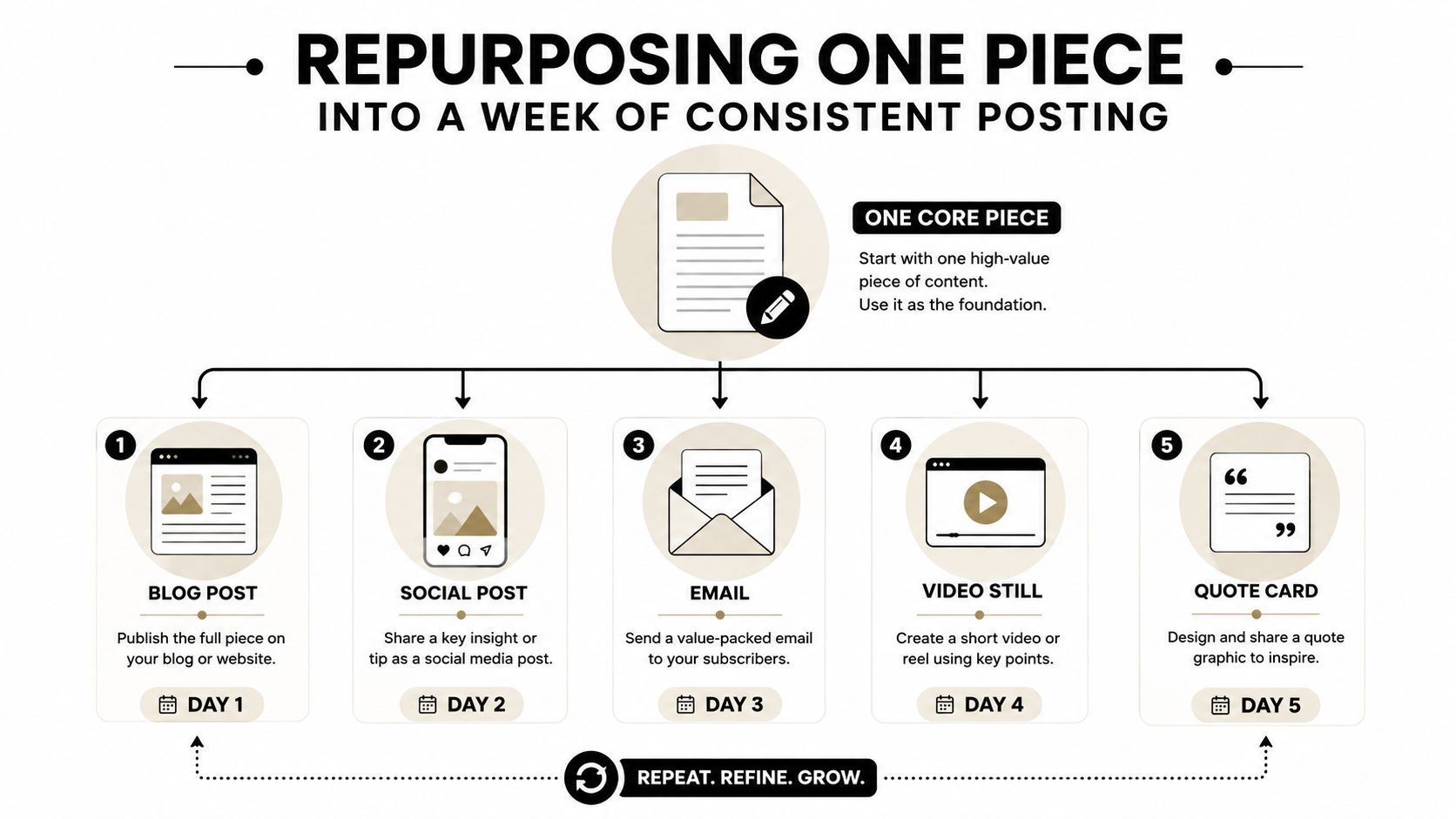
Start with one substantial article and extract these assets:
The formats serve different jobs. A hook earns attention, a thread teaches, a contrarian point creates conversation, an example builds trust, and an email invites an ongoing relationship. The underlying idea remains recognizable, but each version should be written for the way the audience encounters it.
Don't automate the entire process before you know what deserves to be repeated. First mark the sentences that carry the argument, the examples that make it tangible, and the questions readers might ask. Then use tools to format, schedule, or adapt those selected pieces. Guidance on how to maximize content reach can help you think about distribution without treating repetition as strategy.
Your source article should function as a reservoir, not a script. The content repurposing and reach framework offers another way to map one core idea across channels while preserving a consistent voice.
Improvement needs evidence, but the wrong evidence can make you feel productive while your writing stays unchanged. Track craft, audience response, and consistency separately. One category tells you what you're practicing, another shows whether readers respond, and the third reveals whether your system survives real life.
| Category | Metric | Why It Matters | Week 4 Target |
|---|---|---|---|
| Craft | Words per session | Shows whether you can generate ideas with less friction | Record a baseline and improve it gradually |
| Craft | Drafts finished | Measures completion, not just activity | Finish a repeatable volume of drafts |
| Craft | Revisions per piece | Shows whether you're developing ideas beyond first-draft polish | Complete distinct revision passes |
| Audience | Saves, replies, and DMs | Reveals usefulness, resonance, and conversation | Identify patterns in responses |
| Audience | Inbound opportunities | Connects writing with professional outcomes | Log relevant conversations and requests |
| Consistency | Days shipped | Measures whether your publishing system holds | Set a cadence you can maintain |
| Consistency | On-time rate | Tests reliability rather than intention | Review missed publishing commitments |
| Consistency | Longest streak | Shows what your current system can sustain | Establish a realistic baseline |
Use the first two weeks to install the habits. Spend the next four weeks practicing your weakest craft area, whether that's structure, clarity, voice, or storytelling. Use the following four weeks to gather feedback and revise with intention, then use the final two weeks to review patterns and reset the system.
Don't judge progress only by impressions or word count. Ask whether you're making stronger claims, choosing better examples, and helping readers understand something they can use. That is how writing becomes an asset instead of a recurring chore.
Legacy Builder helps professionals turn their stories, insights, and vision into consistent personal-brand content through strategy, writing, design, distribution, and audience interaction. If you want a practical publishing system that preserves your voice while building stronger writing habits, visit Legacy Builder and explore how the team can support your next 90 days.


You could – but most in-house teams struggle with the nuance of growing on specific platforms.
We partner with in-house teams all the time to help them grow on X, LI, and Email.
Consider us the special forces unit you call in to get the job done without anyone knowing (for a fraction of what you would pay).
Short answer – yes.
Long answer – yes because of our process.
We start with an in-depth interview that gives us the opportunity to learn more about you, your stories, and your vision.
We take that and craft your content then we ship it to you. You are then able to give us the final sign-off (and any adjustments to nail it 100%) before we schedule for posting.
No problem.
We have helped clients for years or for just a season.
All the content we create is yours and yours alone.
If you want to take it over or work on transitioning we will help ensure you are set up for success.
We want this to be a living breathing brand. We will give you best practices for posting and make sure you are set up to win – so post away.
Subscribe to our newsletter and get insights on how to grow your personal brand.
