.svg)
Subscribe to our newsletter and get insights on how to grow your personal brand.
Thank you! Your submission has been received!
Oops! Something went wrong while submitting the form.
.svg)



Most advice on how to generate leads online still starts in the wrong place. It tells founders to post more, publish more, and wait for the algorithm to reward them, even though attention isn't intent and clicks don't pay invoices.
The businesses that win online usually don't chase volume first. They build a system that turns visibility into trust, then trust into conversations, then conversations into qualified opportunities. That's why a content-led inbound model matters so much, especially when businesses with an active blog generate 13× more leads on average than businesses without one, and firms publishing 16 or more blog posts per month can generate up to 3.5× more leads than those publishing four or fewer posts, according to 2026 benchmarks cited in the lead-generation summary from Martal.
The catch is that content alone doesn't create demand. It only works when it's attached to a clear audience, a useful offer, a landing page that removes friction, and follow-up that respects how buyers move. For service businesses and personal brands, that's the game, because trust does most of the conversion work long before a form fill.
Publishing content helps, but posting content is not a lead strategy. A founder can build a large audience and still attract weak inquiries if the content speaks to curiosity instead of buying intent. A smaller creator with a tighter point of view often gets better leads because the audience knows exactly what problem they solve and who they solve it for.
That distinction matters. Content can create attention, but leads only appear when attention meets a specific offer, a relevant next step, and enough trust for someone to act. The simplest way to put it is this, content earns permission, systems earn the lead.
A post can be popular and still be commercially useless. The person who likes a post, saves a carousel, or watches a clip all the way through may never be a buyer. A lead starts when the reader sees themselves in the problem, believes the solution fits, and feels safe enough to exchange contact information or start a conversation.
That is why personal brands often outperform faceless businesses on lead quality. A founder's story, judgments, and lived experience act like filters. They attract people who already agree with the frame, which lowers friction before sales ever gets involved.
Practical rule: if your content can be appreciated by almost anyone, it usually won't convert almost anyone.
The older outbound model tried to interrupt strangers. A trust-based inbound model helps the right strangers self-identify. Once someone recognizes their own problem in your content, they are much closer to a qualified inquiry than a random website visitor.
For a closer look at the mechanics behind converting attention into action, the framework in how to create content that converts is a useful companion to this process.
Lead generation online works when three things happen in sequence. First, the right people find you. Second, the right message convinces them you understand their situation. Third, a clear path turns that interest into a lead, usually through a dedicated page, a focused call to action, or a conversation starter.
That is why weak lead generation often looks busy but produces little. There is traffic, but no qualification. There is engagement, but no next step. There is reach, but no trust transfer.
Personal brands have an advantage here because trust travels through the founder, not just the content. A service business owner who speaks directly about the exact pains their clients face can create stronger commercial intent than a more polished brand that sounds broad and generic. The goal is not to become louder. The goal is to become more legible to the people already looking for help.
If you want a sharper filter for who should receive that message, use find your ideal customer profile before you build the funnel.
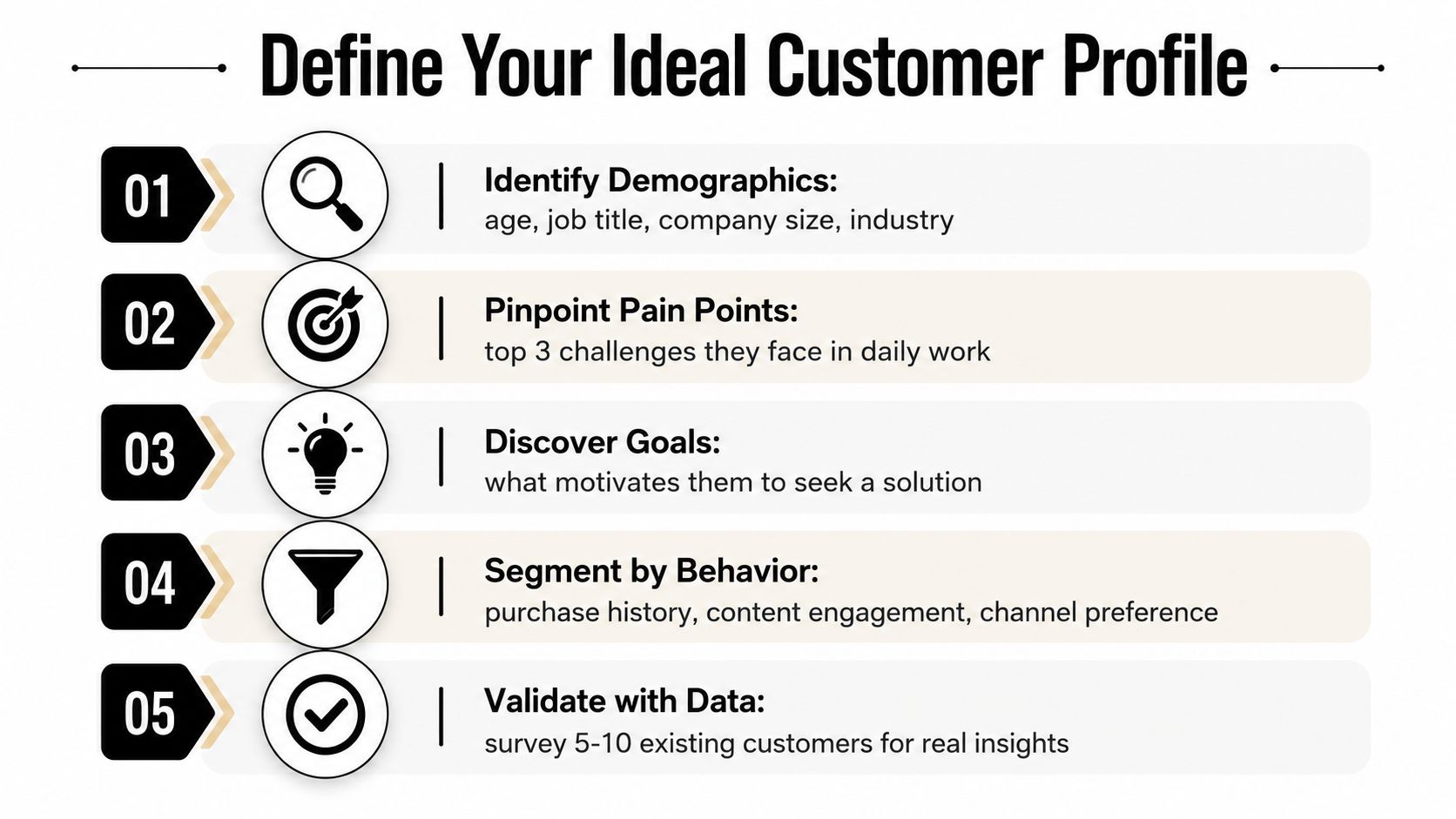
A funnel built for everyone converts no one well. The first serious decision in how to generate leads online is defining the exact buyer you want, not just the industry you hope to reach. Broad targeting invites broad interest, which usually means weak intent and slower sales follow-up.
Start with your best clients, not your dream clients. Look at the people who bought quickly, stayed engaged, and got value fast. Then identify the patterns that repeat, including the role they hold, the decisions they control, the problems they already admit, and the content they naturally respond to.
Demographics help, but they're not enough. A useful ICP includes job title, company size, industry, pain points, content habits, and buying triggers. It should tell you where that person spends attention and what makes them raise a hand.
A simple worksheet works better than a complicated spreadsheet. Write down who they are, what they're trying to fix, what they've already tried, and what would make them trust a specialist. If you need a deeper reference point, find your ideal customer profile can help you pressure-test the basics before you build on them.
Use this filter before choosing a platform, a topic, or an offer:
That last point matters most for founders and experts. High-trust buyers usually want proof of judgment, not just proof of activity. They want to know that you understand their context, their constraints, and the trade-offs inside the decision.
Once the ICP is clear, every downstream choice gets easier. Topics become sharper. Lead magnets become more relevant. Outreach becomes less random. Even your homepage copy improves because you stop trying to sound broadly appealing.
For founders, the practical template is simple. Define the person, define the pain, define the trigger, define the proof. Then keep tightening until the language feels specific enough that the wrong people would self-select out.
If you want a structured explanation of audience modeling, the 2026 buyer personas guide for founders is a useful adjacent resource.

Once the audience is clear, the next mistake is trying to post about everything. A strong lead engine uses three to four content pillars that reflect your expertise and your buyer's strongest problems. Those pillars create consistency, which makes the brand easier to recognize and the offer easier to remember.
A good structure is to separate content by job. Some content earns attention, some content builds trust, and some content captures the lead. When those roles blur together, the feed gets busy but the funnel gets weak.
Content pillars should map to the questions your ICP already asks. If you're a founder coach, one pillar might address decision-making, another could address execution, another could focus on positioning, and another could cover proof or case examples. The point is not variety for its own sake. The point is repetition around the problems that create buying intent.
That same logic applies to lead magnets. A lead magnet should not be a random PDF giveaway. It should function like a pre-qualification device. A checklist, diagnostic, mini-course, or framework can all work if they attract the right person and repel the wrong one.
A useful test is whether the asset would still be valuable if nobody booked a call afterward. If the answer is yes, it's probably strong enough to build trust. If the answer is no, it's probably just a bait asset.
The article on how to structure X content pillars is a solid reference if you want a simple way to turn expertise into recurring themes without sounding repetitive.
A good lead magnet needs a clean landing page with one job, collecting the next step. The page should state the problem, promise the outcome, and keep the call to action singular. Avoid stacking too many links, too many choices, or too much brand language that never explains the benefit.
Benchmarks in the verified source set show gated assets can convert at roughly 20 to 30%, and optimized dedicated landing pages average about 23% conversion, according to Salesforce's lead-generation guidance. That makes the page and offer combination the critical point, not just the traffic source.
For email nurture, keep the path simple. A strong sequence doesn't need to be long to be effective, it needs to be relevant, timely, and specific to the problem the lead just revealed. If you want practical ideas for building the list that supports that sequence, 10 proven email list building strategies for 2026 is a good implementation companion.
Organic systems compound, but founders rarely have the luxury of waiting on compounding alone. The fastest sustainable approach is usually a mix of selective outreach, targeted paid amplification, and relationship-first engagement. That's how you create near-term pipeline without training your brand to feel like a spray-and-pray machine.
The best outbound still feels like context, not interruption. A short list of the right people is more valuable than a huge list of indifferent prospects, especially when you're selling expertise, advice, or done-for-you services.
The Dream 100 idea works because it forces focus. Instead of chasing a market, you identify the exact people, brands, communities, or operators you want to be in front of, then show up where they already pay attention. That might mean commenting thoughtfully, sharing a useful resource, replying with a specific insight, or building a private list of high-value relationships.
The key is consistency, not volume. Send useful messages that reflect real familiarity with the person's work. Reference something they said, published, or built. The message should open a conversation, not ask for a call on the first touch.
Practical rule: if the first message sounds like a pitch deck, the relationship is already late.
Paid search and LinkedIn ads can help when the target buyer already has clear intent or a narrow professional profile. They're useful for capturing active demand and reinforcing the content you're already publishing. They're not a substitute for positioning, and they're not a fix for a vague offer.
For outbound hygiene, deliverability matters more than most founders think. If your cold email setup is weak, the campaign can fail before the recipient ever sees it. A practical reference on improve cold email deliverability is worth keeping close if email is part of your acquisition mix.
The most effective mix is usually modest and disciplined. A few high-quality DMs, a tightly targeted paid campaign, and visible organic content often outperform broad mass outreach because they all reinforce the same signal. The prospect sees the same person, the same expertise, and the same point of view across more than one channel, which lowers resistance.
Lead generation changed fast, and the technical side now shapes strategy more than many founders realize. Email infrastructure, audience selection, and channel mix all affect whether your message even gets a fair shot. In practice, the funnel has gotten narrower, not wider.
Recent guidance treats email setup as part of the acquisition system itself, with SPF, DKIM, DMARC, one-click unsubscribe, conservative send volumes, and short 3 to 5 touch sequences before scale-up. That shift matters because aggressive blasting now creates more risk than benefit for most personal brands and service businesses.
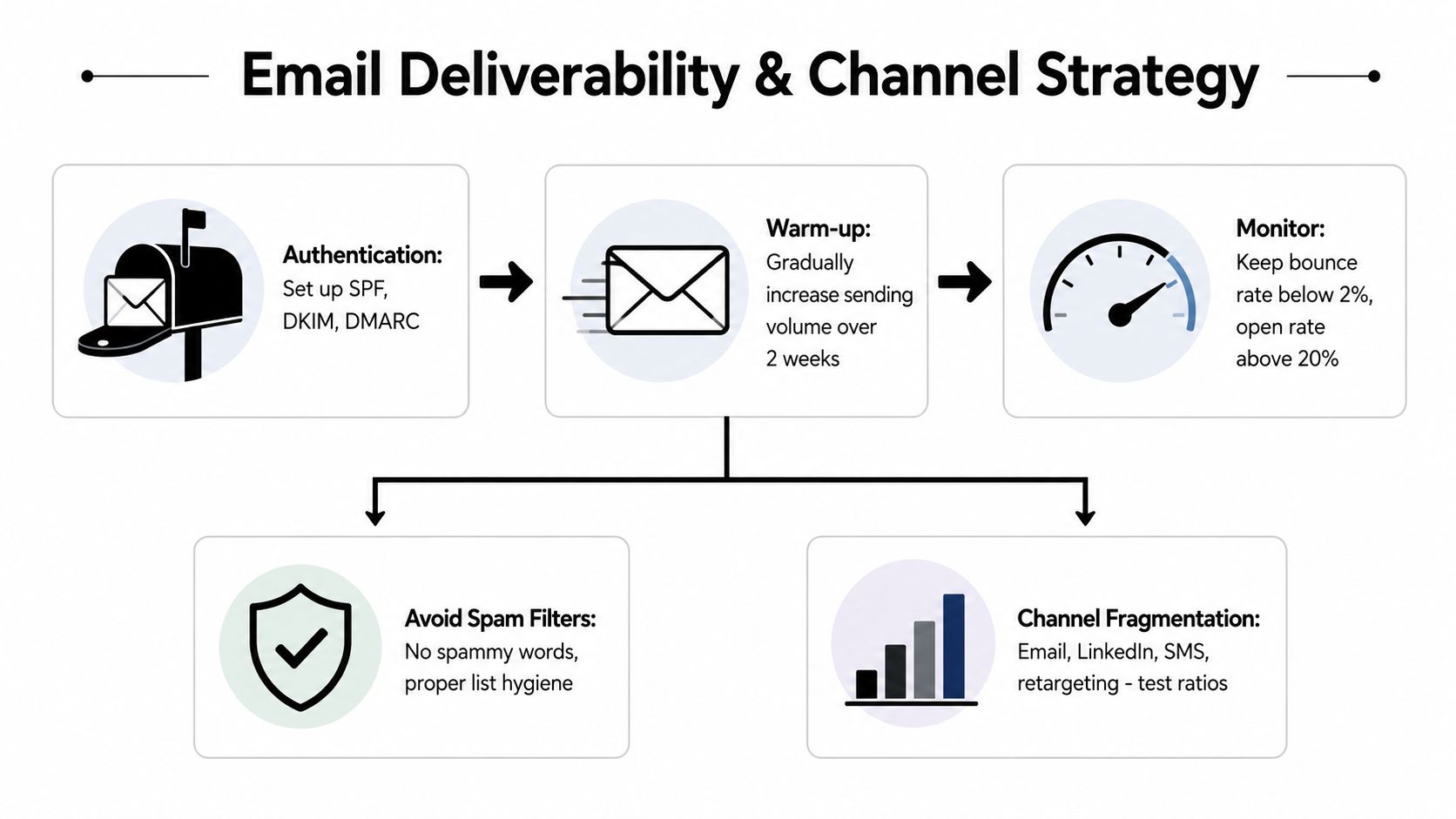
If email is part of your lead engine, deliverability is not optional. Poor hygiene hurts trust, and trust is the asset you're trying to build. That's why conservative send behavior, clean lists, and respectful unsubscribe handling are no longer just ops issues, they're strategic constraints.
The same applies to channel fragmentation. Buyers now move between search, LinkedIn, newsletters, communities, podcasts, and private conversations. There isn't one dominant path for every market, so the job is to choose the channels where your ICP already pays attention and where your credibility can accumulate over time.
The temptation is to be everywhere. The better move is to pick the few channels that match the way your buyer wants to learn and evaluate. If your audience values depth, search and email may carry more weight. If they respond to professional trust signals, LinkedIn and partnerships may do more of the work.
That's the practical reason narrow funnels outperform broad ones. A disciplined system reduces noise, keeps follow-up manageable, and gives you better feedback on what drives qualified conversations. You don't need more exposure if the exposure doesn't move the right buyer closer to trust.
A useful way to think about the mix is this, search captures intent, social builds familiarity, email maintains the relationship, and selective partnerships widen reach without diluting relevance. When those pieces support the same narrative, the funnel feels coherent instead of noisy.
Vanity metrics can mask a broken funnel for months. Followers, page views, and impressions may look healthy while the pipeline stays thin. The core question is whether the system produces qualified opportunities at a cost you can keep supporting.
A better benchmark is channel efficiency and buyer intent. SEO often matters most for lead-generation goals, average B2B website visitor-to-lead conversion is only a small slice of traffic, and lower-cost sources like SEO, email marketing, and webinars usually work best when they are tied to a clear offer and a clear ICP. Those benchmarks do not tell you exactly what to build, but they do show why channel economics and fit matter more than raw reach.
The first metric to track is cost per qualified lead, not cost per lead. A cheap lead that never responds is expensive in disguise. The second is lead-to-opportunity conversion, because it shows whether your qualification is doing real work. The third is revenue per source, which tells you where to scale and where to stop wasting attention.
Here's a simple dashboard structure that's useful:
| Metric | What It Measures | Benchmark Range | Action Trigger |
|---|---|---|---|
| Cost per qualified lead | What you pay for a sales-ready prospect | Varies by channel | Scale when it stays stable while opportunity quality holds |
| Lead-to-opportunity conversion | How well leads become real sales conversations | Varies by offer and fit | Fix messaging or qualification if it drops |
| Revenue per source | Which channels produce actual income | Varies by source | Shift budget toward the strongest source |
| Landing page conversion | How well the offer and page work together | Around 23% on optimized dedicated pages, per Salesforce | Test copy, CTA, and form friction if it lags |
| Gated asset conversion | How well the lead magnet captures interest | Roughly 20 to 30%, per Salesforce | Tighten relevance if it underperforms |
Use A/B tests to improve one variable at a time. Test the headline, the CTA, the form length, or the lead magnet promise, but do not change everything together. The goal is cleaner signal, not more activity.
For service businesses, that distinction is decisive. If your content brings engagement but not qualified conversations, the issue is usually fit, proof, or offer clarity, not traffic volume. If your leads convert but the sales cycle drags, the issue is usually nurture, timing, or follow-up discipline. In founder-led businesses, the numbers only matter if they point to trust, intent, and a repeatable path to revenue.
A founder doesn't need a perfect system on day one. They need a system that can be built, tested, and tightened without getting lost in tactics. The first 90 days are about setting the frame, proving the offer, and removing obvious leaks.
Month 1 should focus on clarity. Define the ICP, pick one core offer, build one strong lead magnet, and set up one landing page with one CTA. If the message is still fuzzy at the end of month one, don't add more channels. Tighten the positioning first.
Month 2 is for activation. Publish against your main pillars, start the outreach list, and begin nurturing every new lead with fast, relevant follow-up. The biggest mistake here is impatience. Founders often confuse “nothing is happening” with “nothing is working” before the system has enough repetitions to generate clean data.
Month 3 is for optimization. Keep the pages that convert, cut the ones that don't, and double down on the channels that create qualified conversations. One practical pattern I've seen repeatedly is that the founder who stays consistent for 90 days usually beats the founder who keeps restarting the strategy every two weeks.
Practical rule: if you can't describe what the system should do in the next 30 days, you probably don't have a system yet.
Use this week-by-week rhythm. Week 1 and 2, define the buyer and the offer. Week 3 and 4, launch the page and the email follow-up. Week 5 through 8, publish, outreach, and track quality. Week 9 through 12, refine based on response, not hope.
A business that wants predictable leads online doesn't need more noise. It needs a narrow audience, a credible message, a conversion path, and the discipline to keep improving the parts that move revenue.
If you want a personal brand that attracts higher-trust leads instead of scattered attention, Legacy Builder can help turn your story, expertise, and content into a clearer lead engine with stronger positioning, consistent publishing, and strategic audience interaction.


You could – but most in-house teams struggle with the nuance of growing on specific platforms.
We partner with in-house teams all the time to help them grow on X, LI, and Email.
Consider us the special forces unit you call in to get the job done without anyone knowing (for a fraction of what you would pay).
Short answer – yes.
Long answer – yes because of our process.
We start with an in-depth interview that gives us the opportunity to learn more about you, your stories, and your vision.
We take that and craft your content then we ship it to you. You are then able to give us the final sign-off (and any adjustments to nail it 100%) before we schedule for posting.
No problem.
We have helped clients for years or for just a season.
All the content we create is yours and yours alone.
If you want to take it over or work on transitioning we will help ensure you are set up for success.
We want this to be a living breathing brand. We will give you best practices for posting and make sure you are set up to win – so post away.
Subscribe to our newsletter and get insights on how to grow your personal brand.
