.svg)
Subscribe to our newsletter and get insights on how to grow your personal brand.
Thank you! Your submission has been received!
Oops! Something went wrong while submitting the form.
.svg)



Posting more often doesn’t make you an expert. It makes you louder.
That’s the advice most founders get wrong. They’re told to “show up consistently,” “build in public,” and “share value,” as if visibility alone creates authority. It doesn’t. Visibility amplifies what’s already there. If the depth is weak, your audience eventually feels it. If the depth is real, content becomes a force multiplier.
A lot of ambitious professionals sit in the middle of a frustrating gap. They know more than they’re saying. They’ve solved real problems, led teams, built products, survived hard decisions. Yet when they try to post online, they feel behind people who seem better branded, more polished, and more certain. That tension is real, and it often feeds the exact problem that stalls authority in the first place: hesitation. If that sounds familiar, read this guide on overcoming imposter syndrome and building your brand.
The bigger issue is strategic. Too many people chase proof before they build substance. They optimize their headshot, rewrite their headline, and copy whatever format is trending on LinkedIn. Then they wonder why nothing compounds. Authority doesn’t come from looking credible for a month. It comes from becoming hard to ignore over years.
The internet loves the illusion of instant expertise. A few sharp posts, a niche keyword in your bio, a handful of podcast appearances, and suddenly someone is calling themselves a thought leader. That model is broken.
Real authority is built through skill, pattern recognition, judgment, and public proof. It’s not declared. It’s earned slowly, then recognized suddenly.
The problem is that most advice about how to establish yourself as an expert starts at the wrong end. It starts with content tactics. Post three times a week. Comment more. Use hooks. Repurpose clips. None of that is useless, but it’s secondary. If your expertise is shallow, your content will eventually flatten into recycled opinions. If your expertise is deep, even simple content will land.
The founders who win long term understand a hard truth. Brand follows substance. Not the other way around.
Most people don’t have a visibility problem. They have a clarity problem and a depth problem.
That’s why this article takes a different approach. Not “how to look like an expert.” Not “how to game perception.” Instead, the question is how to build authority that survives scrutiny, attracts serious opportunities, and keeps compounding when trends change.
Legacy-level authority comes from four things working together:
If you skip the first one, the rest becomes performance.
You don’t start by asking what content to make. You start by deciding what you want to be known for, and whether you’ve earned the right to own that territory.
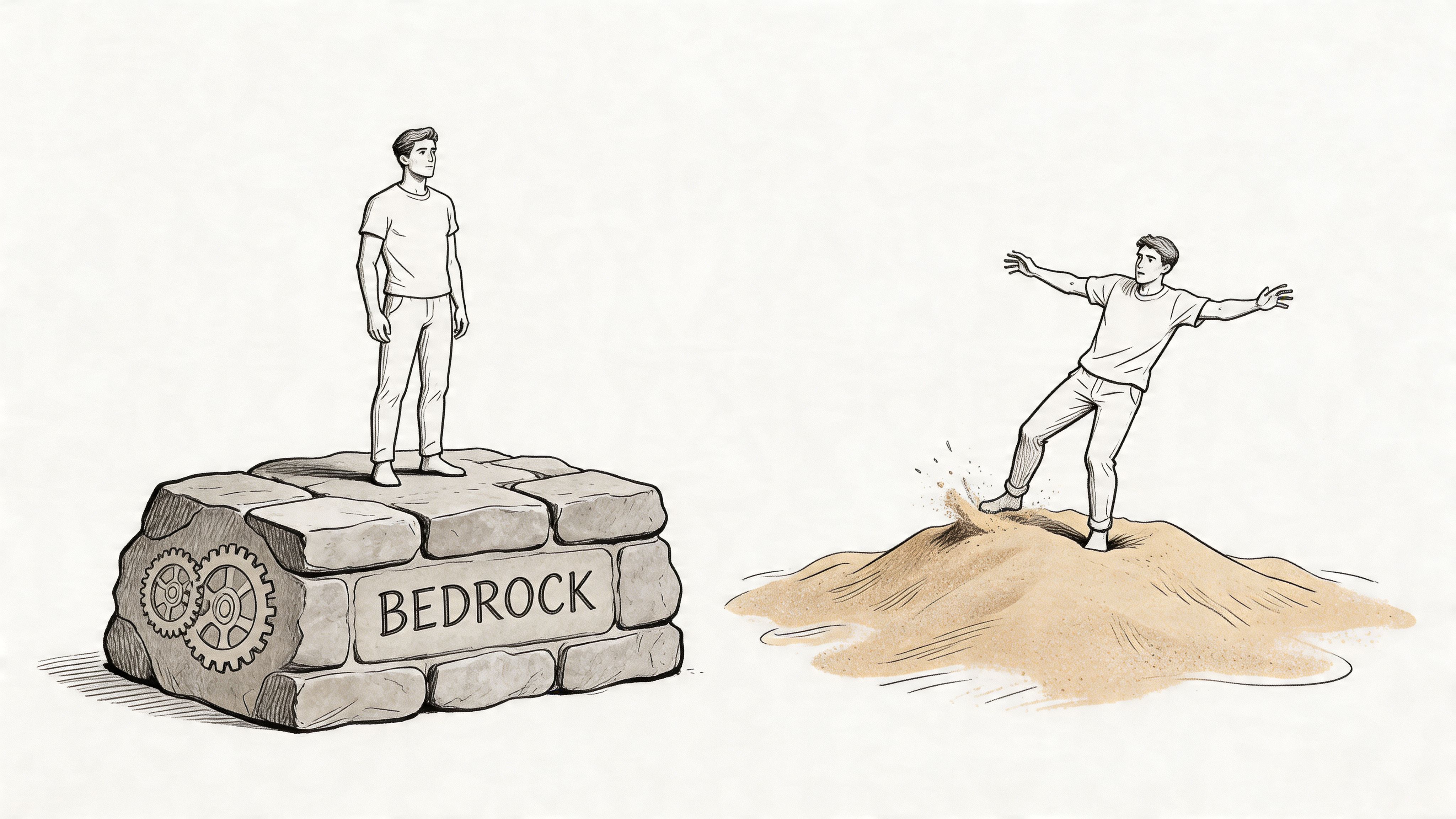
Many build their expert brand on sand. They pick a broad topic because it sounds impressive. Leadership. Innovation. Growth. Strategy. Then they publish generic advice that could’ve come from anyone. That doesn’t create authority. It creates sameness.
Your strongest position sits at the intersection of three things:
Miss one of those and the whole thing wobbles. Passion without demand becomes a hobby. Demand without skill becomes marketing spin. Skill without sustained interest becomes a grind you eventually abandon.
A better approach is to define your niche by the problem you solve, the people you solve it for, and the lens you bring to it.
Here’s a simple way to pressure-test your positioning:
| Question | Weak answer | Strong answer |
|---|---|---|
| Who do you help? | Businesses | B2B SaaS founders moving from founder-led sales to team-led growth |
| What do you help them do? | Grow online | Build a reputation that brings qualified inbound opportunities |
| Why you? | I know branding | I’ve turned complex founder experience into clear authority content and market positioning |
That last line matters. Expertise isn’t just topic knowledge. It’s applied judgment.
If you want authority that lasts, you need a method for getting better faster than your peers. Casual repetition won’t do it. Research on deliberate practice summarized by Cognition Today shows that top performers using a structured method achieve 20-30% faster skill acquisition than people practicing in an unstructured way, with success rates improving to 80-90% in controlled studies.
That matters because founders often confuse work experience with mastery. Time served is not the same as skill built.
Use this structure:
Practical rule: Don’t practice your whole craft at once. Practice the smallest unit that improves the outcome.
Many founders benefit from writing a personal operating philosophy. If you haven’t clarified your values and direction, use this personal mission statement template to define your purpose and values. It gives your expertise a center of gravity.
Demographics are lazy positioning. “I help entrepreneurs” tells me almost nothing. Which entrepreneurs? At what stage? Facing what constraint? Under what pressure?
Strong experts speak to a live problem. They know the exact tension their audience is dealing with.
For example:
That specificity changes your language, examples, offers, and content topics. It also sharpens your online positioning. If you need a practical framework to build an online presence that actually works, focus on consistency between your expertise, your profile, and the problems you solve. Random visibility doesn’t convert. Coherent visibility does.
Ambition often sabotages authority. Founders want to look expansive. They want room to talk about everything. That instinct kills memorability.
A narrower lane doesn’t trap you. It gives people a reason to remember you.
Start with one sentence:
I help [specific audience] solve [specific problem] through [specific lens or method].
If that sentence feels too narrow, you’re probably getting close.
Generic content gets consumed and forgotten. Signature ideas get associated with your name.
That’s the difference between someone who posts and someone who leads. If you want to establish yourself as an expert, you need ideas that organize your experience into repeatable frameworks. Not slogans. Not recycled motivation. Frameworks.
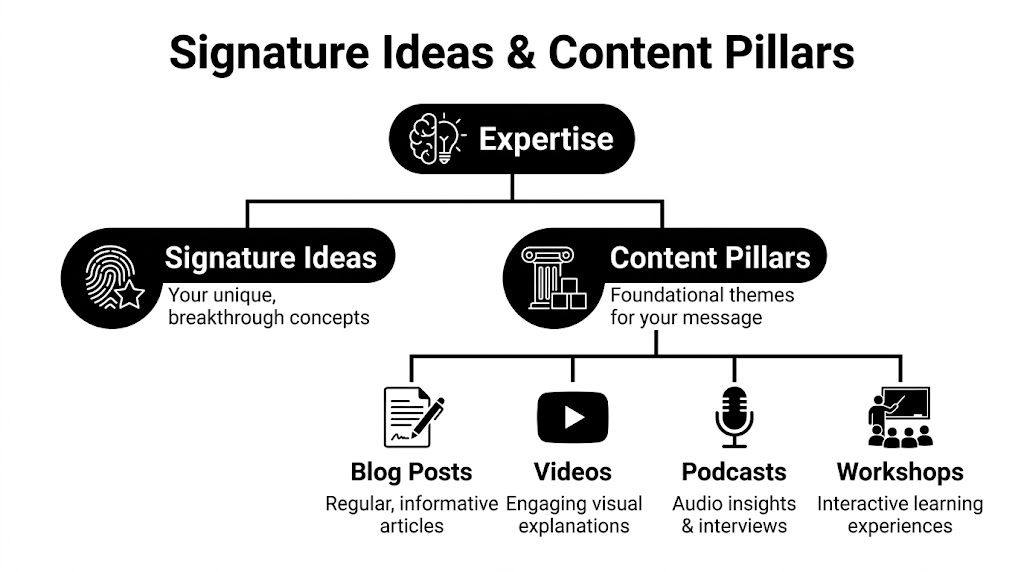
A signature idea is a distinct point of view you can explain in one line, teach in depth, and apply across multiple examples.
It usually comes from one of these places:
If you’re a founder who helps companies grow through trust, a weak idea is “authenticity matters.” Everybody says that. A stronger idea is “authority compounds when expertise, language, and proof all reinforce the same promise.” That’s clearer, more ownable, and easier to build content around.
You don’t need ten signature ideas. You need a few that are useful and repeatable.
Try this filter:
| Test | Bad sign | Good sign |
|---|---|---|
| Can people repeat it? | It needs five minutes of setup | It fits in one sentence |
| Can you teach it? | It’s vague inspiration | It has steps, criteria, or decisions |
| Can you prove it? | It’s just opinion | You can back it with work, stories, or examples |
| Can it travel? | It only works in one post | It can become posts, talks, workshops, and sales language |
Examples of strong founder-level frameworks might include:
If your idea can’t survive outside one post, it’s not a signature idea yet.
Once you’ve got your signature ideas, build content pillars underneath them. These are the recurring themes your audience should expect from you.
A practical setup is four or five pillars. Enough variety to keep content fresh, not so many that your brand blurs.
Here’s a clean founder example:
Talk about what’s changing in your industry, what buyers now expect, what old playbooks no longer work, and where people waste effort.
Share what you’ve learned from hiring, sales, product, delivery, positioning, leadership, or scaling decisions. By doing so, experience becomes authority.
Address the questions prospects keep asking, the objections they bring, and the misconceptions slowing them down.
Teach your process. Show how you think, how you diagnose, how you sequence decisions, and why your approach works.
Use selective stories, failures, and standards to reveal judgment. Not oversharing. Not diary content. Calibrated credibility.
If you want a stronger handle on what thought leadership content is, start here: it’s content built around original perspective and earned insight, not just educational posting.
A lot of strong professionals lose trust at the profile level. Their content says one thing, their bio says another, and their featured links look random.
Fix these areas first:
For a deeper process, use this guide to thought leadership content creation. The key is coherence. Your profile should feel like a landing page for your authority, not a digital filing cabinet.
A strong strategy means nothing if you publish in bursts, disappear for weeks, and come back with no continuity. Inconsistency kills momentum faster than imperfect content ever will.
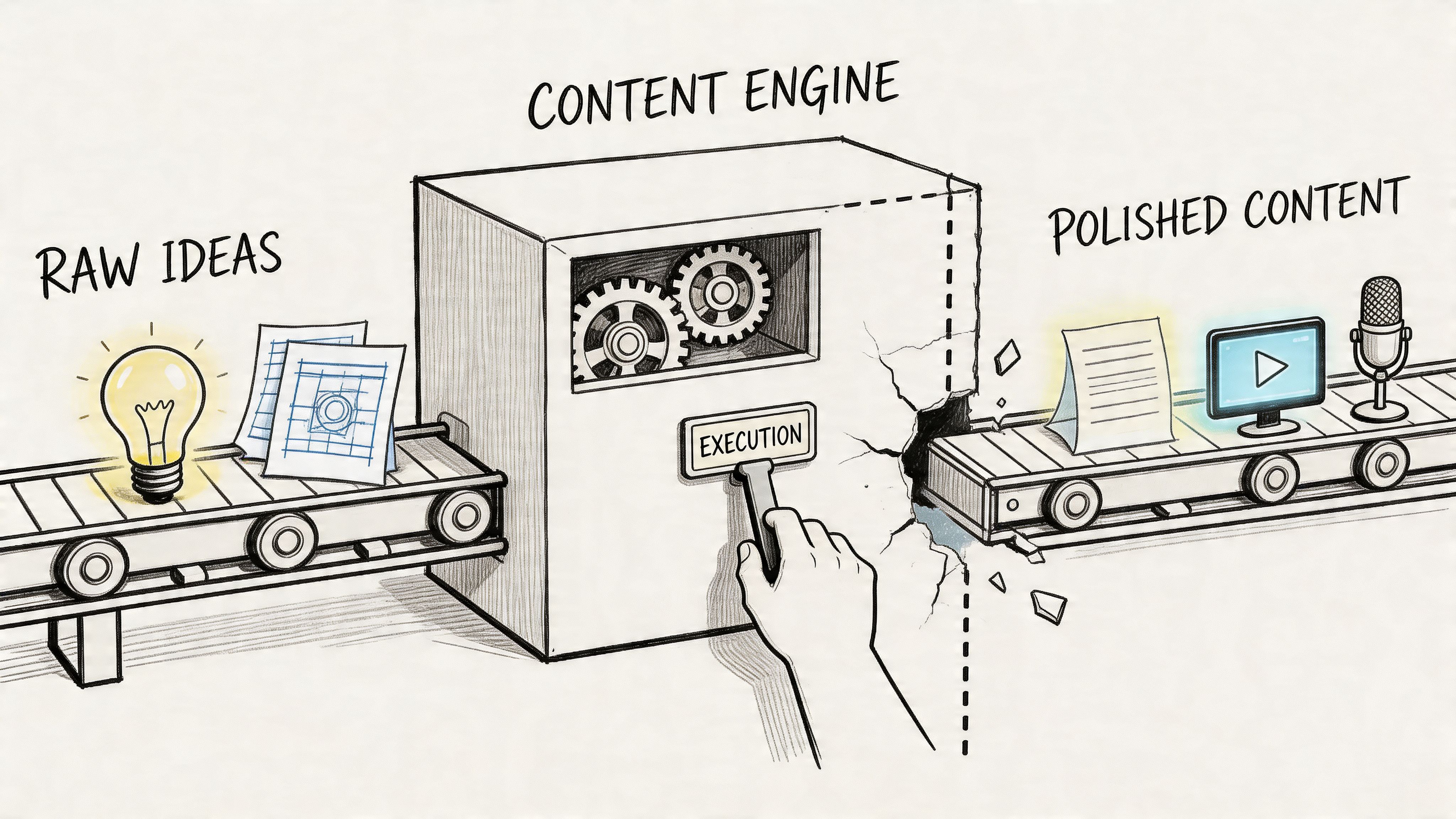
The fix is simple. Stop treating content like spontaneous inspiration. Treat it like an operating system.
A lot of founders stay vague because vagueness feels safe. “Be more active on LinkedIn” sounds reasonable and guarantees nothing. Specific goals create accountability.
According to a Michigan State University study summarized by Jatinder Pal Ahuja, people who write down their goals and share them with an accountability partner have a 76% success rate, compared with 43% for unwritten goals. That’s a 33% higher success rate.
Apply that directly to authority building.
Instead of saying “I need to post more,” say:
Write the goal, assign the cadence, and attach another person to it. That’s how consistency stops being optional.
The most effective content systems usually follow one sequence.
Take one insight, framework, objection, or story. Don’t create five disconnected topics. Build around one strong idea at a time.
Turn that idea into a deeper asset such as a founder memo, article, workshop outline, or recorded monologue. This becomes the source material.
Now break that source asset into multiple pieces:
This keeps your message coherent while reducing the blank-page problem.
Here’s a useful walkthrough on content execution:
Publishing is only half the work. Distribution is where authority starts compounding.
Most founders post and leave. That’s lazy. If you care about being known, stay in the conversation.
A simple distribution routine looks like this:
| Activity | Why it matters |
|---|---|
| Respond to comments with substance | It turns passive readers into engaged followers |
| Comment on relevant industry posts | It expands your visibility in the right rooms |
| Send useful follow-up messages | It moves warm attention into real relationships |
| Re-share winning ideas in new formats | It reinforces your signature themes |
Notice what’s missing. Chasing virality. You don’t need a broad audience. You need the right audience seeing the same valuable ideas often enough to trust your judgment.
Here's where most authority plans break. The system looks good on paper and collapses under real work pressure.
Use the simplest workflow you’ll maintain:
If you don’t want to manage the whole machine yourself, some founders use internal teams, freelancers, or services such as Legacy Builder, which works with founders and professionals to turn their expertise into ongoing content, profile optimization, and strategic distribution. The point isn’t outsourcing for convenience. It’s protecting consistency when your calendar gets crowded.
Calling yourself an expert means very little. Other people believing it means everything.
Many smart founders fail because, despite having real skill, real outcomes, and real experience, they don’t package evidence. So the market defaults to judging them by polish, confidence, and frequency. That’s a mistake you can fix.
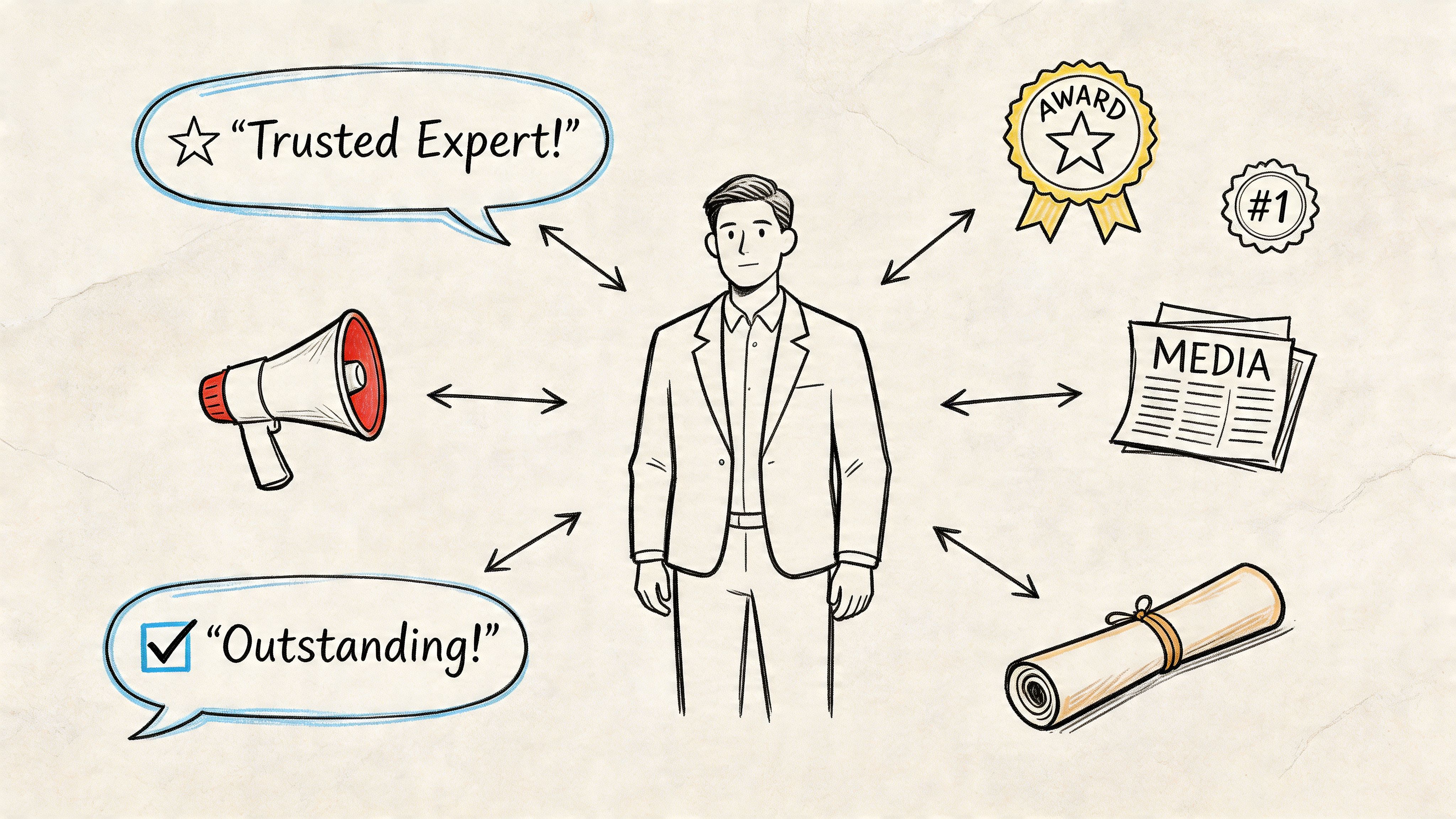
The strongest social proof comes from transformation you helped create. Not compliments. Not vague praise. Evidence.
Weak testimonial:
“Great to work with. Highly recommend.”
Strong testimonial:
“They helped us clarify our positioning, tighten our message, and turn scattered founder insight into content our buyers responded to.”
The second one is better because it names the problem, the intervention, and the result qualitatively. It sounds real.
Ask for testimonials right after a clear win. Don’t wait until months later when the specifics blur. And don’t ask broad questions. Ask prompts that produce usable detail:
You don’t need to publish private client details to build authority. You do need to show your thinking.
Use this case structure:
What was broken, unclear, slow, or underperforming?
What did you notice that others missed?
What did you change in positioning, process, communication, or execution?
Describe the shift qualitatively if you can’t share hard numbers.
That format does two important things. It shows that you can produce results, and it reveals how you think. Discerning buyers care about both.
Good case material doesn’t just prove you worked hard. It proves you made sound decisions.
Media, podcasts, guest essays, event appearances, and expert roundups all matter because third-party platforms lend credibility. But these opportunities are often approached poorly. They pitch themselves too early, too broadly, and with no sharp angle.
A better method is to pitch around a specific idea:
That gives editors, hosts, and organizers a reason to care. Nobody needs another generic “lessons from entrepreneurship” guest.
Speaking works because it compresses expertise into public trust. A good talk signals clarity, confidence, and command.
Start smaller than your ego wants. Internal team sessions, niche communities, customer webinars, founder groups, association events, and private masterminds all count. Strong recordings from smaller rooms often lead to larger opportunities later.
Here’s what to speak about:
| Good topic | Bad topic |
|---|---|
| A repeatable decision framework | Your vague journey to success |
| A common mistake in your niche | A broad motivation talk |
| A case-based lesson with practical takeaways | Generic trends everyone already knows |
The job is not to sound impressive. The job is to be useful in a way that makes people remember who taught them.
Authority gets stronger when multiple signals reinforce each other. Your stack might include:
One strong signal helps. Several aligned signals create trust faster.
Being known is not the finish line. Being durable is.
A lot of people build a personal brand that looks impressive for a season and disappears when attention shifts. That’s what happens when authority is built on social proof without depth, or on activity without a larger body of work behind it.
The long game is different. A summary of research and industry observations in Red Slice notes that 62% of self-proclaimed LinkedIn experts have less than 5 years of experience. The same source says authentic brands that invest in consistent, long-term content see 4x more sustainable authority growth, while the 2025 Edelman Trust Barometer cited there reports a 15% drop in trust for online influencers. The point is obvious. Audiences are getting better at spotting borrowed credibility.
Legacy-level authority shows up in signals that matter more than likes.
Look at:
Those signals tell you whether your authority is portable. If your influence only exists on your own profile, it’s still fragile.
Once your authority has traction, package it into things that outlast the feed.
Some founders should build a consulting or advisory offer around their method. Others should write a book, launch a workshop series, create a course, build a media platform, or turn their content engine into a category-defining point of view.
Choose the asset that best fits your strengths:
| If you’re strongest at | Build this |
|---|---|
| Diagnosing complex problems | Advisory or consulting offer |
| Teaching clearly | Course, workshop, or cohort program |
| Framing ideas publicly | Book, newsletter, or podcast |
| Convening people | Community, event series, or movement |
Don’t build all of them at once. Pick the one that deepens your authority instead of fragmenting it.
This is the real shift. Legacy-level authority stops depending entirely on your daily presence. Your ideas become systems, assets, standards, and IP that other people can engage with, apply, and share.
That’s how an expert becomes a leader. Not by posting more. By building a body of work that keeps teaching, signaling, and attracting long after a single post fades.
If you want to know how to establish yourself as an expert, stop asking how to look credible faster. Ask how to become more useful, more distinct, and more provable over time.
That means building depth before chasing attention. Turning your experience into signature ideas. Publishing consistently enough to create familiarity. Backing your claims with visible proof. Then packaging your authority into assets that outlast the algorithm.
The people who matter can tell the difference between performance and substance. Build substance first. Then let the brand catch up.
If you’re ready to turn real expertise into a clear authority strategy, Legacy Builder helps founders and professionals translate their experience, ideas, and point of view into consistent content, stronger positioning, and a brand that compounds over time.


You could – but most in-house teams struggle with the nuance of growing on specific platforms.
We partner with in-house teams all the time to help them grow on X, LI, and Email.
Consider us the special forces unit you call in to get the job done without anyone knowing (for a fraction of what you would pay).
Short answer – yes.
Long answer – yes because of our process.
We start with an in-depth interview that gives us the opportunity to learn more about you, your stories, and your vision.
We take that and craft your content then we ship it to you. You are then able to give us the final sign-off (and any adjustments to nail it 100%) before we schedule for posting.
No problem.
We have helped clients for years or for just a season.
All the content we create is yours and yours alone.
If you want to take it over or work on transitioning we will help ensure you are set up for success.
We want this to be a living breathing brand. We will give you best practices for posting and make sure you are set up to win – so post away.
Subscribe to our newsletter and get insights on how to grow your personal brand.
