.svg)
Subscribe to our newsletter and get insights on how to grow your personal brand.
Thank you! Your submission has been received!
Oops! Something went wrong while submitting the form.
.svg)


Ever get that sinking feeling?
You’ve just landed a huge client, your audience is growing, or you’ve shipped a project you’re proud of, but instead of celebrating, a voice in your head whispers, “It was just a fluke. Any minute now, they’ll figure out I have no idea what I’m doing.”
If that sounds familiar, you’ve met imposter syndrome. It’s not just a little self-doubt; it’s that nagging, persistent fear that you’re a fraud and your success is completely undeserved.
This feeling gets cranked up to eleven when you're building a personal brand. You're putting your ideas, your expertise, and your face out there for the world to see. Every post, every video, every comment can feel like a performance, making it way too easy to compare your messy, behind-the-scenes reality with someone else's perfectly polished highlight reel.
That feeling of being an imposter is ridiculously common, especially among people who are pushing themselves to grow. High achievers are prime targets because the game they're playing—innovating, learning, and performing—never really ends.
The numbers back this up. A recent study found that 62% of adults have felt imposter syndrome at work in the past year alone. For younger professionals and creatives—the very people most likely to be building a brand online—that number is even higher. So let’s be clear: this isn't a personal flaw. It's a shared experience.
This is what it looks like in the wild:
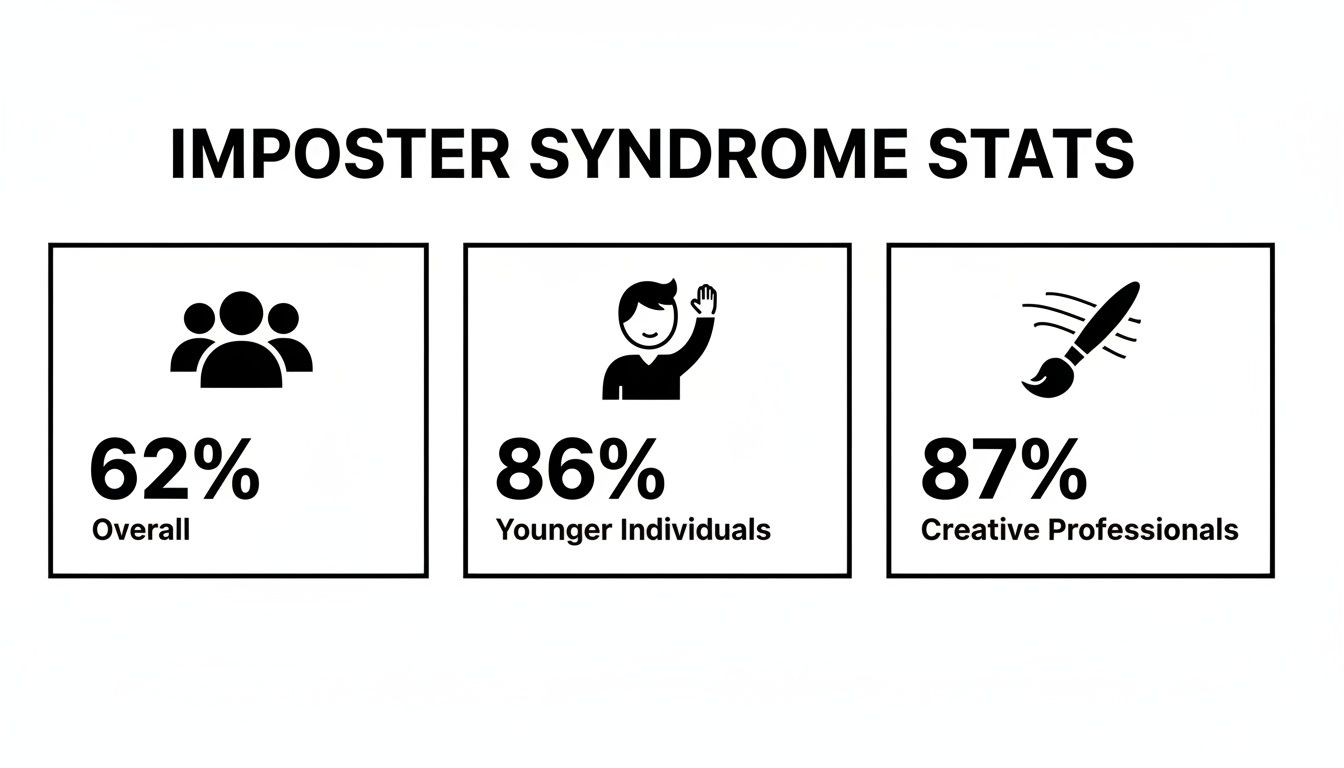
As you can see, creatives and younger pros—the ones on the front lines of building an online presence—feel this the most.
For leaders and entrepreneurs, this isn't just some internal battle. It directly torpedoes your growth. That fear of being "found out" and judged is paralyzing, and it usually shows up in a few classic ways:
I created a simple table to help you catch these thoughts in the act and reframe them on the spot. It's all about trading that internal feeling for an external, evidence-based reality check.
Recognizing these triggers is the first step. The goal isn't to get rid of self-doubt for good—a little humility keeps you hungry and open to learning. The real objective is to build a toolkit to manage it.
When you learn to handle these feelings, they stop being a roadblock. Instead, they become a signal—a chance to connect with your audience on a real, human level by sharing the actual journey, not just the highlight reel. Our guide on a modern playbook for personal branding for leaders digs deeper into how to build that authentic presence.
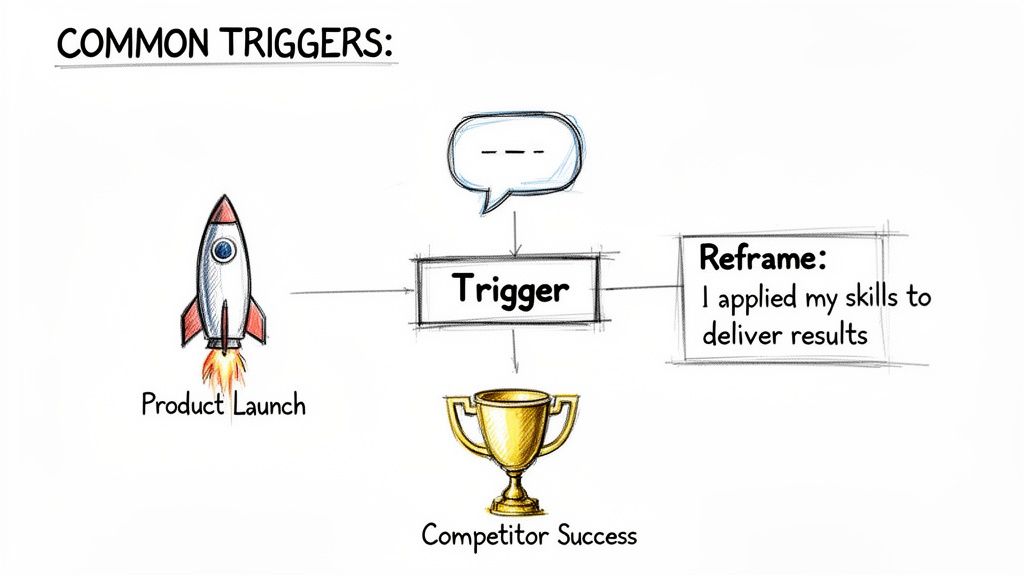
Imposter syndrome doesn't just show up out of the blue. It’s a reaction, and it needs a trigger—a specific situation, thought, or comparison that makes you feel like a fraud.
If you’re building a personal brand, you know these moments well. It’s that wave of doubt that hits right before you launch a new service. It’s the sting you feel after reading a critical comment. Or maybe it’s seeing a competitor’s perfectly polished success story pop up on your LinkedIn feed.
Getting a handle on this starts with identifying exactly what sets it off for you.
For the next week, become a detective of your own thoughts. Pay attention to when that feeling of inadequacy spikes. Was it during a sales call? While drafting a post? Note the specific context. Vague feelings are hard to fight, but specific triggers are problems you can solve.
Once you start looking, you’ll see the patterns. Your triggers likely fall into a few common buckets, especially when you’re putting yourself out there.
Common Triggers for Brand Builders:
These moments feel threatening because they open you up to judgment, which your brain's inner imposter takes as proof of fraud. It's really just a form of internal questioning. If you want to build a stronger foundation, it helps to learn how to overcome self-doubt from the ground up.
Once you know your triggers, you can start challenging the thoughts they create. This is a classic technique called Cognitive Reframing, and it's all about questioning your automatic negative thoughts and swapping them for more balanced, evidence-based ones.
An imposter thought is an emotional reaction, not a statement of fact. Your job is to separate the two.
Key Takeaway: Feelings are not facts. Your feeling of being an imposter is a signal, not a verdict. Reframing helps you respond to the signal with logic instead of letting the feeling take over.
This isn’t about forced positivity. It's about creating a realistic and constructive inner script that actually serves you better than the default "I'm a fraud" narrative.
To make this practical, create a "Reframe Script" for your top 2-3 triggers. Think of it as a pre-written response you can pull out the moment you feel imposter syndrome creeping in.
Here's a simple way to structure it:
Let's run through another one. Say you just wrapped up a successful launch.
By actively identifying your triggers and preparing these reframes, you're building a mental toolkit. You stop the imposter cycle before it spins out of control, turning moments of doubt into opportunities to reinforce what you're actually capable of. This is how you start to own your success.
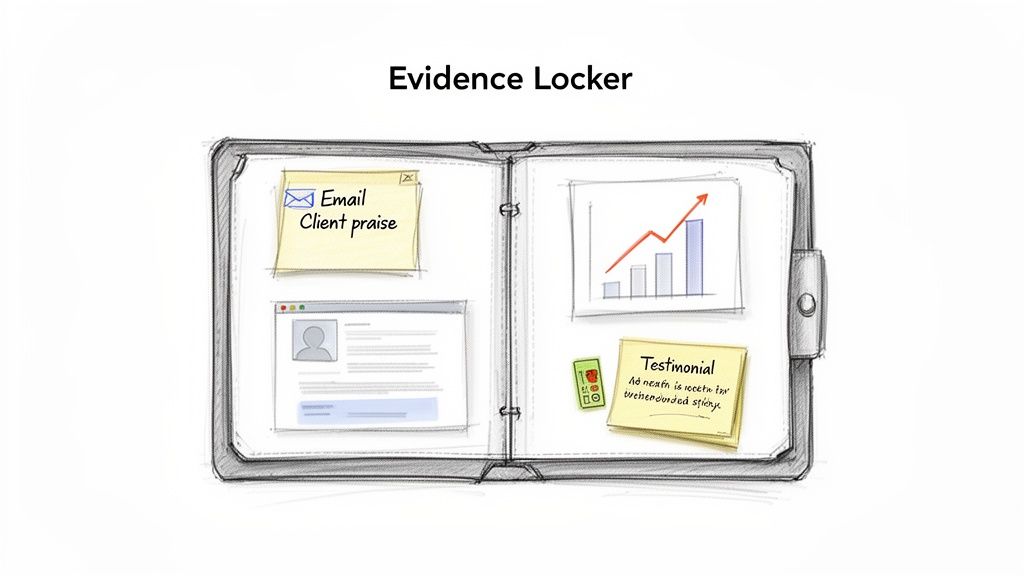
That nagging voice of imposter syndrome? It loves ambiguity. It thrives on vague feelings and has a nasty habit of writing off your biggest successes as pure luck.
The best way to shut it down is with cold, hard proof. This is where an Evidence Locker comes in. It’s a dedicated spot where you collect undeniable proof of your skills, your impact, and your wins.
Think of it like you're building a legal case against your own self-doubt. The next time your brain whispers, "You're a fraud," you can open your locker and hit it with objective evidence that says otherwise. It's a simple habit, but it makes your achievements tangible and irrefutable.
This whole process is a direct counterattack on our tendency to obsess over one tiny mistake while completely ignoring a hundred wins. It forces you to actually see and internalize your successes, building a foundation of confidence that's based on fact, not feelings.
Your locker needs to be a mix of warm, fuzzy praise and cold, hard data. The goal is simple: capture any piece of evidence that proves you're competent, helpful, and moving forward. Don't second-guess it. If it feels like a win, it belongs in the locker.
Here’s what I always tell my clients to save:
Documenting this stuff is a direct antidote to the paralysis that imposter syndrome causes. One report found that 63% of people who feel like imposters end up procrastinating. An evidence log makes your success so obvious that it's hard to justify stalling.
Look, the system doesn't have to be fancy. It just has to be consistent. The easier you make it to add new proof, the more likely you are to actually do it.
My Personal Tip: I use a simple Notion database tagged with things like "Client Praise," "Speaking Gig," and "Data Win." When I feel that doubt creeping in before a big presentation, I spend five minutes scrolling through it. It’s an instant confidence boost because it's grounded in reality.
Here are a few dead-simple ways you can start today:
By the way, organizing your wins isn't just for your own sanity—it's also a killer way to gather material for future marketing. You're building a resource library. Those client testimonials? They're the backbone of case studies that sell. In fact, we have a whole guide on how to write business case studies that actually convert that shows you how to turn these wins into assets.
The real key here is to make capturing evidence a reflex. Get a great email? Screenshot it and drop it in the folder immediately. See a positive comment? Add it to your Notion page before you even think about replying. Make this a seamless habit, and your Evidence Locker will become an undeniable record of your value—ready to silence your inner critic for good.
Having an Evidence Locker is a game-changer for fighting imposter syndrome with cold, hard facts. But real, lasting confidence isn't built in a day—it's forged in the small, consistent actions you take every single day.
It’s all about weaving new habits into your life that systematically build you up over time. This isn't about piling more onto your to-do list. It’s about making tiny shifts that deliver massive results.
We're going to zero in on three practical habits that get right to the root of imposter syndrome. These aren't quick fixes. They're sustainable practices that train your brain to see your value, lean into growth, and handle feedback like a pro. The goal is to make self-assurance your new default setting.
Imposter syndrome loves it when you ignore your daily wins. The "5-Minute Win Journal" is a dead-simple way to fight back. It forces you to hunt for and acknowledge your successes, no matter how small they feel.
At the end of each day, just take five minutes. Write down three things that went well. And get specific. Don't just jot down "finished a project." Dig into the details of how you made it happen.
What kind of "wins" should you track?
This simple act retrains your brain to scan for positives instead of just defaulting to threats and flaws. Over time, you build an internal library of your own competence, making it a lot harder for that inner critic to tell you it was all "just luck."
You don't build confidence by staying in your comfort zone. You build it by stepping just outside of it. A micro-challenge is a small, intentional step that feels a little scary but is totally doable. We're not talking about diving into the deep end here—it's about consistently dipping your toes in the water.
The trick is to pick something with low stakes but a high potential for that "I did it" feeling. Think of it like lifting weights. You don't start with the heaviest plates in the gym. You start light and build strength.
A micro-challenge is a deliberate step into discomfort. By proving to yourself you can handle small risks, you build the resilience and self-trust needed to take on bigger opportunities without being derailed by fear.
Micro-Challenge Ideas for Anyone Building a Brand:
Every time you complete one of these, you send a signal to your brain: "See? I can handle this." It’s this incremental progress that builds authentic, earned confidence that won't crumble under pressure.
When you feel like an imposter, feedback can feel like a personal indictment. The key to getting over this is to build a system for how you seek and process feedback, separating your worth from your work. It’s about turning criticism into a tool for growth, not a confirmation of your deepest fears.
Don't just wait for random comments to roll in. Proactively ask for input from a handful of people you trust. And when you ask, be specific. A vague "what do you think?" gets you vague (and useless) replies. As you work to build these new muscles, you might also want to explore evidence-based ways to improve confidence and set healthy boundaries to really solidify this practice.
A Simple Framework for Getting Better Feedback:
When you take control of the feedback process, you turn it from something you dread into a core part of your strategy. Having room to improve doesn't make you a fraud—it makes you a professional who's committed to getting better.
Let's be honest. The hardest part of building a personal brand isn't figuring out the LinkedIn algorithm; it's the internal battle that happens right before you hit "publish." It's that voice in your head screaming, "Who are you to say this?"
That feeling—the raw fear of being called out as a fraud—is what keeps so many smart, capable professionals from sharing what they know. It keeps them playing small.
The pressure to show up as the perfect, all-knowing "expert" is suffocating. But what if you changed the goal? What if it wasn't about proving your expertise, but simply sharing your experience?
That one simple shift changes everything. It takes the power away from imposter syndrome and gives you permission to show up as you are.
Your audience isn't searching for a flawless guru who’s never put a foot wrong. They're looking for a guide—someone who’s just a few steps ahead and is willing to share the real story of how they got there. The bumps, the detours, and the hard-won lessons are the most valuable parts.
Authenticity isn't about airing all your dirty laundry. It's about letting people see the process, not just the polished final product.
This is how you build real trust and a human connection that sterile, "expert-only" content can never touch. It’s the foundation of genuine brand authenticity. If you want to dig deeper into this, we've covered more on what is brand authenticity and why it matters right here.
People connect with stories of struggle and growth because they see themselves in them. When you talk about a challenge you overcame, you’re not just telling a story; you're handing them a roadmap and giving them permission to be imperfect, too.
This is where you stop performing and start connecting.
It’s also a powerful way to neutralize one of the biggest fears tied to imposter syndrome: making mistakes. Research from the Executive Development Network found that 61% of professionals with imposter syndrome are terrified of making errors.
By reframing your "mistakes" as valuable lessons in your content, you turn a perceived weakness into a source of strength and connection.
When that "I'm a fraud" feeling hits, creating content is the last thing you want to do. That's when you need a go-to playbook. These prompts are designed to pull you out of your own head and into sharing mode.
Here are a few ideas to get you started.
Use these prompts as a launchpad. The goal is to prove to yourself that your experiences—even the messy ones—are valuable to others.
Remember, vulnerability builds connection. When you share a lesson learned from a misstep, you’re not admitting to being a fraud. You are demonstrating wisdom, resilience, and a commitment to growth—qualities that attract a loyal and engaged audience.
Your experience is your expertise.
Stop waiting for some imaginary day when you finally feel "ready" or "expert enough." That day never comes, because the goalposts always move.
Instead, start sharing from where you are right now. Share what you're learning, what you're building, and what you’re figuring out along the way. That is the story only you can tell, and it’s the one your audience is waiting for.
If you’re feeling like a fraud, trust me, you’re not alone. A lot of questions pop up when you start digging into imposter syndrome. Let's get straight to the ones I hear most often from high-performing professionals.
This one’s crucial. People often confuse the two, but they couldn't be more different.
Humility is healthy. It's about knowing you're good at what you do but also recognizing you don't have all the answers. It keeps you grounded and open to learning from others. Imposter syndrome, on the other hand, is a destructive internal narrative. It’s that nagging voice convinced you’re a total fraud who got here by dumb luck, no matter what the evidence says.
Here’s the difference in plain English:
One fuels curiosity and teamwork. The other fuels anxiety and makes you want to hide.
Honestly? For most high-achievers, probably not completely. And that's okay. The goal isn't to silence every last shred of self-doubt—a little bit keeps you on your toes and stops you from becoming arrogant.
The real win is changing your relationship with that voice.
You get better at spotting it the moment it shows up. You learn to connect it to a trigger—like a big presentation or a new project—and then you pull out the tools. You hit it with the facts from your Evidence Locker and reframe the thought on the spot. Over time, the imposter voice gets a lot quieter, and you get incredibly fast at shutting it down.
It stops being this terrifying monster under the bed and becomes more like that annoying neighbor who always complains. You know their patterns, you stop taking them seriously, and you get on with your day.
The intensity dies down. The frequency drops. You’re in control, not the doubt.
Leading a team while fighting your own imposter syndrome is a whole different level of tough. You feel this immense pressure to be bulletproof, which makes it hard to admit when you're uncertain.
But here’s the secret: being transparent about your own growth is one of the most powerful things you can do for your people. It shows them it’s okay to be human.
Here are a few ways to do it without announcing "I feel like a fraud!" to your whole team:
When you lead with this kind of authenticity, you create a culture where it’s safe to take risks, ask for help, and learn from mistakes. That's the ultimate antidote to an environment where imposter syndrome thrives—and it's how you build a team that’s truly unstoppable.
Building an authentic personal brand is the ultimate countermove to imposter syndrome, but showing up consistently can be draining. Legacy Builder turns your unique story and expertise into high-impact content so you can focus on leading, not just posting. We handle the strategy, creation, and distribution to build your influence online.
Ready to build a brand that’s undeniably you? Visit us at https://www.legacybuilder.co.


You could – but most in-house teams struggle with the nuance of growing on specific platforms.
We partner with in-house teams all the time to help them grow on X, LI, and Email.
Consider us the special forces unit you call in to get the job done without anyone knowing (for a fraction of what you would pay).
Short answer – yes.
Long answer – yes because of our process.
We start with an in-depth interview that gives us the opportunity to learn more about you, your stories, and your vision.
We take that and craft your content then we ship it to you. You are then able to give us the final sign-off (and any adjustments to nail it 100%) before we schedule for posting.
No problem.
We have helped clients for years or for just a season.
All the content we create is yours and yours alone.
If you want to take it over or work on transitioning we will help ensure you are set up for success.
We want this to be a living breathing brand. We will give you best practices for posting and make sure you are set up to win – so post away.
Subscribe to our newsletter and get insights on how to grow your personal brand.
