.svg)
Subscribe to our newsletter and get insights on how to grow your personal brand.
Thank you! Your submission has been received!
Oops! Something went wrong while submitting the form.
.svg)



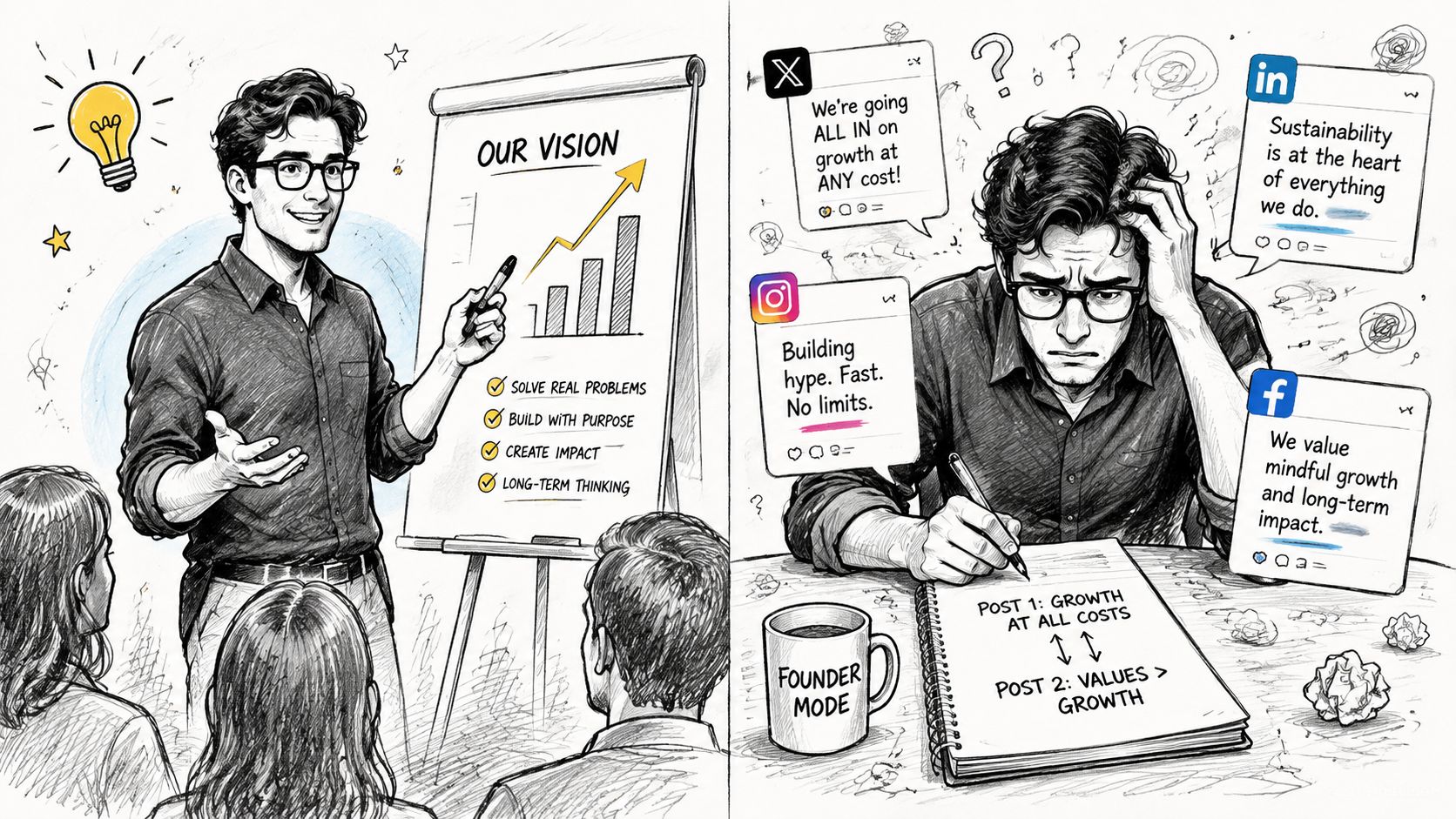
You publish a sharp LinkedIn post on Monday, send a thoughtful email on Wednesday, and update your website on Friday. Each piece sounds reasonable by itself. Together, they make your audience wonder whether they're looking at one brand or several unrelated ones.
That problem rarely starts with a lack of ideas. Founders and professionals usually know what they want to say. The breakdown happens later, when content moves through multiple channels, contributors, approval steps, templates, and AI tools. Consistent brand messaging is a systems problem before it's a writing problem.
Many professionals treat consistency as a polish issue. They worry about using the same colors, formatting a logo correctly, or choosing a preferred spelling. Those details matter, but they're not the central risk. The larger problem appears when your audience receives conflicting answers to basic questions: Who are you? Who do you help? What do you believe? Why should anyone trust you?
A founder may sound direct and commercially focused in a sales call, reflective and personal on LinkedIn, and heavily corporate on the website. Each version may have been written with good intentions. Yet the audience has to rebuild its understanding of the brand every time it encounters a new channel.
Lucidpress and Marq research linked consistent brand presentation with revenue increases ranging from 10% to 33%, based on surveys conducted in 2016 and updated in 2019. The earlier research connected consistency with roughly 23% higher revenue, while the later work estimated an impact of as much as 33%. These findings are summarized with their methodology in brand consistency statistics from Omnibound.
The lesson isn't that repeating a slogan automatically creates revenue. It's that consistent presentation helps buyers recognize your positioning and understand your promise without unnecessary interpretation. Recognition reduces the work your audience must do before it can evaluate your offer.
A separate benchmark found that consistently presented brands were three to four times more likely to achieve excellent brand visibility, while 71% of respondents identified market confusion as the main downside of inconsistent brand use. The same report found that organizations with consistency problems estimated an average 23% revenue lift from always presenting their brand consistently, as documented in the Impact of Brand Consistency report.
Practical rule: If your audience needs to decode your positioning from scratch on every channel, your brand is paying an attention tax.
The issue persists even inside companies that have written guidelines. 81% of companies report dealing with off-brand content, while only about 25% of companies with brand guidelines say they enforce them consistently. Separate industry reporting found that 63% of marketers struggle to keep content consistent across channels, according to DASO Content's brand consistency statistics.
That gap explains why a tone document alone rarely fixes the problem. Teams need an approved message architecture, accessible examples, ownership rules, review points, and a way to retire outdated language. Without those pieces, every new contributor improvises.
For a deeper explanation of the relationship between repetition, recognition, and trust, read what brand consistency means and why it builds unshakable trust. The practical shift is simple: stop asking whether a piece of content sounds good in isolation. Ask whether it reinforces the same recognizable brand the audience encountered yesterday.
Consistent messaging starts with narrowing your subject, not expanding your content calendar. If your brand tries to speak to everyone about everything, contributors have no stable decisions to make. They choose different audiences, benefits, examples, and emotional angles, then create drift without realizing it.
Your pillars should function as message boundaries. They tell you what your brand repeatedly returns to, what it can credibly discuss, and which topics belong somewhere else.
Collect the language your audience already uses. Review sales call notes, customer questions, onboarding conversations, testimonials, support requests, and your own strongest content. Look for repeated problems, desired outcomes, objections, and phrases that describe your distinctive approach.
Then answer these questions in writing:
Write several possible answers before editing. The first version usually describes your services. The stronger version describes the change your audience wants and the belief that guides your method.
Choose three or four themes that meet all of these tests:
Give every pillar a short name and a one-sentence definition. Add three supporting points, one proof source, and one boundary. The boundary matters because it prevents a pillar from becoming a vague category that can justify any topic.
For example, a personal branding consultancy might define a pillar around authentic authority. Its supporting points could include turning lived experience into useful ideas, making expertise accessible, and preserving a founder's natural voice during production. Its boundary might exclude generic motivational content with no connection to the founder's expertise.
Your pillars shouldn't compete equally in every piece. Select one primary pillar for each asset, then use another as supporting context. This creates variation without changing the brand's underlying position.
A useful hierarchy looks like this:
A sales page might lead with the master promise and support it with process proof. A social post might lead with a sharp belief from one pillar. An email might connect two pillars through a personal story. The wording changes, but the architecture stays intact.
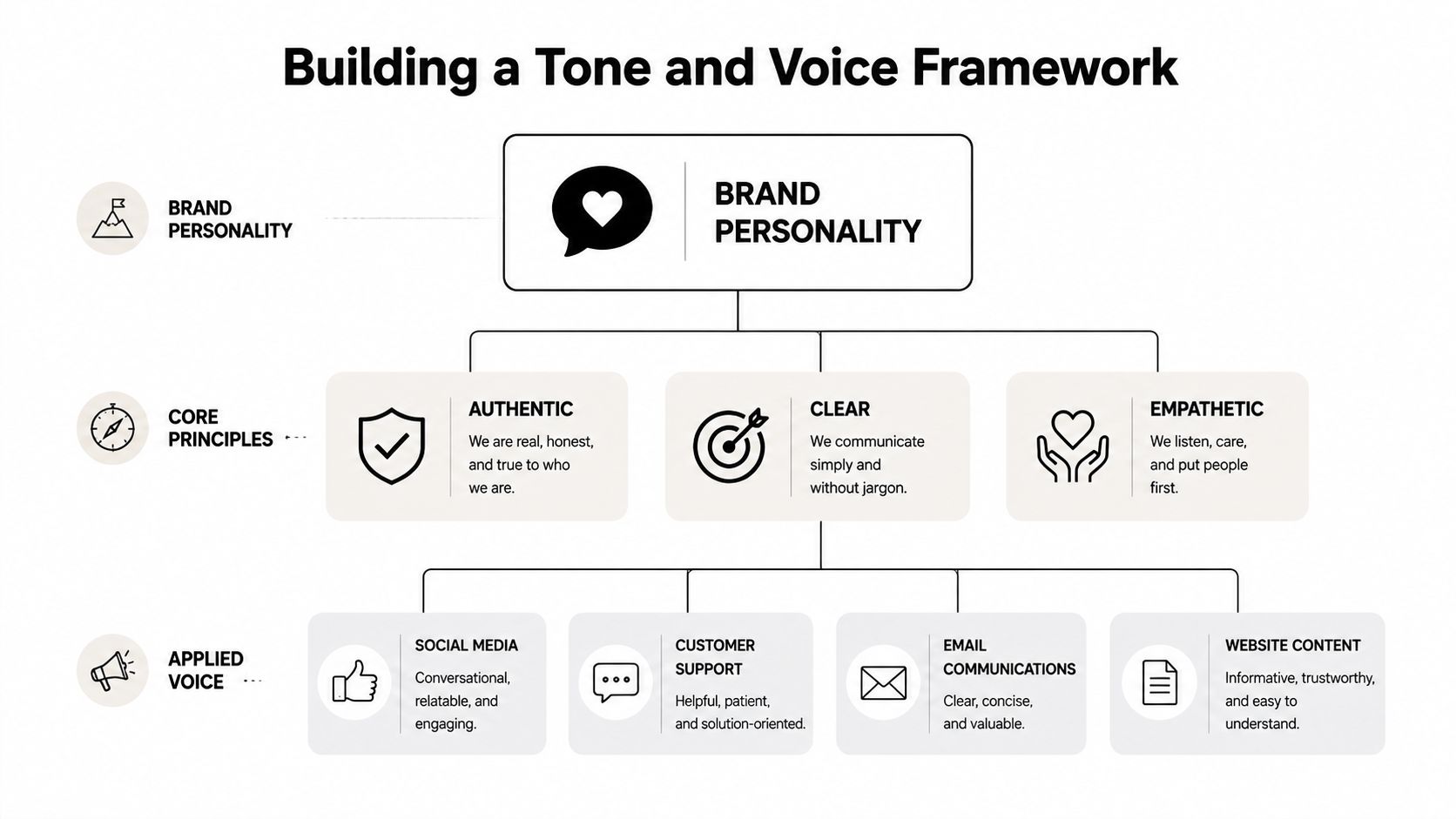
Brand pillars define what you say. Voice defines the recognizable character behind those ideas, while tone adjusts that character to the situation. Your voice should remain stable. Your tone can become warmer in customer support, more decisive in a sales proposal, and more conversational in a social post.
A weak tone document lists forbidden words and vague adjectives such as “professional,” “friendly,” or “effective.” Those labels don't tell a writer what to do. A useful framework converts personality into observable choices.
Choose three or four personality traits, then define each one through behavior.
| Personality trait | Writing behavior | Avoid |
|---|---|---|
| Clear | Use concrete verbs, short explanations, and specific examples | Dense jargon and abstract claims |
| Direct | State the recommendation before the background | Long introductions and hedging |
| Empathetic | Name the reader's real constraint without dramatizing it | Patronizing reassurance |
| Insightful | Explain the trade-off behind the advice | Advice that could apply to anyone |
This turns “sound authoritative” into an editorial decision. Authority doesn't require inflated language. It can come from clear judgment, relevant experience, and the willingness to explain what fails.
Keep the document short enough that a writer will use it during production. Include:
The examples do more work than the adjective list. “We help businesses achieve growth” is broad and forgettable. “We turn a founder's scattered expertise into a repeatable content system” gives a writer a clearer model of specificity, audience, and value.
A visual identity can reinforce this framework, but it shouldn't replace it. The Department of Vibe manifesto on visual identity is a useful resource for thinking about how design choices express a brand's character rather than merely decorate content.
Channel adaptation is necessary. Copying identical language everywhere creates its own kind of stiffness. A thoughtful controlled experiment with 198 participants found that strategic consistency across different tools produced more positive brand associations and a stronger brand attitude than simple repetition of the same message. The findings are available in this cross-tool campaign consistency study.
Use the same idea in a form that fits the context. A social post can challenge a common assumption. An email can develop the reasoning. A sales conversation can connect the idea to the buyer's situation. The core position remains stable, while the delivery respects the channel.
For practical guidance on turning principles into usable standards, see brand voice guidelines that actually stick. Your framework works when another person can apply it without asking you to rewrite every sentence.
A messaging matrix turns brand strategy into a working reference. It connects each channel's job to your pillars, proof, audience context, and tone adjustment. Without it, content planning becomes a sequence of isolated requests: “We need a post,” “We need an email,” or “We need copy for this deck.”
The matrix changes the starting question. Instead of asking what to publish, your team asks which pillar should serve which audience need on which channel.
| Workflow | How it works | Common result |
|---|---|---|
| Reactive content production | A contributor starts with a blank page and chooses a topic, angle, and tone independently | Frequent reinvention and message drift |
| Governed content production | The contributor selects a pillar, audience problem, proof point, and channel format from an approved system | Faster decisions with a recognizable through-line |
The governed model doesn't eliminate creativity. It removes low-value decisions so writers can spend their attention on framing, examples, and useful insight.
Use a spreadsheet, Airtable, Notion database, or another tool your team already opens. Keep one row for each channel and add columns for the audience context, primary pillar, supporting pillar, approved promise, proof options, tone adjustment, call to action, and review level.
| Channel | Primary Goal | Tone Adjustment | Example Hook |
|---|---|---|---|
| Demonstrate expertise and point of view | Direct, conversational, experience-led | “Most founders don't have an idea problem. They have a system problem.” | |
| Email newsletter | Develop trust and deepen an argument | Personal, explanatory, reflective | “The content looked polished, but the audience still couldn't describe the offer.” |
| Website | Clarify value and support evaluation | Precise, confident, outcome-focused | “Turn scattered expertise into a consistent public presence.” |
| Sales deck | Help a buyer understand fit and next steps | Structured, evidence-led, specific | “Here's where the current process loses consistency.” |
| Customer support | Reduce uncertainty and protect confidence | Calm, empathetic, action-oriented | “Here's what happens next, and what you can expect from us.” |
Treat the example hooks as starting points, not permanent copy. The matrix should guide decisions while leaving room for timely observations and channel-specific language.
Assign one owner to maintain the matrix. Every new campaign should record the approved core message, the variations used by channel, and any objections that surfaced. When a phrase starts appearing in multiple places, decide whether it belongs in the official system or should remain campaign-specific.
Your operational details count as brand touchpoints too. An organized email signature setup with SigFinch can help keep contact information, role descriptions, and links aligned across a team. The point isn't to make every signature identical. It's to prevent small inconsistencies from undermining a professional experience.
Review the matrix whenever your offer, audience, or positioning changes. Don't revise it because one post underperformed. Revise it when the business has made a meaningful strategic decision.
Governance earns a bad reputation when it means sending every caption through several layers of approval. That approach protects nobody for long. It slows publishing, frustrates contributors, and encourages people to work around the process.
Useful governance does something different. It makes the right action obvious, gives the right person ownership, and reserves review for content that carries meaningful risk. The purpose is not to control every sentence. It's to protect the message while helping the team move.
Start by classifying content according to risk and strategic importance.
Then assign named owners. One person should own the messaging architecture. Another can manage the editorial calendar. Channel owners can adapt content within the approved framework. Reviewers should know exactly what they're checking, such as factual accuracy, audience fit, voice, compliance, or strategic alignment.
Governance principle: Approve the boundaries centrally, then let capable people create inside them.
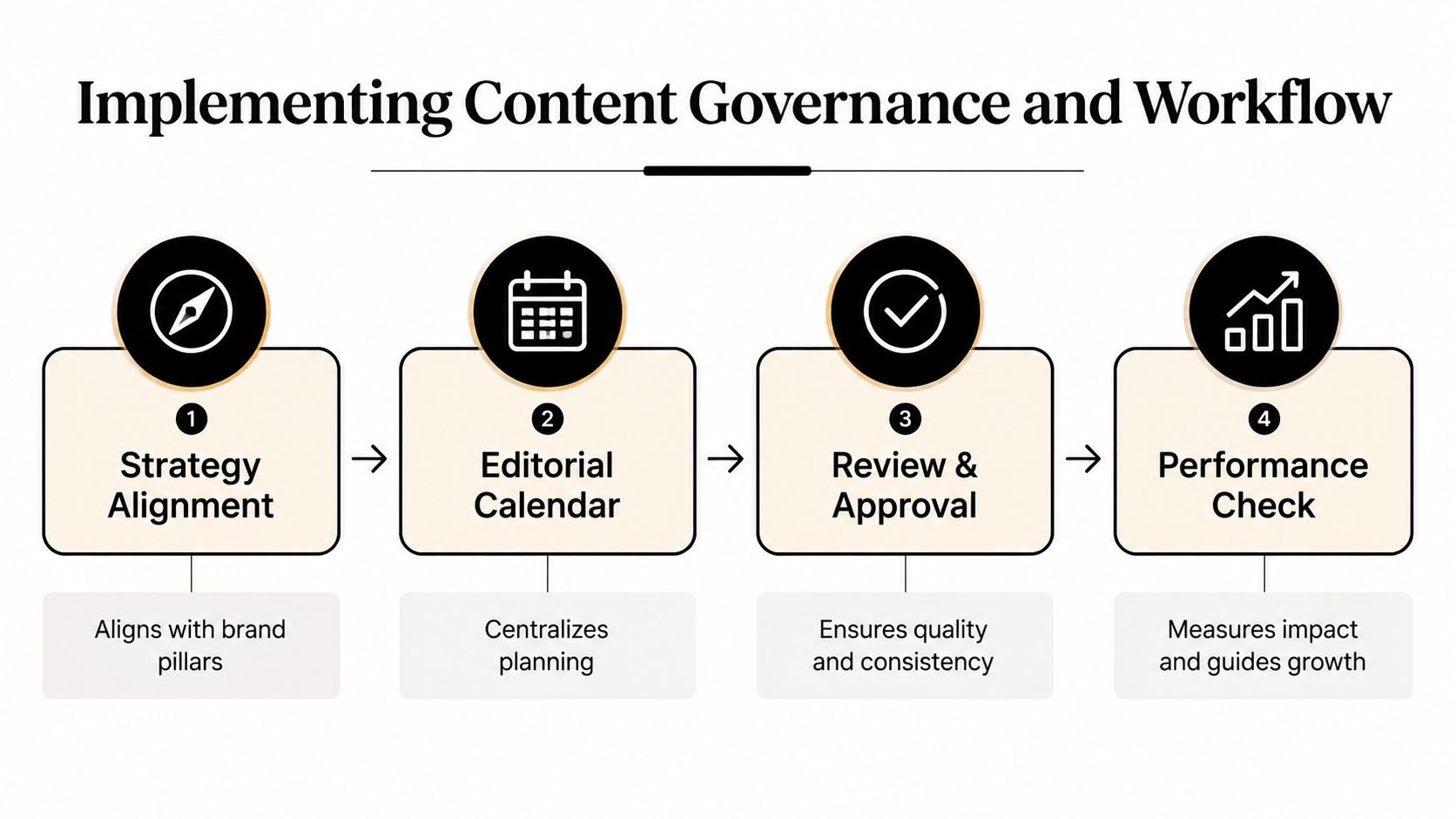
Strategy alignment comes first. Every brief should identify the audience, primary pillar, intended action, and relevant proof. If a contributor can't complete those fields, the content isn't ready to write.
Editorial planning gives the message a place in the broader sequence. Mark the channel, format, owner, deadline, status, and source material. A calendar also exposes accidental repetition and gaps between campaigns.
Review and approval should use a checklist rather than personal taste. Ask whether the content reinforces the approved promise, sounds like the brand, makes supportable claims, and fits the audience's level of awareness. A reviewer should suggest changes tied to a standard, not say, “I don't like this.”
Performance checking should examine qualitative and operational signals as well as channel metrics. Look for recurring questions, confusion in sales conversations, requests for clarification, and content that attracts the wrong audience. Those observations may reveal a messaging problem more clearly than an isolated post result.
Teams coordinating publishing across tools can also review the PostSyncer MCP client integration documentation when connecting content workflows. The technology matters less than the rule behind it: automation should distribute approved content reliably, not invent brand decisions at the point of publication.
Create a single home for the current positioning statement, pillar definitions, voice cheat sheet, approved descriptions, offer language, and high-use templates. Mark documents as current, archived, or under review. Remove outdated files from active folders instead of expecting people to remember which version is correct.
AI-assisted workflows need the same discipline. Give the tool the approved framework, examples, audience context, and prohibited shortcuts. Then require a human to check whether the draft reflects real experience and appropriate nuance. Generic or robotic wording can make a consistent brand feel inauthentic, especially when the message claims personal expertise or human involvement.
The practical question isn't whether every channel should sound identical. It's whether a reasonable audience member would recognize the same beliefs, promise, and standards behind each expression. For a broader operating model, use this guide to content governance.
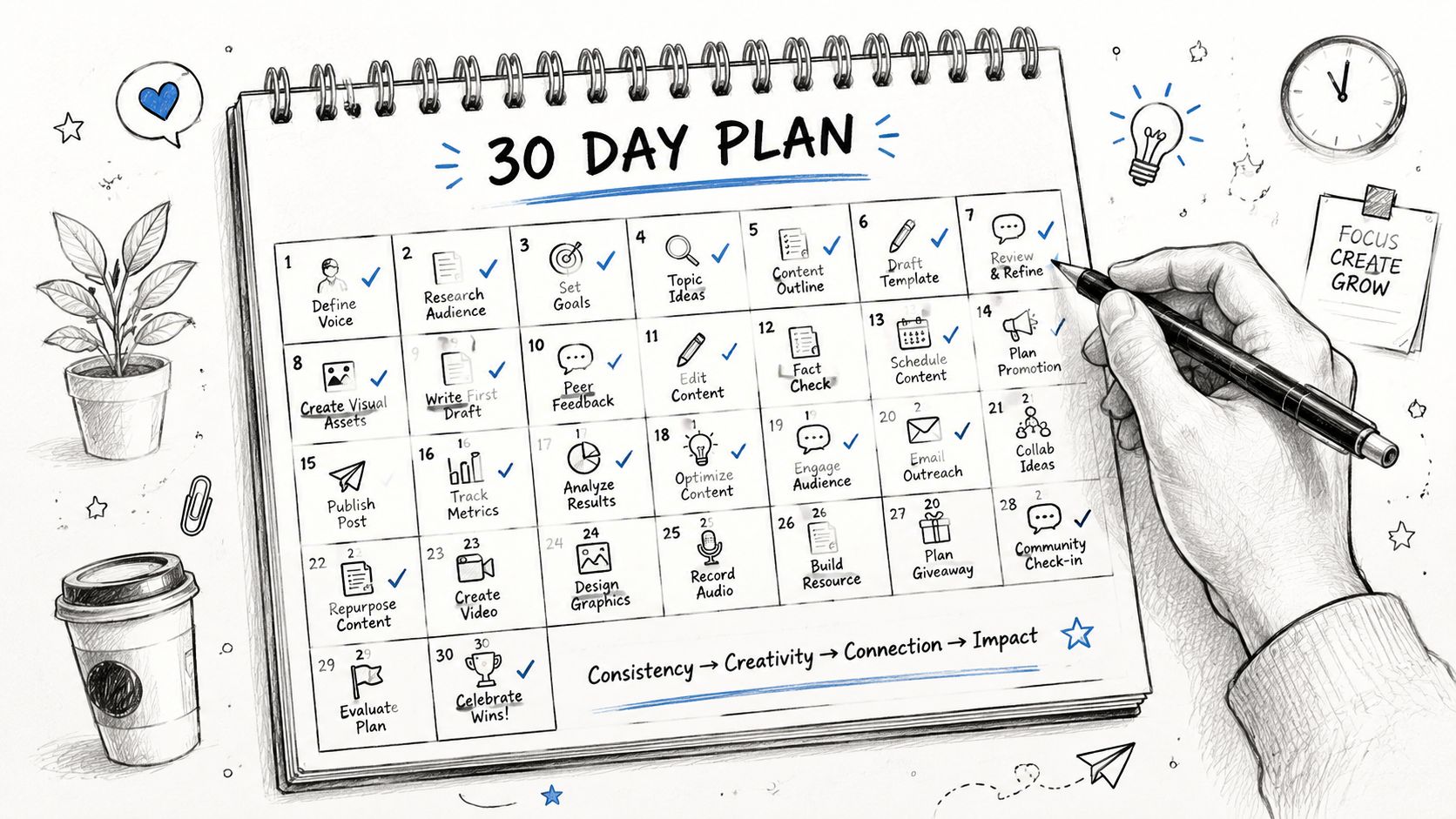
A messaging system becomes useful when it changes what you do on an ordinary Tuesday. Use the first week to audit your existing website, social profiles, emails, sales materials, and recurring templates. Record conflicting promises, tone shifts, outdated descriptions, and unanswered audience questions.
In the second week, choose your core pillars and write the master promise. Create the voice cheat sheet with traits, behaviors, red flags, and examples. Ask someone outside the writing process to describe what your brand stands for after reviewing the draft. Their confusion will show you where the language remains too broad.
Use the third week to build the messaging matrix. Map each channel to a goal, tone adjustment, pillar, proof point, and example hook. In the final week, assign owners, establish review levels, centralize current assets, and publish a short checklist that contributors can use before submitting content.
Your launch checklist is straightforward:
Consistency won't come from forcing yourself to repeat the same post. It comes from making the right message easier to find, adapt, approve, and improve.
Legacy Builder helps founders and professionals turn their stories, expertise, and vision into consistent content through strategy, writing, design, distribution, and audience engagement. If your message is strong but your publishing process keeps fragmenting it, visit Legacy Builder to explore a more dependable brand messaging system.


You could – but most in-house teams struggle with the nuance of growing on specific platforms.
We partner with in-house teams all the time to help them grow on X, LI, and Email.
Consider us the special forces unit you call in to get the job done without anyone knowing (for a fraction of what you would pay).
Short answer – yes.
Long answer – yes because of our process.
We start with an in-depth interview that gives us the opportunity to learn more about you, your stories, and your vision.
We take that and craft your content then we ship it to you. You are then able to give us the final sign-off (and any adjustments to nail it 100%) before we schedule for posting.
No problem.
We have helped clients for years or for just a season.
All the content we create is yours and yours alone.
If you want to take it over or work on transitioning we will help ensure you are set up for success.
We want this to be a living breathing brand. We will give you best practices for posting and make sure you are set up to win – so post away.
Subscribe to our newsletter and get insights on how to grow your personal brand.
