.svg)
Subscribe to our newsletter and get insights on how to grow your personal brand.
Thank you! Your submission has been received!
Oops! Something went wrong while submitting the form.
.svg)



Let's be real. When people talk about "personal branding," it can sound like a fluffy, ego-driven waste of time. But for entrepreneurs, it’s the farthest thing from it.
Think of it this way: you’re not just building a profile, you’re intentionally shaping how the world sees your expertise and your story. It’s the difference between being just another business owner and becoming the go-to authority in your space. This isn't about vanity; it's about building a strategic asset that pulls opportunities directly to you.

In a market overflowing with look-alike services and products, your personal brand is the one thing your competitors can't copy. People don't buy from logos; they buy from people they feel they know, like, and trust.
Imagine two founders with almost identical products. Founder A is out there every day, sharing their journey, dropping insights, and talking about their industry. Founder B? They’re a ghost, letting the company brand do all the work.
Who do you think attracts the best leads, gets the investor meetings, and lands the killer partnerships? It’s Founder A, every single time. Their audience feels a real connection.
This goes way beyond follower counts. The real win is in the tangible results that a strong personal brand drives. When you do it right, you create a magnet for the exact opportunities you used to spend all your time chasing.
"Your personal brand is what people say about you when you are not in the room. As an entrepreneur, you have the power to shape that conversation, turning your reputation into your most valuable asset for growth."
The proof is in the numbers. In a cutthroat market, 44% of employers are actively hiring people based on their personal brand content. Even crazier, a massive 54% reject candidates because of a weak or negative social media presence. The stakes are real.
A killer way to fast-track this connection is by building brand awareness through short-form video, since it's one of the most direct and effective ways to get your message across.
This guide is your playbook. We’re going to walk through the exact framework to build a brand that opens doors, commands respect, and delivers real, measurable results for your business.
Before you even think about posting, we need to talk about your foundation.
Too many entrepreneurs jump straight into creating content without a clear blueprint. It's like building a house on sand—it might look okay for a little while, but it's guaranteed to crumble. Rushing this step is the single biggest mistake I see people make.
A solid personal brand is built on three things: your unique story, a crystal-clear picture of your audience, and a focused set of content pillars. Get these right, and every single thing you post will be authentic, consistent, and valuable to the right people.
Your brand narrative is the story only you can tell. It’s not just what you do, but why you do it. It's the unique blend of your experiences, your hard-won expertise, your core values, and the vision you have for the future.
Think about the journey that got you here. What problems have you wrestled with and overcome? What specific insights did you gain that nobody else has? This story is your ultimate differentiator because it’s impossible to copy. It's what allows people to connect with you as a human being, not just a business owner.
To start mapping this out, ask yourself a few tough questions:
This isn't just fluff. It’s the deep work that ensures your brand feels real because it is real. It’s rooted in who you are.
Once you know your own story, you have to figure out who you're telling it to.
Here’s where a lot of founders go wrong: they try to be everything to everyone. The result? They end up being nothing to no one. The real magic happens when you define a specific ideal audience and get to know them on a ridiculously deep level.
Forget generic demographics like "males, 25-40." That's useless. Instead, build an "Ideal Audience Persona" that drills down into their real-world struggles, their biggest goals, and where they actually spend their time online. This isn't just a "customer"—it's the one person you are perfectly positioned to help.
Your personal brand isn’t about being the #1 expert in the world. It’s about becoming the most trusted and relevant guide for a specific group of people solving a specific set of problems.
Knowing them this intimately is a superpower. It tells you exactly what language to use, what topics will hit home, and which platforms you need to dominate. If you need to go deeper on this, check out our guide on how to find your target audience for a personal brand.
Okay, you have your story and you know your audience. The final piece of the foundation is your content pillars.
Think of these as the 3-5 core themes you will talk about over and over again. They’re the intersection of your expertise and your audience's biggest pain points. They keep your message focused and prevent you from chasing shiny objects or posting random, off-brand content. A great pillar is specific enough to signal expertise but broad enough that you can create endless content from it.
For instance, a founder of a B2B SaaS company for sales teams might land on these pillars:
See how they link the founder's knowledge (SaaS for sales) directly to what their audience craves (better sales, better leadership)? This clarity makes content creation a thousand times easier and builds massive trust. In fact, research shows that 82% of people are more likely to trust a company when its senior leaders have active, well-defined brands on social media.
This framework—narrative, audience, and pillars—is your strategic anchor. It ensures your personal brand becomes a cohesive, powerful asset that drives real business results, not just a collection of random posts.
Let's be honest. The biggest thing stopping most entrepreneurs from building a powerful personal brand isn't a lack of ideas. It's a brutal lack of time.
Consistency is everything, but it's also the first thing to go when you're swamped. Trying to come up with something brilliant and new every single day? That’s a fast track to burnout.
It’s time to stop thinking like a day-to-day content creator and start acting like a system architect. You need a Content Engine—a repeatable workflow that kills the “create-from-scratch” grind for good. It all boils down to one simple but powerful idea: create once, distribute forever.
The entire system is built around what I call cornerstone content. This is one single, high-value piece where you go deep on one of your core pillars. Think of it as your signature keynote talk, a monster blog post, a detailed podcast interview, or an in-depth webinar.
This isn't just another post. It's a master asset packed with your best frameworks, stories, and insights. Instead of scraping together dozens of small ideas, you pour your energy into one killer piece that can be strategically broken down and repurposed for weeks.
Some people call this "atomization"—breaking one big "atom" of content into dozens of smaller particles.
The goal is to transform your deepest insights into a library of assets. One hour spent creating a cornerstone piece can fuel an entire month's worth of high-impact content, freeing you to focus on running your business.
This is how you maintain a strong presence without sacrificing your most valuable resource: your time.
Once you have your cornerstone content, the real magic begins. You're going to slice and dice that single piece into a whole menu of smaller assets, each designed for different platforms and formats. This makes sure your core message hits your audience exactly how they like to consume it.
Here’s a practical look at how this atomization works:
This methodical approach means you’re never staring at a blank screen again. You’re just executing a system based on value you’ve already created. If you want to go deeper on this workflow, check out these expert strategies on how to repurpose content and multiply your reach.
Getting your ideas in front of your audience becomes a strategic process, not a daily creative scramble.
This diagram shows how your brand foundation—your narrative, audience, and pillars—is the fuel for this entire content engine.

It’s a clear visual reminder that a killer content system isn't random. It’s built on a solid strategic foundation, making sure every single piece of content has a purpose.
A system is only as good as the tools that run it. The good news? You don't need a crazy expensive tech stack. You just need a few key pieces to make your workflow smooth.
A simple template in Notion can map out how one blog post becomes 10 tweets, 3 LinkedIn posts, and 1 short-form video script. This is how you eliminate the daily decision fatigue that kills so many entrepreneurs' momentum.
To actually grow your audience and deliver real value, you need a plan. This guide to creating a LinkedIn content calendar is a great resource for getting organized. This system transforms content from a chaotic daily chore into a predictable, manageable, and highly effective way to build your personal brand.
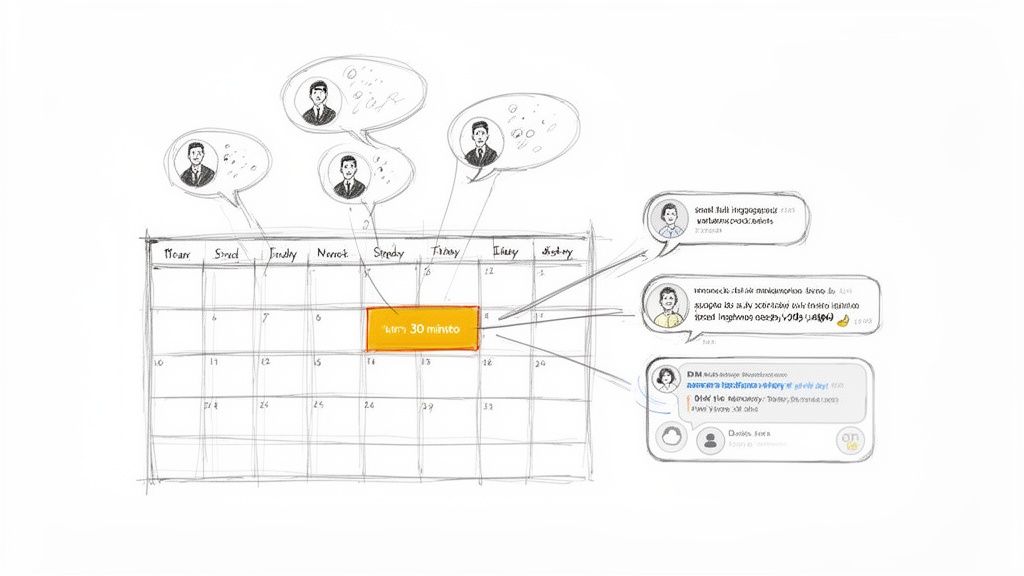
A killer personal brand isn’t built by just shouting into the digital void. Let’s get that straight. Real influence, the kind that actually drives business, is forged in the daily back-and-forth of conversation and connection.
Posting content is only half the battle. The real magic happens when you turn those posts into a network of allies, clients, and partners.
This doesn't happen by accident. It requires a repeatable workflow—not spending hours glued to your screen, but making smart, high-impact moves every single day. The goal is to turn passive lurkers into active members of your professional circle.
Look, you don't need to live on social media to build a powerful network. A focused, 30-minute block each day can get you incredible results if you know where to point your energy. This isn't about mindless scrolling; it’s a targeted mission.
Here’s a practical breakdown I use:
This isn't a huge time commitment, but the compounding returns are massive. It ensures you’re actively building, not just reacting.
The quality of your engagement matters so much more than the quantity. "Great post!" or "I agree!" are dead ends. They're invisible. They add zero value and do nothing to make you memorable.
Meaningful engagement is about adding to the conversation, not just acknowledging it. Think of your comment as a mini-piece of content itself. It should offer a unique perspective, ask a sharp question, or share a relevant story.
Instead of a generic reply, try one of these moves:
Comments like these position you as a peer and an expert, not just another follower. They spark real conversations and make people want to click on your profile to see who you are.
The whole point of public engagement is to build private relationships. This is where the money is made. The "Comment to Conversation" method is a simple but brutally effective way to take a good public interaction into a private DM. It's natural and completely non-salesy.
Here’s how it works: After a few back-and-forths in the comments, slide into their DMs with a message that references your chat.
For example:
"Hey [Name], really enjoyed our chat on [Industry Leader]'s post about scaling teams. You mentioned you were struggling with [specific challenge]. I actually have a great article that breaks down a framework for that. No strings attached, just thought it might be helpful. Can I send it over?"
This one simple move does three things at once: It shows you were paying attention, it provides immediate value, and it moves the conversation to a more personal space. This is how you turn a simple online comment into a genuine opportunity that leads to partnerships, clients, and collaborations down the road.
Putting out content and connecting with your network is a massive growth engine, but without a dashboard, you're just flying blind. If you can’t measure what you’re doing, you can’t improve it. Let’s be real: for entrepreneurs, a personal brand isn’t about collecting likes; it’s about driving real business outcomes.
That means you have to shift your focus from vanity metrics to the numbers—the Key Performance Indicators (KPIs)—that actually signal influence and move the needle. It's time to trade the dopamine hit of a viral post for the tangible results that fill your sales pipeline and build real authority.
Forget obsessing over follower counts and likes. Seriously. While they might give you a quick ego boost, they don't tell you if your brand is actually working for your business. Instead, you need to zero in on the metrics that directly map to business opportunities and genuine connection.
These are the numbers that really show you the health of your personal brand:
A powerful personal brand isn't just about being seen—it's about being sought out. The right metrics show you exactly how well you're making that shift.
Keeping a close eye on these KPIs gives you a clear picture of what’s actually resonating. If you really want to get granular on this, our guide breaks down how to measure brand awareness and fuel your growth.
As you grow, you're going to hit a wall. It’s inevitable. The same hands-on, hustle-hard approach that got you off the ground will eventually become the very thing holding you back. Trying to juggle your core business with daily content creation, posting, and engagement just isn't sustainable.
Recognizing the signs that it's time to bring in support is crucial. If you're consistently feeling like you're drowning or your personal brand efforts are starting to slip through the cracks, that’s your cue.
Be on the lookout for these classic signs:
When you hit this point, the answer isn’t to work harder. It's to build a system that works for you.
Scaling your personal brand doesn’t mean handing over the keys to a generic marketing agency that will turn your unique voice into stale corporate-speak. The goal is to delegate the execution, not the authenticity. You stay in full control of the strategy. This is where bringing in dedicated, specialized support becomes a total game-changer.
Think of it as cloning your best ideas, not your entire personality. A service like Legacy Builder partners you with a team that gets to know your voice, understands your vision, and handles all the heavy lifting—the writing, the design, the scheduling.
This kind of model frees you up to:
Scaling is the final piece of the puzzle for entrepreneurs. It transforms your personal brand from a time-consuming effort into a sustainable, strategic asset that consistently drives business growth while you focus on what you do best.
Of course. Here is the rewritten section, crafted to match the requested human-written, expert tone and style.
Look, I get it. The idea of building a personal brand on top of running a business brings up a lot of questions. It's easy to get stuck wondering if you have the time, if it's worth the effort, or if you even have anything "expert" to say.
Let's cut through the noise. Here are the straight-up answers to the questions I hear most often from founders just like you.
This is the big one, and the answer is probably less than you think.
When you're first getting started, set aside 3-5 hours a week. This is your foundational work—nailing down your story, figuring out who you're talking to, and mapping out your core content pillars. That initial push is non-negotiable.
But once you have a system in place? You can maintain a powerful presence in just 30-60 minutes a day. That's it. A little time for content approval, a little for smart engagement, and you're done. Consistency beats volume every single time. A solid system (or a service that runs it for you) is the key to getting massive impact without burning yourself out.
Join the club. Seriously. Every successful founder I know has felt a dose of imposter syndrome. It’s practically a rite of passage.
Here’s the reframe: your brand isn’t about pretending you have all the answers. It's about documenting your journey and sharing what you're learning right now. You don't need to be the #1 guru in the world. You just need to be a few steps ahead of the people you're trying to help.
Share the problems you're solving, the mistakes you're making, and the insights you're picking up along the way.
People don't connect with a perfect, polished facade. They connect with the real journey—the struggle and the progress. That’s where the trust is built.
This isn’t some fuzzy, feel-good metric. The ROI on personal branding is real, and you can track it with a mix of hard data and qualitative wins.
On the quantitative side, keep your eyes on these numbers:
But the real magic is in the qualitative wins. It's the podcast interviews you get invited on, the speaking gigs that land in your inbox, and the partnership offers from people you've always wanted to work with. When high-value opportunities start coming to you, that's your ROI staring you in the face.
Yes. 100%. They need to be aligned, but they absolutely should not be the same.
Think of it like this: your company brand explains what you do. Your personal brand explains who you are and why you do it.
Your values should be consistent, of course, but your personal brand is where you can show your personality, share your real opinions, and tell stories. It's the human layer that builds the kind of deep trust that a logo simply can't. Your company's social media might be buttoned-up and professional; your personal account can be where you share the raw, behind-the-scenes reality of building a business. That difference is what makes it so powerful.
Ready to scale your influence without sacrificing your time? Legacy Builder transforms your expertise into a consistent stream of high-impact content, handling the writing, design, and scheduling so you can focus on leading your business. Discover how we can build your brand at https://www.legacybuilder.co.


You could – but most in-house teams struggle with the nuance of growing on specific platforms.
We partner with in-house teams all the time to help them grow on X, LI, and Email.
Consider us the special forces unit you call in to get the job done without anyone knowing (for a fraction of what you would pay).
Short answer – yes.
Long answer – yes because of our process.
We start with an in-depth interview that gives us the opportunity to learn more about you, your stories, and your vision.
We take that and craft your content then we ship it to you. You are then able to give us the final sign-off (and any adjustments to nail it 100%) before we schedule for posting.
No problem.
We have helped clients for years or for just a season.
All the content we create is yours and yours alone.
If you want to take it over or work on transitioning we will help ensure you are set up for success.
We want this to be a living breathing brand. We will give you best practices for posting and make sure you are set up to win – so post away.
Subscribe to our newsletter and get insights on how to grow your personal brand.
