.svg)
Subscribe to our newsletter and get insights on how to grow your personal brand.
Thank you! Your submission has been received!
Oops! Something went wrong while submitting the form.
.svg)



You can be excellent at what you do and still be overlooked. Your LinkedIn profile lists several roles, your portfolio contains solid work, and your conversations reveal real expertise. Yet a hiring manager, prospective client, or senior leader still can't quickly answer the question that matters: why should we choose you for this particular need?
That gap usually isn't a competence problem. It's a positioning problem. Learning how to create a personal value proposition gives your experience a clear, audience-relevant shape, so people can understand your contribution before they have to reconstruct it from scattered details.
A hiring manager scans your profile, a prospect reviews your website, or an executive hears your introduction. In each case, they need to understand your relevance quickly. A personal value proposition gives them that context. It is a market-facing promise that connects who you are with the value you create for a particular audience. Harvard Business School Online defines it as a sentence stating who you are and what value you provide. Its four parts are target audience, value provided, differentiation, and proof points.
The audience changes the promise. A job seeker might emphasize the business problems they solve inside a team. A consultant might focus on the result they create for clients. A senior leader building visibility might highlight the decisions, direction, or clarity they bring to an organization. One universal slogan rarely serves all three situations well.
“Strategic leader with a passion for innovation” describes an aspiration. “I help B2B founders turn complex expertise into clear market narratives that support sales conversations” gives someone a reason to remember you. The second statement makes one relevant promise and leaves room for evidence to support it.
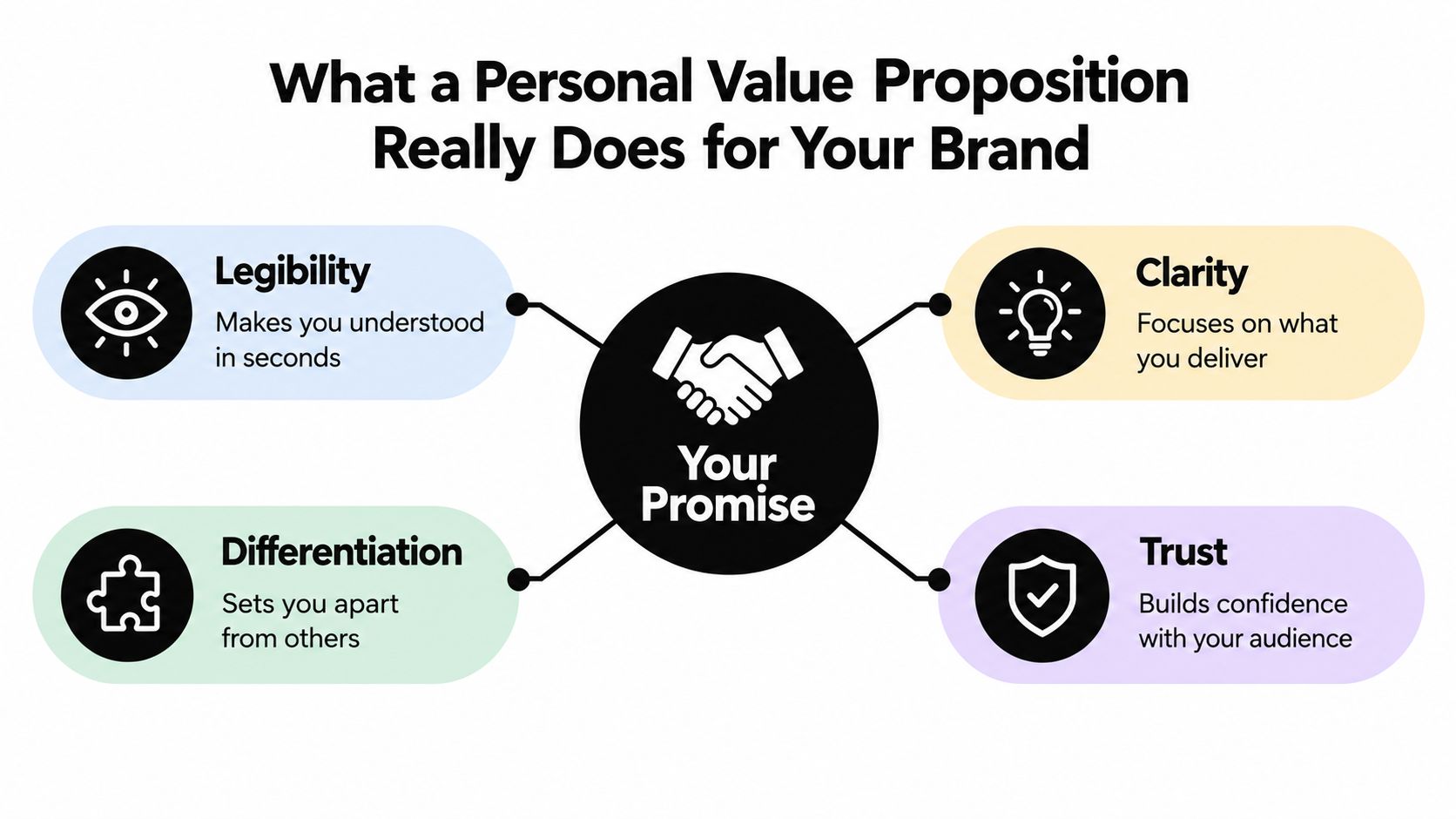
Abstract language can make a profile sound polished while hiding the actual contribution. Catalysts, visionaries, ecosystem builders, and transformation partners may appear distinctive, but they require the reader to interpret what you do. A strong proposition makes your contribution legible without a second explanation.
Businesses use value propositions to state a distinct benefit for a specific customer. Personal branding applies the same reasoning to an individual identity. You are not presenting yourself as a product. You are making your relevant contribution easier to recognize.
A useful proposition answers four questions:
Your profile may position you as a product strategist, your content may focus on executive communication, and your introduction may emphasize operations. Each claim can be accurate, yet the combination makes your positioning harder to remember.
Consistency means reinforcing the same underlying promise across your profile, content, portfolio, conversations, and visible work. Adapt the wording to the setting, but keep the audience, contribution, and proof pattern aligned.
Practical rule: Don't ask whether your proposition sounds impressive. Ask whether the right person can repeat it accurately after one conversation.
A vague proposition usually describes personality instead of audience need, lists capabilities without their value, or promises outcomes without evidence. Precision does not erase your range. It gives that range a useful center.
A proposition gets stronger when it starts with a clear audience and a direction you can keep demonstrating. Settle your purpose, values, and goals before drafting, because the statement must reflect how you intend to work, not a slogan built for one opportunity.
Begin with the person or group you want to serve, rather than a job title. “Professionals” is too broad to guide your language. Ask who has a problem you understand, who can act on your advice, and whose progress you want to support. A founder preparing for a funding conversation needs different language from a hiring manager seeking a team leader, even if both audiences value strategic thinking. A useful target-audience guide for personal brands can help you test those boundaries.
Write quick answers to these prompts. Keep the first pass rough.
Look for repetition rather than a perfect career story. If you repeatedly simplify complex ideas, align teams, and turn scattered input into decisions, that pattern may matter more than the titles attached to it. Those recurring behaviors can support different promises for job search, client acquisition, or leadership visibility, provided the audience and proof change with the context.
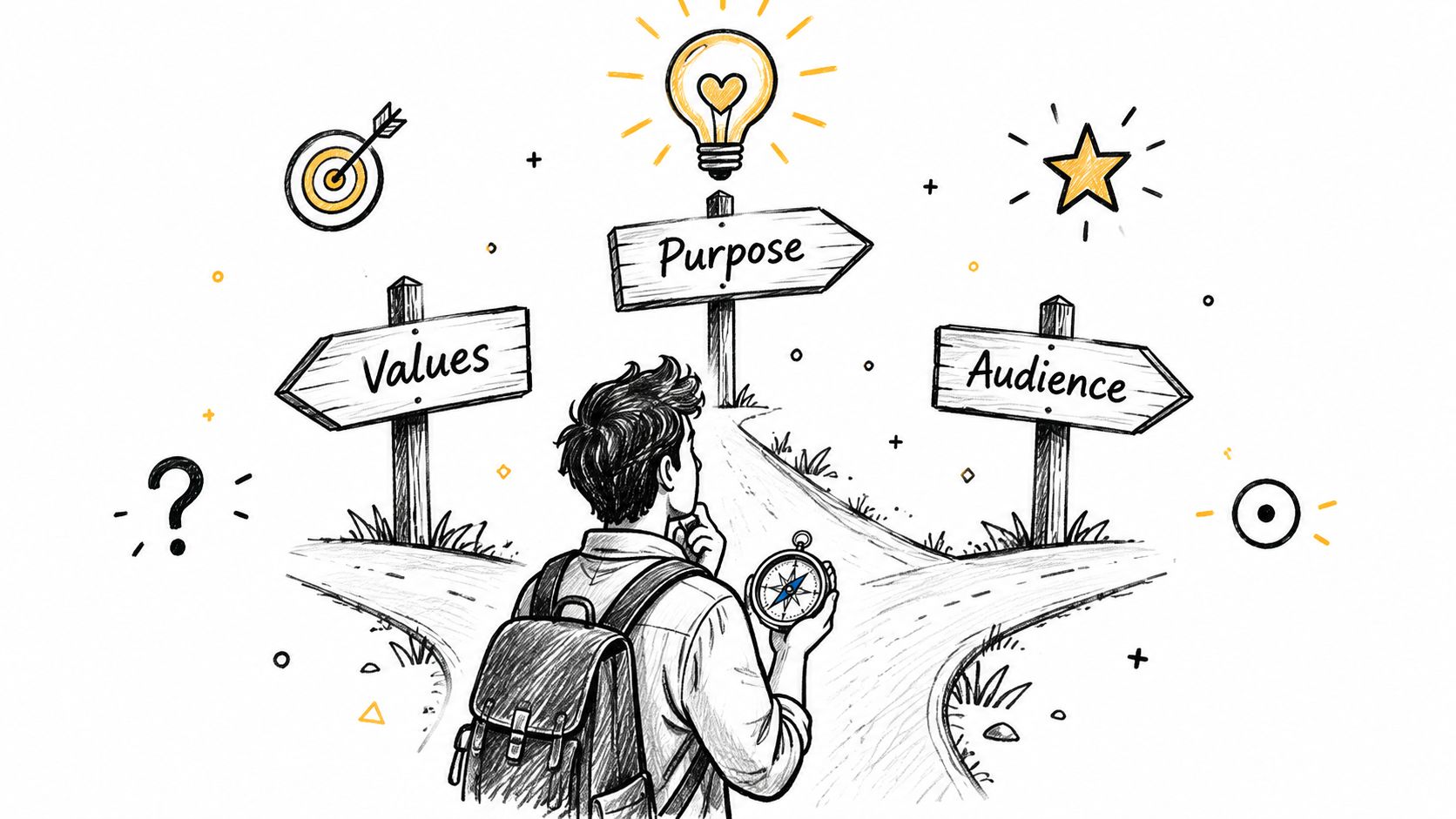
Your values should constrain the promise. If you value depth, do not position yourself around constant speed. If you care about practical execution, do not present yourself as a pure visionary. Your proposition becomes credible when the work it promises matches the way you operate.
Use this filter on every draft:
If you need a guided sequence for turning these decisions into visible brand activity, this 90-day personal brand plan can help organize your positioning, content, and consistency.
The output of this phase is an evidence bank, not a finished sentence. Capture audience language, recurring needs, your preferred way of working, and proof patterns. That material helps you turn non-linear experience into a credible promise and prevents generic wording built around aspiration alone.
Once you know whom you serve and what you want to be known for, assemble the proposition in four parts. The framework is practical because each part does a different job. Audience creates relevance, value names the benefit, differentiation gives the promise a reason to stand out, and proof reduces doubt.
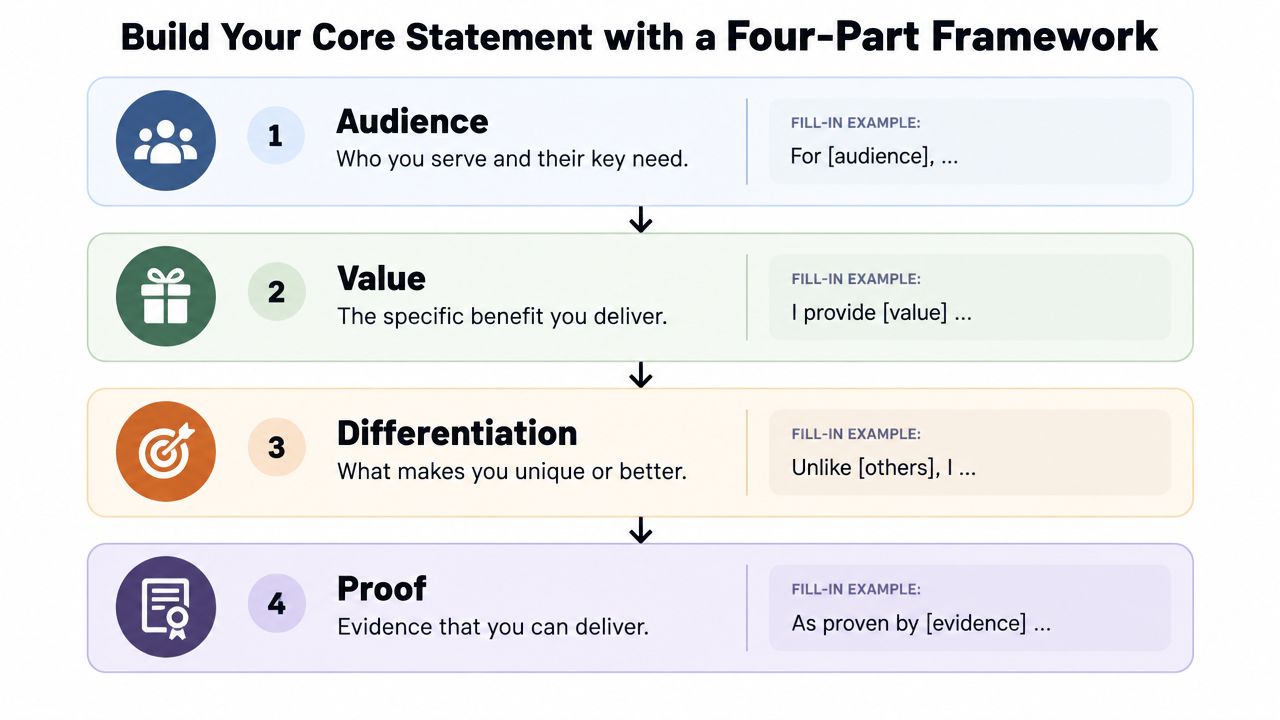
Name the group in terms they recognize. “Companies” tells nobody enough. “Early-stage SaaS founders preparing for enterprise sales” gives you a meaningful boundary.
Then define the value as an outcome, not a list of tasks. “I write content” is an activity. “I turn technical expertise into content that helps buyers understand the problem and take the next step” explains why the activity matters.
Differentiation can come from a distinctive combination, not just a rare skill. You might combine research, facilitation, and technical fluency. You might bring operator experience to a field dominated by consultants. You might be especially effective with complex, regulated, or sensitive subjects.
Proof doesn't always require a dramatic result. Use a relevant portfolio example, client feedback, repeatable deliverable, documented process, recommendation, or pattern across projects. The proof must support the promise you're making, not merely demonstrate that you've been busy.
Core template: For [specific audience], I help [audience need or desired transformation] by [your distinctive approach], supported by [relevant proof].
Consider the difference:
The second version is still a draft. It may need sharper audience language or more concrete evidence, but a reader can understand the work, the audience, and the mechanism.
Remove adjectives that don't carry evidence. “Passionate” and “results-driven” rarely differentiate you on their own. Replace them with the behavior or result those words are trying to summarize.
Academic work has similarly framed personal branding as a strategic process of creating, positioning, and maintaining a positive impression based on a unique combination of individual characteristics. A systematic review of personal branding supports the importance of a differentiated promise communicated through a consistent narrative.
Use this collection of brand positioning statement examples when you need to compare structures, but don't borrow language before you understand your own evidence. Templates can accelerate drafting. They can't supply your differentiation.
Keep the core statement concise enough to say naturally. It isn't meant to contain your whole biography. Its job is to create a clear opening for the profile, conversation, case study, or next question.
One universal statement rarely performs equally well everywhere. A job seeker, consultant, and executive may share a core identity, but each audience is making a different decision. Your proposition should answer three contextual questions: what is this audience doing instead of working with you, what transformation do they want, and what evidence matters to them?
A hiring manager may need confidence that you can perform in a role. A client may need confidence that you understand a commercial problem. A senior leader may need confidence that your judgment improves decisions beyond your immediate remit. Same person, different proof.
| Context | Audience Focus | Proof to Emphasize |
|---|---|---|
| LinkedIn headline | The role, problem, or audience you want to be found for | Relevant expertise and clear outcomes |
| LinkedIn About section | The person deciding whether to continue learning about you | Career pattern, working approach, and selected evidence |
| Networking introduction | A new contact with limited attention | The problem you help with and the situation where it matters |
| Client pitch | A buyer comparing possible approaches | Understanding of the buyer's need, method, and credible examples |
| Leadership visibility | Peers, executives, and future collaborators | Judgment, decisions influenced, and ideas you consistently advance |
| Content | People encountering your expertise over time | Demonstrated thinking, useful frameworks, and lived observations |
For a LinkedIn headline, lead with the audience or problem rather than an internal identity. “Product leader” is accurate but broad. “Product leader helping complex B2B teams turn customer insight into focused roadmaps” gives searchers and readers more to work with. Your LinkedIn About section best practices can help you expand that promise into a fuller narrative.
Create a core proposition, then adapt its emphasis:
Each version preserves the same underlying themes, but the audience and proof change. That is strategic consistency, not inconsistency.
Don't cram every capability into every touchpoint. A profile can establish your territory. A conversation can make the promise personal. Content can demonstrate your thinking. A pitch can connect your method to a buyer's immediate decision. When each asset does its specific job, your brand feels coherent without sounding copied and pasted.
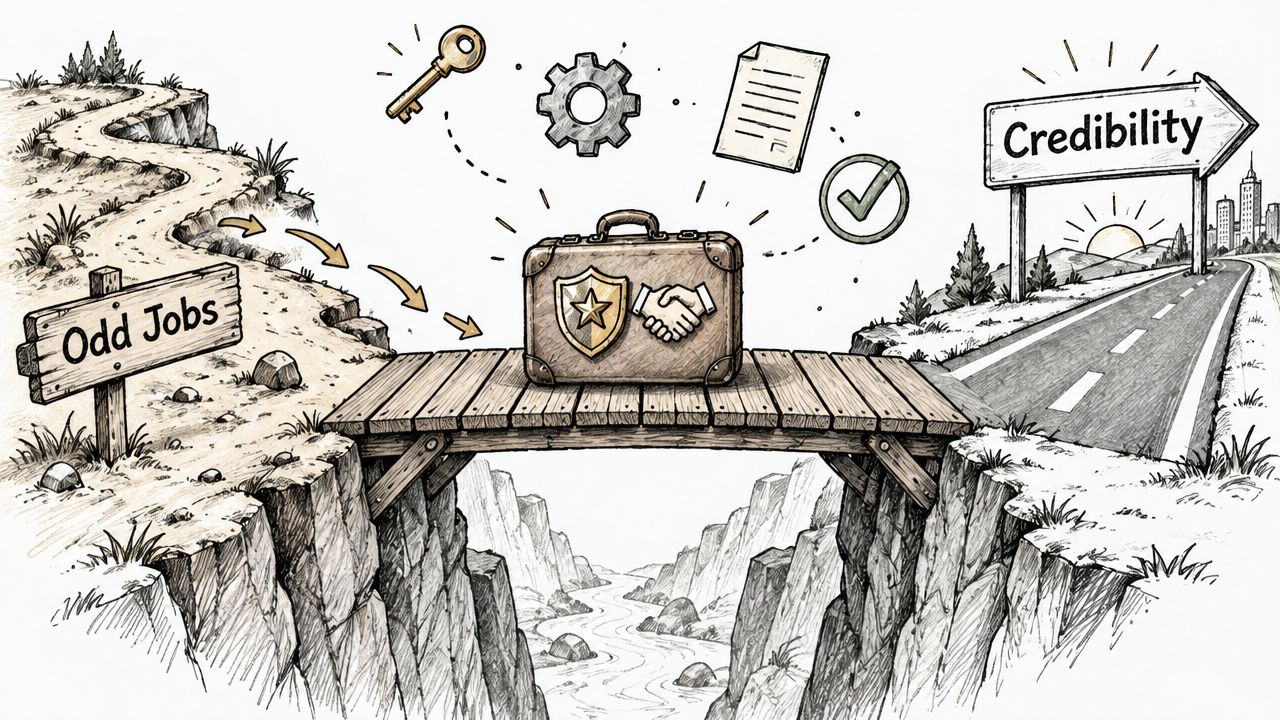
A non-linear career isn't automatically a credibility problem. The problem appears when you present it as a sequence of unrelated facts and expect the audience to discover the pattern themselves. Career switchers, generalists, and early-stage founders need to name the recurring contribution that connects the work.
Recent guidance on personal value propositions highlights the difficulty of using proof points when evidence is qualitative, early-stage, or spread across industries. YourEFactor's discussion of non-linear experience points to a practical gap in common frameworks, which often assume a neat track record.
Start by reviewing your work without judging whether each experience looks prestigious. For every project, ask:
A former journalist moving into product marketing might focus on extracting customer insight, asking precise questions, and turning complexity into clear narratives. A founder with experience in education, sales, and operations might position around building practical systems that help teams adopt new ways of working. The through-line isn't the industry. It's the recurring value.
Early proof can include a portfolio, a workshop you designed, a process you improved, a recommendation from someone who used your work, or a clear account of what you learned and applied. Qualitative proof becomes stronger when you make it specific. “People liked my work” is weak. “A sales team used the revised messaging in discovery calls because prospects understood the offer sooner” gives the reader something concrete to evaluate.
Avoid apologetic language such as “although my background is unusual” or “I may not have the traditional experience.” That framing makes the audience focus on the gap. State the pattern directly, then support it.
Credibility comes from a believable connection between your promise and your evidence, not from pretending your path was linear.
You also need to balance authority with authenticity. Generic self-promotion says you're exceptional. Authoritative authenticity shows how you think, what you notice, and what you repeatedly help people do. Share the limits of your experience when they matter. A precise boundary often makes the rest of the promise more trustworthy.
A proposition becomes useful only after people can understand it, remember it, and connect it to evidence. Don't protect the first draft because you worked hard on it. Put it in front of people who resemble your intended audience and ask them what they think you do, who they believe you help, and what makes you different.
Their answers expose problems that self-editing misses. If they describe your role instead of your value, the statement is activity-led. If they name several unrelated audiences, the scope is too broad. If they understand the promise but don't believe it, add better proof rather than more adjectives.
Use this checklist before publishing:
Ask a trusted colleague to repeat your proposition back to you without looking at the text. This is more revealing than asking whether they “like” it. You want accurate recall, useful questions, and enough interest to continue the conversation.
Put the core promise in your profile foundation, then build visible behavior around it. Choose content themes that demonstrate the way you solve problems. Select portfolio examples that support the same audience and outcome. Use your introduction at events, but adjust the final phrase to the person you're speaking with.
Don't confuse repetition with duplication. Your headline can be compact, your About section can add context, and your content can prove the thinking behind the claim. The audience should encounter a consistent point of view expressed in different forms.
Authenticity and transparency remain central to how people decide whom to follow and buy from. A 2025 branding summary reports that 88% of consumers say authenticity is crucial and 90% say transparency matters. Those figures are consumer-focused, but the practical lesson applies to personal brands: polish can earn attention, while believable substance earns trust.
Review the proposition when your audience, offer, responsibilities, or direction changes. Otherwise, keep using it long enough for your work to confirm the promise. If you want support turning your expertise into a clear, consistently managed presence, Legacy Builder helps shape personal brands through content, short-form video, newsletters, profile optimization, and strategic distribution in the client's voice. Visit the platform to explore whether its approach fits the audience and promise you've defined.


You could – but most in-house teams struggle with the nuance of growing on specific platforms.
We partner with in-house teams all the time to help them grow on X, LI, and Email.
Consider us the special forces unit you call in to get the job done without anyone knowing (for a fraction of what you would pay).
Short answer – yes.
Long answer – yes because of our process.
We start with an in-depth interview that gives us the opportunity to learn more about you, your stories, and your vision.
We take that and craft your content then we ship it to you. You are then able to give us the final sign-off (and any adjustments to nail it 100%) before we schedule for posting.
No problem.
We have helped clients for years or for just a season.
All the content we create is yours and yours alone.
If you want to take it over or work on transitioning we will help ensure you are set up for success.
We want this to be a living breathing brand. We will give you best practices for posting and make sure you are set up to win – so post away.
Subscribe to our newsletter and get insights on how to grow your personal brand.
