.svg)
Subscribe to our newsletter and get insights on how to grow your personal brand.
Thank you! Your submission has been received!
Oops! Something went wrong while submitting the form.
.svg)


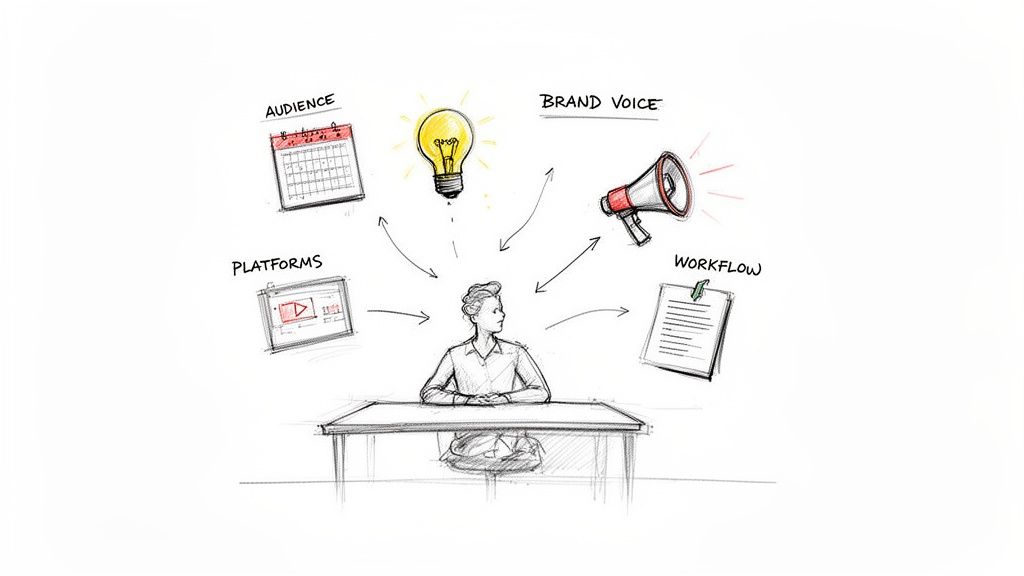
Your content strategy is more than just a calendar—it's your entire game plan. It's the repeatable framework that turns what you know into content that actually connects with the right people. Without one, you're just throwing content at the wall and hoping something sticks. A solid strategy makes sure every single thing you create has a purpose.
Look, before you even think about writing a post or hitting record on a video, you have to nail the foundation. Building a content strategy without this is like building a house on sand. It might look okay for a minute, but it's going to collapse.
This first phase is all about getting crystal clear on three things: your mission, your audience, and your voice. I see so many people skip this, and it always leads to the same place—inconsistent messaging, wasted time, and content that just doesn't land.
This isn’t just some busywork. It's the strategic core that makes everything else work. When you know exactly what you’re trying to achieve and who you're talking to, creating content becomes faster, more focused, and way more effective.
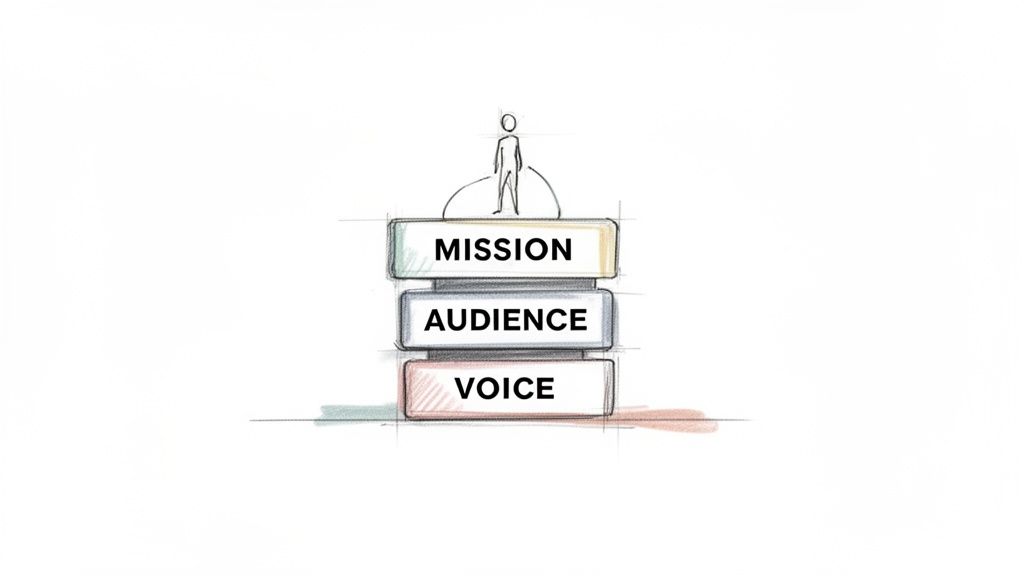
Let's get one thing straight: vague goals like "grow my audience" are useless. They don't give you any direction. Your content needs a job. What specific result are you aiming for? Defining this upfront is what turns your content from a hobby into a real business asset.
Your goals need to be tied directly to your business. Here are a few real-world examples of what I mean:
Each of these goals requires a totally different kind of content and approach. That's why clarity from day one is non-negotiable.
A great content strategy is a roadmap. It guides you from where you are to where you want to be. Without clear objectives, you're basically driving blind, just hoping you end up somewhere good.
Okay, so you know where you're going. Now, who's coming with you? The key here is to go way beyond surface-level demographics and build real empathy. What’s keeping your ideal client up at night? What are their biggest career goals? What’s the one professional headache they’d pay anything to solve?
Answering these questions lets you create content that feels like you're reading their mind. For example, forget a generic persona like "Marketing Manager, age 30-40." Get specific: "Meet Sarah, a SaaS marketing manager who's tearing her hair out trying to prove the ROI of her content budget. She's drowning in data and just needs a simple way to show her boss she's winning."
That level of detail is gold. We've got a whole guide on how to find your target audience for a personal brand that walks you through this exact process.
Finally, how are you going to sound? Your brand voice is the personality behind your content. It's what makes it recognizably yours. Are you analytical and data-heavy? Or are you more motivational and inspiring? Witty and casual, or authoritative and to-the-point?
There's no right answer, but you absolutely have to be consistent. Your voice should feel authentic to you and match what your audience expects. A financial advisor talking to high-net-worth clients will sound very different from a creative coach working with artists.
Jot down a few words that define your voice (e.g., "Empathetic, Action-Oriented, Insightful") and stick to them. This ensures that whether you're writing a quick tweet or a deep-dive article, your tone is consistent, which builds trust like nothing else. If you’re in the tech space, this is a great resource on how to develop a SaaS content marketing strategy.
Once you’ve nailed down your mission and who you’re talking to, it's time to give your expertise some structure. This is where content pillars come in. Think of them as the 3-5 core topics you’re going to own. They are the absolute backbone of your content strategy.
Pillars stop you from scrambling every morning, frantically asking, "What should I post today?" Instead of reacting, you start operating from a clear, strategic framework. Every single thing you create will tie back to these foundational themes, making sure you’re always on-brand and on-point for your audience.
The magic happens right at the intersection of what you know inside and out, and what your audience is desperate to solve. It’s a simple Venn diagram. One circle is “What I could talk about for hours,” and the other is “What my audience is losing sleep over.” Your content pillars live in that sweet spot where they overlap.
So, start by just dumping it all out. List your professional skills, the unique experiences you've had, the topics you get genuinely excited about. Then, pull up your audience research again. What are their biggest headaches, their most annoying challenges, their ultimate goals?
Let’s say you’re a financial consultant who works with creative freelancers. The intersections might look something like this:
See how that works? These pillars are specific, they speak directly to the audience, and they’re broad enough that you could create hundreds of content ideas from each one.
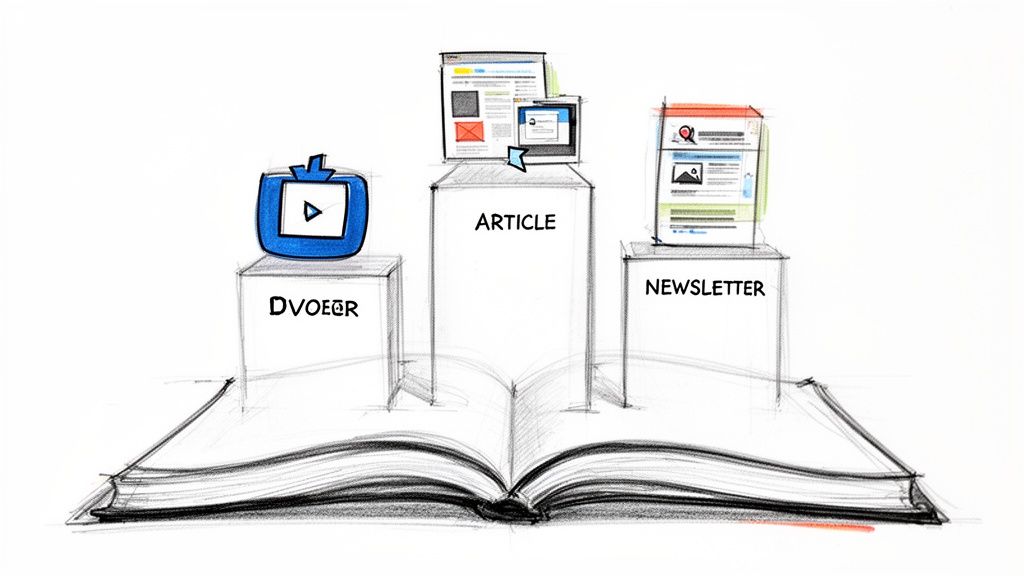
With your pillars locked in, you need to decide how you’re going to bring them to life. The format you choose is just as important as the topic. It’s the delivery mechanism, and a great idea in the wrong format is a wasted opportunity. What crushes it on one platform will completely bomb on another.
The goal isn’t to be everywhere, doing everything. It's about picking a smart, versatile mix of formats that fits your personality and, more importantly, how your audience actually consumes content.
Here’s a quick breakdown of a few key options:
This kind of mix lets you meet people where they are and appeal to different ways of learning.
Your content format is the delivery vehicle for your expertise. Choosing the right one ensures your message doesn't just get sent—it gets received and understood.
The most successful personal brands don't just stick to one thing. They build a system where different formats work together to support each pillar. This strategy keeps your content feeling fresh, but it also makes repurposing a breeze—which is the secret to staying consistent without burning yourself out.
Let’s go back to our financial consultant. A single idea from their "Smart Financial Systems for Creatives" pillar could be spun out in multiple ways:
This is the "create once, distribute many times" model in action. You maximize the value of every single idea. It ensures that no matter where someone stumbles upon your work, they get something valuable that reinforces who you are and what you know. Your pillars tell you what to talk about; your format mix tells you how.
You’ve got your foundation and your content pillars sorted. Awesome. Now, where is all this great content actually going to live?
This is where so many personal brands trip up. They get excited and try to be everywhere at once—LinkedIn, X, Instagram, TikTok, you name it. Spreading yourself that thin is a surefire way to burn out fast and master absolutely nothing.
The smart play isn’t about being everywhere; it's about being in the right places, consistently. You need to zero in on the primary platforms where your target audience hangs out and then commit to owning that space. It’s how you build real momentum, not just noise.
Forget trying to conquer the entire internet from day one. I tell all my clients to follow a "master one, then expand" philosophy.
Pick one core platform and go all-in. Learn its quirks, understand what makes its users tick, and focus on building a real community there first.
For a B2B consultant, this probably means living on LinkedIn, using carousels and sharp insights to get in front of industry leaders. If you're a coach or a visual artist, Instagram is likely your best bet. The goal is simple: become a recognized, trusted voice on one channel before you even think about the next one.
Digging into the details matters. For instance, a solid Tiktok vs Youtube Shorts comparison shows just how different audience behaviors can be, even on platforms that seem similar. Your decision should land at the intersection of three simple questions:
Choosing your primary platform isn’t just about aesthetics. It’s about building a home base where you can forge deep relationships and become the go-to resource for a specific community.
This focus pays off, big time. We know that a staggering 95% of B2B marketers use social media to distribute content, making it the #1 organic channel for connection. The data doesn't lie.
Once you’ve picked your channels, your content calendar becomes your mission control. This isn't just a spreadsheet with dates—it's the system that turns your strategy into action and saves you from the last-minute scramble of "what should I post today?"
A well-built calendar is what drives consistency. And consistency is what builds trust and keeps you top-of-mind. It’s the tool that breaks your big-picture strategy down into small, manageable, daily tasks.
Here’s a practical way to structure a calendar that actually works for you:
This kind of planning shifts you from being reactive to proactive. If you need a solid starting point, our guide on a content calendar template for social media that actually works gives you a great framework to build from.
Remember, consistency is the engine of brand growth. Your calendar is the key that starts it.
A killer strategy is nothing more than a pretty document if you don't have a system to actually do the work. Your content workflow is the engine that turns your grand plans into real, high-quality content without burning you out. This is the behind-the-scenes process that separates the pros from the people who just post whenever they feel like it.
This system isn't just about writing or recording; it covers everything from that first spark of an idea all the way to hitting "publish." It's your structured approach to brainstorming, research, creating, and scheduling. Without it, you'll be inconsistent, and inconsistency kills the trust you're working so hard to build.
First thing's first: you need to map out every single step it takes to get a piece of content out the door. This isn't about creating rigid, soul-crushing rules. It's about creating clarity. When you know the exact sequence of events, you save a ton of mental energy and stop things from falling through the cracks.
Document this workflow somewhere your team (even if it's a team of one) can see it. I'm a big fan of using a Notion database or a Trello board for this. It becomes the one place to look for anything and everything related to your content operation.
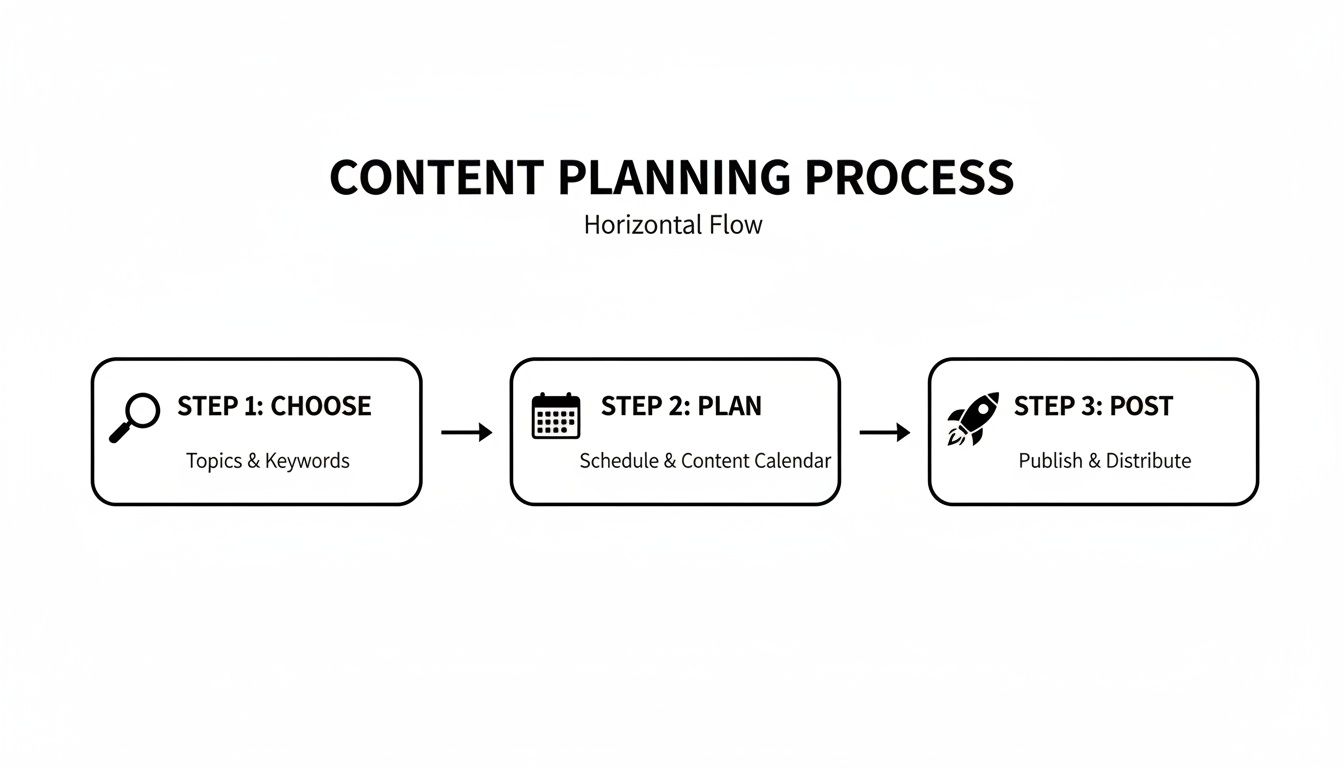
This simple flow—choosing what to talk about, planning how you'll make it, and then actually posting it—is the core of any workflow that actually works. It makes sure every single piece of content has a purpose.
For most personal brands I work with, a solid workflow looks something like this:
Getting this process down is the foundation for any content strategy that’s built to last.
Want to know the real secret to having a massive impact without being online 24/7? It's the "create once, distribute many times" model.
This is where you take one big, cornerstone piece of content and chop it up into a bunch of smaller assets for different platforms. It's simply the smartest way to get the most value out of every single idea you have.
This isn't just about saving time. It's about getting the most possible mileage out of your best work. That comprehensive blog post you spent hours on? It's not just one asset. It's the raw material for a dozen more.
Repurposing isn't about being lazy; it's about being efficient. It lets you hammer home your core messages across multiple channels, reaching different parts of your audience in the format they actually prefer.
Let's say you just published a detailed guide on "Financial Habits for Freelancers." Here’s how you could spin that one piece of content into gold:
This simple process transforms one big effort into an entire week's worth of valuable content. Your message sinks in, your reach explodes, and you stay top-of-mind. Building this into your workflow is non-negotiable if you want to grow without going crazy.
To make this crystal clear, here’s what that looks like in a simple matrix.
See how that works? You’re meeting people where they are, in the format they prefer, all without having to reinvent the wheel every single day. That's how you build a sustainable and high-impact personal brand.
You've got your workflow humming and you're cranking out high-value content. Awesome. But now for the million-dollar question: is any of it actually working?
Likes and shares are nice for the ego, but they don't pay the bills. This is where we stop chasing vanity metrics and get serious about the Key Performance Indicators (KPIs) that prove your brand is actually growing.
A solid content strategy isn't just about creating stuff. It's about measuring, learning, and adapting. This is the feedback loop that turns your plan from a static document into a living, breathing system that gets smarter over time. If you're not tracking the right data, you're just throwing content at a wall and hoping something sticks.
First things first: your metrics need to be tied directly to the business goals you set from day one. Different goals demand you watch different numbers.
Let’s get practical. What does this actually look like for a personal brand?
Tracking these specific, goal-oriented KPIs is what separates the pros from the hobbyists.
You don't need a crazy-expensive suite of tools to figure this out. The data you need is probably already sitting right in front of you, for free. You just need to know where to look.
Most social platforms have their own built-in analytics. LinkedIn, for instance, gives you a pretty detailed look at your post views, audience demographics, and follower growth. That's your first stop.
For your website, Google Analytics is non-negotiable. It’s the industry standard for a reason. Specifically, live inside the Acquisition report. This will show you exactly which channels—organic search, social media, direct traffic—are sending people your way.
Your analytics aren't just numbers. They're your audience telling you exactly what they love, what they ignore, and what they want more of. Listen up.
Collecting data is only half the job. The real magic happens when you use that data to make smarter choices about your content. This means doing regular content check-ups—I recommend monthly—to see what's actually hitting the mark.
During your review, ask yourself some hard questions:
This constant analysis is what drives optimization. For a much deeper dive on this, check out our guide on how to measure brand awareness and fuel your growth. It gives you a clear framework for turning these insights into real action.
The global content marketing industry is expected to explode to nearly $1.95 trillion by 2032, according to recent content marketing industry projections. The brands that win a piece of that pie will be the ones who master this data-driven loop. This is how you ensure your content strategy doesn't just look good on paper—it delivers tangible, measurable results.
When you're building a personal brand from the ground up, a lot of questions pop up. It's totally normal. Here are the most common ones I hear from professionals, along with some straight talk to help you cut through the noise and stay focused.
Let's be real: building a personal brand that actually means something is a marathon, not a sprint. You'll probably see some early buzz—a few more comments, shares, and connection requests—within the first 1-2 months if you're consistent. That's the easy part.
The real payoff, like significant audience growth, a steady flow of inbound leads, or being the person everyone thinks of in your niche, takes time. You should be thinking in terms of 6-12 months of putting in the work, day in and day out. Consistency is the name of the game. It’s what builds the momentum that pays off down the road.
Building a personal brand is about earning trust at scale. That trust isn't built overnight. It's earned through a consistent stream of valuable, reliable insights that solve real problems for your audience.
Everyone hits this wall eventually. It's a common fear, but this is exactly why we established your content pillars in the first place. When you feel stuck, don't just stare at a blank screen. Go back to your pillars and the audience research you did. That’s your North Star.
Just ask yourself: "What are the ten most common questions my ideal client has about [insert your pillar here]?" Boom. Your audience is a never-ending well of content ideas if you just listen.
Here are a few other places I go when I need inspiration:
Your investment breaks down into two things: time and money. The good news is you can get started with a shoestring budget. Use free tools like Canva for design and Buffer for scheduling. They're more than enough to get you going.
In the beginning, your biggest investment is your own time. It’s the hours you put into researching, creating, and engaging. As your brand starts to gain traction and you see a real return, that’s when you can start to strategically invest some cash.
Maybe you hire a freelance writer to polish up your drafts, a video editor to make your shorts pop, or a virtual assistant to handle scheduling. This frees you up to do the one thing no one else can: share your core expertise.
Absolutely not. You need to be an expert in your field—that’s why people are following you in the first place.
When it comes to personal branding, authenticity and value will always trump slick, agency-level production. People follow you for your insights, not because you have perfect graphic design or poetic writing.
Focus on one thing: providing clear, actionable advice that solves a problem for your audience. Use simple tools to make your visuals look clean and professional. Your genuine point of view is your greatest asset. Don't let the fear of not being a "creative" stop you from sharing what you know.
Ready to stop guessing and start building? At Legacy Builder, we specialize in transforming your expertise into a high-impact personal brand that gets results. Learn more about how we can build your legacy at https://www.legacybuilder.co.


You could – but most in-house teams struggle with the nuance of growing on specific platforms.
We partner with in-house teams all the time to help them grow on X, LI, and Email.
Consider us the special forces unit you call in to get the job done without anyone knowing (for a fraction of what you would pay).
Short answer – yes.
Long answer – yes because of our process.
We start with an in-depth interview that gives us the opportunity to learn more about you, your stories, and your vision.
We take that and craft your content then we ship it to you. You are then able to give us the final sign-off (and any adjustments to nail it 100%) before we schedule for posting.
No problem.
We have helped clients for years or for just a season.
All the content we create is yours and yours alone.
If you want to take it over or work on transitioning we will help ensure you are set up for success.
We want this to be a living breathing brand. We will give you best practices for posting and make sure you are set up to win – so post away.
Subscribe to our newsletter and get insights on how to grow your personal brand.
