.svg)
Subscribe to our newsletter and get insights on how to grow your personal brand.
Thank you! Your submission has been received!
Oops! Something went wrong while submitting the form.
.svg)


Most advice on how to build strategic partnerships starts in the wrong place. It tells you to hunt for a big-name partner, craft a friendly message, and hope chemistry does the rest. That's backwards. The deal usually breaks long before the first call, because the founder never defined the objective, the sponsor, the decision rules, or the KPIs that make the partnership real.
The old partnership problem is still the same one management has wrestled with for years, only now the stakes show up faster. Peter Simoons' summary of the “80% rule” says only about 20% of alliances reach their intended success threshold, while roughly 80% underperform or fail to deliver full value, which is why careful partner selection, trust, and governance matter so much (Peter Simoons on the 80% rule). If you want a partnership that scales, treat it like a system you build inside your company first, then extend outward.

For founders who want a formal legal baseline before they start brokering deals, RNC Group founder agreements is a useful reference point for thinking about roles, ownership, and expectations before the relationship gets messy.
If you're already building long-term business relationships, the internal discipline behind them matters just as much as the external pitch. I'd also pair this mindset with a practical relationship-building playbook like a guide to building relationships in business that last, because partnerships don't survive on enthusiasm alone.
The biggest mistake is treating a partnership failure like a relationship failure. It usually starts with bad internal setup. If no one owns the relationship, no one owns the scorecard, and no one has authority to stop a weak deal, the partnership drifts fast.
The pattern is plain. Alliances fail because teams skip the work that should happen before outreach, the objective, the decision rights, and the operating rules. That is the core lesson in the management guidance in the brief, and it is why internal selection, governance, and measurement belong before the first message goes out. Peter Simoons on the 80% rule and IMD on strategic partnerships both point in the same direction, define the target, assign ownership, and set the rules first. That is not bureaucracy. It is how you keep a partnership from becoming expensive confusion.
Founders chase prestige because prestige is easy to spot. A recognizable logo, a popular creator, or a well-known platform feels like momentum. Then the deal lands, everyone celebrates, and two weeks later nobody knows who sends the draft, who approves the offer, or what result proves the work was worth it.
Practical rule: do not pitch until you can explain the objective, the owner, and the scorecard in one breath.
The internal setup is the essential filter. Wharton's partnership framework separates alliances into window, options, and positioning strategies depending on whether you are learning, building capability, or pursuing scale-based advantage (Wharton Strategic Partnerships). That matters because “let's collab” is not a strategy. It is a vague request with no operating logic behind it.
For personal brands and small teams, the inside-out move is simple. Write down what the partnership must do for you, what you can commit, who owns the relationship, and what outcome ends the debate. If you are still sorting out how you work with people, start with a practical guide like a guide to building relationships in business that last, because partnerships do not survive on enthusiasm alone. For founders who want a formal legal baseline before they start brokering deals, RNC Group founder agreements is a useful reference point for thinking about roles, ownership, and expectations before the relationship gets messy.
Start with a one-page brief, not a prospect list. If you cannot state what the partnership is for, you are not ready to reach out. The objective has to be narrow enough to shape the structure and specific enough to measure later, because a loose objective distorts every decision that follows.
Use four decisions, in this order. First, name the outcome. Second, identify the capability you are missing. Third, assign an internal owner who can approve the work. Fourth, decide how success will be measured. McKinsey advises teams to define success metrics and review the relationship on a recurring basis (McKinsey on strategic alliances).
If your internal answer is fuzzy, your partner search will be fuzzy too.
For personal brands, the objective usually falls into one of three buckets, capability-building, market expansion, or audience access. The goal should determine the alliance model, not the other way around. A creator who wants audience access should not structure the deal like a product integration. A founder trying to validate a new offer should not treat it like a pure awareness play.
Here is the useful rewrite. Bad objective, “let's do a collab with a bigger creator.” Better objective, “I want to generate qualified pipeline by borrowing trust from a partner whose audience already buys this category.” That single sentence changes the whole deal, because now you know whether you need reach, proof, or distribution. You also know what you are willing to trade to get it, including how agencies track ad ROI when the partnership touches paid promotion.
For small teams, the one-page brief prevents the classic failure mode, pitching externally before you have defined your own decision rights. That is how partnerships get bogged down in slow approvals and vague ownership. Lock the internal brief first, then outreach becomes a business decision, not a vibe.
A polished logo is not a partnership strategy. If the partner cannot move your objective, the brand name adds vanity and extra meetings. Screen for fit, not fame. Ask one blunt question first, who can work with us now in a way we can govern?
Score every candidate on capability fit, culture fit, audience overlap, and in-kind commitment. The right partner brings the missing skill, distribution, or platform, works at a pace your team can handle, reaches the audience you need, and puts real effort, assets, or access into the deal. Mission Plus Strategy also stresses feasibility, culture assessment, and a joint planning committee before launch, which is exactly the kind of internal structure that keeps a partnership from turning sloppy (Mission Plus Strategy collaboration process). I would rate each area from 1 to 5, then cut any candidate that fails the first two categories.
| Partner Screening Scorecard | |||
|---|---|---|---|
| Criterion | What to Evaluate | Score (1–5) | Notes |
| Capability Fit | Can they actually contribute the missing skill, distribution, or platform? | ||
| Culture Fit | Do they move at a speed and style your team can live with? | ||
| Audience Overlap | Does their audience match your buyer or follower profile? | ||
| In-Kind Commitment | Will they put real effort, assets, or access into the deal? |
A useful test is to compare two podcast partners. One has a large audience and a polished brand, but every guest request turns into a long back-and-forth and the host's team wants payment for basic placement. The other has a smaller show, but the host replies fast, understands your topic, and will co-create clips, email promotion, and a follow-up intro. For a small team, the second partner usually wins because execution beats prestige.
Cash-only arrangements often make the relationship feel transactional before trust has formed. Once money dominates, people stop collaborating generously and start protecting their side of the deal. If you need a practical way to track whether a partner is driving return, how agencies track ad ROI is a useful lens for thinking about attribution, even outside paid media.
The rule is simple. Choose the partner who can be governed, measured, and corrected quickly. That is the one who can help you scale without turning the deal into a reputational gamble.
If your outreach writing still feels vague, cold emails that actually get replies is the next thing to tighten, because weak screening and weak outreach usually come from the same bad brief.
Generic cold outreach dies because it asks for time before it proves relevance. If your first message is “would love to connect,” you've already lost. Open with a specific asset, a specific reason, and a specific next step.
First touch, keep it short and anchored to something they already made.
Example: “I saw your recent episode on [topic]. The point about [specific angle] is exactly where my audience is getting stuck. I think there's a clean way to turn that into a partner conversation.”
That message works because it shows you paid attention, and it gives them a reason to keep reading. If email deliverability is shaky, fix the basics before blaming the copy. How to stop email from going to spam in Gmail is a practical reminder that inbox placement matters before persuasion can even begin.
Second touch, send a value-mapping one-pager. It should contain four things, audience, offer, commitment, and success metric. For a personal brand, that might mean audience overlap, a co-created content idea, the assets you'll produce, and the outcome you want. For a B2B founder, it might mean ICP fit, a webinar or newsletter swap, a resource commitment, and a pipeline or lead-quality target.
Practical rule: if you can't explain the value exchange on one page, you're not ready for the call.
Third touch, propose a focused 20-minute conversation. Don't ask for a vague “chat.” Ask to confirm fit, review the asset, and decide whether the next step is worth anyone's time. That framing respects busy people and filters out tire-kickers fast.
For a cleaner outbound system, I'd keep the language direct and human, then tighten the sequence with a simple follow-up cadence. If you want examples you can adapt, how to write cold emails that actually get replies is a useful companion reference. The goal isn't volume. The goal is getting the right person to say, “send me the one-pager.”
The deal shape should follow the objective. Too many founders start with the structure they're most familiar with, then force the partnership to fit it. That's backwards. A partnership meant to create reach, prove demand, or share resources should not all look the same on paper.

Revenue share makes sense when both sides want profit alignment and are willing to live with more complexity. It raises commitment because the upside and downside are shared, which also raises the risk if the relationship is new. Use this when the partnership directly touches monetization and both parties have skin in the game.
Value exchange is lighter. You trade assets, access, or expertise without turning the relationship into a full commercial machine. It's the cleanest fit for early trust building, especially when one side brings audience and the other brings content, distribution, or credibility. For small teams, this is often the safest first move.
Co-marketing sits in the middle. It's ideal when the goal is lead gen, shared visibility, or product validation. You can move quickly, learn fast, and keep the work visible enough to judge whether the partnership deserves a bigger bet.
Here's the decision rule I use. If the objective is reach, lean toward co-marketing. If the objective is resource-sharing, use value exchange. If the objective is profit alignment, consider revenue share only after trust and process are already visible. That's the sequence, not the other way around.
A new relationship should almost never begin with the heaviest structure. Too much commitment too early creates friction that has nothing to do with the actual partner. Start light, prove execution, then layer in complexity once both sides have earned it.
Small teams do not need corporate theater. They need a few clauses that stop misunderstandings from becoming expensive. The goal is not a long contract, it is clear boundaries so both sides can move fast without guessing.

The five clauses that matter most are scope of work, IP ownership, exclusivity, termination, and confidentiality. Keep those five clear before anything goes live. If you are a personal brand, protect your content rights and your ability to reuse formats. If you are a SaaS founder, spell out ownership and termination language in plain English.
The operational side matters just as much. Give each side one point of contact, one shared tracker, and one escalation path. Define the metrics the team will use to judge success, then review the relationship on a schedule instead of waiting for something to break. If the work lives in ten inboxes, the deal will drift.
Required: no partnership should launch without a clear owner on each side and a written way to resolve disagreement.
For a founder or creator, the legal review should be fast and focused. Hand your lawyer or contract tool the checklist, not a blank page. That keeps the review centered on the parts that protect the outcome instead of wasting time on generic boilerplate. If a clause does not affect scope, ownership, control, or exit, it is probably not the bottleneck.
A simple checklist is enough for most small teams: confirm who owns the deliverables, who can use the assets after launch, what happens if one side misses the deadline, and how either party exits cleanly. That is the layer that keeps a promising deal from turning messy when the work gets real. If you need a separate lens for lead quality, how to measure lead quality and boost your ROI in 2026 is a useful companion for tightening the definition of “good” before you scale volume.
A signed deal is not a partnership. It's the starting gun. The first 90 days should prove whether the relationship can produce outcomes without constant babysitting, because that's where most deals reveal their real quality.
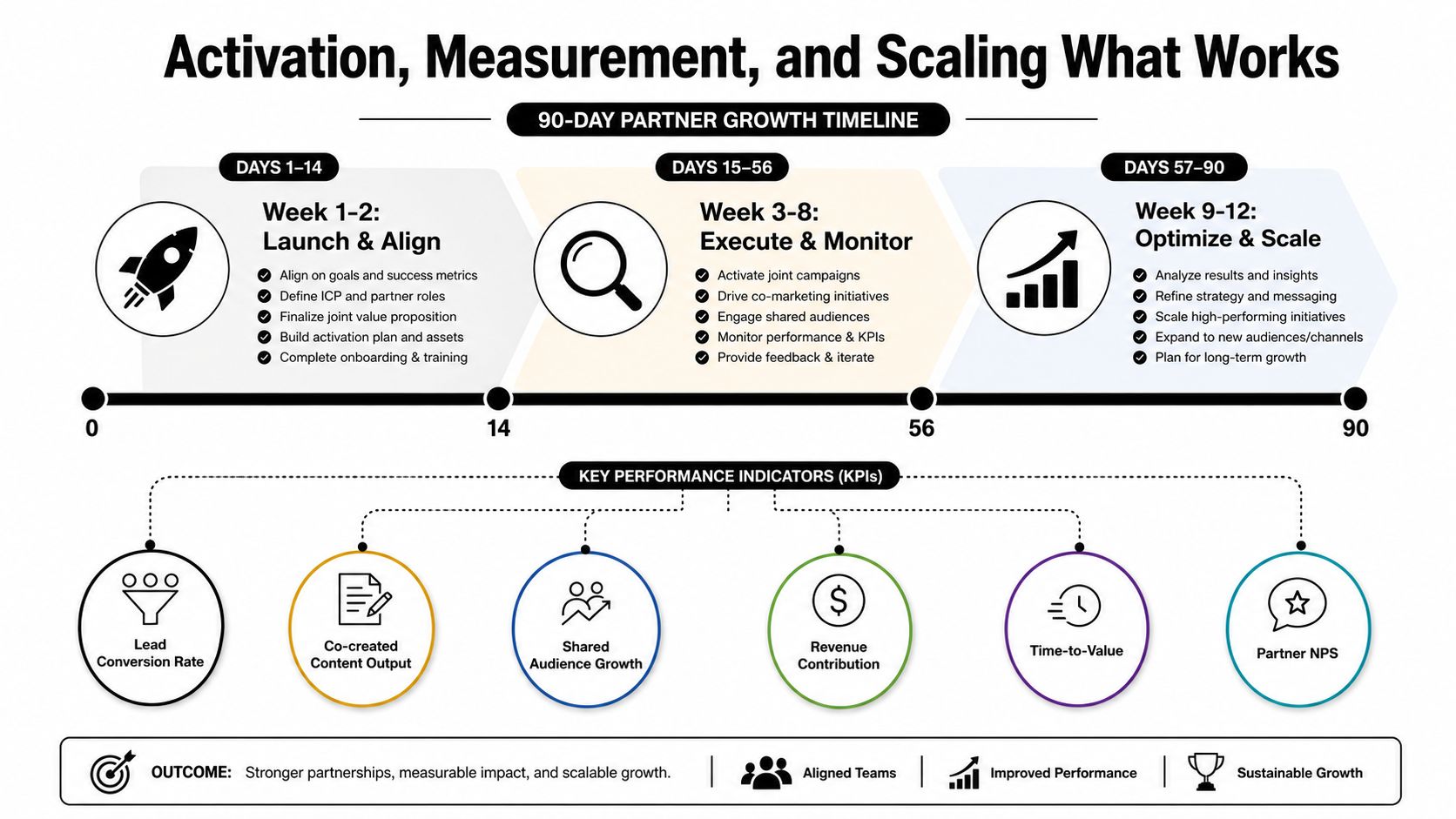
In Week 1 to 2, align on launch assets, responsibilities, and the one metric that matters most. In Week 3 to 8, ship the agreed assets, monitor responses, and fix friction fast. In Week 9 to 12, decide whether to expand, simplify, or stop.
Track the metrics that tell you if the partnership is working. For early-stage partnerships, I'd watch qualified leads, pipeline value, audience growth, engagement rate, retention, and CAC. If you need a separate lens for lead quality, how to measure lead quality and boost your ROI in 2026 is a useful companion for tightening the definition of “good” before you scale volume.
A lightweight quarterly review should answer four questions, what shipped, what moved, what stalled, and what gets pruned. If a partner generates attention but consumes too much coordination, cut it loose. If two partners keep moving the metrics, double down on those relationships and give them more runway.
That's the scaling rule many ignore. Don't add more partners because the calendar looks empty. Add more only after the current portfolio proves it can create measurable value with less friction than your other channels.
If you want help turning this into a real partnership system inside your brand or team, start with your one-page brief, then audit your current outreach, scorecard, and deal structure against it. If you want a partner to help organize the content and relationship side of that work, connect with Legacy Builder and use the framework here to brief your next outreach and review cycle before you sign anything.


You could – but most in-house teams struggle with the nuance of growing on specific platforms.
We partner with in-house teams all the time to help them grow on X, LI, and Email.
Consider us the special forces unit you call in to get the job done without anyone knowing (for a fraction of what you would pay).
Short answer – yes.
Long answer – yes because of our process.
We start with an in-depth interview that gives us the opportunity to learn more about you, your stories, and your vision.
We take that and craft your content then we ship it to you. You are then able to give us the final sign-off (and any adjustments to nail it 100%) before we schedule for posting.
No problem.
We have helped clients for years or for just a season.
All the content we create is yours and yours alone.
If you want to take it over or work on transitioning we will help ensure you are set up for success.
We want this to be a living breathing brand. We will give you best practices for posting and make sure you are set up to win – so post away.
Subscribe to our newsletter and get insights on how to grow your personal brand.
