.svg)
Subscribe to our newsletter and get insights on how to grow your personal brand.
Thank you! Your submission has been received!
Oops! Something went wrong while submitting the form.
.svg)


Most lead quality advice starts in the wrong place. It tells you to generate more top-of-funnel activity, then clean it up later with automation, scoring, or a better CRM.
That sequence burns founders.
If you're building a company through your own reputation, audience, and personal brand, every bad lead costs more than ad spend. It costs calendar space, attention, and trust. A weak-fit discovery call doesn't just waste an hour. It interrupts the work that grows the business.
The practical question isn't how to get more names into your pipeline. It's how to measure lead quality so your influence turns into conversations you can close.
The market loves vanity. More followers, more inbound, more DMs, more form fills. Founders absorb that logic and start treating volume as proof that marketing works.
It isn't.
A crowded pipeline can hide a weak business development system. You feel busy, your CRM looks active, and your content appears to be working. Meanwhile, the leads that come in aren't urgent, aren't ready, or aren't a fit for how you sell.
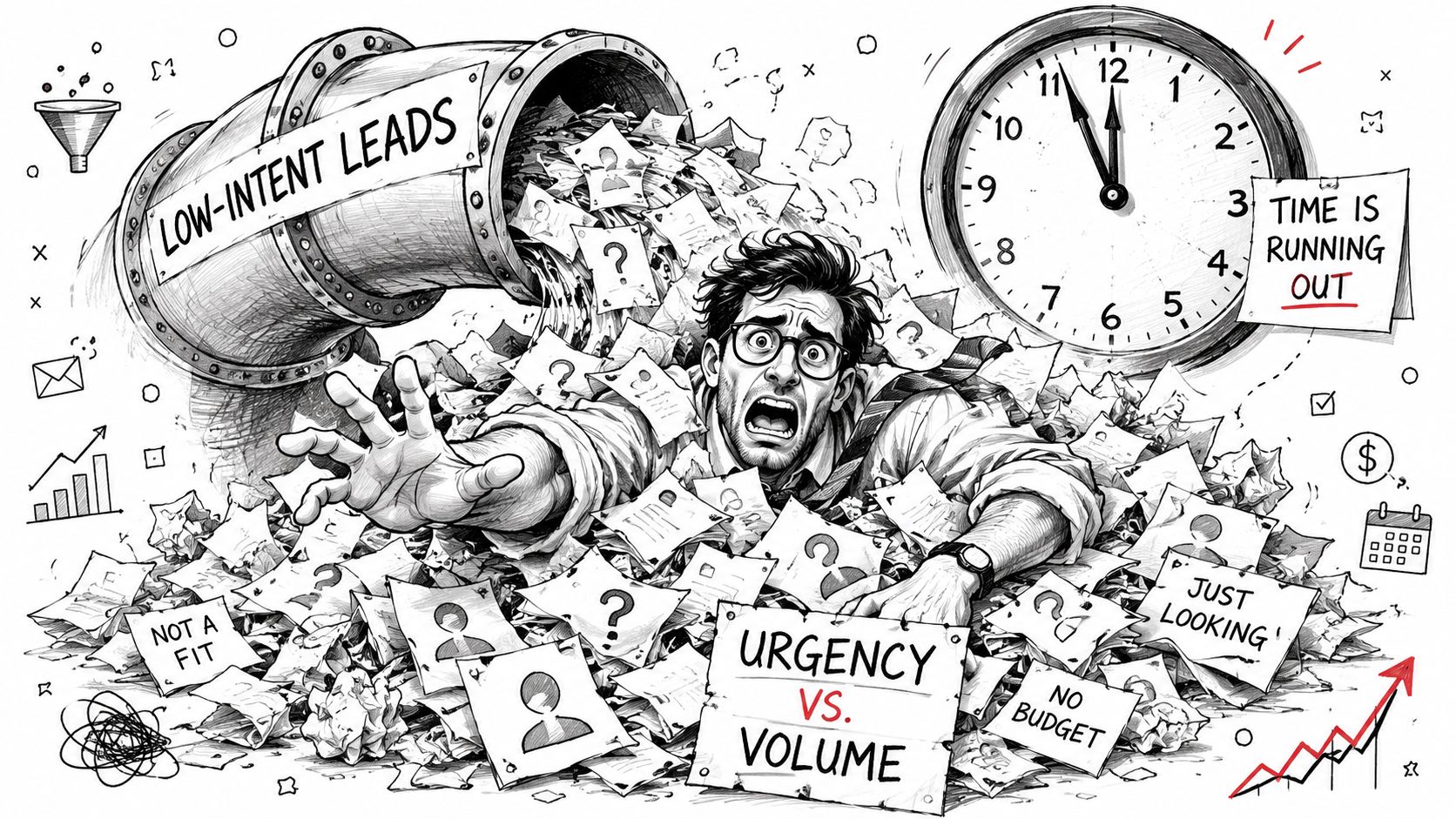
A useful corrective comes from this Pipeline CRM analysis of lead quality and urgency. It found that leads scoring high on budget/timeline but low on urgency have a 65% lower conversion rate than leads scoring high on both, regardless of volume.
That matters because founders often misread polite interest as buying intent. Someone may admire your content, fit your ICP, and even discuss budget. If they have no immediate reason to act, they clog the pipeline without creating revenue.
Practical rule: If a lead can't answer "why now?" clearly, treat them as nurture, not pipeline.
This is the trap behind a lot of well-meaning growth content, including broad lists of SaaS lead generation strategies for 2026. More channels can help. More channels without a quality filter usually create more noise.
You usually don't spot the problem in traffic reports. You spot it in operating friction:
For personal brand builders, this gets worse fast. Your audience is broad by design. Your business is not. Content attracts readers, listeners, and admirers who may never buy.
Founders often treat low-intent leads as harmless upside. They're not harmless. They distort decision-making.
When you count every inquiry the same way, you start funding the wrong channels, repeating the wrong content themes, and spending time on people who like your ideas but won't pay for implementation.
A lead pipeline should clarify reality, not comfort your ego.
The shift is simple to say and harder to run: stop asking, "How many leads did we get?" Start asking, "Which leads moved toward a real sale, and what signals did they show before they did?"
That's where measurement becomes strategic, not administrative.
Before you score leads, automate routing, or build dashboards, you need one written definition of what a qualified lead is.
This step is often skipped because it sounds obvious. It isn't. Even solo founders usually carry three different definitions in their head. One for content performance, one for pipeline reporting, and one for who they'd want to speak with.
That mismatch creates the classic problem where marketing says leads are coming in and sales says the leads are junk. In a founder-led business, you're often playing both roles, so the conflict happens internally.
A Universal Lead Definition is a short document that names the minimum conditions a lead must meet before you treat it as real pipeline.
Start with explicit criteria. These are the facts that don't depend on interpretation.
A founder-led services business might define qualified leads with questions like these:
If you're still refining those filters, sharpen them through a tighter persona process such as this buyer persona guide for founders.
Then layer in implicit criteria. These are the actions that suggest seriousness.
Many personal brand builders get better signal than larger companies. Your audience leaves clues. They reply to emails, watch webinars, visit your offer page, ask direct questions, and engage repeatedly before booking time.
According to Search Influence's guide on measuring lead quality, experts recommend defining lead quality collaboratively by agreeing on qualification criteria and sharing performance data. That approach can increase sales lead conversions by 20–40% when explicit criteria act as a go/no-go gate and implicit criteria are weighted more heavily.
That phrasing matters. Go/no-go gate first. Weighted behavior second.
If the lead doesn't fit your market, no amount of engagement should push them into sales priority.
The cleanest lead systems reject good engagement from the wrong person and reward moderate engagement from the right person.
Keep your first version short enough that you would use it.
| Component | What to define |
|---|---|
| Ideal buyer | The type of person or company you serve best |
| Required fit | Industry, role, budget context, market, or company profile |
| Required problem | The specific pain point you solve |
| Intent signals | Actions that suggest real interest |
| Sales readiness | What must happen before a call is worth taking |
| Disqualifiers | Conditions that remove a lead from active pursuit |
A strong Universal Lead Definition does two things at once. It protects your time, and it gives your content engine better feedback. Once you know who counts, you can look backward and see which posts, emails, interviews, or referral sources consistently attract them.
You don't need enterprise software to start scoring leads well. A spreadsheet is enough if the logic is clear.
The goal isn't mathematical elegance. It's triage. You want a repeatable way to separate readers from prospects, and prospects from buyers.
A practical lead scoring model for founders has two buckets:
This avoids a common mistake. People give too much weight to activity and not enough to fit. Someone can binge your content and still be a poor buyer. Another person can engage lightly but be exactly the kind of client you close quickly.
According to ActiveProspect's lead quality measurement guide, modern scoring models assign points based on source, demographics, and engagement. For example, an appointment booking might add +25 points and decision-maker status +10 points.
That makes sense because booked time and buying authority usually beat softer signals like likes or passive page views.
Use a model like this to start. Adjust the categories to fit your offer and sales motion.
| Category | Attribute/Action | Points |
|---|---|---|
| Explicit | Decision-maker status | +10 |
| Explicit | Strong firmographic or business fit | Add points based on your criteria |
| Explicit | Ideal source reputation | Add points based on your criteria |
| Implicit | High engagement behavior | Add points based on your criteria |
| Implicit | Trigger event mentioned | +15 |
| Implicit | Urgency expressed | +10 |
| Implicit | Appointment booked | +25 |
| Negative | Poor fit or low-quality signal | Subtract points based on your criteria |
A few notes matter here.
First, keep your scoring language plain. Don't write "engagement depth coefficient." Write "replied to email" or "mentioned active project."
Second, score actions that indicate movement, not vanity. A founder should care more about a pricing-page visit, webinar attendance, or direct inquiry than broad social engagement.
Third, add negative scoring. If a lead wants something outside your offer, lacks authority, or shows weak intent, your model should lower their priority.
People often get too clever too soon. They set rigid cutoffs before checking whether the scores match actual buying behavior.
A safer approach is:
The verified benchmark to keep in mind is that a lead quality score of 70 or above on a 0–100 scale typically signifies a high-quality lead with strong conversion likelihood, while scores below 50 often correlate with low intent or poor fit. Use that as a reference point, not a substitute for your own model calibration.
If you want a useful companion resource on structuring automation around this process, Stamina's lead scoring insights are worth reviewing. The value isn't the tooling pitch. It's the reminder that automation only works after the scoring logic is sound.
Your score should explain sales behavior. If high scorers don't close, the model is wrong.
What works:
What doesn't:
A founder doesn't need a perfect scoring model. You need one that helps you decide who deserves your next call.
A lead scoring model without clean inputs becomes theater. The score looks precise, but it's built on partial or messy information.
Most founders already have enough raw data to measure lead quality. The issue isn't access. It's fragmentation. One signal lives in the CRM, another in email software, another in website analytics, and another in your calendar.
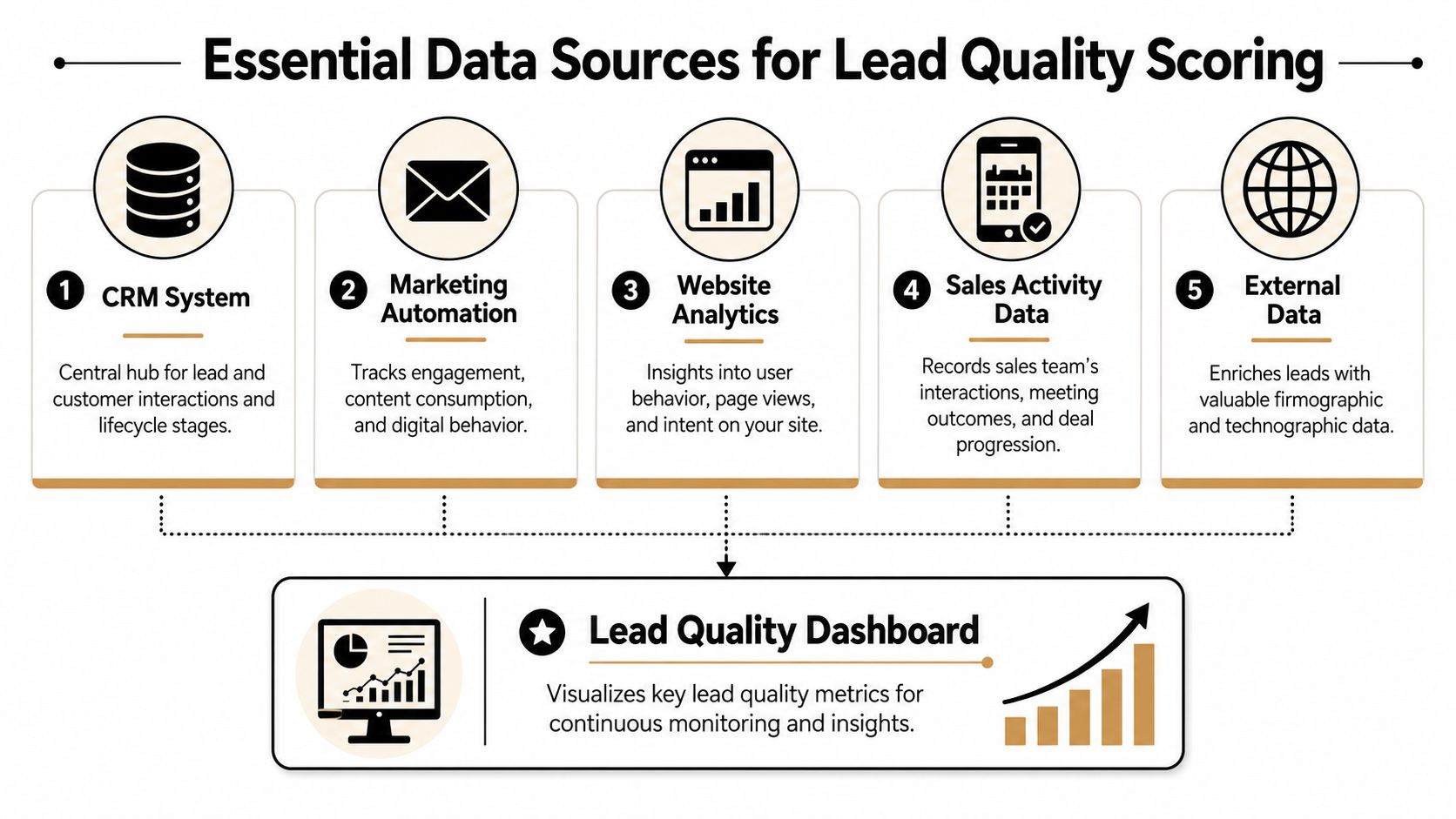
For a lean founder-led setup, these are the core sources:
Clean collection matters as much as reporting. If event tracking is messy or duplicated, your lead quality analysis will be unreliable. That's why it's smart to periodically track your data quality, especially when multiple tools are passing lead data back and forth.
You do not need a BI team. You need one page that answers whether your pipeline quality is improving.
Here are the core views to include:
| Dashboard view | Why it matters |
|---|---|
| Lead-to-customer conversion rate | Ties lead quality to revenue, not surface activity |
| Funnel progression by stage | Shows where quality breaks between Contacted, Qualified, Opportunity, and Sale |
| Lead score by source | Reveals which channels attract serious buyers |
| Cost per qualified lead | Stops cheap but weak channels from looking efficient |
| Sales feedback summary | Adds human judgment to the numbers |
A useful operating benchmark from the verified data is that lead-to-customer conversion rate is one of the clearest ways to measure quality because it connects platform activity to revenue, not just form fills.
At this stage, dashboards become diagnostic instead of decorative.
Leads demonstrating high engagement behaviors such as opening emails, attending webinars, and downloading gated content, combined with firmographic fit, are up to 3x more likely to close. And when teams track funnel stages like Contacted → Qualified, they can reduce wasted sales effort by 25–40%.
If your email platform is part of that picture, it helps to understand the surrounding engagement layer through metrics like those in this email campaign performance guide.
For a quick walkthrough of how these systems come together in practice, this video is a useful complement:
A dashboard should help you make one decision fast: invest more, fix the funnel, or stop feeding a low-quality source.
Most lead quality systems fail for a boring reason. Nobody revisits them.
The market changes, your content evolves, your offer shifts, and your audience mix moves with it. A scoring model that worked six months ago can become less useful if nobody compares it to actual sales outcomes.
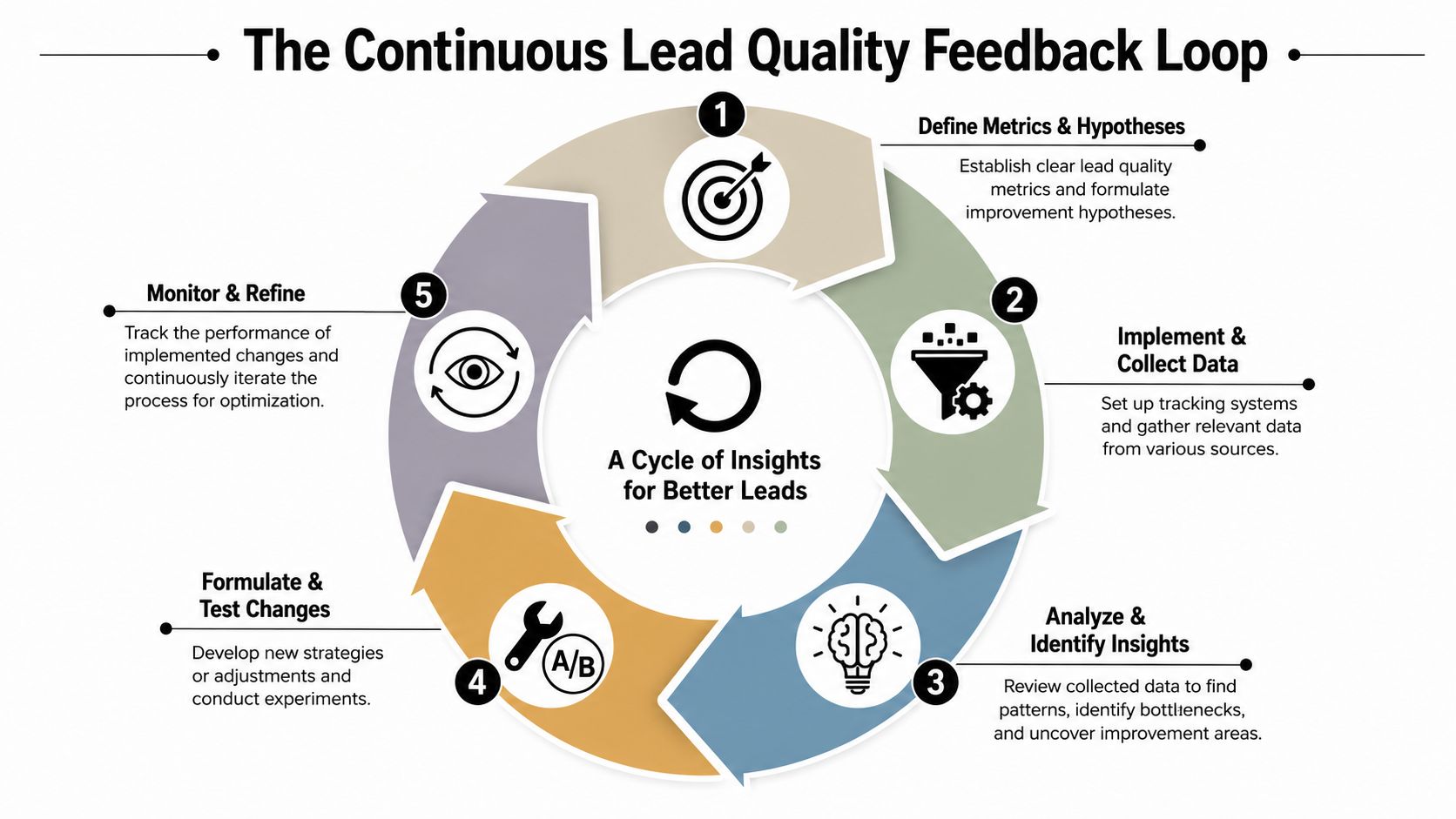
A practical founder version looks like this:
Define the metric and the hypothesis
Example: "Leads from podcast appearances seem more qualified than broad paid traffic."
Collect the data consistently
Make sure source tagging, scoring, and sales-stage updates are happening.
Analyze the breakpoints
Look for channel differences, stage drop-offs, and mismatches between score and close outcome.
Test a change
Shift spend, adjust qualification rules, change the call-to-action, or tighten disqualifiers.
Refine the model
Keep what improves pipeline quality. Remove what creates noise.
The numbers won't tell you everything. Sales notes fill in the missing context.
A useful review rhythm is to ask the same questions each time:
Quality issues often show up first in conversations, not dashboards. The founder who takes calls usually feels the decline before the CRM proves it.
The best operating discipline in the verified guidance is simple: review the model regularly with sales and marketing stakeholders, and maintain a change log.
From the Search Influence methodology, quarterly reviews with stakeholders and documenting each model modification help keep the system aligned with outcomes. That cadence works especially well for founder-led businesses because it's frequent enough to catch drift without turning optimization into a weekly distraction.
You should also keep an eye on source quality and compliance posture. The verified data notes that third-party lead vendors can deliver 15–20% more invalid or fraudulent leads than organic or direct channels, and that non-compliant leads can create legal penalties exceeding $50,000 per violation in regulated industries. For founders, the lesson is straightforward. Don't outsource judgment to low-trust lead volume.
If a lead source creates cleanup work, calendar waste, and shaky consent records, it's not a growth channel. It's an operations problem.
One final discipline separates mature teams from busy ones. They don't optimize for what converts into leads. They optimize for what contributes to closed deals.
That sounds obvious, but many founder-led brands still reward channels that generate conversation rather than customers. The better move is to ask which source produces the strongest progression through your actual sales motion, then put more budget and effort there.
Measurement only matters if it changes your next decision.
A founder doesn't need more lead theory. You need a system that protects your time and points your effort toward revenue.
The core moves are straightforward. Reject the volume obsession. Define one shared standard for a qualified lead. Score fit and intent separately. Pull your data into one operating view. Review what closes, then adjust.
The payoff isn't cleaner reporting. It's sharper focus.
When you know how to measure lead quality, you stop giving equal weight to every inquiry, comment, download, and booked call. You stop overvaluing attention from people who like your ideas but won't buy your work. You start seeing your content, audience, and pipeline as one system.
For personal brand builders, that's the difference between being visible and being commercially effective. Influence creates opportunities. Qualification turns them into business.
Start small if you need to.
Pick one thing this week:
Do one of those well, and your marketing gets harder to fool.
Lead quality measurement isn't a one-time setup. It's a discipline. Founders who practice it make better offers, create better content, and close better clients because they learn from real buying behavior instead of surface activity.
That's how you build a durable brand. One qualified lead at a time.
If you're building a founder-led brand and want help turning your expertise into content that attracts better-fit opportunities, Legacy Builder helps professionals create authentic, strategic content systems that grow influence without sacrificing clarity or consistency.


You could – but most in-house teams struggle with the nuance of growing on specific platforms.
We partner with in-house teams all the time to help them grow on X, LI, and Email.
Consider us the special forces unit you call in to get the job done without anyone knowing (for a fraction of what you would pay).
Short answer – yes.
Long answer – yes because of our process.
We start with an in-depth interview that gives us the opportunity to learn more about you, your stories, and your vision.
We take that and craft your content then we ship it to you. You are then able to give us the final sign-off (and any adjustments to nail it 100%) before we schedule for posting.
No problem.
We have helped clients for years or for just a season.
All the content we create is yours and yours alone.
If you want to take it over or work on transitioning we will help ensure you are set up for success.
We want this to be a living breathing brand. We will give you best practices for posting and make sure you are set up to win – so post away.
Subscribe to our newsletter and get insights on how to grow your personal brand.
