.svg)
Subscribe to our newsletter and get insights on how to grow your personal brand.
Thank you! Your submission has been received!
Oops! Something went wrong while submitting the form.
.svg)



Most advice on how to attract customers online is lazy. Post more. Chase trends. Run ads. Hack the algorithm. None of that gives you a durable business. It gives you a content treadmill.
The underlying problem is simpler. You do not need to be louder. You need to be more recognizable. Buyers are flooded with competent people. They remember the ones with a clear point of view, a consistent story, and a presence that feels human.
That matters even more now. Buyers move across channels, compare you, and decide long before they book a call. Strong omnichannel brands, with consistent content across multiple channels, see significantly higher purchase rates than single-channel efforts, and integrated campaigns report substantially higher order rates. More than half of shoppers engage with four or more touchpoints before buying, according to these omnichannel customer engagement statistics.
So stop treating customer attraction like broadcasting. Build a system people can enter from anywhere. Your story pulls them in. Your profile clarifies the value. Your content proves you know what you are doing. Your outreach starts real conversations. Your conversion path turns attention into revenue.
That is the game.
The worst online growth advice is “just post every day.”
Daily posting without a positioning system creates noise. You publish a lot, say very little, and train your audience to scroll past you. Consistency matters, but empty consistency is not strategy.
The better model is this: become a magnet, not a megaphone.
Most founders think customer attraction is a reach problem. It is usually a trust problem.
If your content sounds generic, your profile reads like a resume, and your offers appear out of nowhere, more impressions will not save you. More people will ignore you faster.
Common mistakes look like this:
Rule: If a stranger lands on your profile and cannot tell who you help, what you believe, and why you are different within seconds, you are not attracting customers. You are creating friction.
Customer attraction online gets easier when every piece fits together.
You need:
This is slower than hacks. It is also far more useful, because it builds an asset you own. Your reputation compounds. Your ideas compound. Your network compounds.
That is how founders attract the right customers online without turning into full-time performers.
Before you fix your funnel, fix your narrative.
Your brand is not your font, your headshot, or your slogan. Your brand is the story people repeat about you when you are not in the room. If you do not define it, the internet will do it for you, badly.
Google Trends data points to a significant spike in searches for “authentic personal branding algorithms” since Q1 2025, yet most content still avoids the hard part. Strategic daily interactions rooted in a core story can drive substantially higher engagement, and a majority of creators abandon their strategies because of inconsistency fatigue, according to this analysis of underserved market segments.
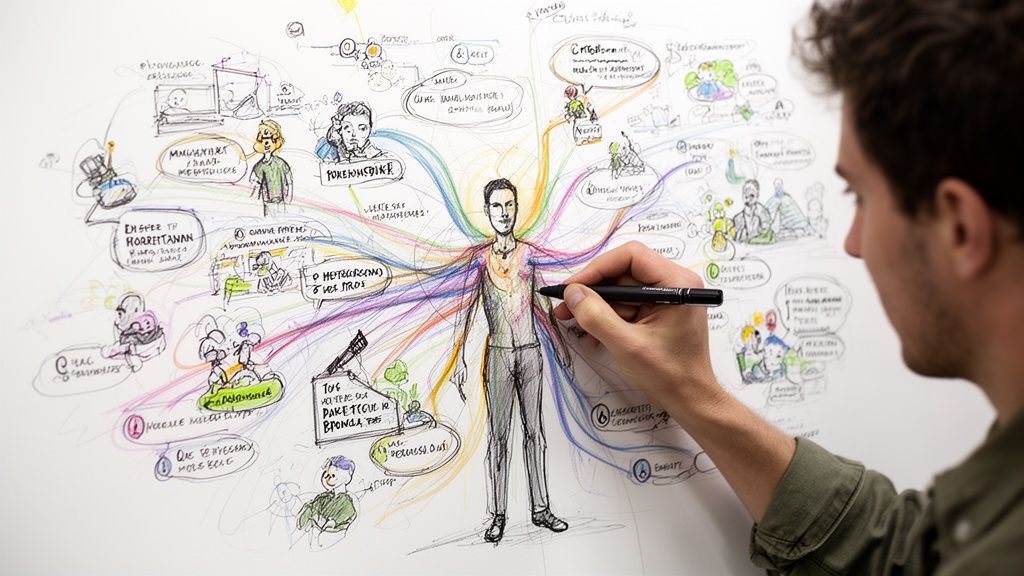
Many overcomplicate storytelling. You do not need a dramatic life story. You need a coherent one.
Start with four questions:
Write short answers, not polished copy. Look for repeated patterns. Those patterns are your narrative spine.
Here is a simple way to frame it:
| Element | What to define |
|---|---|
| Origin | The experience that shaped your perspective |
| Problem | The issue your audience keeps struggling with |
| Belief | Your contrarian or clear viewpoint |
| Method | How you solve the problem in practice |
| Outcome | What changes for the client |
A founder might say, “I built my career watching smart operators hide behind bland messaging. I help experts turn lived experience into content that earns trust and inbound demand.” That is already stronger than “I help businesses grow online.”
Your story should feed your content. If it cannot, it is too vague.
Create three to five themes you can talk about for months. For example:
These themes become your content lanes, talking points, and outreach angles.
Tip: If you struggle to articulate your story, map your career through turning points, not job titles. Turning points reveal tension. Tension creates interesting content.
If you want a practical structure for this work, this brand storytelling framework is a useful reference.
Do not hide behind broad values like authenticity, excellence, and impact. Everyone says that. Nobody remembers it.
Say what happened. Say what changed your mind. Say what you now help people avoid. Buyers trust specificity because it sounds lived-in.
That is the foundation. Everything else works better when your audience can quickly understand your perspective and see themselves inside your story.
A weak profile kills strong content.
Someone reads your post, gets curious, clicks your profile, and finds a vague headline, a corporate banner, and a bio that says nothing. You just lost the lead.
For traditional businesses moving into digital branding, this matters even more. Many struggle with consistent digital engagement, but story-driven profiles and content lead to higher customer retention, according to this piece on underserved niches for business growth.
Your profile is not a biography. It is a landing page.
Focus on these parts:
Ask one question when reviewing your profile:
Could an ideal buyer answer these three things immediately?
If not, rewrite it.
Here is a better framing model:
One is a label. The other is a promise.
Your profile should echo the narrative you defined earlier. Same language. Same point of view. Same audience.
That does not mean copying the same paragraph everywhere. It means keeping the signal consistent across LinkedIn, X, your website, newsletter landing page, and email signature.
For tactical guidance on cleaning up that footprint, this beginner’s guide to building online presence covers the basics well.
Practical move: Rewrite your headline and bio as if you were introducing yourself to one ideal client, not a room full of random followers. Precision attracts. Broadness repels.
Your problem is rarely a lack of ideas. It is a lack of structure.
Founders stall because they treat content like a side quest. They post when they feel inspired, disappear when client work piles up, then wonder why inbound interest stays inconsistent. That cycle will keep wasting your expertise until you build a system that turns your story, insights, and client lessons into repeatable assets.
You need a content engine that can run without daily bursts of motivation.
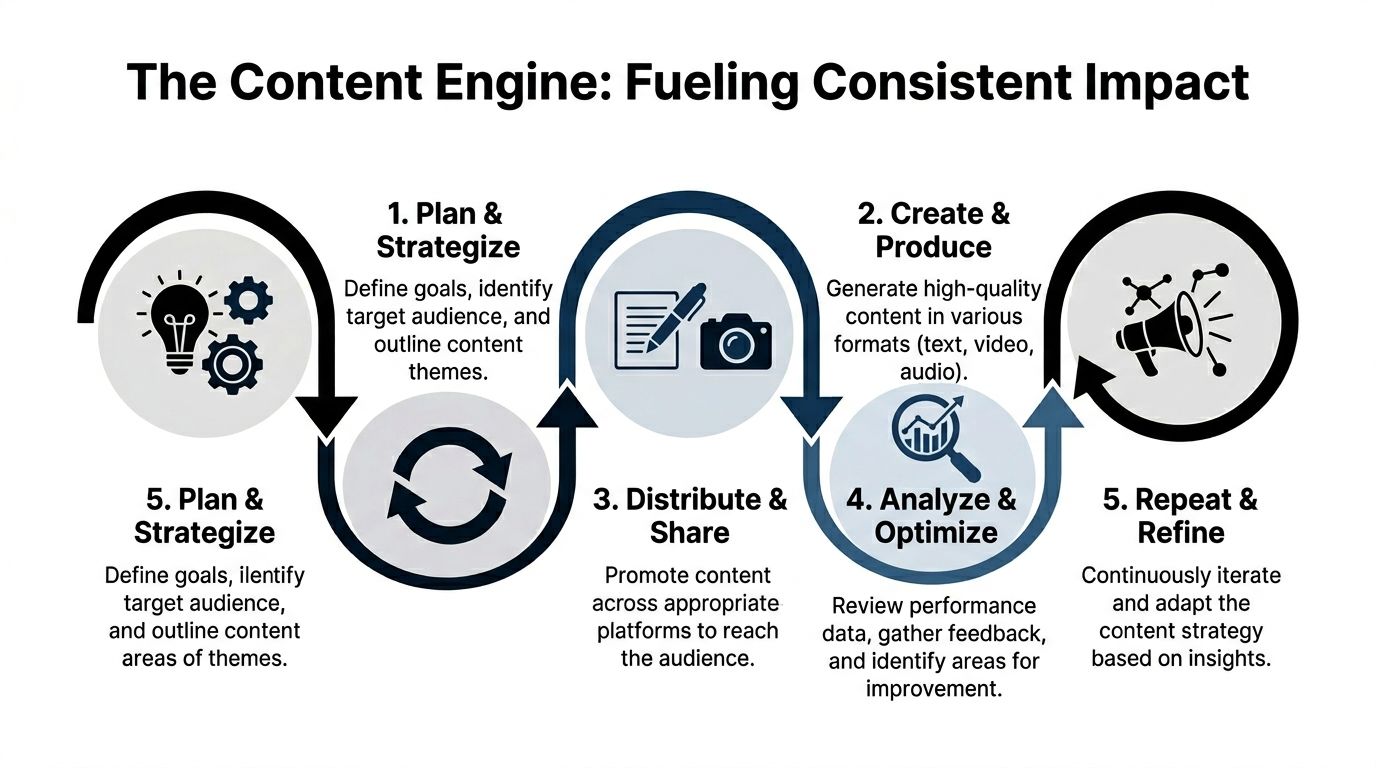
Do not try to say everything at once. Pick one clear idea each week and push it through your channels with discipline.
The best pillar topics usually come from material you already have:
That approach matters because personal-brand content works best when it feels lived, not manufactured. Your audience does not need more generic advice. They need repeated proof that you understand the problem from the inside and have a clear way through it.
If you need help mapping those themes, this guide on how to create a content strategy that builds your brand gives you a practical starting point.
One pillar should produce several assets. Each one should carry the same core message, but the format and entry point should change.
A practical weekly flow looks like this:
| Day | Asset | Purpose |
|---|---|---|
| Monday | Long-form LinkedIn post | Establish your point of view |
| Tuesday | Short X thread | Sharpen the argument into quick, clear takeaways |
| Wednesday | Short-form video | Put your face, voice, and conviction behind the idea |
| Thursday | Email newsletter | Add context, story, and a stronger relationship layer |
| Friday | Follow-up post or comment round | Re-surface the idea and keep the conversation active |
This is how professionals stay visible without sounding repetitive. Repetition with a clear angle builds recognition. Random posting builds noise.
People do not hire you because you posted 19 times this month. They hire you because your message stayed consistent long enough to become memorable.
That means one idea should show up in several places:
This is not about flooding every platform. It is about reinforcing the same signal until the right buyer can explain what you do without checking your profile again.
Content systems fail when they ask too much from you.
A sustainable process is simple.
Set aside one block each week to capture ideas, review notes from calls, and choose your next pillar. Do not wait for inspiration. Pull from real conversations, real objections, and real client results.
Write and record in batches, then schedule distribution later. You will produce better work when you are focused on one job at a time.
Keep a running file of phrases from sales calls, emails, DMs, and voice notes. Buyer language beats polished brand copy because it reflects the problem people describe.
Likes can flatter you and mislead you. Pay attention to comments, saves, replies, direct messages, and conversations that turn into qualified opportunities. Those are stronger signs that your content is attracting the right people.
Tip: Repurposing works when the message stays consistent and the packaging changes. A LinkedIn reader may want the strategic takeaway. An email subscriber may care more about the backstory, decision process, or lesson learned.
Tools like Notion, Buffer, Typefully, Descript, and Canva can handle planning, scheduling, editing, and design. Legacy Builder also offers a done-with-you process built around consultation, content creation, profile optimization, and strategic distribution for professionals who struggle to maintain consistency.
Strong content does not exist to fill the feed. It should accomplish something specific.
Every piece you publish should do at least one of these:
If it does none of the three, cut it.
A real content engine turns your experience into an asset. That is the difference between posting for attention and building a body of work that attracts customers long after you hit publish.
Content alone is passive. Relationships close deals.
A lot of founders hide behind posting because outreach feels uncomfortable. That is backwards. If you know exactly who you want to reach, waiting for them to discover you is inefficient.
Use a Dream 100 approach. Build a list of the people who matter most: Prospects, referral partners, podcast hosts, investors, peers, community builders. Then engage them with intention.
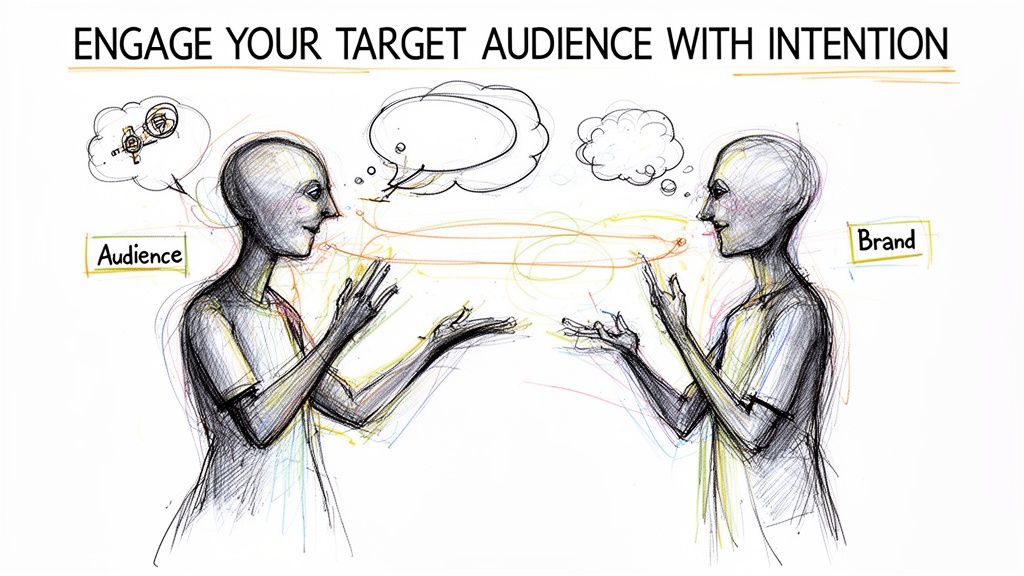
Broad networking feels productive because it is endless. It is also sloppy.
A tighter list changes your behavior. You notice patterns. You see what people care about. You can add relevant comments instead of generic praise.
Segment your Dream 100 into groups like:
This is not just neat organization. It changes your messaging.
A segmented, intentional engagement strategy used by an online retailer delivered a significant email conversion lift and a substantial on-site conversion increase, according to McKinsey’s example of targeted engagement and segmentation. For a personal brand, the takeaway is straightforward. Personalized outreach beats generic activity.
Do three things consistently.
Do not write “great post.” Add a perspective, ask a sharp question, or connect the idea to a real example.
Repost or quote-post work from people in your Dream 100 when you have something useful to add. This creates visibility without begging for attention.
Message people after a real interaction. Mention the post, podcast, or idea you engaged with. Keep it light. No pitch unless the relationship has earned it.
A useful message sounds like this:
“I liked your point about buyer hesitation coming from unclear positioning, not price. I see the same pattern with founders whose profiles still read like resumes. Curious if you’ve noticed that too.”
That starts a conversation. It does not trigger defense.
Key takeaway: You do not need more outreach. You need better-selected outreach with stronger context.
Most founders rush the ask. They try to convert before they have been recognized.
Better sequence:
That process feels slower. It often shortens the path to trust because it removes the usual spam signal.
If you want to attract customers online without sounding desperate, this is the move. Become familiar. Become useful. Then become the obvious choice.
Attention is worthless if it dead-ends.
A lot of founders create good content, start good conversations, and then fumble the handoff. No lead magnet. No email sequence. No clear offer. No onboarding. The prospect gets interested, then disappears.
You need a conversion path that feels natural.
Do not send everyone straight to “book a call.”
That works only for people with high intent. Many buyers need a smaller commitment first.
Good entry points include:
The best lead magnet is tightly connected to your paid offer. If you sell positioning, offer a messaging audit. If you sell content strategy, offer a weekly content planning template. If you sell advisory work, offer a diagnostic.
Once someone opts in, do not dump them into a generic newsletter and hope for the best.
Use a short email sequence that does four things:
| Purpose | |
|---|---|
| Email 1 | Deliver the promised asset fast |
| Email 2 | Reframe the deeper problem |
| Email 3 | Share a practical win or proof point |
| Email 4 | Introduce your method |
| Email 5 | Offer the next step |
Many founders get too clever here. Keep it plain. Useful subject lines. Tight writing. Clear next actions.
Data on service conversion paths shows that opt-in trials convert at a notable rate. Early behavior matters too. Dropbox found users who took a key action in the first hour were more likely to become payers, according to this review of data-driven customer success and onboarding metrics.
That lesson applies far beyond software. If someone downloads your guide, gets an audit, or joins your workshop, give them one immediate action that creates momentum.
A useful explainer on this principle is below.
Many track opens and clicks. Fine. But the more useful question is: what early action signals serious intent?
For your business, that might be:
Once you know that signal, build automation around it.
For example:
Practical rule: Your conversion path should reduce uncertainty, not increase pressure.
Good conversion design feels like guided momentum. Each step solves a small problem and makes the next step easier to say yes to.
That is how content turns into pipeline.
If you care more about follower count than qualified conversations, you are still playing the wrong game.
Track signals tied to business value:
Ignore vanity spikes. A post can go viral and bring nothing useful. Another can trigger three serious buyer conversations and change your quarter.
The long game is simple. Tight story. Strong profile. Consistent content. Intentional outreach. Clean conversion path. Then repeat long enough for trust to compound.
This is how to attract customers online without turning your business into a casino of random tactics. You are building an asset. A reputation people remember. A body of work people trust. A system that keeps working after individual posts disappear.
If you want help building that system, Legacy Builder works with founders, professionals, and personal brands to turn your story, expertise, and perspective into consistent content, sharper profiles, and a stronger online presence that supports real customer attraction.


You could – but most in-house teams struggle with the nuance of growing on specific platforms.
We partner with in-house teams all the time to help them grow on X, LI, and Email.
Consider us the special forces unit you call in to get the job done without anyone knowing (for a fraction of what you would pay).
Short answer – yes.
Long answer – yes because of our process.
We start with an in-depth interview that gives us the opportunity to learn more about you, your stories, and your vision.
We take that and craft your content then we ship it to you. You are then able to give us the final sign-off (and any adjustments to nail it 100%) before we schedule for posting.
No problem.
We have helped clients for years or for just a season.
All the content we create is yours and yours alone.
If you want to take it over or work on transitioning we will help ensure you are set up for success.
We want this to be a living breathing brand. We will give you best practices for posting and make sure you are set up to win – so post away.
Subscribe to our newsletter and get insights on how to grow your personal brand.
