.svg)
Subscribe to our newsletter and get insights on how to grow your personal brand.
Thank you! Your submission has been received!
Oops! Something went wrong while submitting the form.
.svg)


Most advice on how to analyze competitors is built for companies comparing products, pricing pages, and feature grids. That model breaks down fast when you're building a personal brand. You're not trying to out-list someone else's software features. You're competing for attention, trust, memory, and relevance.
That changes the job completely.
If you study competitors the old corporate way, you end up with a bloated spreadsheet and weak content. You start copying formats, echoing angles, and sounding like a diluted version of people who already own the conversation. That's not strategy. That's creative surrender.
A personal brand needs a different lens. You need to study how other voices attract the audience, what they repeat, what they avoid, what their followers respond to, and where they leave frustration unresolved. Then you use that information to build a point of view they can't replicate because it comes from your lived experience, your expertise, and your decisions.
Corporate competitor analysis usually obsesses over static comparison. Feature A versus Feature B. Price versus price. Message versus message. That can help a product team, but it won't help a founder become unforgettable.
For a personal brand, competition is simpler and harder. It's whoever your audience listens to before they listen to you.

The old approach produces noise because it treats every competitor equally and every detail as important. That's a mistake. A rigorous UX competitive analysis process recommends focusing on 4 to 6 competitors, not a giant list, because going beyond 6 increases resource burden by 40 to 50% without improving insight quality, according to UXPin's guidance on competitive analysis for UX.
That principle applies even more strongly to personal brands. If you track too many voices, you stop seeing patterns and start collecting clutter.
Practical rule: If your competitor file is growing faster than your content clarity, you're researching too much and deciding too little.
You need to stop asking, "What are they doing?" and start asking better questions:
This shift matters because personal branding isn't a feature war. It's a relevance war. The audience doesn't reward the observer with the broadest scope. They reward the clearest voice with the sharpest angle.
The point of competitor analysis isn't to become better at their approach. It's to spot where their approach creates room for yours. If their content is polished but generic, you can be specific. If they speak to everyone, you can become the obvious choice for a narrower group. If they sound clever but distant, you can sound experienced and useful.
That's how you win. You don't become the next version of them. You become the only version of you that the market can recognize instantly.
Your competitor list is useless if your arena is fuzzy.
Founders waste weeks tracking loud people instead of relevant people. For a personal brand, your real competition is not every creator in your niche. It is the small group of voices shaping how your audience thinks, what they trust, and who they hire.
Your arena sits at the overlap of three things: the topic you want to own, the audience you want to attract, and the outcome you want your content to produce.
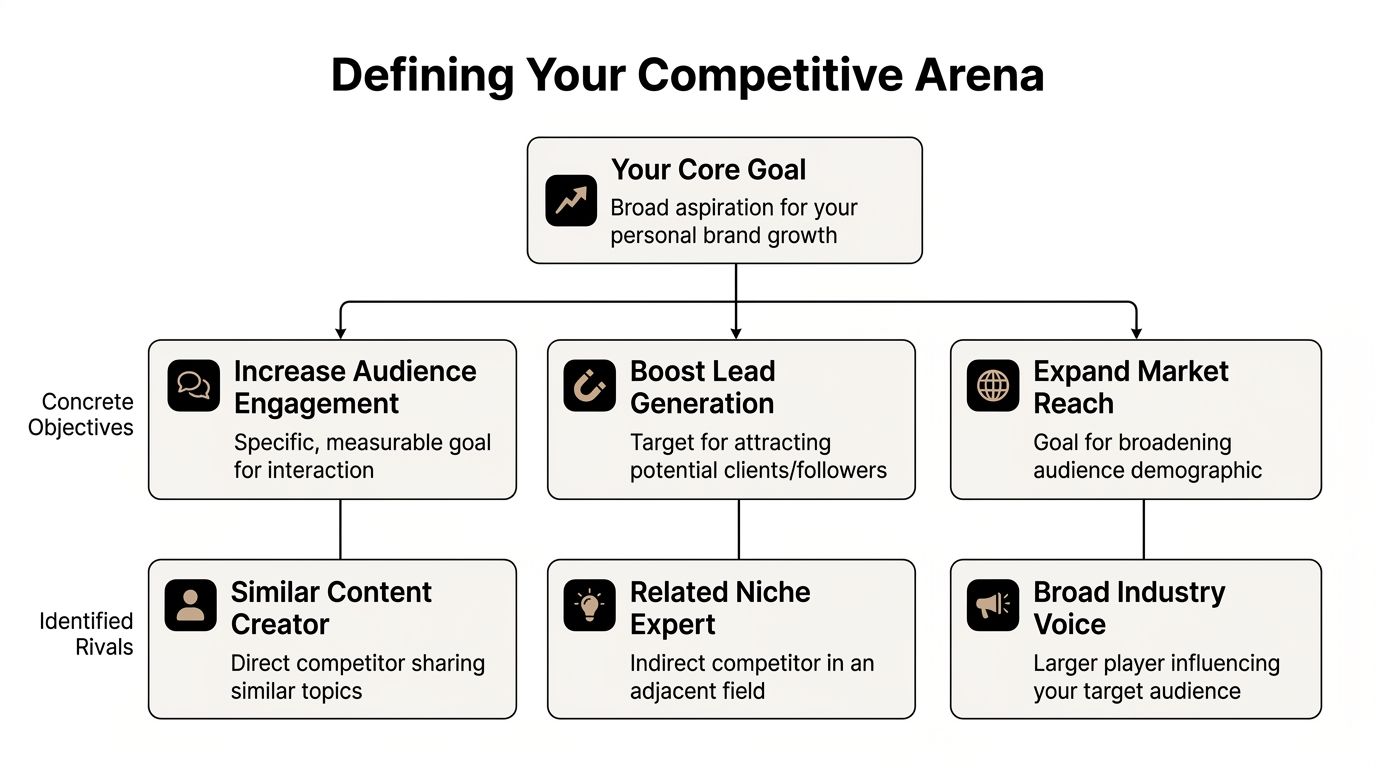
Pick the result first. Then choose the rivals.
"Grow my brand" tells you nothing. A useful goal changes who belongs on your list and what you study once they are there.
Choose one objective:
This matters more for personal brands than company brands. You are not comparing product pages or pricing tables. You are studying who already owns mindshare with the audience you want.
A founder selling fractional CMO work should study trusted operators, consultants, and educator-types who influence the same buyer. A founder trying to grow a paid newsletter should study writers who convert attention into subscription habits. Same broad niche. Different arena.
If your niche still feels broad, narrow it before you build a rival list. This guide on finding your niche with an authentic and profitable approach will help.
Do not sort competitors by follower count. Sort them by the role they play in your audience's decision-making.
Use four categories:
Direct rivals
People with similar offers, similar topics, and a similar audience. If you help B2B founders improve LinkedIn content, direct rivals are other strategists, ghostwriters, or consultants serving that same buyer.
Indirect rivals
People solving the same pain from a different angle. A positioning consultant, sales advisor, or demand generation operator may compete for the same audience attention even if their offer is different.
Aspirational rivals
Established voices your audience already trusts. You may not lose deals to them today, but you are still being judged against the standard they set for clarity, authority, and consistency.
Emerging rivals
Smaller creators or professionals gaining traction fast. These voices matter because they often reveal where audience attention is shifting before the bigger names react.
This structure keeps you focused on influence, not noise.
A tight list beats a bloated spreadsheet.
Use this structure:
| Rival Type | Who to Include | Why They Matter |
|---|---|---|
| Direct | People with overlapping offers and audience | They shape buyer comparisons |
| Indirect | Adjacent experts solving the same pain | They reveal alternate positioning |
| Aspirational | Established names your audience respects | They show the attention ceiling |
| Emerging | Rising voices getting unusual engagement | They signal shifts in audience interest |
A practical shortlist looks like this:
That is enough to spot patterns without drowning in screenshots.
Here is the filter I use with founders: if you cannot explain in one sentence why a person belongs on the list, cut them. "Smart content" is not a reason. "Our buyers compare us to them" is a reason. "My audience shares their posts and repeats their language" is a reason. "They convert the same problem into a different offer" is a reason.
For a cleaner way to organize what you find, use a simple SWOT lens to understand competitor strengths and weaknesses. It helps you separate real strategic signals from polished content that only looks impressive.
Glancing at a few posts and trusting memory is a lazy way to audit content. You need a repeatable way to inspect the full brand system, because personal brands rarely win through one channel alone.
A strong audit looks at three surfaces: the home base, the public content, and the commercial path. In plain terms, that means their site, their main platform, and their offers.
Open their website, newsletter landing page, or creator profile link hub. You're looking for the strategic center of gravity.
Check these questions:
If a founder's homepage says "I help SaaS leaders build category-defining brands" and every CTA drives to a strategy call, that's different from a creator whose site funnels visitors into a free newsletter and then a paid course. Same niche, different engine.
Pick the platform where they matter. For most professionals, that's LinkedIn, X, YouTube, or a newsletter. Don't spread your attention across every account equally.
Use this checklist and capture your notes in one file.
| Audit Area | What to Look For | Notes/Opportunity |
|---|---|---|
| Website and bio | Headline, promise, credibility, CTA | Is the positioning sharp or generic? |
| Content pillars | Recurring topics and themes | Which topics get real response? |
| Formats | Text posts, carousels, video, long-form, email | What format seems native to their audience? |
| Engagement quality | Comments, shares, questions, saves | Are people reacting or actually engaging? |
| Audience language | Phrases followers use in comments and replies | What words keep showing up? |
| Offer path | Newsletter, consulting, community, course | Where does attention convert? |
Don't just count likes. Read comments closely. Look for patterns like confusion, praise, objections, and repeated follow-up questions. Those signals tell you whether content is performing at the level of vanity or trust.
If you need a sharper framework for evaluating your own output against theirs, use this guide on measuring content performance for your personal brand.
Most founders often stop too soon. They study content but ignore what the content is trying to sell.
Track the whole ladder:
A personal brand without a visible offer path is usually still experimenting. A personal brand with a tight path tells you exactly how they think attention turns into revenue.
Field note: If someone's content feels inconsistent, their business model usually is too. The offer path exposes that fast.
At the end of this audit, you should know four things:
That's the difference between casual observation and strategic analysis. Casual observation notices activity. Strategic analysis identifies intent.
Strong personal brands don't just publish often. They repeat a coherent worldview until the audience can describe it back to someone else.
That coherence is what you're mapping.
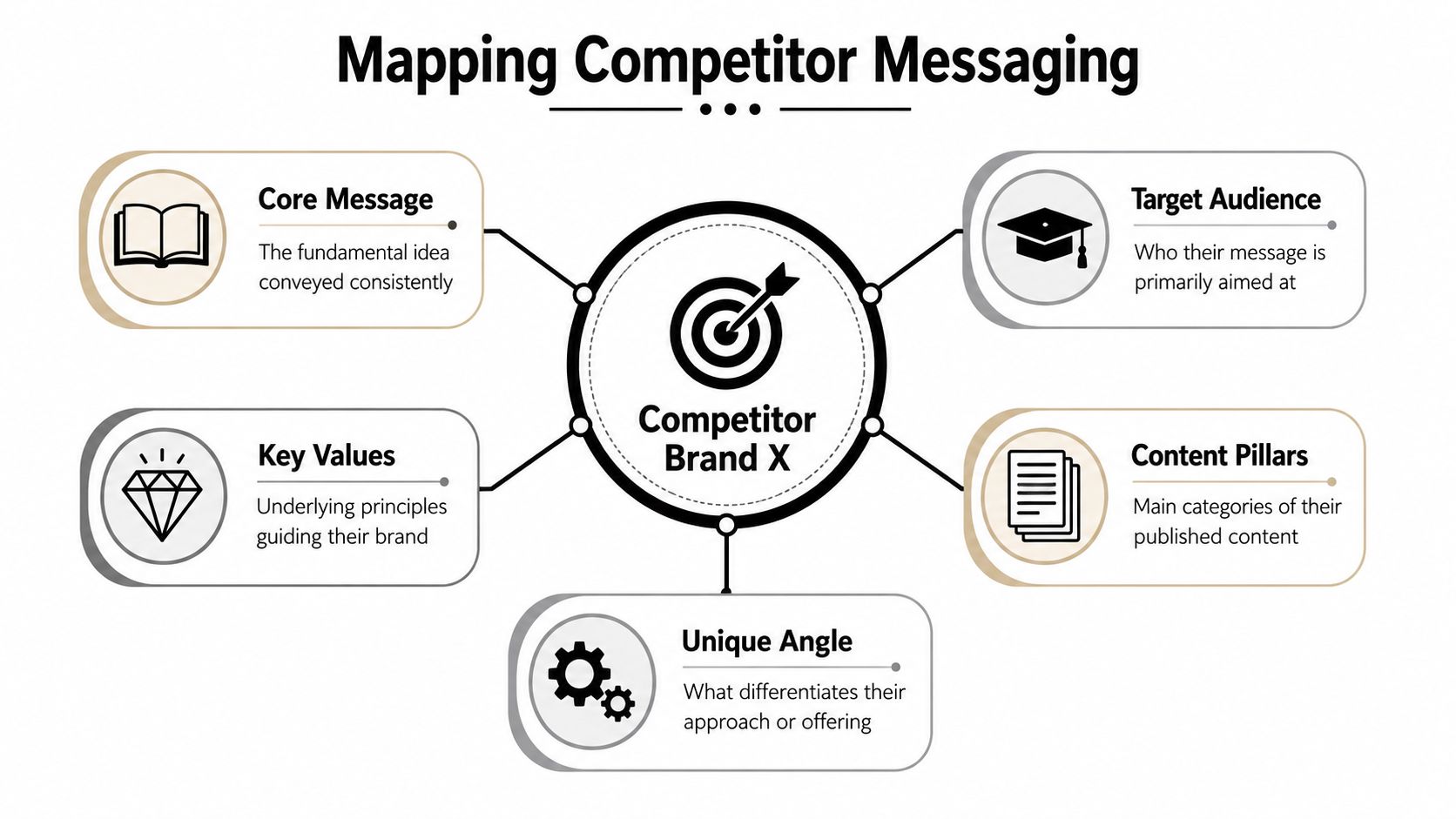
Start by watching this breakdown of positioning mechanics in action:
Every serious brand has one central idea doing most of the work. Sometimes it's explicit. Sometimes it hides inside repeated phrases, examples, and post topics.
Look for:
Repeated claims
Statements they come back to again and again, such as "most founders don't need more content, they need better distribution."
Recurring enemies
Bad advice, outdated systems, lazy tactics, shallow thinking. The enemy often reveals the position.
Promised transformation
What they say changes when people follow their method.
Write the big idea in one line. If you can't, you haven't understood their positioning yet.
Two people can talk about the same subject and build completely different brands. The difference usually sits in the language.
One founder may sound analytical, using frameworks, categories, and operational language. Another may sound narrative-driven, using stories, identity shifts, and emotional vocabulary. Same topic. Different audience magnet.
Make notes on:
Many founder brands go wrong by copying topics from competitors and ignoring tone. The result feels hollow because the surface matches but the voice doesn't.
If you want a clearer lens for building your own contrast, read this guide on brand positioning strategy and defining your edge.
Your audience usually remembers the frame before they remember the facts. That's why tone and language matter so much.
You don't need fancy software. A basic document works.
Create columns like these:
| Brand | Big Idea | Audience | Tone | Excludes | Monetization Signal |
|---|---|---|---|---|---|
| Competitor A | Main belief they push | Who they speak to | How they sound | Who they are not for | What they lead people toward |
The excludes column matters more than often acknowledged. Great positioning always leaves someone out. If a competitor is clearly speaking to enterprise executives, they're probably leaving out scrappy operators. If they speak to beginners, experienced buyers may tune out. Every exclusion creates room.
The best openings often appear where a competitor's message and their audience response don't fully match.
Examples:
That's useful tension. It tells you where they are overextended, underdefined, or misaligned. And that's where your position can hit harder.
A polished competitor feed hides the true opportunity.
For personal brands, the win is not finding a topic nobody has mentioned. The win is finding the questions respected voices keep attracting but fail to answer in a way their audience can use. That is where you get traction fast.
Start where audience intent is visible. Read comment sections, public newsletter replies, YouTube comments, Reddit threads, niche Slack groups, and industry communities. Then ask one hard question:
What does the audience still need after consuming all this content?
That answer shows you the gap.
The strongest gaps share three traits:
If a creator keeps posting about authority, but followers still ask, "How do I do this without posting every day?" you have a usable opening. The audience does not need more motivation. They need a method.
Diagnostic cue: Repeated implementation questions usually mean the competitor built attention with ideas but failed to build trust with specifics.
Public feeds are useful, but they are still stage-managed. Founders posture. Creators protect their image. Consultants avoid sounding confused.
Private and semi-private spaces tell the truth.
Reddit threads, specialized Discord servers, closed professional groups, and trade communities expose the raw friction behind the polished brand. You will see where advice breaks down, where people feel left out, and where a popular voice attracts the wrong audience for the offer they sell.
For a personal brand, this matters more than feature comparison. You are not tracking product gaps. You are tracking unmet questions, emotional resistance, and practical blockers that other voices keep glossing over.
Do not save random screenshots and call it research. Organize the friction into patterns you can act on.
Use buckets like these:
Clarity gaps
People do not understand the sequence, terminology, or decision-making process.
Credibility gaps
People are not convinced the advice applies to their stage, industry, or personality.
Execution gaps
People understand the concept and still cannot put it into practice.
Identity gaps
People do not see themselves in the examples, tone, or assumptions behind the content.
That last one gets missed constantly in personal brand analysis. A competitor may get huge reach with content for extroverted operators, public-facing creators, or aggressive self-promoters. If your audience is quieter, more technical, more senior, or more skeptical, that mismatch is your opening.
If you want a structured way to compare where competitors are visible and where they leave holes, a tool like AI Visibility Gap Analysis can help you frame the gaps more systematically.
These are not the same.
A content gap is a subject nobody explains well.
A resonance gap is a subject plenty of people cover, but they cover it in a voice, format, or frame that misses the audience you want.
That distinction matters. Personal brands rarely win by inventing a brand-new topic. They win by making an existing topic feel specific, credible, and usable for a defined type of person.
Examples:
The second category often has more upside. It gives you a lane that feels fresh to the audience even when the topic itself is familiar.
A useful gap should earn a place in your strategy. Use three filters:
If it passes all three, build around it.
A real growth lever can become:
Good competitor analysis should change what you publish and how people describe you. If it only gives you a list of what others are doing, you are still watching the market from the sidelines.
Insight without a publishing system is wasted effort. If your competitor analysis doesn't change what you create every week, you did research, not strategy.
The founders who win don't keep rethinking the market from scratch. They build a repeatable engine that turns observed demand into consistent brand assets.
Your analysis should lead to 3 to 5 content pillars. Not 12. Not a giant mind map full of ideas you'll never use.
Each pillar should come from one of three sources:
A good pillar is broad enough to support multiple formats but narrow enough to reinforce your identity.
Examples:
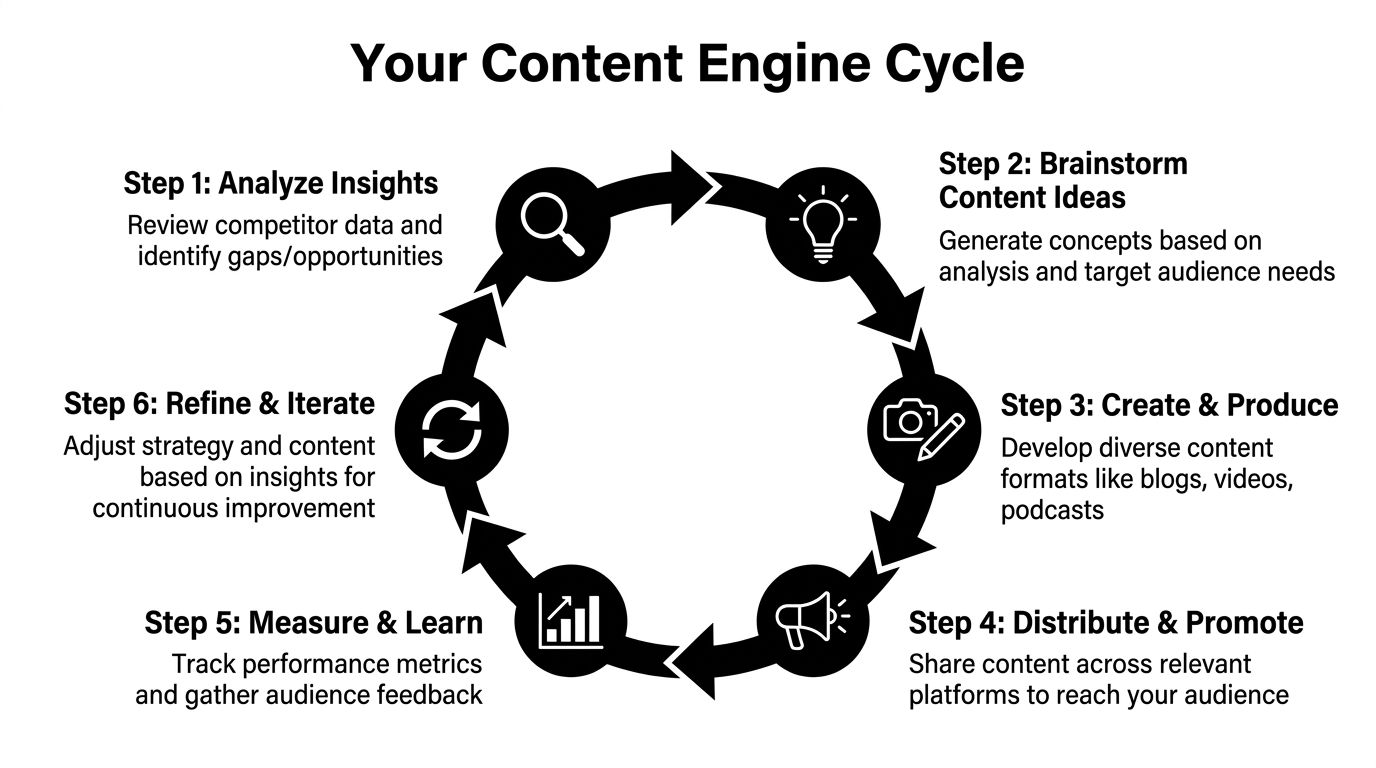
Many fail here because they rely on inspiration. That's unreliable. Use a simple rhythm instead.
| Day or Phase | Focus | Output |
|---|---|---|
| Insight capture | Review comments, conversations, and competitor shifts | Raw notes |
| Idea selection | Match notes to pillars | Shortlist of topics |
| Creation | Draft one core asset | Post, article, email, or video |
| Distribution | Adapt for platform-native formats | Clips, threads, carousels, quotes |
| Review | Check audience response and objections | New input for the next cycle |
This works because it removes guesswork. Your content stops being a random act of expression and becomes a strategic response to market evidence.
Competitive insight expires when you stop updating it. Product strategy teams are advised to keep a dynamic matrix and refresh it quarterly. Productboard notes that teams that fail to update matrices quarterly see insight decay by 25% within 6 months, reducing strategic relevance, as outlined in their competitor analysis glossary.
For a personal brand, that means your audience shifts, new voices emerge, and old assumptions get stale. So keep a lightweight operating rhythm:
You don't need a giant dashboard. You need a habit.
The strongest personal brands don't react to every competitor move. They notice patterns, decide what matters, and publish from conviction.
A real content engine should create three outputs at the same time:
That's the standard. If your content engine produces attention without trust, it's weak. If it builds trust without distinction, you're forgettable. If it creates both but never supports the business, you're performing instead of building.
Your competitor analysis should make your content sharper, your positioning cleaner, and your publishing easier. If it doesn't, simplify the process and get closer to the audience.
If you want help turning your expertise into a clear content system instead of another pile of half-used ideas, Legacy Builder helps founders and professionals build authentic personal brands through strategy, writing, design, and consistent distribution. It's built for people who know they have something worth saying but don't want to waste time guessing how to say it.


You could – but most in-house teams struggle with the nuance of growing on specific platforms.
We partner with in-house teams all the time to help them grow on X, LI, and Email.
Consider us the special forces unit you call in to get the job done without anyone knowing (for a fraction of what you would pay).
Short answer – yes.
Long answer – yes because of our process.
We start with an in-depth interview that gives us the opportunity to learn more about you, your stories, and your vision.
We take that and craft your content then we ship it to you. You are then able to give us the final sign-off (and any adjustments to nail it 100%) before we schedule for posting.
No problem.
We have helped clients for years or for just a season.
All the content we create is yours and yours alone.
If you want to take it over or work on transitioning we will help ensure you are set up for success.
We want this to be a living breathing brand. We will give you best practices for posting and make sure you are set up to win – so post away.
Subscribe to our newsletter and get insights on how to grow your personal brand.
