.svg)
Subscribe to our newsletter and get insights on how to grow your personal brand.
Thank you! Your submission has been received!
Oops! Something went wrong while submitting the form.
.svg)


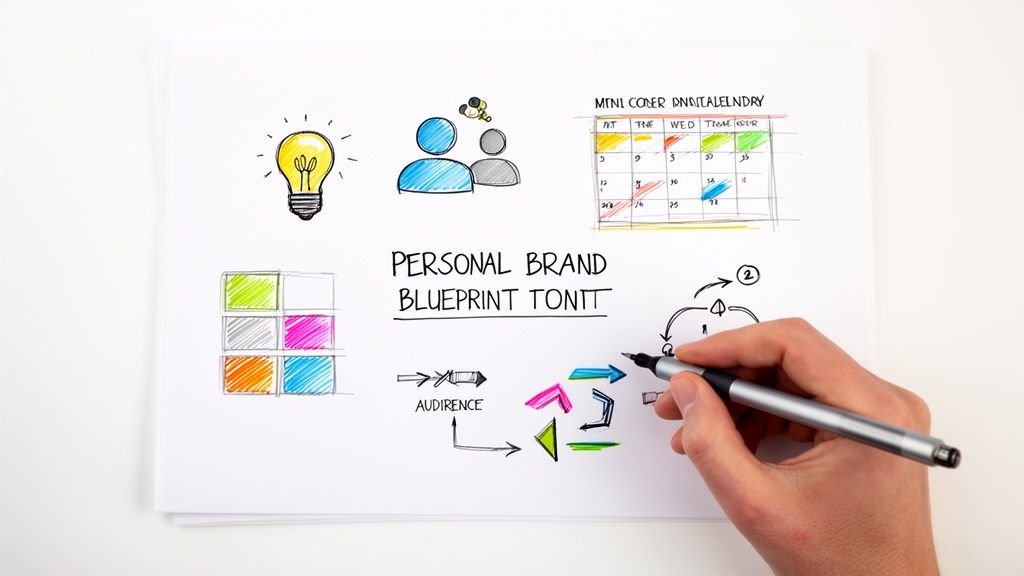
Let's get one thing straight: building your own brand isn't about faking it 'til you make it. It’s about being intentional in how people see your expertise and what you bring to the table. This means digging deep to define your story, figuring out exactly who you're talking to, and then showing up consistently with your message.
That’s how you turn your skills into an identity people recognize and, more importantly, trust.
In a world overflowing with talented people, just being good at what you do isn't enough to get you noticed. The real question isn't if you should build a brand, but how you can do it in a way that feels authentic and actually moves the needle.
This isn't about creating some slick, corporate persona. It's about strategically communicating the value you already have. A strong personal brand becomes your biggest advocate, speaking for you in rooms you haven't even walked into yet.
I've put this guide together to give you a clear, no-fluff blueprint. We're skipping the abstract theories and jumping straight into the practical steps that turn your story into your greatest asset. The goal is simple: create a presence that not only proves your expertise but also attracts the right people—whether they're clients, employers, or future collaborators.
Forget the myth that branding is just for C-suite execs or big-name influencers. The game has changed. A deliberate online identity is now a non-negotiable for anyone serious about career growth.
The market for personal branding services is exploding for a reason, projected to nearly double from USD 613 million in 2024 to USD 1,156 million by 2034. This isn't just a trend; it's a fundamental shift. Professionals are realizing that a clear brand is the key to influence and visibility. You can explore more data on this trend and see how it's shaping careers.
A brand that tries to speak to everyone ultimately connects with no one. The power lies in specificity—in knowing exactly who you are, who you serve, and why it matters.
Building a brand that sticks comes down to three core pillars. This is the exact process I use with my clients to define their Narrative, lock in their Audience, and build their Identity.

As you can see, it all starts with your story. From there, you refine it by truly understanding your audience, and then you bring it all to life with a consistent identity. Each step stacks on the last, creating a brand that’s cohesive and impossible to ignore.
To give you a clearer picture of where we're headed, here's a quick look at the blueprint we'll be following.
This table lays out the entire journey. By the end of this guide, you’ll have a solid answer and a practical system for each one of these pillars. Let's get to it.
Before you can show the world who you are, you have to get crystal clear on it yourself.
So many people jump straight to the tactics—logos, websites, posting schedules. They end up with a personal brand that feels hollow because it’s missing the one thing that truly matters: a core story.
Your story—your experiences, your screw-ups, your perspective—is the single thing no one can ever replicate. It’s your ultimate unfair advantage.
A brand that feels genuine has to be anchored in something real. This means digging deeper than what you think people want to hear and getting honest about what actually drives you.
Authenticity isn’t some fluffy buzzword. It’s the filter for every single decision you’ll make. When your actions line up with your words, people feel it. Trust is built in those moments of consistency.
This isn’t about inventing a persona. It’s more like an excavation. You're digging for the raw materials that made you who you are today. Think about the defining moments, the challenges that almost broke you, and the passions that kept you going.
To get the ball rolling, ask yourself these questions:
Your authentic narrative isn't just a backstory; it's a forward-facing compass. It guides your content, clarifies your audience, and ensures that the brand you build is one you can sustain for the long haul because it’s fundamentally you.
This is the deep work that separates a brand that simply exists from one that truly connects and endures. The answers you uncover here are the bedrock of your brand’s DNA.
Once you’ve done the digging, it’s time to sharpen those raw materials into a clear, concise mission.
This isn't some corporate mission statement you stick on a plaque. It’s a personal declaration that keeps you laser-focused. It needs to answer three simple questions: Who do you help? What do you help them do? And what’s the ultimate transformation?
For example, a software developer’s mission isn't "I write code." That’s a task. Their mission is, "I help non-technical founders bring their vision to life by building intuitive and scalable web applications." See the difference? One is a skill, the other is a solution.
Here’s a simple framework to nail yours down:
Fill that in, and you’ve got a powerful tool. It’s your new elevator pitch. It’s the first line of your social media bio. It’s the north star for every piece of content you create.
When you’re this clear on your mission, you can tell your story with conviction. If you want to go even deeper on this, check out our guide on how to build your brand storytelling framework.
Get this right, and you'll have a written foundation that isn't just a part of your brand—it is your brand.
A brand that tries to talk to everyone ends up connecting with no one. Seriously. Once you’ve nailed down your authentic story, the very next move is to get laser-focused on who you're talking to and where you fit into their world.
This isn’t about sketching out a generic "customer avatar" you'll never use. It's about strategically finding the one specific group of people who desperately need what you have to offer. That clarity is everything. It's the difference between shouting into a crowded room and having a meaningful, one-on-one conversation.
Your entire goal here is to pinpoint the exact community you want to serve, get inside their heads, and position yourself as the only logical answer to their biggest problems.

Forget casting a wide net. Real brand power comes from being incredibly specific. Your niche audience is that small, hungry group of people whose problems you are uniquely wired to solve. They’re the ones who will read your content and feel like you wrote it just for them.
So, where are these people hiding? The best intel comes from places where they’re already talking.
This is a non-negotiable step. Learning how to identify your target audience is where your brand story finally collides with the needs of real people, and that's where the magic happens.
Look, checking out your competition isn't about copying what they do. It’s about finding the gaps they’ve left wide open for you to fill. Your mission is to see where others are winning and, more importantly, where they're dropping the ball. That's where your brand can step in and shine.
Fire up a simple spreadsheet and track 3-5 key players in your space. Here’s what you need to look at:
This kind of analysis gives you the intel to zig where everyone else zags. Maybe they're all focused on high-level strategy—you can be the one who rolls up their sleeves and provides tactical, in-the-weeds guides on how to actually get it done.
Okay, time to pull it all together. Your final task here is to distill everything you've learned into a single, powerful positioning statement. This becomes your internal north star, guiding every piece of content you ever create.
It follows a dead-simple formula: For [target audience] who [have a specific problem], I provide [your solution] so they can [achieve a transformation].
For example: "For emerging tech leaders who struggle to communicate their vision, I provide actionable storytelling frameworks so they can inspire their teams and secure executive buy-in."
This isn't a catchy tagline for your website. It’s a strategic declaration. It defines your market, your value, and your promise.
Once you have this, you'll truly understand what is strategic positioning and how it creates a defensible edge in a noisy market. This has never been more critical. The data shows personal posts from individuals outperform company shares by a staggering 561% because trust is shifting from faceless corporations to relatable people. A well-defined audience and a sharp position are your greatest assets.
Now that you’ve got your story down and a crystal-clear picture of your audience, it’s time for the fun part: giving your brand a face and a voice. This is where we turn all that strategic groundwork into the real-world stuff people see and remember.
The name of the game here is consistency. When your look and your message are locked in and aligned everywhere, you build instant trust and recognition. This is how you stop looking like an amateur and start looking like a pro people can depend on.
Your visual identity is way more than just a logo. It's the gut feeling someone gets when they land on your profile or website. And here's the good news: you don't need a huge budget or a fancy design degree to create a look that feels polished and authentically you.
Think of it as creating a simple uniform for your brand. This way, whether someone stumbles upon you on LinkedIn or finds your blog, they immediately know they’re in the right place.
Your visual brand really just needs three core pieces:
How you say things is just as important as how you look. Your verbal identity, or your brand voice, is the personality that bleeds through in your writing. It should feel like a direct extension of your core story and resonate with the people you’re trying to reach.
Your goal is to sound like a human, not a corporate-speak robot. Use the same language your audience uses. If they're direct and data-focused, your writing should be too. If they connect with empathy and stories, lean into that.
Your brand voice isn't about trying to be clever; it's about being clear. It’s the consistent tone that builds a relationship with your audience, one post at a time. Authenticity in your writing is what makes people feel like they know, like, and trust you.
A strong voice makes you memorable. It ensures that your captions, emails, and website copy all sound like they came from the same person—you.
To keep yourself honest and organized, pull all of this into a simple one-page document. Think of this "Brand Identity Kit" as your personal cheat sheet for staying consistent. It's a surprisingly powerful tool for making your brand feel cohesive.
Here’s what you should drop into your kit:
This simple checklist takes your brand from an abstract idea to a practical toolkit. It’s the final piece of the puzzle before we dive into building out your content system.
Okay, you've got the foundation of your brand dialed in. You know your story, who you're talking to, and what you stand for. But a brand that isn't seen is just a great idea.
Now, we shift from planning to doing. This is where we build a system to get your expertise out of your head and in front of the right people, consistently.
Forget the hustle-culture myth that you need to be everywhere at once. The real goal is to find a sustainable rhythm—one that you can actually stick with and that makes an impact. It's about being smart with what you create, where you put it, and how you make sure it gets seen.

The secret to never staring at a blank screen again? Stop thinking in one-off posts and start thinking in themes.
Your content pillars are the 3-4 core topics that connect what you know with what your audience needs. These are the subjects you could talk about all day. They should flow directly from the positioning work you've already done.
Let's say you're a project manager who helps startups get organized. Your pillars might look like this:
These pillars become your creative engine. Every LinkedIn post, short video, or article you create should tie back to one of them. This makes creation easier and, more importantly, reinforces your expertise over and over again. If you want to go deeper, our guide on how to create a content strategy to build your brand is a great next step.
Consistency is everything. I'll say it again: consistency is everything.
It's far better to post three high-quality, on-brand pieces of content every single week than it is to post ten times one week and then ghost your audience for a month. A simple, repeatable schedule is your best friend here.
We're in an authenticity arms race. With 81% of consumers saying they need to trust a brand before they buy, your content has to prove you're a real human. It's not just about raw reach; it's about recognition. LinkedIn has seen a 42% jump in profile services, which tells you the platforms themselves are rewarding people who build real, optimized personal brands.
This isn't optional anymore. Consistent, authentic content is how you build influence today.
A solid weekly schedule is your best defense against burnout. Here’s a template to get you started without feeling like you're drowning in content creation.
This is just a starting point. Tweak it. Own it. The most important part is choosing a schedule you know you can keep up with for the long haul.
Creating great content is only half the job. If no one sees it, it doesn't matter. But don't make the mistake of spreading yourself too thin. Pick one or two platforms where your ideal audience actually spends their time and go all-in.
Your brand doesn't grow in a vacuum. Distribution is an active process of placing your content into existing conversations, not just posting it and hoping for the best.
Beyond just hitting "publish," you need a distribution plan. This is how you amplify your reach. It means actively engaging in conversations, teaming up with peers, and repurposing your best ideas into different formats. Once your content is ready, the next move is to implement powerful content distribution strategies to make sure your message lands. This is how you go from being just another voice to being a memorable one.
Look, getting started with a personal brand brings up a lot of questions. It's totally normal to hit a wall or wonder if you're even headed in the right direction. This is where we clear the air.
Let's tackle the most common hurdles and mindset blocks I see people struggle with. Think of this as the straight talk you need to move forward with confidence.
This is the number one question, and I'll be blunt: this is a long game, not a weekend project. In the beginning, you absolutely need to block off a few solid hours a week for the foundational stuff—figuring out your story, your audience, and your message.
Once you’ve got that system locked in, your focus shifts to creating and engaging. A realistic, sustainable goal is 3-5 hours per week. That’s enough time to create 2-3 solid pieces of content, get them out there, and actually talk to people without burning out. Consistency will always beat intensity.
So many people get paralyzed by this. They think they need a Ph.D. and 20 years of experience before they can say anything. That's a myth. You don't need to be the #1 expert on the planet. You just need to be one step ahead of the person you're trying to help.
Your credibility doesn't come from a fancy title; it comes from documenting your journey. Share what you’re learning. Talk about the results you're getting, even the small ones.
Brand authority isn't about having all the answers. It’s about being a trusted guide on a shared journey. Your unique perspective and relatable experiences are often more valuable than a lofty title.
Focus on the value you can provide right now. Your expertise will grow with your brand, and your audience will trust you more because you’re sharing an authentic, in-the-trenches perspective.
If you put yourself out there, someone will eventually leave a negative comment. It’s just part of the game. The key is knowing how to react—and when not to.
First, figure out what you're dealing with. Is it actual feedback or just noise?
Your mental energy is your most valuable asset here. Protect it.
100% yes. In fact, many of the most powerful personal brands are built by introverts. Building a brand online isn't about being the loudest person in the room—it's about being the most thoughtful and consistent.
Digital platforms are an introvert's dream. You can take your time to write insightful articles, have meaningful 1-on-1 conversations in the DMs, and build deep relationships without the pressure of a crowded networking event.
A few strategies that work great for introverts:
Your thoughtful nature is a superpower. Use it to provide the depth and insight that others are missing.
I hear this fear all the time. But a "crowded" market is a validated market. It proves there are people with money actively looking for solutions. Your job isn't to be louder than the big names; it's to carve out your unique corner.
This is where your story and sharp positioning are everything. No one has your exact mix of skills, personality, and life experience.
Instead of seeing a crowded space as a problem, see it as proof of opportunity. Go deeper on a sub-topic. Serve an even more specific audience. Bring a completely different tone to the conversation. Your uniqueness is what makes you stand out, even in a noisy world.
At Legacy Builder, we specialize in transforming your unique story into high-impact content that builds a memorable and authentic personal brand. If you're ready to stop guessing and start building a presence that truly reflects your expertise, we can help. Learn more about how we build your legacy, one piece of content at a time.


You could – but most in-house teams struggle with the nuance of growing on specific platforms.
We partner with in-house teams all the time to help them grow on X, LI, and Email.
Consider us the special forces unit you call in to get the job done without anyone knowing (for a fraction of what you would pay).
Short answer – yes.
Long answer – yes because of our process.
We start with an in-depth interview that gives us the opportunity to learn more about you, your stories, and your vision.
We take that and craft your content then we ship it to you. You are then able to give us the final sign-off (and any adjustments to nail it 100%) before we schedule for posting.
No problem.
We have helped clients for years or for just a season.
All the content we create is yours and yours alone.
If you want to take it over or work on transitioning we will help ensure you are set up for success.
We want this to be a living breathing brand. We will give you best practices for posting and make sure you are set up to win – so post away.
Subscribe to our newsletter and get insights on how to grow your personal brand.
