.svg)
Subscribe to our newsletter and get insights on how to grow your personal brand.
Thank you! Your submission has been received!
Oops! Something went wrong while submitting the form.
.svg)



The hard part of how do entrepreneurs start a business isn't paperwork. It's turning a legal entity into a company that gets paid, and the data makes that distinction impossible to ignore. One entrepreneurship summary notes that a founder in the United States can legally start a business in about six days, yet steady sales can still take up to a year to show up, while entrepreneurs filed 5.2 million new business applications in 2024, a 48.6% increase over 2019 (PIT entrepreneurship statistics).
That gap explains why so many founders stall after launch. They celebrate formation, then discover that customer acquisition, market fit, and repeat demand are the job. If you want a business that grows, stop treating incorporation as the finish line and start treating it as one checkpoint in a longer revenue build.
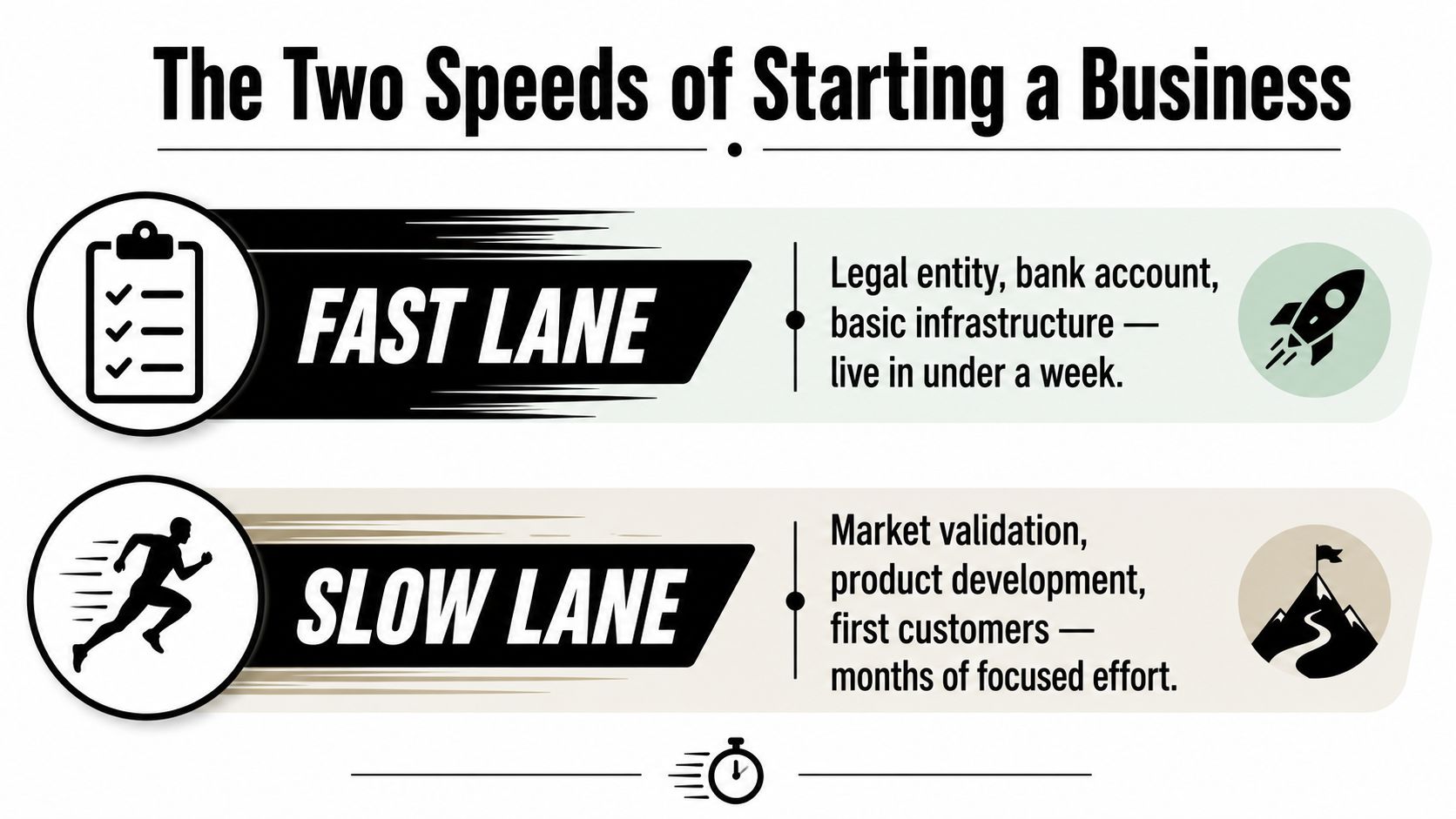
Starting a business happens at two very different speeds. The first speed is legal and administrative, and it moves fast. The second speed is commercial, and it moves at the pace of trust, demand, and repeat buying.
A founder can register, open accounts, and put basic infrastructure in place quickly. The entrepreneur data above shows that the legal start can happen in about six days in the United States, but sales can take up to a year to become steady (PIT entrepreneurship statistics). That's not a small difference. It's the whole game.
Most first-time founders obsess over when the LLC was formed or when the website went live. That's ego math. Real progress is measured by whether a stranger became a prospect, a prospect became a buyer, and a buyer came back.
Practical rule: If nobody has paid you yet, you don't have a business problem. You have a demand problem.
That's why lean founders spend their energy on validation, offer clarity, and early cash collection before they polish the logo. The business formation data from Mesa Community College reinforces the same point, since many founders launch with limited capital and need tight financial discipline from day one (Mesa entrepreneurial facts). Fast setup is useful. Revenue is what matters.
The right mindset is simple. First, prove that someone cares. Then, make it legal. Then, tighten the system so fulfillment doesn't become chaos. Duke's Entrepreneurship Manual puts opportunity evaluation before planning and planning before formation for exactly that reason, because you don't want to lock yourself into a structure before you know the market wants the thing (Duke Entrepreneurship Manual).
If you remember one thing, remember this. Starting is easy. Building is expensive in time, attention, and emotional energy. Treat them like different jobs.
The cheapest mistake is to discover that nobody wants the offer before you've set up the whole machine. Start with evidence, not paperwork. Duke's sequencing is right, opportunity evaluation comes before planning, and planning comes before formation (Duke Entrepreneurship Manual).
Run short interviews with people in the exact pain zone you want to serve. Don't pitch first. Ask what they've already tried, what's still broken, and what they're improvising to solve it. If they can describe the pain in their own words, you're close.
A clean outreach note sounds like this, and it works because it doesn't smell like a sales blast.
I'm researching how people handle [specific problem]. You mentioned this issue before, so I'd value ten minutes to hear how you're dealing with it now. I'm not selling anything.
Then listen for repeated language. If people describe the same frustration with different wording, that's signal. If they nod politely and stay vague, that's noise.
After interviews, look at competitors and landing pages. You're not trying to copy them. You're trying to see whether the market already understands the problem and whether your angle is sharper. A simple smoke-test page can collect interest before you register a full structure, and pre-orders or letters of intent can tell you whether anyone will commit before you overbuild.
One useful guide for this stage is a quick validation process like how to validate a business idea. Use it as a checklist, not as theater.
A founder should be able to answer five questions before moving on:
If you can't get to five real conversations with people who might buy, don't form the company yet. Keep working the problem. Most bad ideas collapse quickly once they meet actual buyers.
Long business plans often become procrastination in a suit. For most solo founders, a one-page plan beats a 40-page document because it stays usable after the excitement fades. The point is not to impress anyone. The point is to force clarity.
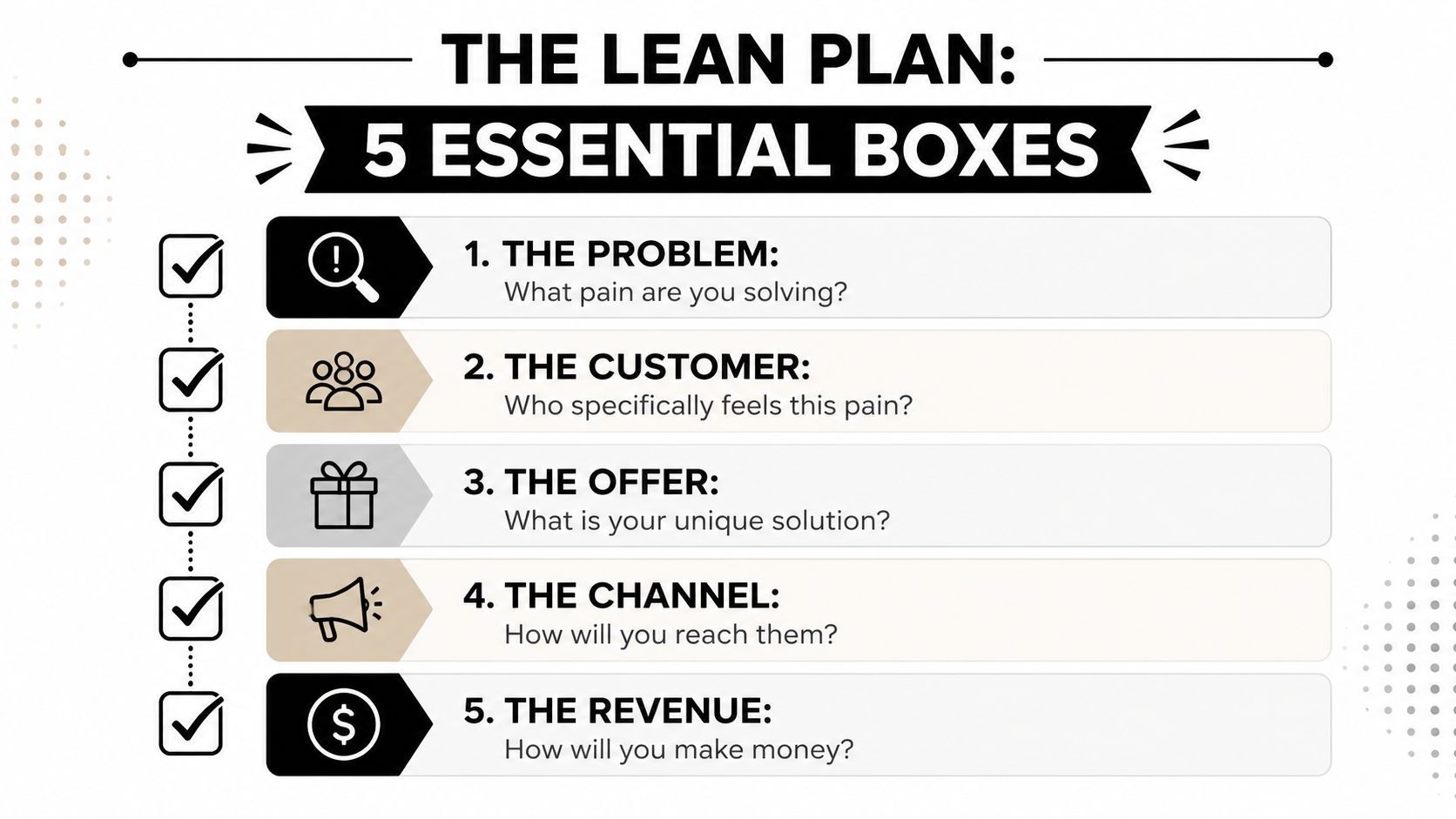
Your lean plan should fit on one page and answer five things:
If you can't say each one out loud without drifting into jargon, the plan isn't ready. It's too vague to guide decisions.
The SBA's startup framework places market research, business planning, and funding before launch, and it also highlights the practical setup work many founders forget, such as banking, licenses, and a web presence (SBA 10-step startup guide). That's useful, but not every founder needs a formal, lender-ready plan on day one.
Use the full version when you're raising outside capital, talking to banks, or structuring a more complex venture. If you're a solo founder testing a hypothesis, keep it light. A lean plan should act like a weekly scorecard, not a binder that gathers dust.
A good plan changes your behavior. If it doesn't, it's just paperwork.
If you want a simple way to keep the business grounded, review the plan every week against cash collected, conversations booked, and the next offer revision. That's enough structure to keep you moving without burying you in admin.
Once the idea has proof, formation becomes a checklist, not a philosophy debate. Pick the structure that fits how you'll operate, then get the boring pieces right the first time. That boring work saves you from expensive cleanup later.
If you're alone and testing an offer, a sole proprietorship can be the simplest starting point. If you want clearer separation between personal and business finances, an LLC is often the next practical step. If you're planning to pay yourself in a more tax-specific way or you expect a more complex setup, talk to a qualified advisor before you lock it in.
Don't let structure choice become a status game. Choose based on liability, taxes, ownership plans, and how much complexity you can manage. The wrong structure is the one you can't operate cleanly.
The technical setup many beginners skip is the stuff that makes a business feel real on day one. Get your EIN or tax ID, open a business bank account, connect a payment processor, and make sure you've got the licenses or permits your work requires. Then set up accounting software, payroll if you need it, and a basic web presence so customers know you exist.
This is also where founders often need practical funding context. If you're figuring out who may back early-stage work, the US angel investors for startups resource is a useful place to map the field without treating fundraising like a lottery ticket.
A few rules matter more than people admit:
If you're also looking at formation and registration support, Legacy Builder offers business structuring services, including LLC-to-corporation conversions and multi-entity planning, which can matter when the business stops being a side project and starts needing a cleaner foundation. The point is to build a setup you can run, not just one that sounds impressive.
Early traction is not a mood. It's a repeatable operating rhythm. In the first ninety days, a solo founder wins by making more direct contact, collecting more proof, and turning every small win into sharper positioning.
A founder launching a B2B service should start with a dream-100 list, not a giant audience strategy. Pick the people, companies, or communities most likely to care, then reach out with specific language that references their actual situation. Cold outreach works better when it doesn't feel like a template.
Use a simple weekly cadence:
That cadence keeps you focused on conversations booked, pilots signed, and cash collected. It ignores vanity metrics on purpose.
A first client is more than revenue. It's proof, language, and material for the next sale. Write down the exact phrase they used to describe the problem, the outcome they wanted, and the reason they chose you. That becomes the seed of a case study, a sales page, and future outreach.
If you need a broader framework for outreach, the startup marketing framework 2026 is a useful reference point for organizing channels and messaging without drifting into random acts of marketing.
A founder should also look at the network around them, not just the inbox. A 90-day networking plan can help keep referrals and introductions from being accidental, and you can map that with how to expand your professional network. One good conversation often opens the next ten.
The mistake is chasing awareness before proof. The smarter move is to make every early sale teach you how to sell the next one.
In a crowded market, your personal brand can do work that ads can't. It builds trust before the first transaction and keeps working while you're still shaping the offer. That's why content shouldn't be treated like a post-launch garnish.
The strongest founders usually have a simple content system, not a giant media machine. Pick one primary platform, one repeatable format, and one weekly pillar topic. Then repurpose the same ideas into smaller pieces so you're not inventing from scratch every day.
A practical setup looks like this:
If scheduling helps you stay consistent, a tool roundup like Best Twitter Scheduling Tools can save time, but the tool itself won't create the voice. The voice comes from repetition and honesty.
The best content is usually sitting inside your sales calls and customer questions. Pull the recurring objections, explain your point of view, and show your process. That makes the content useful instead of polished for no reason.
If you want a deeper operating model for this, a guide to personal branding for entrepreneurs is a strong companion piece. It fits the same principle, content is not separate from the company, it is part of how the company gets believed.
A solo founder can ramp without burning out by doing this for four weeks: one pillar topic per week, two repurposed posts, one direct customer insight, and one short lesson from the work. That's enough to stay visible without pretending to be a media brand on day one.
The old advice says to go broad, move fast, and chase scale. That advice is still useful for some businesses, but it's lazy when you're entering an underserved market or a tightly defined niche. In those cases, trust and specificity beat generic ambition.
Independent coverage on rural and underserved communities argues that these markets can be viable launchpads because unmet needs are clearer and incumbents often overlook them (SEOBrien underserved communities). That's the part most startup advice skips. If the market already feels ignored, your job is not to act bigger. Your job is to be more relevant.
A good filter set is simple:
That means you may need to move slower, speak more plainly, and design around trust instead of speed. That's not a weakness. It's strategy.
There's a second path that gets ignored even more often, tightly specific micro-niches. Coverage on untapped markets points out that founders are finding problems in complaints, forums, and niche communities, and that the strongest opportunities now may come from specificity rather than broad-market noise (Shopify untapped market). That tracks with what sells. People buy faster when they feel understood.
The personal brand and the market strategy meet here. In an AI-saturated, content-heavy environment, sounding generic is fatal. Buyers can smell formulaic positioning instantly. A founder who speaks like a real operator, with real context and a real point of view, stands out even without huge distribution.
The playbook I'd use looks like this:
Keep one weekly habit above everything else, a money-and-momentum review. Look at cash, conversations, and what moved the business forward. Founders who do that build durable companies. Founders who skip it often mistake launch energy for progress.
If you're serious about starting a business that grows, Legacy Builder can help you turn your story, offer, and content into a cleaner public-facing brand while you build the revenue engine underneath it. Visit Legacy Builder if you want a practical partner for personal branding, content consistency, and early-stage business structure that doesn't feel generic.


You could – but most in-house teams struggle with the nuance of growing on specific platforms.
We partner with in-house teams all the time to help them grow on X, LI, and Email.
Consider us the special forces unit you call in to get the job done without anyone knowing (for a fraction of what you would pay).
Short answer – yes.
Long answer – yes because of our process.
We start with an in-depth interview that gives us the opportunity to learn more about you, your stories, and your vision.
We take that and craft your content then we ship it to you. You are then able to give us the final sign-off (and any adjustments to nail it 100%) before we schedule for posting.
No problem.
We have helped clients for years or for just a season.
All the content we create is yours and yours alone.
If you want to take it over or work on transitioning we will help ensure you are set up for success.
We want this to be a living breathing brand. We will give you best practices for posting and make sure you are set up to win – so post away.
Subscribe to our newsletter and get insights on how to grow your personal brand.
