.svg)
Subscribe to our newsletter and get insights on how to grow your personal brand.
Thank you! Your submission has been received!
Oops! Something went wrong while submitting the form.
.svg)


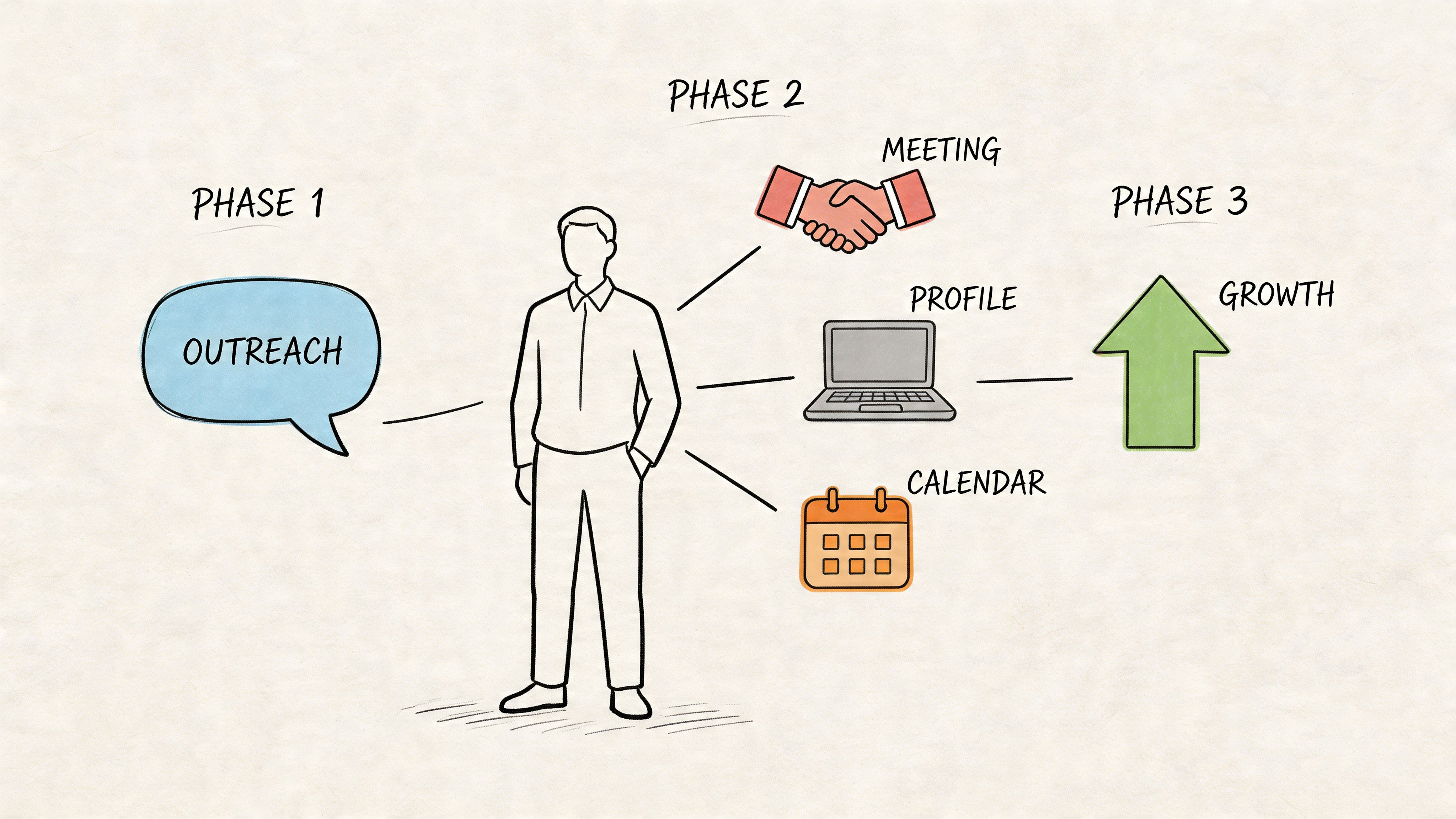
Most networking advice is wrong because it treats relationships like a vanity metric. More connections. More coffee chats. More event badges. More LinkedIn requests. That approach creates activity, not true benefit.
If you’re a founder, you don’t need a bigger contact list. You need a network that compounds. A small circle of trusted operators, buyers, partners, recruiters, media contacts, and peers will outperform a bloated audience of weak ties you never speak to. I’ve seen plenty of people with massive visibility and almost no real access. They can post. They can comment. They can even get likes. But when they need an introduction, a hire, a customer, or a strategic partner, nobody moves.
That’s the difference between an audience and a network.
The market is telling you this matters. The professional networking market is projected at USD 65.64 billion in 2025 and expected to reach USD 201.12 billion by 2030 at a 25.10% CAGR, according to Mordor Intelligence’s professional networking market analysis. Digital networking is growing fast, but growth in platforms doesn’t automatically create better relationships. It just creates more noise.
You need a system that turns your personal brand into a strategic asset. That means three things. Clear positioning. Intentional outreach. Ruthless measurement.
Your network should produce opportunities, insight, and trust. If it only produces notifications, it’s underperforming.
The most popular advice says networking is a numbers game. It isn’t. It’s a relevance game.
Adding random people after every event won’t help if they don’t know what you do, don’t trust your judgment, and don’t remember why they accepted your request. Founders waste months doing “visibility work” that never becomes deal flow because they confuse access with proximity. Sitting in the feed isn’t the same as being top of mind.
A big network with no real relationship depth is fragile. You can have thousands of connections and still have nobody willing to reply quickly, make a warm intro, or vouch for you. That’s not a network. That’s a contact graveyard.
The better question is simple. If you needed one of these tomorrow, who would help?
If you can’t name people immediately, your network isn’t mature enough yet.
Founders usually think about brand as content, design, or messaging. I disagree. Your network is one of the clearest signals of brand strength because it shows who trusts you enough to engage, endorse, refer, and open doors.
That’s why shallow LinkedIn activity isn’t enough. Posting every day without building real relationships just makes you a familiar stranger. Useful, maybe. Trusted, not yet.
A strong network does four jobs at once:
Stop asking, “How do I meet more people?” Start asking, “Which relationships would materially change my trajectory if I built them well?”
That shift matters because it changes your behavior. You stop spraying requests. You start designing a network.
You shouldn’t reach out to anyone until your digital presence can carry the conversation after first contact. Most founders skip this and then wonder why outreach stalls. They’re asking people to connect with a profile that reads like a résumé, not a strategic asset.

When someone checks your LinkedIn or X profile after seeing your name, they make a fast judgment. Not just on competence, but on clarity. Can this person help me, teach me, hire me, partner with me, or introduce me to someone useful?
Your profile needs to answer that fast.
Focus on these elements:
Headline with a point of view
Don’t write a job title and call it branding. Write what you do, who you help, and the category you want to own.
About section with narrative
Skip the stiff corporate summary. Tell the story behind your work, the problems you care about, and the lens you bring.
Featured proof
Pin strong posts, interviews, newsletters, case-based thinking, or speaking clips. You want people to see substance, not just claims.
Clean visual identity
Use a professional headshot, simple banner, and consistent language across platforms.
Clear next step
Make it obvious whether you want investors, clients, peers, podcast hosts, candidates, or collaborators to contact you.
If you operate in startup ecosystems, practical guides like how to build a strong startup network can be useful because they frame networking around intentional relationship-building instead of random attendance.
A lot of networking underperforms because the person doing it has no clear objective. They’re “putting themselves out there.” That’s vague, and vague gets weak results.
According to Apollo Technical’s networking statistics roundup, 80% of professionals view networking as critical to career success, and referrals drive 37% of all hires despite comprising only 6% of applications. That’s exactly why you need precision. The upside is too big to waste on generic outreach.
Use three categories for your target network:
These are people who keep you sharp and honest. Trusted peers. Former managers. Mentors. Friends who understand your ambition and tell you the truth.
These are operators in your field. Buyers, recruiters, investors, founders, marketers, engineers, product leaders, or media people tied to your space.
These are people outside your immediate lane who can offer unique advantages. Cross-industry contacts often create the most interesting opportunities because they bring you non-obvious introductions and ideas.
You don’t need to guess who to meet. Build a Dream 100 list.
Create a simple spreadsheet or Notion database with these fields:
| Field | What to capture |
|---|---|
| Name | Person and company |
| Category | Personal, professional, or strategic |
| Why them | Specific reason this relationship matters |
| Current proximity | Cold, warm, or existing contact |
| Content hooks | Posts, podcasts, interests, themes |
| Next action | Comment, DM, intro request, event meet-up |
Serious networking begins. Not in your inbox. In your targeting.
Here’s a useful filter I use with founders: if you removed this person from the list, would your business or brand strategy materially change? If the answer is no, they probably don’t belong on your priority tier.
A quick primer on tightening your positioning before outreach helps too:
Founders love speed. I do too. But rushing into outreach with weak positioning is just a faster way to get ignored.
Before you try to learn how to expand your professional network, get your house in order. Make sure your profile communicates value. Make sure your recent content proves judgment. Make sure your list reflects actual strategic goals.
Practical rule: If a stranger landed on your profile today, they should understand your relevance in under a minute.
That standard will save you from a lot of wasted outreach.
Cold outreach fails when it asks for attention before earning familiarity. That’s why “Hi, great profile, would love to connect” performs so poorly. It’s lazy, interchangeable, and forgettable.
The best digital networking doesn’t start in the inbox. It starts in public.
If someone is on your Dream 100 list, don’t message them first. Study them first.
Read what they post. Notice their recurring themes. Watch what they praise, what they argue against, and which conversations they keep returning to. Then join those conversations in a way that adds signal.
Good comments do one of three things:
Bad comments say “Great post” or “Totally agree.” Those are invisible.
If you want a practical companion resource on effective LinkedIn networking, that guide is useful because it focuses on intentional engagement rather than mass-connection behavior.
People reply when they feel you’re useful, specific, and sincere. They ignore you when you sound like a template.
Before you ask for a meeting, do at least one value-forward action:
That pattern changes your position. You stop being a cold name and become a familiar one.
The fastest way to become memorable online is to be consistently useful in public.
Most founders either over-formalize outreach or over-casualize it. Both hurt.
Formal sounds robotic. Casual sounds unserious. The right tone is clear, brief, and contextual. You should sound like a peer who has done the homework.
Here are message structures I recommend.
| Scenario | Platform | Template |
|---|---|---|
| After a virtual event | LinkedIn DM | Hi [Name], enjoyed your point about [specific topic] during [event]. Your take on [detail] stuck with me because it connects directly to [your relevant context]. I’m building in [space] and would be glad to stay in touch. |
| Dream 100 first reach-out | LinkedIn DM or X DM | Hi [Name], I’ve been following your thinking on [topic]. Your recent point about [specific idea] was especially sharp. I work on [brief relevance], and I thought this might resonate: [one concise insight or observation]. No ask here. Just wanted to say your work is influencing how I’m thinking about it. |
| Asking for an introduction | Hi [Mutual Contact], I’m reaching out because I think there’s a legitimate reason for me to know [Target Name]. My work in [space] overlaps with their focus on [specific area], especially around [shared theme]. If you’re comfortable making the intro, I can send a short blurb you can forward. If not, no pressure. | |
| Re-engaging a dormant contact | Email or LinkedIn | Hi [Name], it’s been a while. I saw your update on [specific trigger] and wanted to reach out. I’m now focused on [brief update], and your work came to mind because of [reason]. If useful, I’m happy to share what I’m seeing in [relevant area]. |
| Following meaningful comment interaction | LinkedIn DM | Hi [Name], we’ve crossed paths a few times in the comments and I’ve enjoyed the back-and-forth. You’re thinking seriously about [topic], which is rare. Wanted to connect directly and stay in your orbit. |
If you want more plug-and-play examples for email-based outreach, these networking email templates and tools are a useful reference.
Founders often get impatient. They finally get a reply and immediately ask for time, intros, feedback, or business. Bad move.
The first conversation should do one thing well. Establish relevance and trust.
That means your early digital exchanges should revolve around:
Shared context
Why your worlds overlap.
Interesting insight
Something thoughtful enough to continue.
Low-pressure next step
Stay in touch. Trade notes. Continue the thread.
If the chemistry is there, the call or coffee comes naturally.
Outreach works better when your profile backs it up. If someone clicks through and sees consistent writing, smart opinions, and a coherent niche, your message lands differently.
You don’t need to become a full-time creator. You do need a body of visible judgment.
A strong content-led networking rhythm looks like this:
That’s how you expand without sounding needy. Content creates context. Context makes outreach feel earned.
Online networking gives you scale. In-person networking gives you texture. You hear tone, catch hesitation, notice curiosity, and build trust faster.
But many attendees waste events because they attend reactively. They show up, drift, collect a few names, and leave with nothing anchored. A smart founder works the room before entering it.
Say you’re going to an industry conference. Don’t ask, “Who might I meet?” Ask, “Which conversations would make this event worth attending?”
Your prep should include:
This changes your energy immediately. You stop wandering and start operating with intent.
The best in-person networkers aren’t the loudest. They’re the ones who create good conversations.
A founder who asks smart questions beats a founder who recites a polished bio. If you meet someone outside your field, don’t force relevance. Build it.
Here’s what that looks like in practice.
You meet a supply chain executive, and you run a SaaS company. The weak move is pretending you have obvious overlap. The strong move is building a story bridge.
You might say, “I work in software, but a lot of my current thinking is about how trust gets built in operationally complex environments. I’m curious how that shows up in your world.”
Now the conversation has a bridge. It’s not artificial. It’s intellectually honest.
That matters because diverse networks create outsized value. A 2025 World Economic Forum report cited by Oakwood International’s networking strategies article notes that diverse networks increase innovation by 27% and revenue by 19% for SMEs, while 61% of professionals in emerging markets report echo-chamber networks that limit growth.
Skip “What do you do?” unless you want the most rehearsed answer in the room.
Try these instead:
If you want sharper prompts that don’t sound scripted, this roundup of business networking conversation starters is worth bookmarking before your next conference.
Good networking questions don’t extract information. They invite perspective.
The event isn’t the main game. The event is the opening move.
Within a day or two, send a short note that references something specific. Not “Great meeting you.” That’s disposable. Mention the topic, tension, or idea you discussed.
A simple follow-up should include:
That’s how you turn a passing interaction into a relationship seed.
The founder mistake is treating events like lead generation. Better approach. Treat them like trust acceleration. You’re not there to “work the room.” You’re there to find people worth building with.
Most networking fails after the first interaction. Not because the conversation was bad, but because nothing structured happened next.
People assume follow-up should be spontaneous. It shouldn’t. If you care about outcomes, follow-up needs a system.
While 80% of professionals deem networking essential, only 48% maintain consistent touchpoints, and strong follow-up can cut a job search by 1-3 months and significantly improve offer quality, according to Schwab Jobs career tips on networking. The lesson is obvious. Consistency is where value gets created.
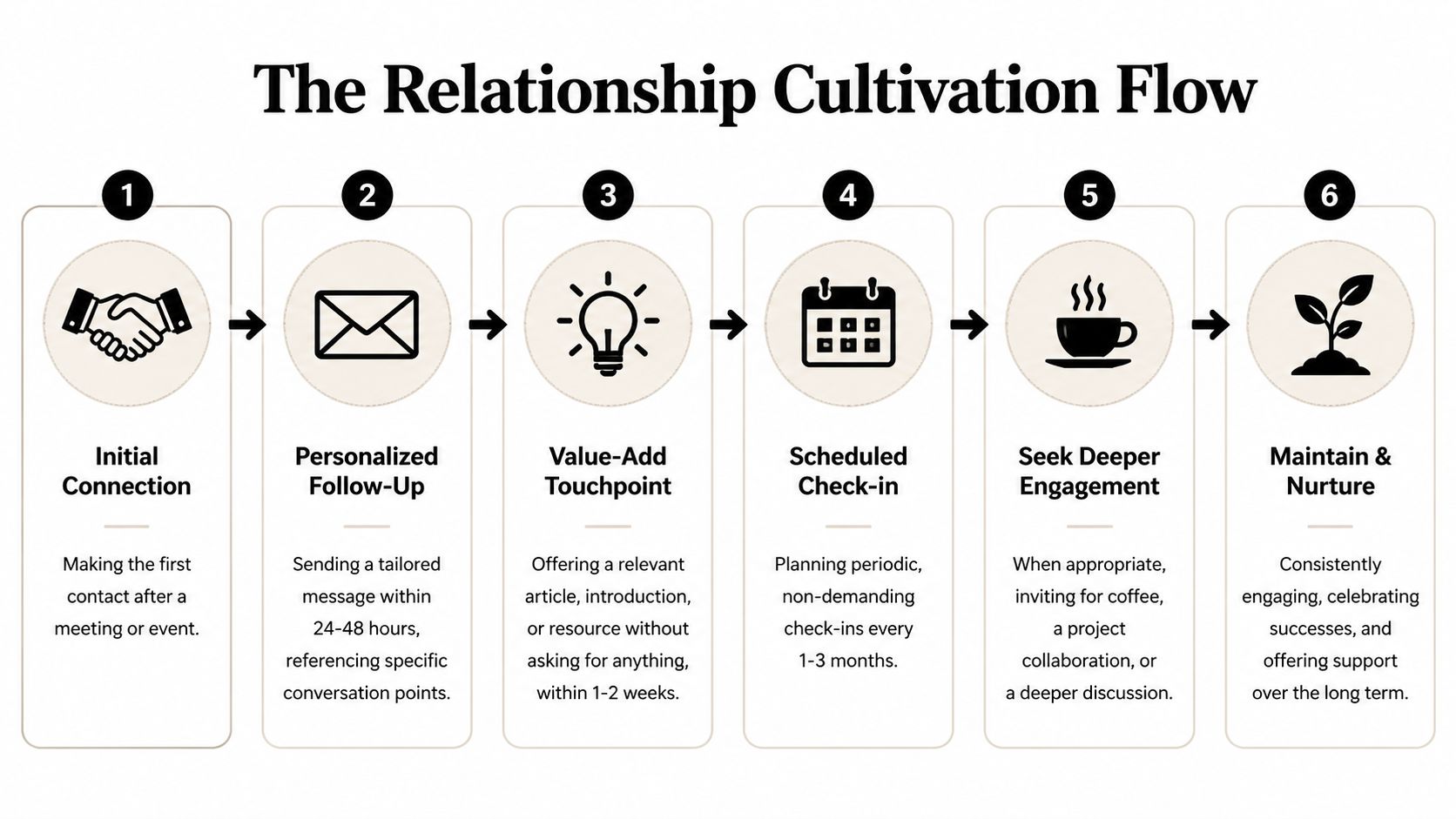
You do not need a complicated CRM to start. A spreadsheet, Notion table, or tool like Clay, Airtable, or Dex can work. What matters is that you track who matters, what happened, and what should happen next.
I recommend a basic cadence like this:
| Timing | Action | Purpose |
|---|---|---|
| Within a day or two | Send a personalized follow-up | Lock in memory and show attentiveness |
| Within the next couple of weeks | Share something useful | Create value without asking |
| In the following months | Check in with context | Keep the relationship alive naturally |
| When relevant alignment appears | Suggest a deeper interaction | Move from acquaintance to active relationship |
That rhythm works because it doesn’t suffocate the relationship. It adds consistency without making you look transactional.
A lot of people hear “add value” and immediately overcomplicate it. You do not need to solve someone’s biggest business problem to be helpful.
Useful touchpoints include:
One of the best deep-dive resources on this is how to follow up after networking and build real connections, especially if your current follow-up style is inconsistent.
A strong follow-up says, “I listened, I remembered, and I’m worth staying in touch with.”
This is the part often skipped, and it’s the part founders should care about most. If you can’t measure your networking, you can’t improve it.
Track practical KPIs such as:
How many of your targeted requests get accepted? If this is weak, your profile, targeting, or opening message needs work.
Are people replying once you reach out? If not, your message probably lacks specificity or relevance.
Out of the people you’ve spoken with, how many enter an ongoing relationship cadence?
Track whether networking creates intros, partnerships, clients, hiring conversations, speaking invitations, investor meetings, or collaborations.
This is the ROI lens. Which channels, event types, and contact categories create value?
I like founders to score contacts using qualitative fields rather than fake precision. Keep it simple:
Review your network monthly. Promote people who are becoming strategic. Deprioritize dead weight.
Not all networking activity deserves equal energy. Some relationships are clearly worth deepening. Others are politely static. Treating them the same is a mistake.
A pleasant exchange is not the same as a useful relationship. Be honest about what’s moving and what isn’t.
Signs a relationship is strengthening:
Signs it isn’t:
You don’t need to force every connection into depth. You need to recognize which ones deserve investment.
It's not usually a lack of access that causes networking failures. They fail because they have no operating rhythm. They do a burst of outreach, get busy, disappear, and start over later.
That stop-start pattern is exactly why many people never see ROI. A 2024 Harvard Business Review study cited in Robert Smith’s guide on building a professional network indicates that over-networking without a focused plan can dilute results by 40%, and a structured 90-day plan helps address a major gap for the 78% of professionals who don’t track networking ROI.

Start by tightening your positioning and activating your easiest warm paths. You’re not trying to go viral. You’re trying to become clear, credible, and reachable.
Audit your digital presence.
Build your target map.
Warm up your network publicly.
Send your first focused wave.
This month is about deepening and diversifying. You’ve started conversations. Now you need to convert activity into relationship momentum.
Refine your outreach based on response quality.
If your messages are getting accepted but not answered, your follow-up is too weak. If nobody is accepting, your profile or targeting is off.
Expand into strategic cold outreach.
Start more live interaction.
Create value loops.
The best networkers become known as useful. Not loud. Useful.
Now you optimize. You’re no longer guessing. You have enough signal to see what is most effective.
Review your relationship pipeline.
Look at who is moving from contact to actual relationship. Highlight the people with momentum and stop over-investing in dead threads.
Analyze your channel performance.
Ask yourself:
| Channel | What to evaluate |
|---|---|
| LinkedIn comments | Which interactions turned into direct conversations |
| DMs and email | Which message styles produced useful replies |
| Events | Which rooms produced follow-up worth keeping |
| Existing network | Which old ties reactivated fastest |
Push for deeper engagement where it makes sense.
This is the time for:
Only do this where trust already exists. Don’t force it.
Document the system and keep it alive.
Write down:
At the end of ninety days, you should know far more than how to expand your professional network. You should know which relationships create compounding value for your brand and business, which activities are noise, and where your next opportunities are likely to come from.
That’s the actual goal. Not networking as social performance. Networking as strategic infrastructure.
If you want help turning your expertise, story, and daily visibility into a stronger professional network, Legacy Builder can help you do it without sounding manufactured. They work with founders, leaders, and creators who want authentic personal brands that attract the right people, create better conversations, and build lasting influence.


You could – but most in-house teams struggle with the nuance of growing on specific platforms.
We partner with in-house teams all the time to help them grow on X, LI, and Email.
Consider us the special forces unit you call in to get the job done without anyone knowing (for a fraction of what you would pay).
Short answer – yes.
Long answer – yes because of our process.
We start with an in-depth interview that gives us the opportunity to learn more about you, your stories, and your vision.
We take that and craft your content then we ship it to you. You are then able to give us the final sign-off (and any adjustments to nail it 100%) before we schedule for posting.
No problem.
We have helped clients for years or for just a season.
All the content we create is yours and yours alone.
If you want to take it over or work on transitioning we will help ensure you are set up for success.
We want this to be a living breathing brand. We will give you best practices for posting and make sure you are set up to win – so post away.
Subscribe to our newsletter and get insights on how to grow your personal brand.
