.svg)
Subscribe to our newsletter and get insights on how to grow your personal brand.
Thank you! Your submission has been received!
Oops! Something went wrong while submitting the form.
.svg)


The most popular advice about personal branding is often the least useful: post more, stay visible, and keep your profile polished. A steady publishing habit can help, but it won't turn a vague point of view into authority. If the right people see your content and still can't tell what you know, whom you help, or why they should trust you, more posts won't solve the problem.
A capable personal brand consultant builds a system for expressing your expertise clearly and credibly. That means shaping a distinctive position, translating real experience into useful ideas, and checking whether those ideas lead to meaningful conversations, not just likes. For a founder weighing outside help, the question isn't who can fill a calendar. It's who can help your reputation travel beyond your immediate network.
A busy publishing calendar can make weak claims harder to ignore. Before committing to daily posts, ask whether you have evidence worth repeating and a voice you can stand behind.
Personal branding began as a management responsibility well before social media. In August 1997, Tom Peters published “The Brand Called You” as a Fast Company cover story, urging professionals to manage their careers deliberately as chief executives of their own “Me Inc.” Peters' account of the article's legacy captures the principle: professionals have responsibility for their reputation beyond the organization that employs them.
For founders, executives, and creators, that responsibility includes making judgment visible. Readers may recognize your name yet remain unclear about the problems you solve or the basis for your advice. Some prospective buyers may read without reacting publicly. Give them enough substance to assess you without requiring a sales conversation.
Practical rule: Don't ask whether you're posting enough until you can explain what your content should make the right person believe, understand, or do.
Frequency has a trade-off. Repetition can reinforce a useful idea; a production treadmill can reward familiar advice and detach your public voice from your work. Engagement from people unlikely to hire or refer you offers little guidance about buyer trust.
Useful content shows a difficult trade-off, explains a technical idea plainly, or identifies an overlooked risk. Evidence gives those observations weight. Your language makes them recognizable as yours. Where AI assists, agree on disclosure expectations and retain responsibility for every claim.
Visibility helps people find you; credibility gives them a reason to listen.
When hiring a personal brand consultant, ask how they will connect claims to supporting examples and preserve your judgment through editing. Assess progress through qualified inquiries, referrals, and prospects referencing your ideas. A promise of more posts or followers leaves the harder credibility work unresolved.
A personal brand consultant turns your experience into a coherent market identity. A systematic review covering 1997 to 2017 found that definitions of personal branding consistently revolve around an individual's value proposition and the connection they build with other people. That distinction matters: self-promotion talks about you; a useful brand makes clear what you offer and why it matters to an audience. The review of personal-brand research provides a useful foundation for assessing whether proposed work goes deeper than surface-level visibility.
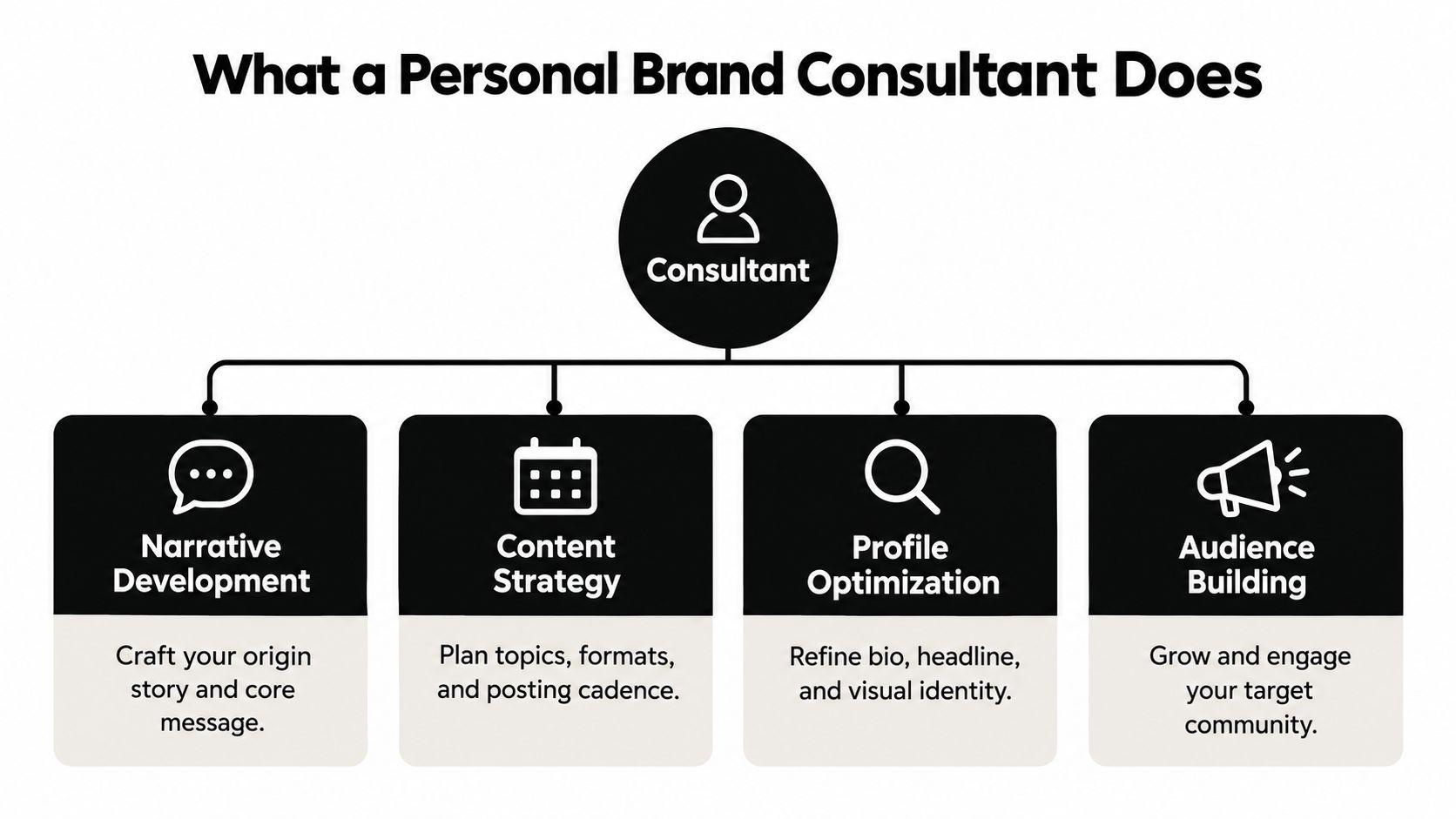
The first deliverable should be a positioning document, not a stack of drafts. It should describe whom you want to reach, what they need, where your expertise is distinctive, and which claims you can support with experience or evidence. A consultant should also capture the way you naturally explain your work, including language you use and language that feels false in your mouth.
Only after this groundwork should the consultant build a content pillar map. The map connects recurring themes to your expertise and audience needs. It might include lessons from operating a company, explanations of a technical process, or considered responses to recurring customer questions. A useful strategy gives you directions to explore, not a collection of generic prompts.
Profile optimization makes your positioning legible at a glance. That can mean refining your headline, bio, featured work, and profile visuals so a visitor can quickly understand what you do and how to take the next step. It often carries weight because it serves people who are already curious enough to visit.
Audience building then turns content into relationships. The deliverable might be an engagement playbook covering whom to respond to, how to handle thoughtful disagreement, and how to follow up when a post starts a relevant conversation. For a related perspective on how story choices connect with a professional visual identity, see what brand storytelling means for design firms, a resource from Jimmy Clemmons Photographer.
A consultant is closer to an architect than a task contractor. The value lies in making the narrative, profile, content, and interaction work together. Legacy Builder is one option for founders and executives seeking positioning and content support, including content strategy, writing, design, and distribution. Whatever provider you consider, ask to see how its deliverables connect into a single system.
A useful dashboard doesn't reduce your reputation to a follower count. It separates different reasons people might respond to your content: they may find you engaging, believe you know your subject, or trust you enough to act. Research synthesizing source-credibility theory finds that attractiveness is more directly associated with engagement, while expertise and trustworthiness are more directly associated with behavioral intention. These are distinct routes, not interchangeable signals. The credibility research synthesis supports measuring them separately.
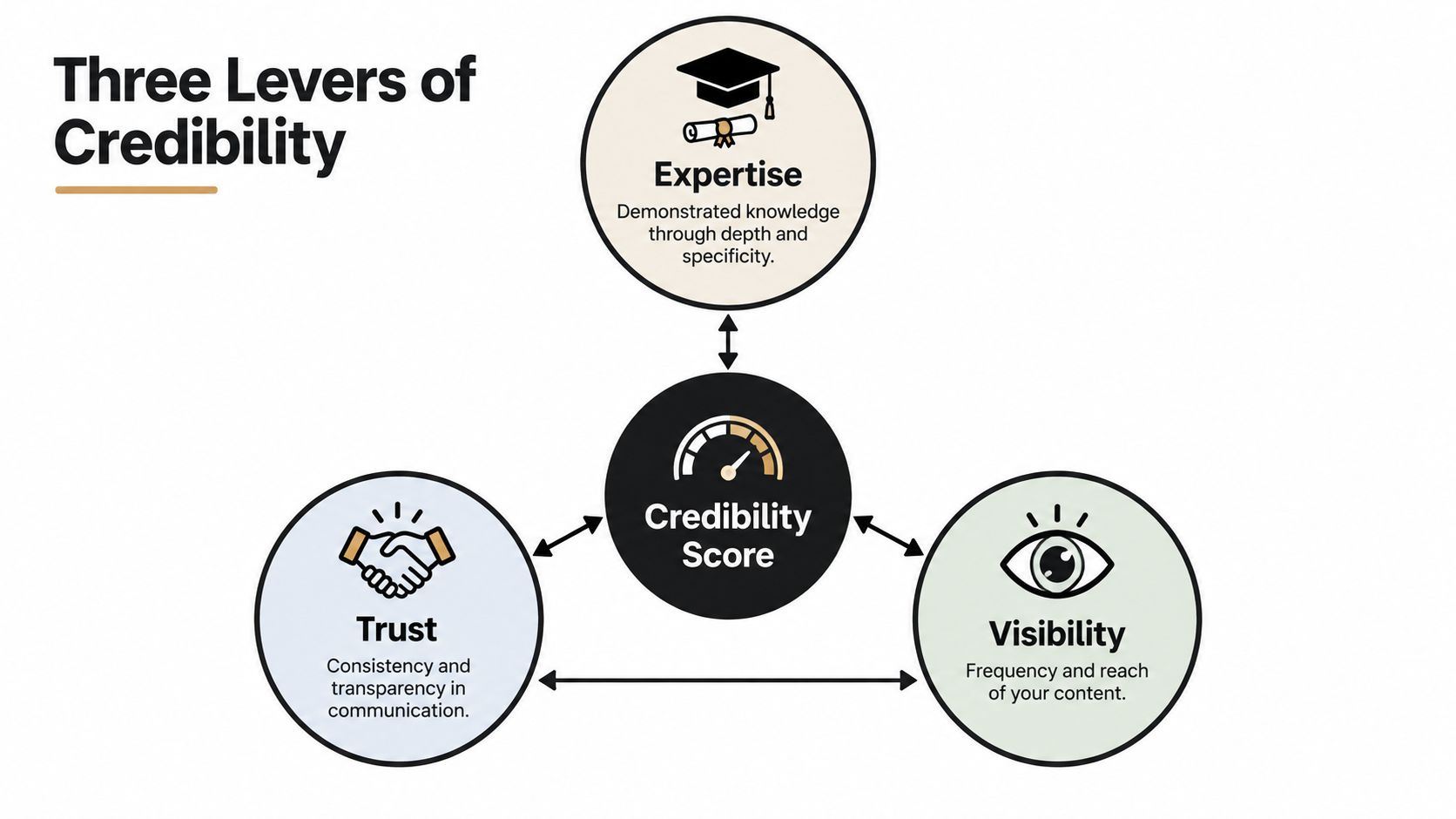
Visibility and presentation can earn attention. Track reach, interactions, and the quality of engagement, but don't treat those numbers as proof of commercial impact. A polished post can draw a response while leaving your audience unclear about your expertise.
Look beyond raw reactions. Are the people engaging relevant to your goals? Do comments show they understood the point? Does the content lead to profile visits from people you want to reach? The answers help distinguish useful attention from activity that merely looks busy.
Saves, detailed comments, and questions about your methods can indicate that people see practical value in your work. Those signals are more meaningful when the content explains how you reached a conclusion, describes a real decision, or makes a complex topic easier to use.
A consultant should show you examples of how content is designed to demonstrate expertise, not just to prompt reactions. Ask for reporting that connects specific posts to the audience response they were meant to elicit.
Qualified inquiries, referrals, and conversions help show whether people trust your point of view enough to take a step. Track where conversations originate and whether they involve the right kinds of opportunities. A large audience with no relevant inquiries may indicate a mismatch between your content and your business goals.
When you review a monthly report, ask which content produced useful attention, demonstrated expertise, or prompted action. A guide to measuring content performance for your personal brand can help structure that review. Follower growth is context, not the verdict. If a consultant celebrates reach but can't explain what happened after people engaged, ask for a clearer link between activity and behavior.
The right path depends on your time, your stage, and how much your public voice shapes a business decision. DIY can work well when you already know your position and can protect time to write, respond, and review. An agency may be useful when you need production capacity across channels. A specialist personal brand consultant is a better fit when the central challenge is extracting your perspective and expressing it in a way that sounds like you.
| Factor | DIY | Agency | Specialist Consultant |
|---|---|---|---|
| Best fit | A professional with a clear position and time to manage the work | A team that needs coordinated production or broad marketing support | A founder or executive whose judgment and voice are central to the brand |
| Voice and expertise | Direct control, but dependent on your writing and editing skills | May rely on templates unless the team learns your perspective in depth | Typically centers discovery, positioning, and voice development |
| Production | You create, edit, publish, and manage engagement | More execution capacity, though work may be shared across clients and staff | Strategy and production can be combined, depending on the scope |
| Main trade-off | Low external cost, high demand on your attention | More capacity, with a risk of generic content | Deeper focus, but requires your active involvement and clear access to your expertise |
| Useful test | Can you sustain the work without neglecting core responsibilities? | Can the team explain how it will preserve your voice? | Can the consultant show a process for turning experience into credible content? |
Consider a solo founder whose content keeps slipping because customer work takes priority. A manageable DIY routine may still be the right starting point, but if the work repeatedly stalls, the constraint is likely time as well as strategy. A generalist agency can increase output, yet it may not know enough about the founder's decisions to produce persuasive thought leadership without close collaboration.
An executive at an established company has a different concern: public statements may affect employer reputation, customer confidence, and internal relationships. A specialist consultant can help align personal positioning with professional responsibilities, while an agency may be better suited to handling wider campaign execution.
An emerging creator may already understand their voice but need help coordinating production and distribution. In that case, an agency's capacity may fit. Choose by the work you need done, not by the label on the proposal. Before you commit, agree on what the provider owns, what you must contribute, how much content is realistic, and how the work will be evaluated. The cheapest route can become expensive in founder time; the largest production plan can also waste effort if it lacks an original point of view.
A discovery call should reveal a consultant's process, not just their confidence. Ask questions that make it hard to hide behind promises of reach or engagement.
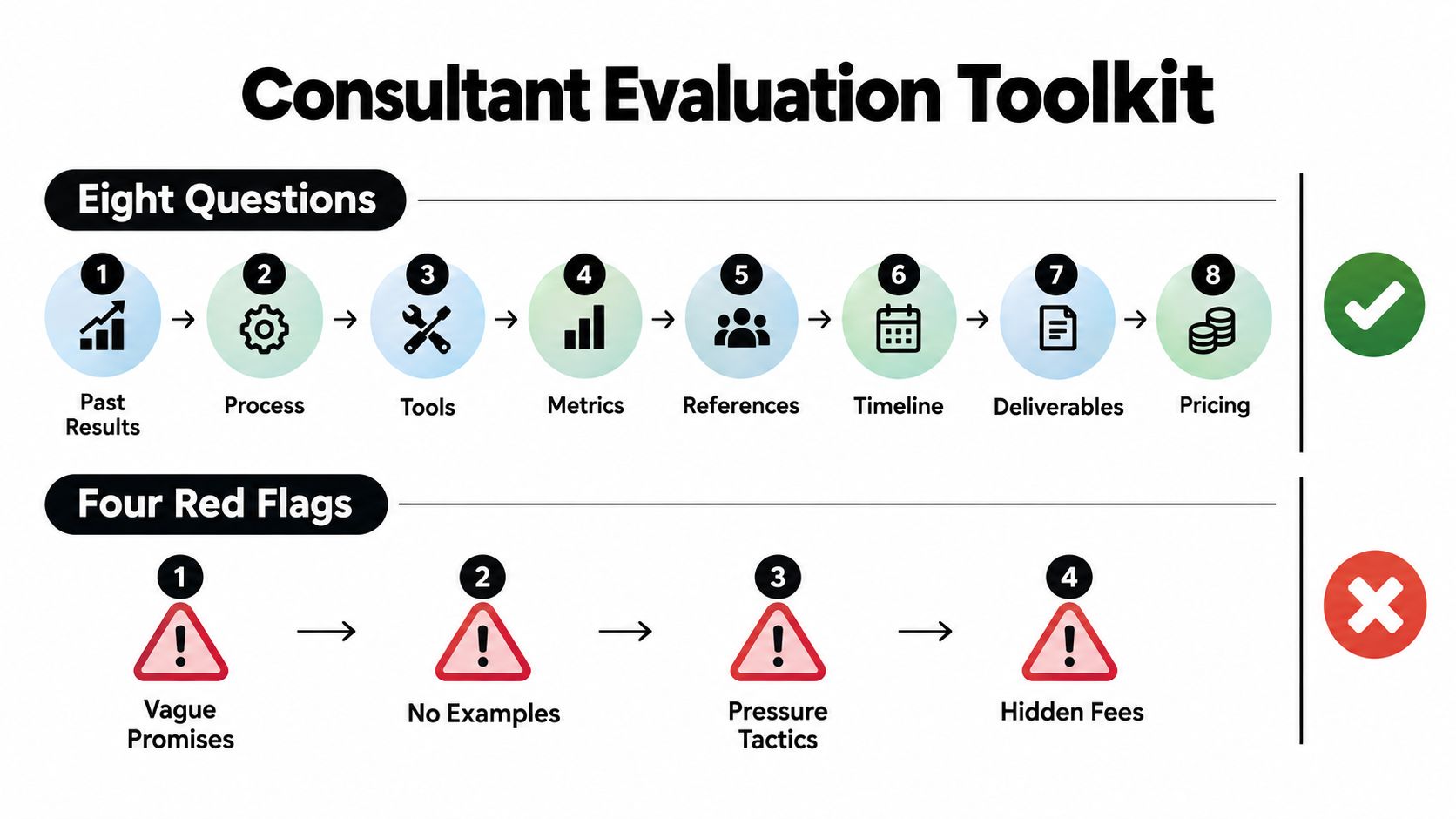
Use these questions to test whether the consultant can connect strategy to delivery:
Be wary of vague promises, examples without context, pressure to sign before you understand the scope, or fees that appear only after work begins. Also ask how the consultant handles AI assistance and disclosure. A proposal should make clear who verifies claims and who gives final approval.
Request a sample roadmap rather than a guarantee. Early work might focus on discovery interviews and reviewing existing content. Later, the consultant could present a positioning statement and content pillar map, then develop a first authority asset such as a detailed article, founder memo, or useful explanation of a customer problem. The timing should reflect your availability and the approval process, not an arbitrary promise.
Thought leadership can reach stakeholders who aren't the visible audience on your feed. The 2025 Edelman-LinkedIn B2B Thought Leadership Impact Report surveyed nearly 2,000 management-level professionals and found that 64% of hidden buyers trust thought leadership more than marketing materials when judging a vendor's capabilities. The report's findings on hidden buyers make a practical point for founders: useful content may help finance, legal, procurement, compliance, or operations stakeholders evaluate your work even if they never comment.
If LinkedIn is central to your work, assess whether your provider can connect positioning to the profile itself. This guide to LinkedIn profile optimization services offers a reference point for evaluating that part of a proposal. You can also watch the following overview as another input to your own assessment:
AI can make production easier, but speed doesn't settle the question of authorship. A defensible workflow separates assistance with structure from responsibility for meaning. A consultant might use AI to organize interview notes, identify recurring themes, or adapt an approved idea into a different format. The client should still own the personal experience, professional judgment, factual claims, and final approval.

That distinction matters to an audience. Recent creator-economy research collected responses from 783 creators, while industry reporting citing consumer research says 77% of consumers want to know when AI is used to create content and 81% value human-created content for its authenticity, originality, and human experience. These figures are reported together in the creator-economy research and consumer findings. The practical takeaway isn't that all AI use should be avoided. It's that clients need a clear standard for how it supports their voice.
Agree on what AI can do and what remains human-led. For example, it might summarize a recorded interview or suggest ways to reorganize an approved argument. It shouldn't invent anecdotes, supply an unsupported claim, or make a decision on your behalf. Keep source notes for factual claims and identify the person responsible for checking them.
Disclosure expectations should also be clear. Decide when an AI-assisted process is material enough to disclose, and label synthetic visuals where they could be mistaken for real photography or documentation. A useful workflow makes the boundary easy to follow, rather than asking the client to approve each post without knowing how it was made.
A periodic voice audit compares published content with your actual language, opinions, and experience. Read posts aloud. Check whether you would defend each claim in a conversation with a customer, colleague, or journalist. If a sentence sounds polished but doesn't sound like you, revise it or remove it.
For teams managing documents and structured workflows, MCP docs can be a useful resource for understanding how tools connect with workspaces. Whatever tools you use, maintain a human review path. A guide to AI-assisted content creation for authentic brand growth can also help frame the operating question: how can production grow without handing away judgment? The safest system makes authorship, evidence, and approval visible to the people involved.
Use a simple filter before hiring: every recommended activity should support visibility, demonstrate expertise, or build trust. If a proposal can't connect its deliverables to one of those outcomes, ask what problem the work is meant to solve.
A recent research review reports that authentic and interactive social-media branding can support consumer trust, loyalty, and purchase intention, while user-generated communications such as reviews and testimonials contribute to trust and brand equity. The review of authenticity and interaction in social-media branding reinforces a practical standard for content quality: it should reflect real work, invite meaningful responses, and avoid claims you can't stand behind.
A voice guide can make the work easier to sustain across writers and formats. For practical reference when documenting language and tone, see this tone of voice guide for creators.
Early work should clarify your narrative and gather examples from your real experience. The next stage should turn that material into content pillars, a profile that reflects your position, and a review process for drafts. By the end of the initial engagement, you should have a completed authority asset and a way to assess its response through relevant conversations, referrals, or qualified inquiries.
Take one action today: write down the audience you want to reach, the problem you help them solve, and one decision or lesson that shows how you approach it. Bring those notes to a prospective consultant. Their questions will tell you whether they can help build a credible system or only promise more posts.
Legacy Builder works with founders and executives to shape positioning, voice, and content into a consistent personal brand, with support for writing, design, and distribution. If you want your real experience to become useful, credible content rather than another empty posting schedule, visit Legacy Builder to explore its approach.


You could – but most in-house teams struggle with the nuance of growing on specific platforms.
We partner with in-house teams all the time to help them grow on X, LI, and Email.
Consider us the special forces unit you call in to get the job done without anyone knowing (for a fraction of what you would pay).
Short answer – yes.
Long answer – yes because of our process.
We start with an in-depth interview that gives us the opportunity to learn more about you, your stories, and your vision.
We take that and craft your content then we ship it to you. You are then able to give us the final sign-off (and any adjustments to nail it 100%) before we schedule for posting.
No problem.
We have helped clients for years or for just a season.
All the content we create is yours and yours alone.
If you want to take it over or work on transitioning we will help ensure you are set up for success.
We want this to be a living breathing brand. We will give you best practices for posting and make sure you are set up to win – so post away.
Subscribe to our newsletter and get insights on how to grow your personal brand.
