.svg)
Subscribe to our newsletter and get insights on how to grow your personal brand.
Thank you! Your submission has been received!
Oops! Something went wrong while submitting the form.
.svg)



The most popular advice on executive thought leadership is also the least useful: post more, show up consistently, share your wins, be authentic. That sounds practical. It isn't. It's content treadmill advice dressed up as strategy.
Busy executives don't have a posting problem. They have an authority design problem. They publish without a sharp point of view, without a repeatable system, and without any standard for what success should look like. Then they wonder why thoughtful posts disappear into the feed.
That approach wastes one of the strongest commercial levers an executive has. 75% of executives say they have explored products or services they were not originally considering after engaging with compelling thought leadership content, according to these thought leadership statistics from DSMN8. That means the right message from the right leader doesn't just build awareness. It changes buyer consideration.
Treat this correctly and your voice becomes a demand-shaping asset. Treat it casually and you become another executive posting polished nothing.
Most executive thought leadership fails because it starts with content instead of position.
A leader says, "I should probably be more active on LinkedIn." The marketing team builds a calendar. A ghostwriter drafts generic posts about leadership, innovation, culture, resilience, and lessons learned. The executive approves a few, ignores a few, and after a month everyone eventually admits it isn't doing much.
That's not thought leadership. That's corporate residue.
Thought leadership only works when people can answer three questions fast:
If your audience can't answer those questions, your content won't stick. It may get likes from colleagues. It won't build authority.
Most executives are publishing commentary when they should be publishing conviction. Commentary reacts. Conviction leads. Commentary sounds informed. Conviction shapes decisions.
Practical rule: If a post could be published by ten other executives in your industry with no edits, it isn't helping your authority.
Plenty of executives confuse visibility with relevance. Visibility is being seen. Relevance is being remembered when a buyer, investor, podcast host, journalist, or future hire needs your category of expertise.
That distinction matters. An executive thought leadership strategy should create a specific market impression. You want your name attached to a narrow set of important ideas, not a broad cloud of respectable opinions.
The problem is simple:
Buyers don't need more executive platitudes. They need interpretation. They want someone who can explain what matters, what doesn't, what is changing, and what to do next.
That's why I push leaders to stop thinking about thought leadership as social media activity. It's a personal authority system. The system should produce a clear market signal over time. Every post, interview, article, keynote, and comment should reinforce the same deeper thesis.
Once you see it that way, the fix becomes obvious. Stop trying to look active. Start trying to become unmistakable.
Most executives skip the hard part. They want help writing content when they need help deciding what their authority is built on.
That mistake is common. Only 29% of C-suite executives are fully confident in their thought leadership efforts, according to Software Equity's analysis of thought leadership strategy. I don't find that surprising. Most programs fail before the first post goes live because the strategic foundation is weak.
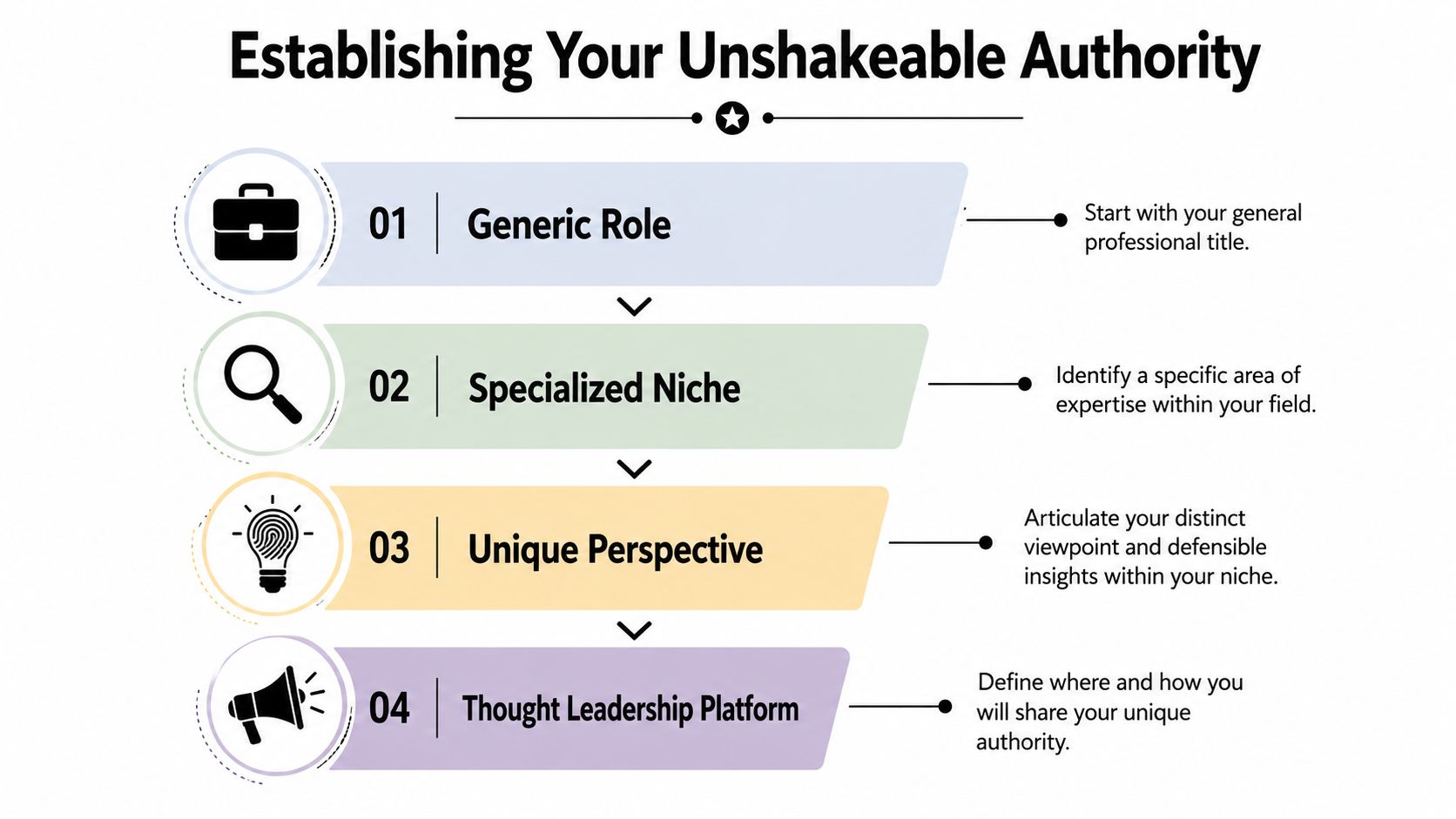
"CEO of X." "Founder of Y." "Chief Revenue Officer at Z." That's not positioning. That's your org chart.
Authority comes from the intersection of who you help, what you believe, and why your interpretation is different. I call these the three pillars of positioning.
Name the audience with painful specificity.
Bad answer: founders, marketers, business leaders.
Better answer: bootstrapped SaaS founders trying to build distribution without a large outbound team. Or enterprise HR leaders trying to modernize employer branding without turning culture into fluff.
Your audience should feel chosen, not vaguely included.
This is your core thesis. Your argument. The hill you're willing to defend in public.
Examples of strong thesis directions:
A thesis gives your content gravity. Without it, every post becomes a disconnected opinion.
Your experience sharpens the edge. Why do you see the issue this way? What have you lived through that changed your view? What pattern have you seen repeatedly that others miss?
This is the difference between "I know the topic" and "I've earned the right to challenge the default view."
If your positioning works, someone else should be able to describe it in one sentence.
Use a simple formula:
If you need help tightening that language, this framework for personal brand statements is useful because it forces clarity instead of buzzwords.
You should also study how positioning translates into market presence, not just messaging. This piece on mastering personal branding for executives to drive influence and growth is worth reviewing for that reason.
Your authority position should feel slightly risky. If nobody could reasonably disagree with it, it probably isn't strong enough.
Before you publish anything, ask:
| Question | What you're looking for |
|---|---|
| Can I defend this in an interview? | Verbal confidence, not just polished copy |
| Does this align with business goals? | Commercial relevance, not abstract thoughtfulness |
| Can I produce ten angles from this thesis? | Repeatability |
| Would the right audience care enough to respond? | Tension, stakes, usefulness |
If your answers are weak, don't write more content. Refine the position first.
Strong positioning gives you structure. Narrative gives you magnetism.
Executives often write like they're filing a board memo. The points are clean. The language is polished. The content is dead on arrival because nobody connects with abstract intelligence alone. People remember a leader's interpretation when it's attached to a lived experience, a hard-earned lesson, or a conflict they recognize.

A SaaS founder and a finance executive can hold equally strong authority. They just won't express it the same way.
The founder might tell the story of losing early deals because the company copied competitor messaging instead of naming the actual customer pain. That story supports a thesis about clarity beating noise.
The finance executive might tell the story of sitting in a tense budgeting meeting and realizing every department used different definitions of efficiency. That story supports a thesis about how operational language shapes strategic decisions.
Neither story needs drama for the sake of drama. It needs a point.
Every memorable narrative has friction. In executive thought leadership, the villain usually isn't a person. It's an outdated assumption, broken process, lazy belief, or industry habit.
Good villains include:
When you name the villain, your audience knows what you stand against. That matters almost as much as what you stand for.
The fastest way to sound forgettable is to explain what you do without explaining what you reject.
Most executive content says, 'This is my perspective.' Better content says, 'The facts of the matter, my observations, and the conclusion I now stand behind.'
Use this simple narrative sequence:
If you're preparing for interviews, podcasts, or quoted media appearances, your stories need spoken clarity too. This guide to executive media communication is useful because it focuses on how leaders can deliver ideas with control under pressure.
For a written framework on developing these stories into brand assets, see this step-by-step guide to storytelling for business leaders.
A strong narrative doesn't make you look softer. It makes your expertise usable.
Inconsistent executives don't need more motivation. They need less friction.
The primary pitfall for most thought leadership efforts is execution. The ideas exist. The intent exists. The calendar doesn't. A week gets busy, then a month disappears, and the market hears nothing. That's why I tell clients to stop thinking in terms of content creation and start thinking in terms of content operations.
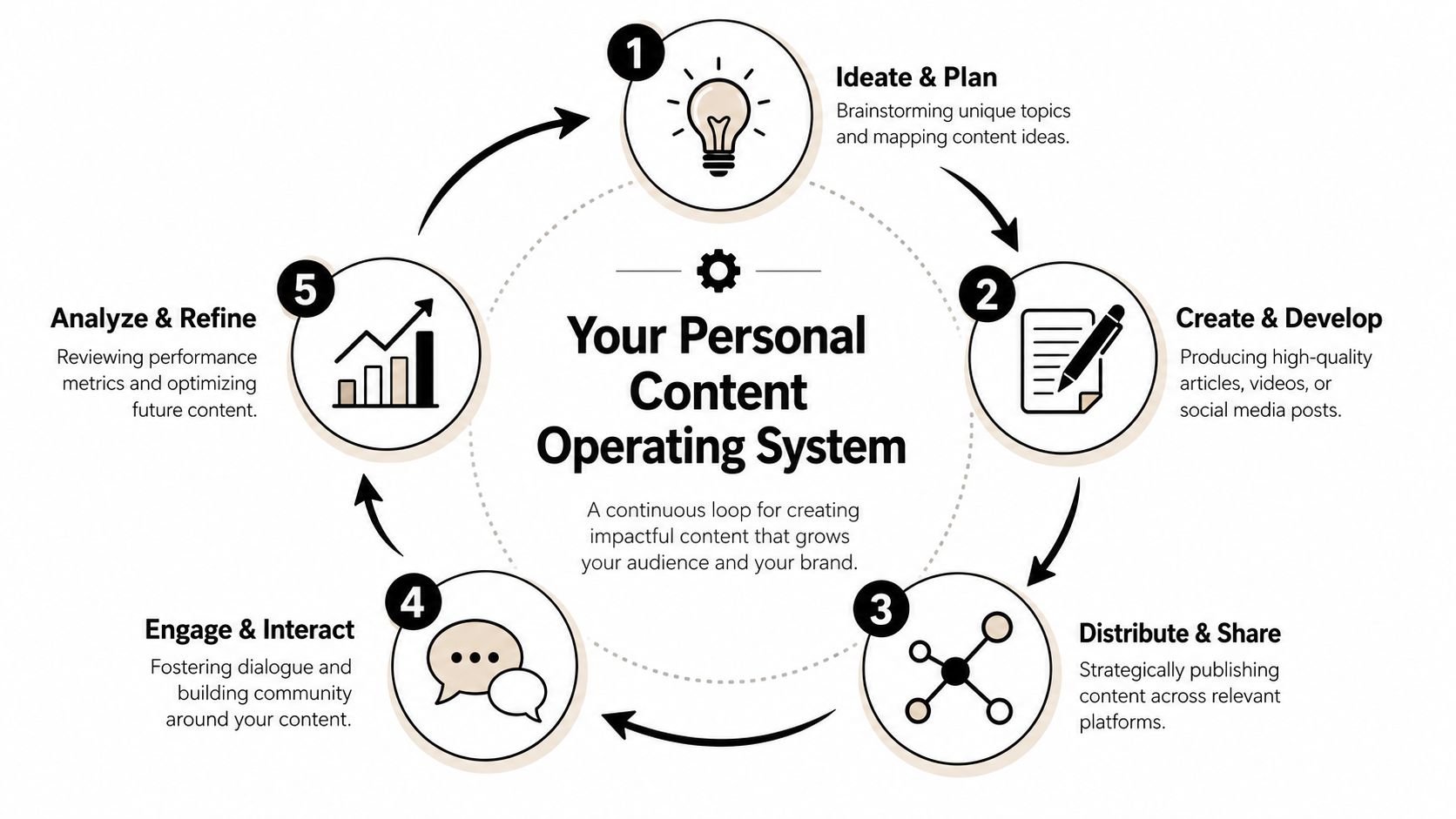
An industry source notes that only 1 in 5 decision-makers spends more than 4 hours per week reading thought leadership content, as noted in Lewis Commercial Writing's thought leadership strategy article. That should change how you operate. You do not need more volume. You need sharper packaging, better distribution, and stronger repetition.
Your content operating system should answer four questions:
Do not build seven pillars. That's how executives end up with scattered messaging.
Pick three:
A cybersecurity founder might use: breach readiness, buyer misconceptions, and board-level communication. A healthcare executive might use: patient experience, operational bottlenecks, and leadership decision-making.
If you hate writing, don't build a strategy that depends on weekly essays from a blank page. Record voice notes. Use interview transcripts. Turn keynote talking points into short posts. If you're clear on camera, use video. If you're strongest in long-form thinking, lean into a newsletter or article cadence.
For executives considering a bigger intellectual property asset later, this comprehensive guide for aspiring authors is a useful way to think about how shorter content can eventually support a business book.
Here is the practical sequence I recommend:
A short explainer can help if you want a visual model for that rhythm.
| Content Pillar | Primary Format | Distribution Channel | Cadence | Repurposing Ideas |
|---|---|---|---|---|
| Core expertise | LinkedIn text post or short video | Weekly | Turn into carousel, newsletter section, podcast talking point | |
| Strategic perspective | Article, memo, or newsletter | Newsletter or blog | Twice monthly | Clip quotes, extract contrarian points, use in media outreach |
| Proof and application | Story post, case reflection, interview answer | LinkedIn and sales enablement | Weekly | Convert into internal training, keynote anecdote, founder Q&A |
Even if you stay hands-on, someone has to own the machine. That could be a chief of staff, content lead, executive assistant with editorial ability, freelance writer, or an outside partner. One option in the market is Legacy Builder, which runs an interview-based process that extracts a client's ideas, turns them into written content, and handles posting cadence through a managed team.
Ownership matters more than enthusiasm. If nobody owns the workflow, your strategy becomes a hobby.
A lot of executives treat thought leadership like a broadcast tower. Publish the post. Watch the views. Move on.
That is the wrong model.
Authority grows faster through dialogue than monologue. If you want influence, you need interaction with the people who shape markets, buy services, host events, write stories, and make introductions. Content opens the door. Conversation moves you through it.
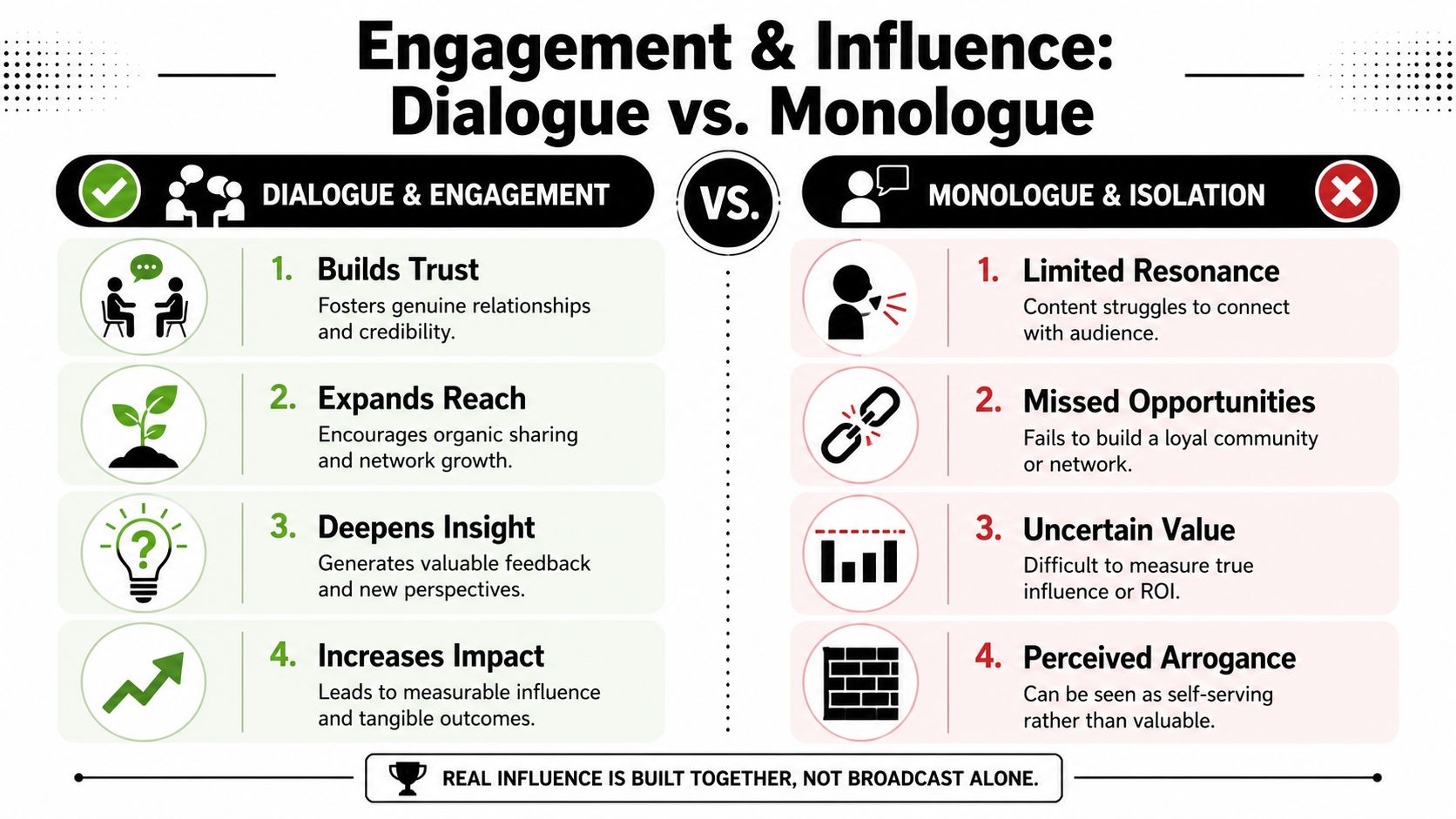
A post can perform well and still do nothing important. Your peers may applaud it. Your ideal buyers may ignore it. That's why vanity metrics are dangerous. They reward surface reaction, not strategic movement.
The better question is this: did your content change the quality of conversations available to you?
Look for signs like:
If your content gets attention but doesn't create better opportunities, your measurement system is broken.
You do not need to "engage with everyone." You need a short list of people who matter to your strategic goals.
I like a focused relationship map:
Read what they publish. Comment with substance. Send direct notes when you have something specific to say. Refer people. Quote their ideas when useful. Show up as a thinking participant, not a self-promoter.
This is also where many executives need better measurement discipline. If you're rebuilding your dashboard away from vanity metrics, this guide on how to measure content performance for your personal brand gives a more practical lens.
Use a simple monthly review. Ask:
| Signal | What it tells you |
|---|---|
| Inbound meetings or introductions | Whether your message is attracting the right market |
| Meaningful DMs and email replies | Whether your ideas are creating real conversation |
| Speaking or media interest | Whether your authority is becoming externally visible |
| Repeated topic resonance | Which ideas deserve deeper investment |
A real executive thought leadership strategy should make your network sharper, not just bigger.
The first pitfall is overthinking. Executives spend too long refining positioning, waiting for the perfect launch, or debating which platform matters most. Clarity matters. Perfection doesn't. You need a strong thesis and a working system, not a six-month branding retreat.
The second pitfall is outsourcing your voice so aggressively that you disappear. Delegation is smart. Voice abdication is not. If your content sounds like it came from a polished agency template, people will feel the distance. Your operator can shape, edit, package, and distribute. They cannot invent your conviction.
Three mistakes show up constantly:
The right standard is simpler. Publish what strengthens your authority position and creates better conversations.
Scale doesn't come from saying more things. It comes from making the same important ideas more discoverable, more portable, and more credible.
Once your foundation works, expand carefully.
A good scaling path looks like this:
You can also build a small support bench. One person might manage scheduling and research. Another might edit drafts or design visuals. The executive still provides the intellectual core. The team extends reach and consistency.
That is the bigger point. Executive thought leadership isn't about becoming an internet personality. It's about building a durable authority asset that compounds across hiring, sales, partnerships, media, and long-term reputation. If you're serious about influence, stop treating it like extracurricular marketing. Run it like an operating system.
If you want help turning your expertise into a working authority system, Legacy Builder helps executives extract their ideas, shape them into authentic content, and maintain a consistent publishing rhythm without sounding generic.


You could – but most in-house teams struggle with the nuance of growing on specific platforms.
We partner with in-house teams all the time to help them grow on X, LI, and Email.
Consider us the special forces unit you call in to get the job done without anyone knowing (for a fraction of what you would pay).
Short answer – yes.
Long answer – yes because of our process.
We start with an in-depth interview that gives us the opportunity to learn more about you, your stories, and your vision.
We take that and craft your content then we ship it to you. You are then able to give us the final sign-off (and any adjustments to nail it 100%) before we schedule for posting.
No problem.
We have helped clients for years or for just a season.
All the content we create is yours and yours alone.
If you want to take it over or work on transitioning we will help ensure you are set up for success.
We want this to be a living breathing brand. We will give you best practices for posting and make sure you are set up to win – so post away.
Subscribe to our newsletter and get insights on how to grow your personal brand.
