.svg)
Subscribe to our newsletter and get insights on how to grow your personal brand.
Thank you! Your submission has been received!
Oops! Something went wrong while submitting the form.
.svg)



The worst advice in executive social media strategy is also the most common: “Just post more.”
No. Volume doesn’t fix a weak position, a vague message, or a broken approval process. It just creates more noise. Most executives don’t fail on social because they lack ideas. They fail because they treat their presence like a side task, hand it off without guardrails, or reduce it to polished corporate filler that nobody believes.
That approach is expensive. With 65.7% of the global population on social media in 2025 and people spending 141 minutes daily there, executive attention is already happening in public whether you participate or not. If you don’t shape the narrative, someone else will. The opportunity is too large to ignore, and the business cost of invisibility is real, as outlined in these social media usage benchmarks.
An executive presence isn’t a mini corporate account. It’s a strategic asset. It builds trust, sharpens market position, attracts talent, opens partnerships, and gives buyers a human reason to believe your company can deliver.
The problem is that most guides stop at branding theory. They tell you to “be authentic” and “stay consistent,” then leave out the parts that break the system: slow approvals, uneven voice, content bottlenecks, and the constant tension between staying personal and scaling output.
That’s where most executive social media strategy falls apart. And that’s exactly what needs fixing.
The failure usually starts with a bad assumption. Executives think social is a distribution channel for company news. It isn’t. Your company page handles announcements. Your executive account should do something harder and more valuable. It should make people trust your judgment.
If your feed reads like investor relations copy with a headshot attached, people scroll past. If every post sounds safe, polished, and committee-approved, people assume someone else wrote it. They’re usually right.
Most executive accounts die in one of three ways:
None of that builds authority. Authority comes from repeated exposure to a clear point of view.
Practical rule: If your audience can swap your name with another executive’s and the post still works, the content is too generic.
Your primary role is not “showing up on social”; it is building a durable reputation asset that compounds. That means your ideas need to be recognizable, your tone needs to sound human, and your content needs to support a business goal.
A surprising number of executives say they want to “build thought leadership.” That phrase usually means nothing. Thought leadership is not a goal. It’s a byproduct.
A real executive social media strategy ties content to outcomes like better inbound conversations, stronger hiring advantage, warmer sales cycles, speaking invitations, or clearer market positioning. Without that, you’ll post for applause and call it progress.
Here’s the blunt version. If you don’t know what reputation you’re trying to build, social becomes a chore. If you do know, it becomes an advantage.
For executives who need to tighten the connection between public presence and trust, this guide to online reputation management for building a powerful brand is worth reading alongside your content planning.
Most executives don’t have a content problem. They have a clarity problem.
They know too much, serve too many audiences, and try to sound relevant to everyone. The result is broad, forgettable content. That’s why the first move in executive social media strategy is narrowing the message until it cuts.

You need three things working together:
That sounds simple. It isn’t. Executives often default to title-based positioning. “CEO sharing leadership lessons.” That’s weak. Title is not a message.
A stronger position sounds like this: operator-led SaaS CEO sharing how enterprise teams buy, implement, and expand software without bloated sales motions. That gives you range without vagueness.
Write these three lines without overthinking them.
Expertise line
What do people consistently ask for your opinion on? Not your résumé. Your repeated value. It might be pricing strategy, scaling culture after Series B, enterprise sales design, category education, or product-led growth mistakes.
Audience line
Get specific. “Founders” is lazy. Try enterprise buyers, VP-level candidates, private equity operators, technical hires, channel partners, or regional business owners entering digital markets.
Pain-to-outcome line
What tension are they trying to solve? Better positioning? Faster trust? Smarter hiring? Cleaner go-to-market execution? Stronger category authority?
When those pieces are clear, combine them into one sentence:
I help [specific audience] understand [specific problem/opportunity] through [specific expertise and perspective].
That sentence becomes your filter. If a post doesn’t support it, cut it.
You can’t spray the same message everywhere and expect it to land. Platform context matters. According to this guidance on audience research and platform fit, 80% of social media users have a LinkedIn profile and 63% use social media for business purposes. If you ignore platform-specific audience behavior, you waste effort.
For most executives, LinkedIn is the primary arena. It supports nuance, professional identity, and business relationships. That doesn’t mean every executive belongs only on LinkedIn. It means you earn the right to expand after your core message works there.
If you need a practical outside reference for sharpening this process, these tips for creators to find their audience are useful because they force specificity instead of vanity targeting.
The fastest way to improve content is to stop asking, “What should I post?” and start asking, “Who is this for, and what decision should it influence?”
A strong message also needs language discipline. The words you repeat become the brand people remember. If your positioning still feels muddy, this breakdown of what brand messaging is and how to create it helps tighten the actual phrasing behind your public presence.
Once your message is clear, you need structure. Not a rigid content prison. A framework that makes posting easier, sharper, and repeatable.
Most executives skip this step and rely on inspiration. That’s amateur behavior. Inspiration is unreliable. A framework gives your team, and your future self, a way to produce strong content without reinventing the wheel every week.
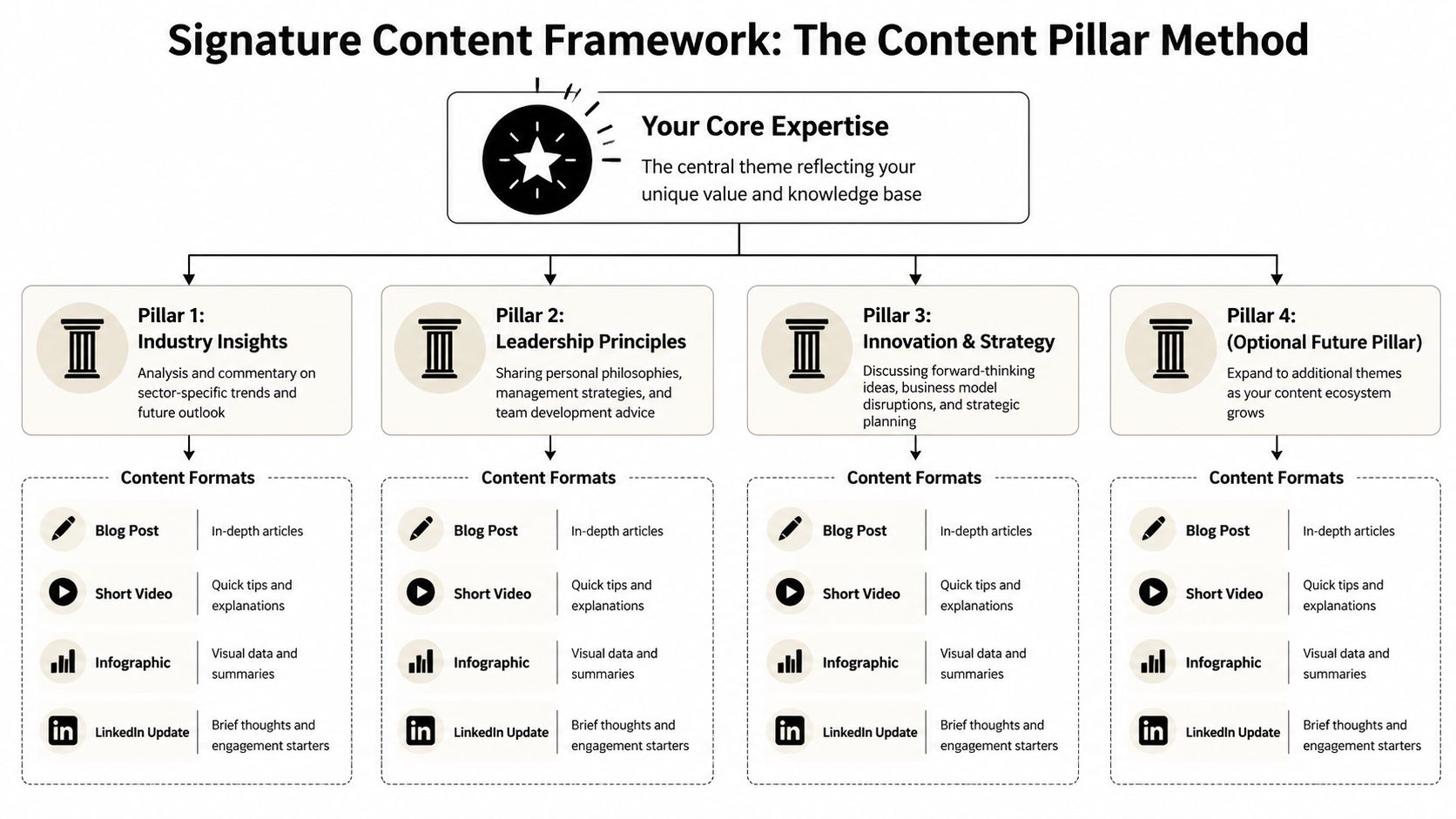
Your best executive social media strategy should revolve around content pillars. These are the recurring themes that prove your expertise from different angles.
A clean setup looks like this:
| Pillar | What it covers | Example post angle |
|---|---|---|
| Industry insights | Market shifts, buyer behavior, category trends | Why most companies misread what buyers actually want |
| Leadership principles | Hiring, delegation, standards, decisions | The meeting rule that improved executive alignment |
| Innovation and strategy | Product bets, competitive positioning, future direction | What incumbents still miss about AI adoption |
| Operator stories | Lessons from wins, mistakes, pivots | The strategic call I got wrong, and what changed after |
You don’t need seven pillars. That usually means you’re unfocused. You need enough range to avoid repetition and enough discipline to stay recognizable.
Random posts create random impressions. A signature framework should produce a narrative arc.
That means your content over a month should answer a larger question your audience cares about. For example:
That sequence builds trust because people start seeing coherence, not just activity.
A strong executive feed feels like an unfolding thesis, not a pile of updates.
Many teams encounter a point where they either become uninspired or experience exhaustion. They think each post needs a fresh idea. It doesn’t. One strong insight can become a week of content if you know how to spin it correctly.
Take one idea: “Enterprise buyers don’t want more features. They want lower implementation risk.”
That can become:
That’s not repetition. That’s reinforcement.
For executives who want examples beyond theory, these real-world content strategy frameworks are useful because they show how strategic themes turn into practical editorial systems.
LinkedIn is still the best home base for B2B executive visibility. According to this roundup of platform engagement benchmarks, LinkedIn’s median engagement rate reached 6.50% in 2025, making it the strongest platform for B2B thought leadership among the listed networks. That matters because good content gets rewarded there when it is specific, opinionated, and useful.
This does not mean posting constantly. It means posting with intent.
Use a simple format mix:
A strong framework also needs a story spine. If you want your content to feel less like commentary and more like a memorable personal brand, study how to build a brand storytelling framework that wins hearts. The mechanics matter. Stories make people remember what plain expertise often doesn’t.
A good content strategy dies fast without an operating system. Busy executives don’t need more ideas. They need a system that survives travel, meetings, launches, and the weeks when attention gets hijacked by the actual business.
Consistency is not a motivation problem. It’s a workflow problem.
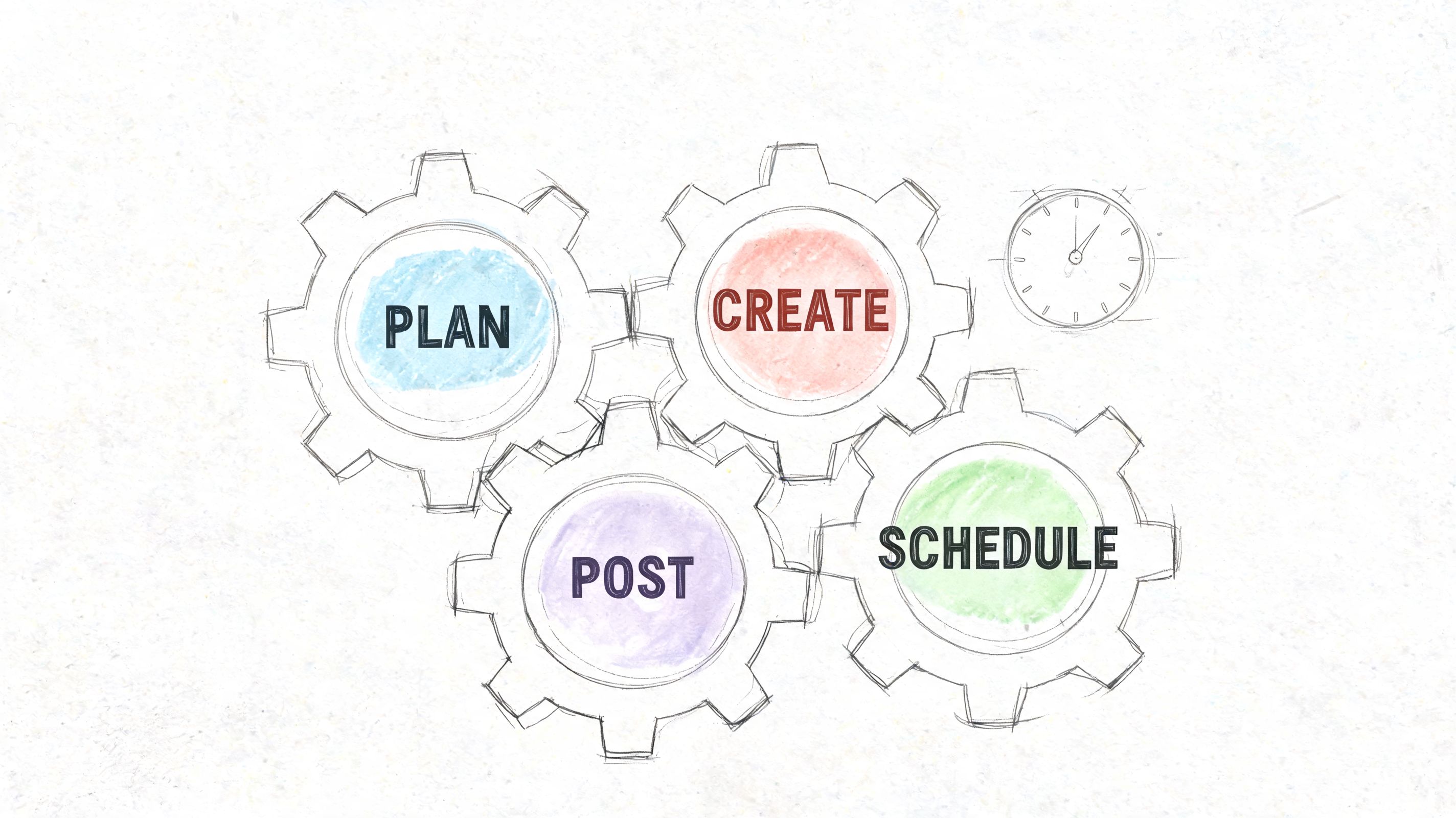
The smartest executives use a create once, distribute forever model. They don’t sit down five times a week trying to manufacture insight from scratch. They extract content from work they’re already doing.
Your raw material is already there:
One useful internal memo can become a LinkedIn post, a short video script, a quote graphic, and a comment thread starter. A conference talk can fuel an entire week of content.
Most executives overcommit, miss the plan, then disappear for two weeks. That cycle kills momentum.
A better system looks like this:
| Day | Activity | Owner |
|---|---|---|
| Monday | Capture ideas from calls, meetings, notes | Executive |
| Tuesday | Draft and shape priority posts | Team or writer |
| Wednesday | Approve and schedule | Executive |
| Thursday | Publish and engage in comments | Executive with support |
| Friday | Review what resonated and save insights | Team |
That cadence works because it respects executive time. The leader contributes judgment and voice. The team handles assembly, formatting, scheduling, and cleanup.
Not all social tasks deserve executive attention. Keep the executive focused on high-value inputs:
Everything else can be systematized.
If your posting routine depends on finding spare time, you don’t have a routine. You have wishful thinking.
Use tools that remove friction. Notion works well for idea capture. Google Docs is fine for collaborative drafts. Buffer, Hootsuite, Sprout Social, and native LinkedIn scheduling all help on distribution. The tool matters less than the process. A mediocre tool with a clean workflow beats a powerful tool nobody uses.
The right system should feel boring in the best way. Predictable. Light. Repeatable. That’s how executive social media strategy stays alive long enough to matter.
This is the part most articles ignore, and it’s the part that determines whether your strategy lasts.
You cannot scale executive visibility by doing everything yourself. You also cannot delegate everything and expect the result to feel authentic. That tension is real. It’s the authenticity-scalability paradox, and many organizations handle it badly.
They swing to one extreme. Either the executive writes every word and burns out, or the team takes over and publishes content that sounds polished but hollow. Neither works.
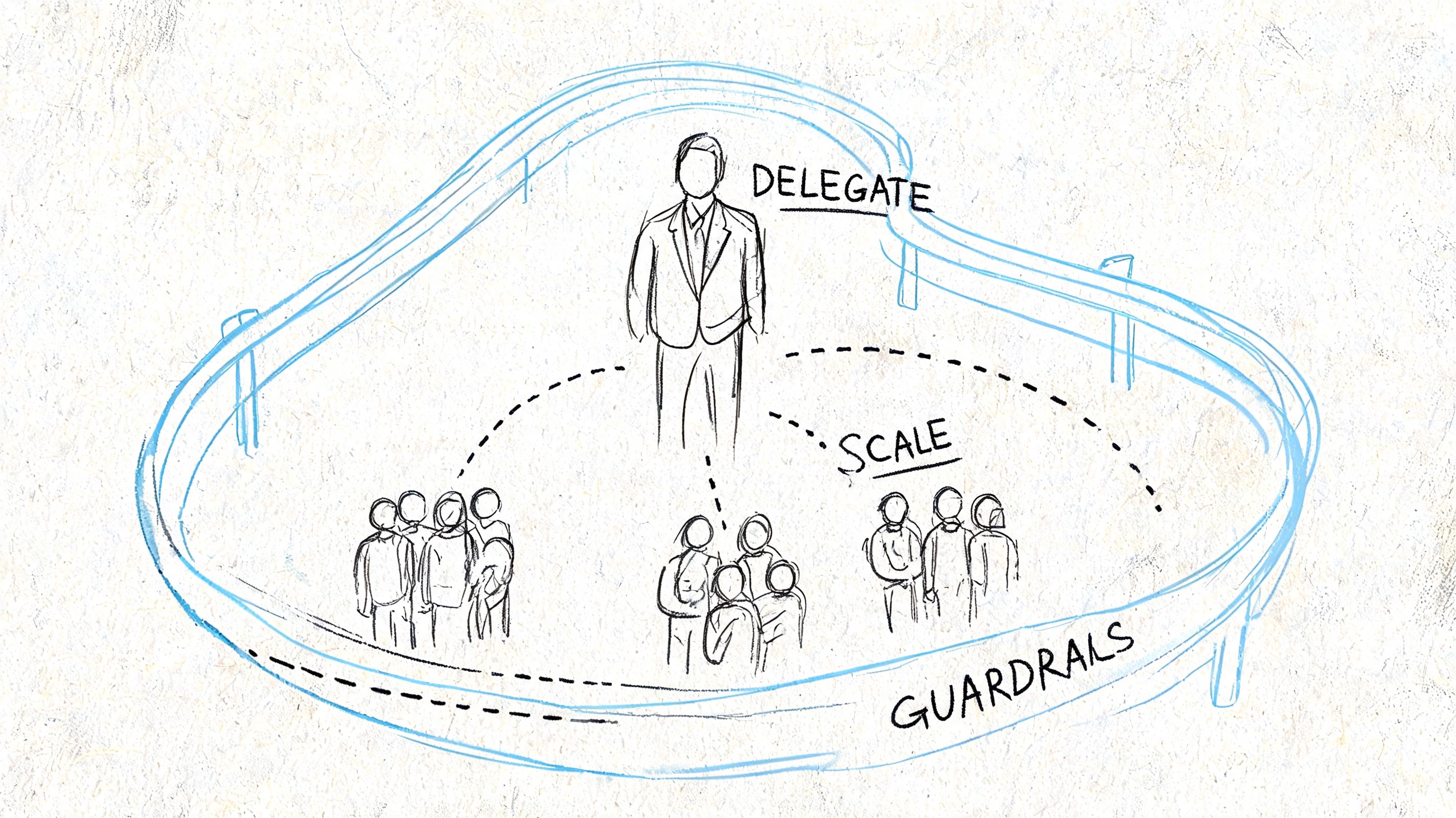
Here’s the model I recommend.
The executive should own:
The team should own:
That division protects the executive’s scarce asset, which is judgment, not production time.
If you want delegated content to sound real, document voice before volume. Neglecting this step often leads to future complications.
Your voice guide should include:
Words you use often
Short list of phrases, themes, and industry language that sound like you.
Words you avoid
Corporate filler, hype language, jargon you never say out loud.
Point-of-view rules
Are you contrarian, measured, teacher-like, blunt, analytical, optimistic, skeptical?
Story boundaries
What can be shared publicly, what requires review, what stays private.
A decent writer can imitate tone. A strong system captures judgment patterns.
The second operational killer is slower than bad writing. It’s the approval process.
A lot of executive content dies in limbo. Draft gets sent. Nobody replies. A few days pass. The post loses relevance. The team starts guessing. Momentum disappears.
That bottleneck is not a small issue. It is one of the major gaps in current guidance. As noted in this analysis of executive visibility strategy blind spots, existing guidance fails to address both the authenticity-scalability paradox and the executive approval bottleneck, even though they are the main operational barriers to consistent output.
Here’s the fix. Use a simple approval ladder:
| Content type | Approval method | Turnaround expectation |
|---|---|---|
| Low-risk thought leadership | Team drafts, executive batch approves | Same day or next day |
| Personal stories or strong opinions | Team drafts from voice notes, executive edits key lines | Same day |
| Sensitive company topics | Team drafts, executive reviews, legal or comms looped in if needed | Planned in advance |
| Reactive commentary | Pre-approved themes and fast go/no-go decision | Immediate decision window |
The key is not complexity. It’s speed and clarity.
Use one channel for approvals. Not email, Slack, text, and a random note from an assistant. Pick one system. Mark each post clearly: approve, revise, or kill. Nothing should sit in “maybe” for days.
Non-negotiable rule: If an executive cannot review content quickly, the team must reduce decision load, not increase reminders.
That means fewer choices per round. Send three strong drafts, not twelve weak options.
Delegation without rules creates inconsistency. Guardrails keep the content sharp and safe.
Your team needs clear answers to questions like:
A good executive social media strategy also includes amplification. Not fake engagement pods. Not vanity tactics. Real distribution.
That means:
Delegation is not the enemy of authenticity. Bad delegation is. Smart delegation protects your time so you can stay present where it matters most.
If your reporting starts and ends with likes, you’re not measuring strategy. You’re measuring applause.
A serious executive social media strategy tracks whether attention turns into business value. That means tying content to goals, using a short list of metrics that matter, and reading performance like an operator, not a fan.
The reporting framework should be simple and ruthless. According to this guide on common social media strategy mistakes, effective executive strategies use the SMART goal framework and track conversion metrics like clicks and sign-ups so reporting becomes actionable instead of turning into a useless data dump.
That means every executive program needs a defined target such as:
Without that anchor, your dashboard becomes clutter.
Track a few things consistently.
| Metric type | What to watch | Why it matters |
|---|---|---|
| Reach quality | Who is seeing the content | Tells you if the right audience is paying attention |
| Engagement quality | Comments, saves, meaningful replies | Shows whether the content is resonating, not just getting glanced at |
| Conversion actions | Clicks, sign-ups, inquiry forms, replies | Connects content to business outcomes |
| Inbound signals | Partnership interest, media requests, speaking asks, candidate mentions | Reveals off-platform business impact |
| Efficiency signals | Posts approved on time, publishing consistency, drop-offs in engagement | Exposes operational problems early |
The hidden value is often in inbound conversations. Prospects mention a post on a sales call. A candidate references your content in an interview. A conference organizer reaches out because your perspective stands out. Those signals count, even if they don’t show up in a platform dashboard by default.
One post doing well doesn’t prove much. One weak week doesn’t mean the strategy is broken. Look for trends.
Ask these questions:
If you want a solid supplemental reference for building a sharper measurement process, this guide on how to measure social media ROI is a useful companion.
Good reporting should tell you what to do next. Post more is not a strategy. Double down, cut, reposition, or test is a strategy.
The executives who win on social don’t obsess over vanity metrics. They build a system that turns visibility into trust, trust into conversation, and conversation into opportunity. That’s the standard.
If you’re tired of inconsistent posting, generic ghostwriting, and strategy that falls apart the moment your calendar gets busy, Legacy Builder helps executives turn real expertise into content that sounds like them. The focus isn’t fluff. It’s building an authentic personal brand with the systems, messaging, and execution support required to grow influence without hijacking your day.


You could – but most in-house teams struggle with the nuance of growing on specific platforms.
We partner with in-house teams all the time to help them grow on X, LI, and Email.
Consider us the special forces unit you call in to get the job done without anyone knowing (for a fraction of what you would pay).
Short answer – yes.
Long answer – yes because of our process.
We start with an in-depth interview that gives us the opportunity to learn more about you, your stories, and your vision.
We take that and craft your content then we ship it to you. You are then able to give us the final sign-off (and any adjustments to nail it 100%) before we schedule for posting.
No problem.
We have helped clients for years or for just a season.
All the content we create is yours and yours alone.
If you want to take it over or work on transitioning we will help ensure you are set up for success.
We want this to be a living breathing brand. We will give you best practices for posting and make sure you are set up to win – so post away.
Subscribe to our newsletter and get insights on how to grow your personal brand.
