.svg)
Subscribe to our newsletter and get insights on how to grow your personal brand.
Thank you! Your submission has been received!
Oops! Something went wrong while submitting the form.
.svg)


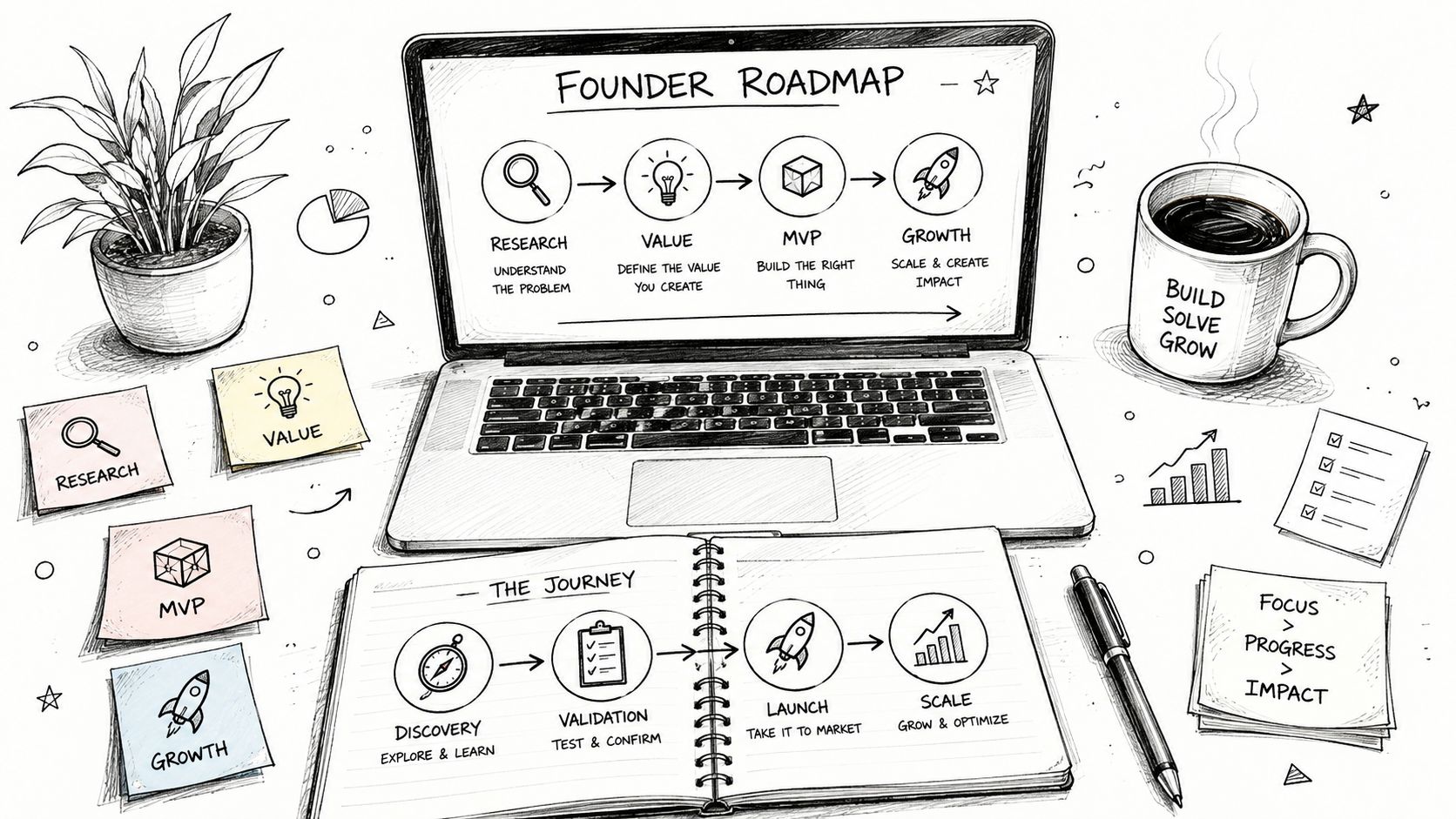
Shipping isn't success. It's only the moment when your assumptions become visible to users.
That distinction changes how founders should approach digital product strategy. A roadmap can organize engineering work, but it can't prove that customers care, explain who owns adoption, or prevent a fast-moving team from building features that create no meaningful outcome. The strongest strategy connects discovery, delivery, distribution, usage, retention, and business value in one operating system.
The pressure to move faster makes this discipline more important, not less. Worldwide digital transformation spending reached $1.85 trillion in 2022, rose to about $2.5 trillion in 2024–2025, and is projected to approach $3.9 trillion by 2027, according to Statista's digital transformation data. That long-term investment means digital products now compete inside an environment of continuous software, data, cloud, and automation spending. Founders need a strategy that survives launch day and keeps producing evidence afterward.
Most product plans fail before the first release because completion becomes the definition of success. The team delivers the roadmap, announces availability, and waits for market feedback. By then, the costly assumptions about customers, adoption, and business value are already embedded in the product.
A feature list directs engineering work. It rarely answers which customer problem matters most, why the product should win, how users will adopt it, or what the business will learn if the release underperforms. A practical strategy makes those decisions explicit. It also identifies what the team will not build, which segment it will not prioritize, and what evidence would justify stopping.
The “build it and they will come” assumption creates three predictable traps:
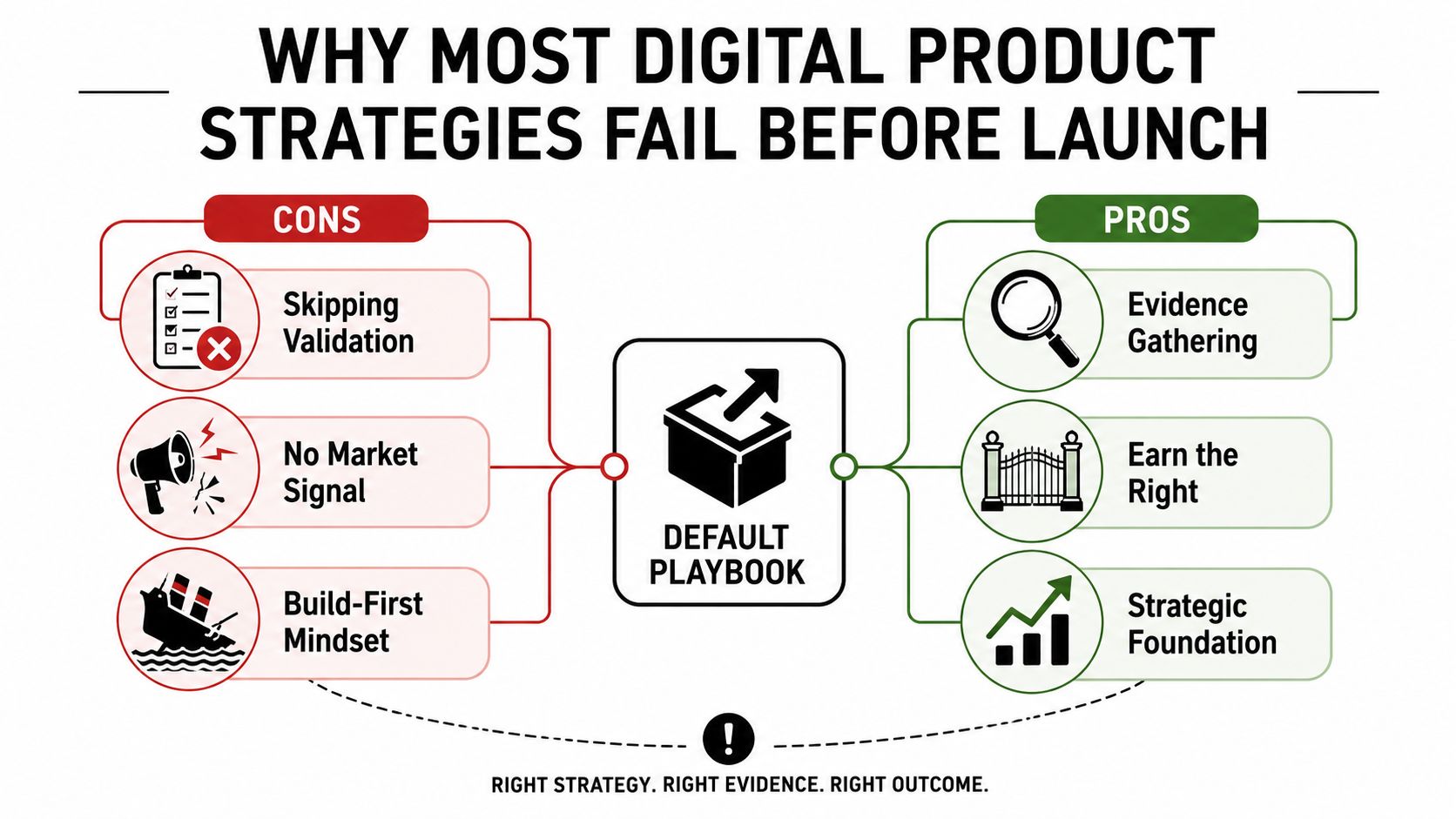
Structured discovery reduces rework by testing risky assumptions before scarce engineering capacity is committed. Amplitude's product benchmarks report that only 25% to 45% of new products succeed overall, with failure rates reaching as high as 85% in some industries. The same source reports new product success rates between 63% and 78% for companies using modern stage-gate processes, compared with 24% for teams without a structured gate process.
These figures do not make a gate a guarantee. They show the value of testing the assumptions that could make a product irrelevant before the team spends heavily on delivery. A clear gate gives founders permission to stop a weak concept while the cost of being wrong remains low.
Practical rule: Ask what must be true for the product to become useful, adopted, and economically viable. Build only after those conditions have a credible test.
Digital transformation also rewards operating discipline after release. One 2025 estimate says businesses allocated 13.7% of revenue to digital initiatives, up from 7.5% in 2024. Sustained investment requires more than a launch plan, whether the product is a SaaS tool, paid community, course, or creator-led product.
The pre-launch test should cover adoption conditions as well as product direction. If distribution, onboarding, internal ownership, and feedback loops remain vague, the product can launch on schedule and still fail in practice. That post-launch adoption gap is where disciplined strategy earns its keep, especially as AI makes it easier to build and easier to ship the wrong thing faster.
A founder should earn the right to build by moving through explicit evidence gates. The process doesn't need a large research department or a polished enterprise workflow. It needs clear assumptions, lightweight tests, named decision owners, and the courage to stop when the evidence weakens.
Start by writing a one-page assumption map. Separate problem assumptions, user assumptions, solution assumptions, and business assumptions. Rank them by risk, not convenience. The assumption that could make the entire product irrelevant belongs at the front of the queue.
Speak with people who recently experienced the problem, not just people who fit a broad demographic profile. Ask what they did, what they tried, what the workaround cost, and what caused them to abandon or delay action. Avoid pitching the solution during the first conversation.
A useful signal has behavioral detail. Someone who describes a repeated workaround, existing spend, internal escalation, or measurable operational burden gives you more than someone who says the concept sounds interesting. Record exact observations in a decision log, then identify the assumptions that the interviews failed to support.
The gate decision can be go, revise, or kill. “Kill” doesn't mean the founder failed. It means the team has protected itself from turning weak evidence into a backlog.
Once the problem has credible signal, test whether your proposed approach is understandable and compelling. Use clickable prototypes, service mockups, concierge delivery, landing pages, or a fake-door flow that measures whether users attempt the next action. Be transparent with participants, and don't represent an unavailable feature as a functioning product.
Look for commitment rather than compliments. A prospect who gives time to configure a workflow, introduces you to a buyer, shares a real dataset, or agrees to a paid pilot demonstrates stronger intent than someone who approves a screenshot.
The internal guide how to validate a business idea can help founders turn an early concept into a more disciplined validation exercise. The useful principle is simple: every test should reduce a specific uncertainty.
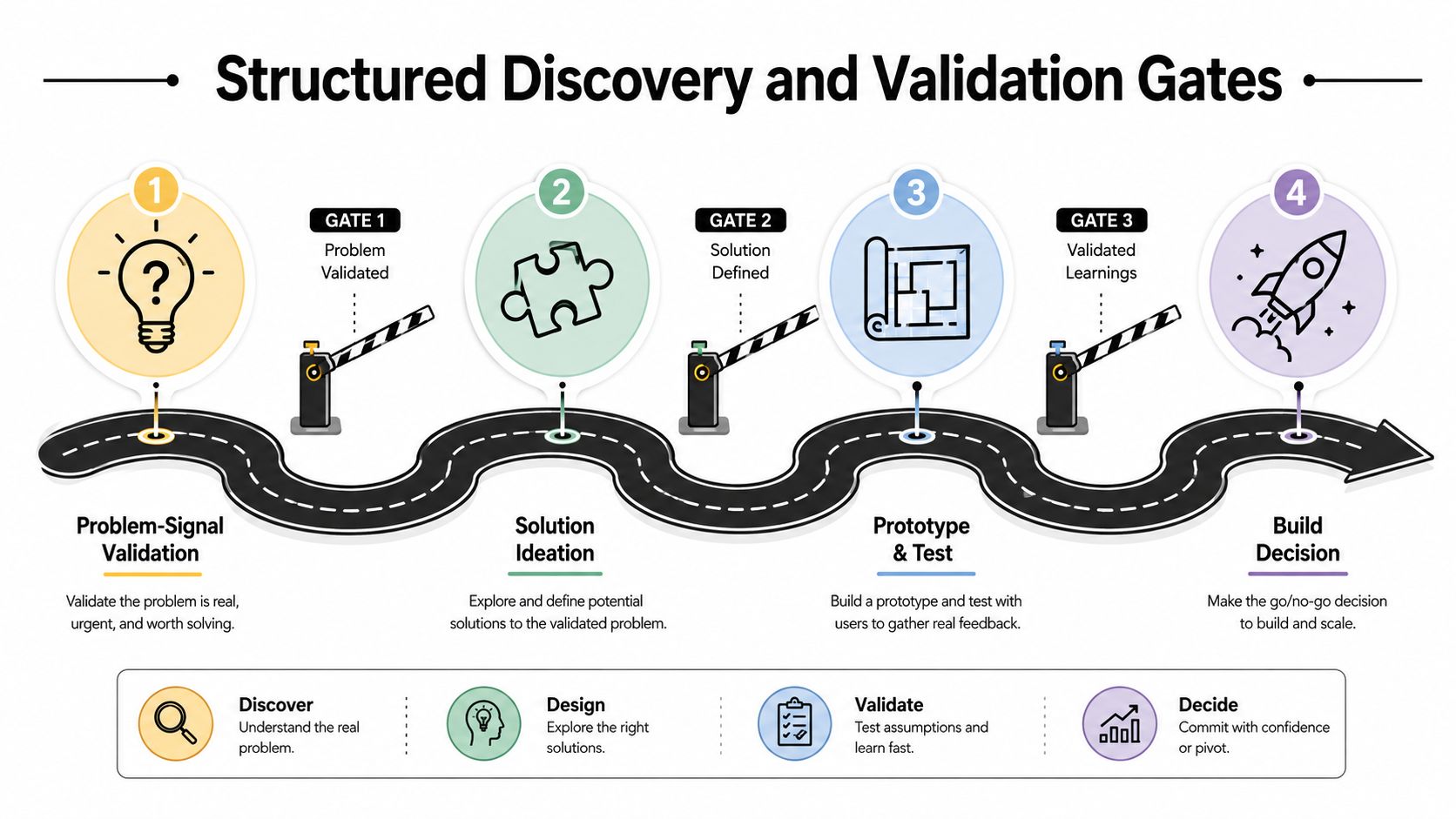
A product can solve a real problem and still lack a viable business model. Test willingness to pay with a real offer, a pricing conversation, a deposit, a paid pilot, or a clearly defined purchase path. A positive response to hypothetical pricing isn't equivalent to a transaction.
Document what the buyer receives, who approves the purchase, what blocks adoption, and what alternative currently absorbs the budget. If the person who feels the pain can't authorize a purchase, map the buying process before you interpret interest as demand.
Use a simple gate record:
This structure prevents reactive pivots. It also creates an institutional memory of why the team rejected an idea, changed the audience, or narrowed the product. Structured stage gates work because they turn conviction into a sequence of decisions.
A shipping counter tells you how busy the team was. It doesn't tell you whether users reached value, returned, paid, or expanded their use. Product progress metrics should measure learning first, adoption second, and monetization when the product has enough usage to support an economic signal.
Discovery metrics are especially useful before a reliable acquisition funnel exists. The benchmark in Measuring discovery success recommends tracking validated ideas per sprint, time to first validation, experiment success rate, and idea discard rate. Its suggested targets are 2 to 3 or more validated ideas per sprint, 5 to 10 days to first validation, 50% to 70% experiment success, and 30% to 60% idea discard.
Those targets aren't universal laws. They're prompts for reviewing whether your discovery system produces useful evidence. A team that validates nothing may be testing weak hypotheses or talking to the wrong people. A team that validates nearly everything may define success too generously.
After launch, measure the path from first meaningful action to repeated value. Activation should represent a user reaching the product's core outcome, not merely creating an account. Time-to-value reveals where users stall. Cohort retention shows whether the product earns repeat use after the novelty fades.
Monetization metrics become useful when they connect usage to the business model. Depending on the product, that could include conversion to paid use, expansion behavior, revenue retention, payback period, or customer lifetime value. Founders who need a practical foundation for tracking churn and LTV can use those measures to connect customer success activity with commercial outcomes.
| Stage | Signal Metrics | Vanity Traps to Avoid |
|---|---|---|
| Discovery | Validated assumptions, time to first validation, discarded ideas | Number of brainstormed features |
| Early release | Activation, time-to-value, qualitative friction, repeat usage | Total signups and launch impressions |
| Growing adoption | Cohort retention, successful outcomes, support themes | Raw daily activity without context |
| Commercial scale | Conversion, expansion, revenue retention, payback | Revenue without segment or cohort analysis |
Set thresholds that trigger a review, not an automatic pivot. A weak activation rate might indicate poor onboarding, a misleading promise, the wrong user segment, or a product gap. The metric tells you where to investigate. It doesn't make the strategic decision for you.
The same discovery benchmark says 60% to 80% of shipped features should achieve or exceed their success criteria within 30 to 90 days. The source notes that lower rates can indicate weak discovery, while very high rates may mean goals are too conservative. Before releasing a feature, write its success criteria. After measurement, classify the outcome as success, partial success, or failure.
For marketing efficiency, the guide on calculating marketing ROI is useful when founders need to connect acquisition activity to actual business value rather than surface-level engagement.
Launch creates awareness. Adoption creates value.
Many teams invest heavily in product design, engineering, and release communications, then leave users to discover the right workflow alone. That gap is where strategy often breaks. A product can be available, functional, and differentiated, yet remain underused because nobody owns onboarding, enablement, internal promotion, or the feedback required to remove friction.
Recent research on the adoption gap found that 58% of organizations admit they lack an optimized strategy, while another finding reports that 73% say their digital strategy needs major work. These figures appear in research on why digital products fail in 2026, which emphasizes the difference between deployment and actual usage.
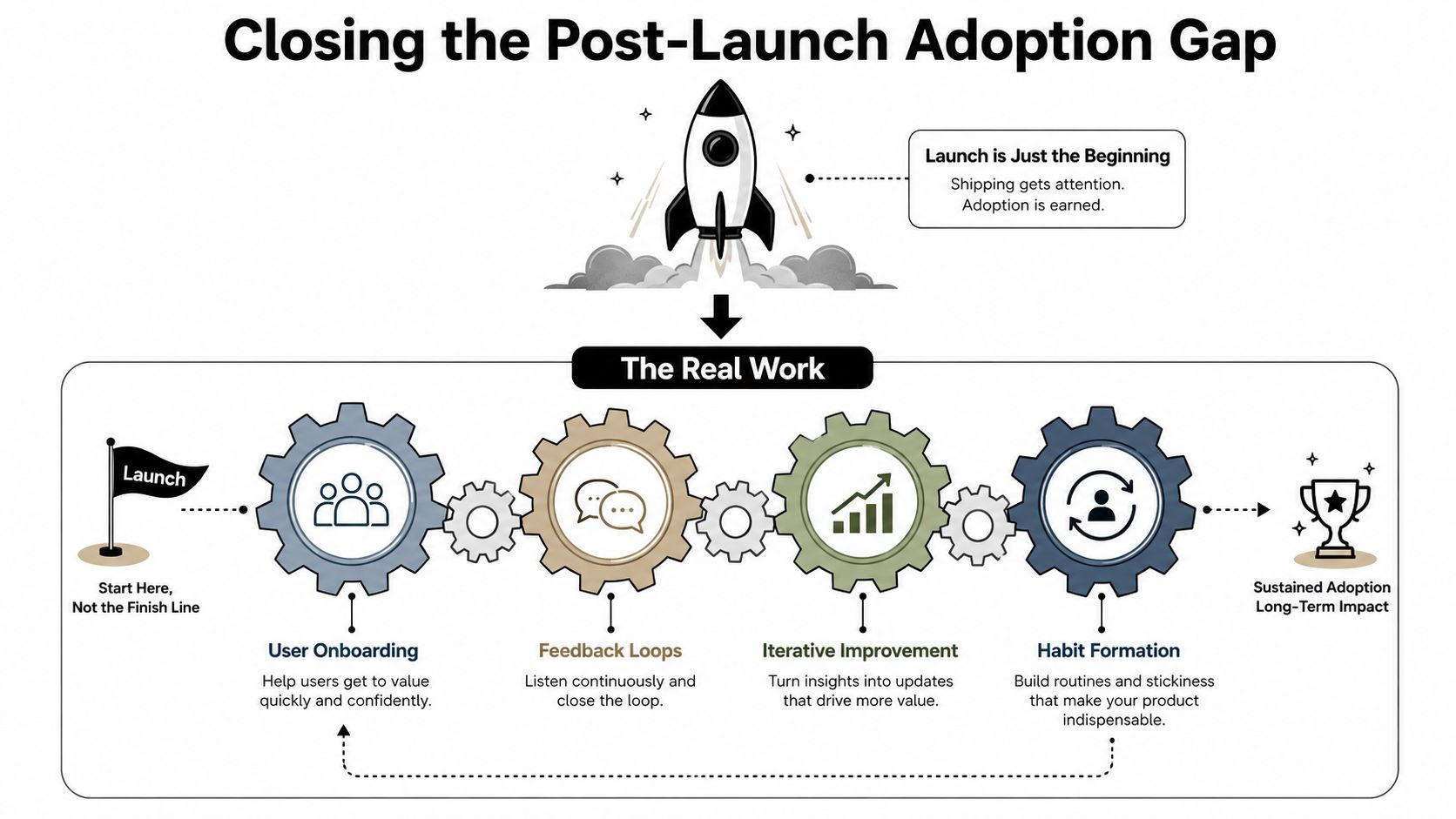
Define the user's path from first contact to habitual use. Don't stop at account creation. Identify the first action that demonstrates comprehension, the first outcome that matters, and the repeated behavior that makes the product part of the user's workflow.
For a SaaS product, that might mean connecting a data source, completing a workflow, inviting a colleague, and returning when the underlying task recurs. For a course or community, it might mean completing an initial lesson, applying the material, sharing progress, and returning for the next prompt. Each product needs its own activation definition.
Assign an owner to every stage. Marketing can own expectation setting, product can own in-app guidance, customer success can own coaching, and the founder may own high-value accounts. Shared responsibility without named ownership usually means nobody notices the drop-off until retention deteriorates.
A social post and a launch email may create initial traffic. They rarely create a durable usage habit on their own. Active adoption uses segmented outreach, contextual education, guided setup, and usage-triggered interventions.
A user who hasn't completed the core action should receive help specific to that barrier. A user who completes the workflow but doesn't return may need a reminder tied to the next relevant job. A team account with one active user may need an invitation prompt or an administrator conversation. The intervention should follow observed behavior, not a generic campaign calendar.
Adoption principle: Every important user behavior needs an owner, a prompt, and a way to learn whether the prompt worked.
Feedback loops should combine product analytics with direct observation. Review support requests, cancellation reasons, session recordings where appropriate, onboarding calls, and user interviews. Look for repeated friction rather than isolated preferences. If several users misunderstand the same step, rewrite the interface or the instruction before adding another feature.
The first post-launch period deserves a written operating cadence. Review activation friction, adoption by segment, qualitative objections, and unresolved requests. Decide which issues require product changes, which require better communication, and which indicate that the team targeted the wrong audience.
The SaaS customer retention strategies resource offers additional ideas for turning retention into an operating practice rather than a last-minute recovery effort. The strategic point is broader than SaaS: launch is a flag at the start of the adoption journey, not the finish line.
AI has shortened the path from idea to prototype, code, research summary, and content draft. It has not made those outputs worth building. The risk is a product that ships faster while its positioning, workflow, and adoption logic remain unresolved.
The cost of approving a feature now feels low because a team can produce it quickly. The cost appears later: a crowded interface, fragmented user journeys, support burden, and a roadmap driven by whatever was easiest to generate. Strategic discipline must therefore become stricter as execution speeds up.
Recent product-management research reports that more than half of organizations hesitate to expand AI adoption, while leadership escalations override over 60% of prioritization frameworks, according to this PwC study on digital product development. The implication is practical. Teams need explicit decision rights before AI multiplies the number of plausible initiatives.
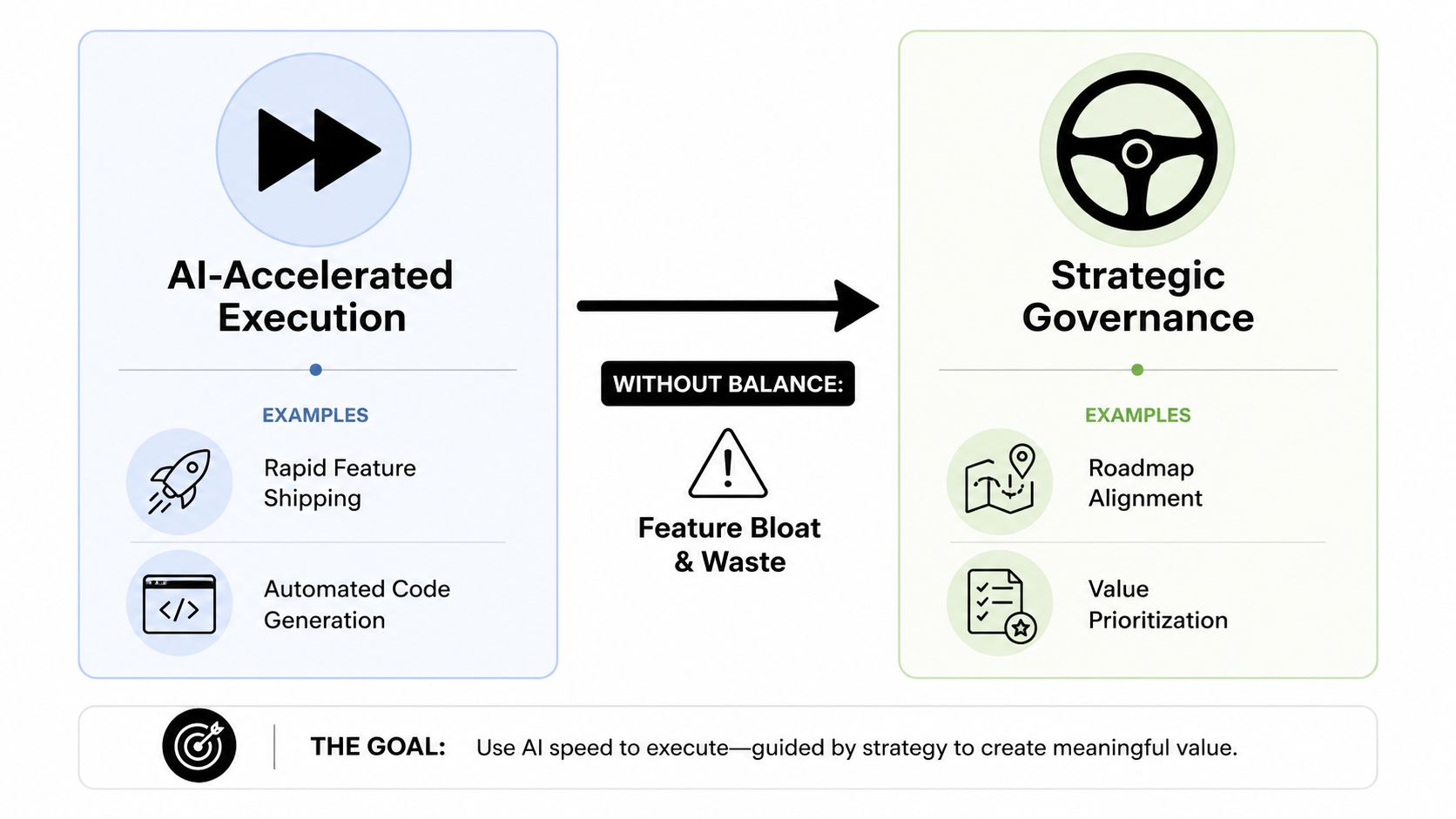
A strategic bet needs accountable ownership, planned investment, and a direct connection to product positioning and the business model. A tactical experiment should be inexpensive, reversible, and built to answer one narrow question. Treating both the same creates either unnecessary approval work or uncontrolled scope.
Keep a living strategy document that records:
AI-generated code still requires product acceptance criteria, security review, accessibility checks, and an owner who understands the intended user outcome. AI-generated feature ideas need evidence before entering the committed roadmap. Competitor monitoring can inform a decision, but customer insight should determine whether the problem matters.
Before a feature becomes a commitment, require a short review gate. Identify the customer problem, state the expected outcome, define the measurement window, name the owner, and specify what the team will stop doing to create capacity. A proposal that cannot answer these questions remains an experiment or gets rejected.
For founders building content-led products, the same discipline applies to generative engine optimization. Connect content structure and discoverability to a defined audience and business outcome. AY Rank's generative engine optimization service provides one specialized resource, but no optimization tactic should outrank clear positioning.
AI should help the team test and learn faster. Human judgment still decides what deserves to exist.
A useful strategy document should fit on a working page, remain easy to update, and force decisions that a roadmap usually hides. Treat it as a living document, not a presentation prepared once for stakeholders.
Begin with a problem-solution statement:
“For [specific audience] who struggle with [recurring problem], we provide [approach] so they can achieve [valuable outcome]. We'll know the problem matters when [observable behavior] occurs.”
Then complete the following components.
| Component | Guiding Question | Common Founder Mistake |
|---|---|---|
| Audience and problem | Who experiences the problem most urgently, and what do they do today? | Targeting everyone |
| Value proposition | What changes for the user, and why is this approach preferable? | Listing features instead of outcomes |
| Business model | Who pays, for what value, and why does the price make sense? | Treating pricing as an afterthought |
| MVP scope | What is essential to test the core promise, and what can wait? | Calling a large roadmap an MVP |
| Distribution and adoption | How will the right users discover, activate, and continue using it? | Assuming launch creates usage |
| Learning roadmap | What will the team learn after release, and what decisions will that evidence inform? | Measuring activity without decisions |
For the value proposition, connect each user pain to a product response and a measurable outcome. For the MVP, mark every proposed capability as must test, supporting, or defer. If a feature doesn't help validate the core promise or enable the first successful outcome, it probably belongs outside the initial scope.
Your distribution plan should name channels and actions, not just audiences. A founder-led SaaS product might combine targeted conversations, partner referrals, educational content, and guided onboarding. A personal-brand product might use consistent publishing, audience interviews, email sequences, and direct invitations. Legacy Builder's work includes extracting positioning, voice, and content pillars through a strategy conversation, followed by content creation and distribution, which can fit the communication side of an adoption plan.
For the first post-launch cycle, write learning milestones rather than only delivery milestones. Examples include confirming which segment activates, identifying the most common onboarding barrier, testing whether users return for the intended job, and deciding which feature requests support the strategy. Review the document quarterly, or sooner when evidence changes the audience, problem, or business model.
Founders who want additional structure can browse PM playbooks for practical product-management workflows. Use outside frameworks selectively. A template is valuable only when it improves decisions and keeps the team close to user behavior.
Legacy Builder helps founders turn their positioning, voice, and ideas into a consistent content and distribution system that supports discovery and adoption. Visit Legacy Builder to explore a strategy-led approach to building a more recognizable personal brand and sustaining audience engagement after launch.


You could – but most in-house teams struggle with the nuance of growing on specific platforms.
We partner with in-house teams all the time to help them grow on X, LI, and Email.
Consider us the special forces unit you call in to get the job done without anyone knowing (for a fraction of what you would pay).
Short answer – yes.
Long answer – yes because of our process.
We start with an in-depth interview that gives us the opportunity to learn more about you, your stories, and your vision.
We take that and craft your content then we ship it to you. You are then able to give us the final sign-off (and any adjustments to nail it 100%) before we schedule for posting.
No problem.
We have helped clients for years or for just a season.
All the content we create is yours and yours alone.
If you want to take it over or work on transitioning we will help ensure you are set up for success.
We want this to be a living breathing brand. We will give you best practices for posting and make sure you are set up to win – so post away.
Subscribe to our newsletter and get insights on how to grow your personal brand.
