.svg)
Subscribe to our newsletter and get insights on how to grow your personal brand.
Thank you! Your submission has been received!
Oops! Something went wrong while submitting the form.
.svg)


In the competitive SaaS market, acquiring new customers is an expensive victory lap, but true, sustainable growth is a marathon won through retention. If your business feels like a leaky bucket, constantly pouring resources into customer acquisition just to see subscribers slip away, you're not alone. High churn rates quietly sabotage your monthly recurring revenue (MRR), inflate customer acquisition costs (CAC), and undermine your growth trajectory. The silent churn of even a few percentage points each month compounds, creating a significant revenue gap over time.
This isn't just a matter of lost income; it's a symptom of a deeper disconnect between your product and your customers' needs. To halt this leakage, it's essential to implement a comprehensive revenue-first playbook for reducing churn rate that focuses on delivering continuous value. Ignoring retention is like trying to fill a pool with a hole in the bottom – you'll burn through resources without ever making real progress.
This article moves past generic advice to offer a prioritized, actionable guide of 10 specific SaaS customer retention strategies. We'll provide a clear framework to not only keep the customers you've worked so hard to win but also to transform them into dedicated advocates for your brand. You will learn practical steps for everything from creating a powerful first impression with personalized onboarding to executing effective win-back campaigns for customers you thought were gone for good. Each strategy is a crucial building block for creating a resilient, customer-first business poised for long-term success. Let's get started.
Effective SaaS customer retention strategies begin the moment a customer signs up. A generic, one-size-fits-all onboarding flow often leads to early disengagement and churn. Personalized onboarding, however, sets the stage for a long-term partnership by aligning your product’s capabilities with the customer's specific definition of success from day one. Instead of just showing users how to use features, this approach focuses on why they should use them to achieve their unique goals.
This strategy involves moving beyond automated product tours to create a success map for each new user. The goal is to understand their individual challenges, desired outcomes, and key performance indicators. By documenting this, you create a shared vision of success that informs every interaction, from the first login to future upsell conversations.
Key Insight: The first 30 days are critical. A customer who achieves a meaningful win in their first month is significantly more likely to see the long-term value in their subscription.
For example, a project management tool could use this method to help a new marketing team set up their first campaign-specific board, rather than just showing them the template library. By focusing on a real, immediate business need, the value becomes tangible, securing user buy-in and laying the groundwork for lasting loyalty.
After a strong onboarding, the key to retaining customers is consistently proving your product’s worth. A customer who doesn't see or understand the value they're receiving will inevitably question their subscription. Continuous value demonstration shifts the focus from feature usage to tangible outcomes, using engagement metrics and regular reporting to show customers exactly how your tool helps them achieve their goals. This proactive communication makes your service indispensable.
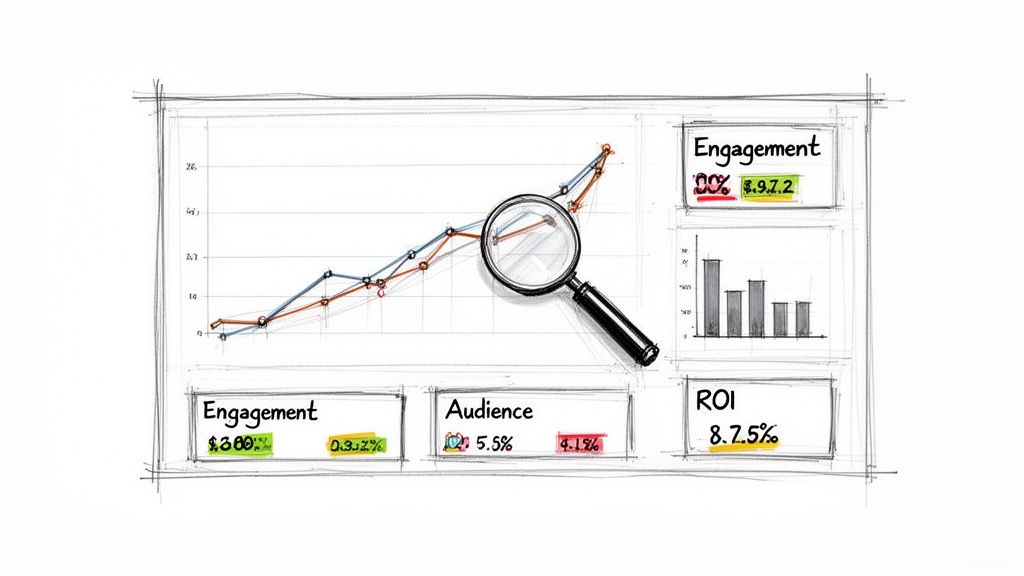
This strategy involves translating product activity into business results. Instead of hoping customers connect the dots themselves, you serve them clear, digestible reports that highlight progress. By transparently showing measurable improvements in the areas they care about, you build trust, justify the ongoing investment, and make renewal a simple decision. This approach is a cornerstone of effective SaaS customer retention strategies because it directly answers the customer's core question: "Am I getting my money's worth?"
Key Insight: Value is not inherent; it must be demonstrated. Customers who can clearly attribute business wins to your platform are far less likely to churn, even when faced with budget cuts.
For instance, a social media analytics tool like Hootsuite can send a monthly executive summary to a client. This report would not just show "posts published" but would specifically highlight a 15% increase in engagement rate and attribute it to content scheduled through the platform, directly demonstrating ROI and securing the account for another quarter.
Moving beyond reactive support is a cornerstone of effective SaaS customer retention strategies. Instead of waiting for a customer to report a problem, proactive customer success management involves initiating contact to assess their health, identify potential issues, and provide strategic guidance. This approach demonstrates that you view the relationship as a partnership, not just a transaction, and it helps prevent dissatisfaction from festering into churn.
This strategy shifts the dynamic from a simple vendor-client relationship to one of a trusted advisor. Customer Success Managers (CSMs) actively monitor usage, celebrate wins, and offer timely advice, ensuring the customer consistently extracts value from the product. Companies like Salesforce and Adobe have built their empires on this model, understanding that long-term loyalty is earned through continuous engagement and a vested interest in the customer’s success.
Key Insight: Proactive outreach can uncover "silent suffering." Many unhappy customers won't complain; they will just quietly stop using your service and churn. Regular check-ins give them an outlet to voice concerns before it's too late.
For instance, a CSM for an email marketing platform might notice a user’s open rates have declined. Instead of waiting for a complaint, they could proactively reach out with a guide on re-engagement campaigns or offer to review their recent subject lines. This type of valuable, preemptive support is critical for building relationships in business that last and solidifies your platform’s role as an indispensable tool.
While excellent support and a powerful product are fundamental, one of the most effective SaaS customer retention strategies is building a space where the value extends beyond your software. A thriving community creates a powerful moat by connecting customers with their peers to share experiences, exchange best practices, and find solutions together. The network effect becomes your retention tool; leaving your service means losing access not just to a tool, but to a valuable professional circle.
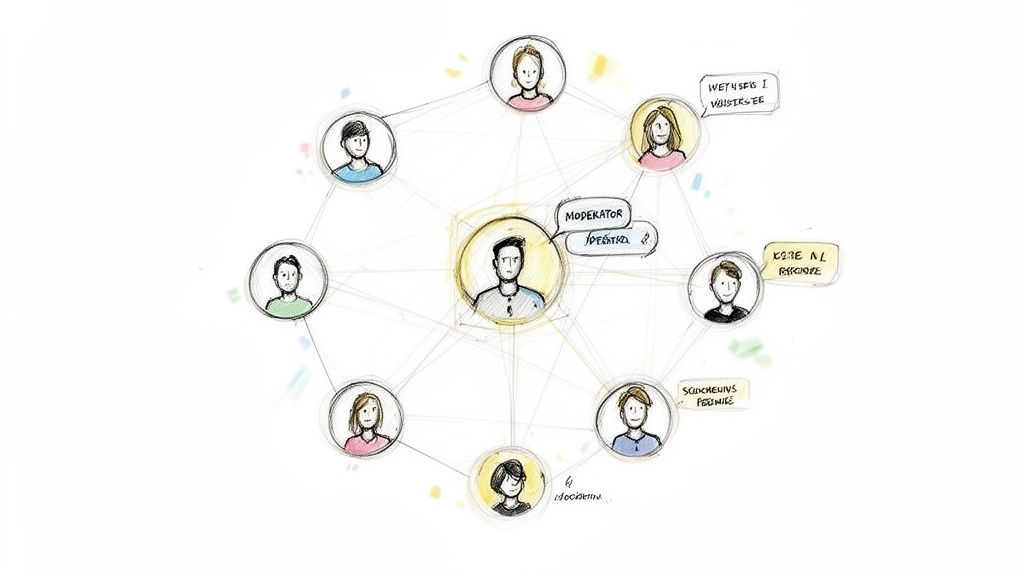
For entrepreneurs and creators, this peer engagement offers accountability, networking, and a pool of collective knowledge that directly impacts their success. Brands like HubSpot and Notion have demonstrated this by fostering user-led communities where members create and share templates, workflows, and certifications. This user-generated content deepens product engagement and makes the ecosystem, not just the software, indispensable.
Key Insight: A customer who builds a relationship with another user inside your ecosystem is far less likely to churn. Their loyalty shifts from being purely transactional (product for money) to relational (connections and shared identity).
For instance, an email marketing platform like ConvertKit fostered its Creator Network, a community where writers and creators could find accountability partners and cross-promotion opportunities. The value proposition expanded from "email software" to "a network that helps you grow your audience." This makes the subscription stickier because the community's value is directly tied to the user's business growth, a core goal that transcends feature sets.
Many SaaS products are feature-rich, but customers who only use a fraction of the available tools will eventually question their subscription’s value. Feature adoption programs are one of the most effective SaaS customer retention strategies because they systematically introduce users to new capabilities over time. Instead of overwhelming them at signup, this approach guides customers on a journey of progressive discovery, revealing deeper value and making your platform indispensable.
This strategy focuses on turning initial engagement into long-term mastery. By strategically timing the introduction of advanced features and pairing it with targeted education, you help customers grow with your product. As their needs evolve, they discover your platform has already anticipated them, which strengthens their commitment and prevents them from looking for alternative solutions.
Key Insight: A customer who continually discovers new value is a customer who stays. Progressive feature adoption transforms a simple tool into a core part of their workflow, making churn a much less attractive option.
For instance, a CRM platform might notice a sales team is only using the contact management features. It could then launch a targeted email campaign showing them how to build their first automated sales sequence, demonstrating a new layer of value that directly impacts their revenue and solidifies the CRM's position in their tech stack.
Rigid, one-size-fits-all pricing is a common source of customer friction and churn. A key SaaS customer retention strategy involves creating flexible pricing structures that grow alongside your customers. This approach acknowledges that a customer's needs will change as their business matures, and your pricing should align with the increasing value they get from your product, not penalize them for it.
Instead of locking customers into a single, static plan, value-based pricing models offer tiers and options that scale with usage, features, or team size. This allows a small startup to begin at a low-cost entry point and seamlessly upgrade as their requirements expand. Models like HubSpot’s feature-based tiers or Slack’s per-user pricing are excellent examples, as they directly tie cost to realized value and operational growth.
Key Insight: Your pricing is not just a revenue tool; it's a retention tool. When customers feel your pricing is fair and grows with them, they see you as a partner in their success, not just a vendor.
For example, a CRM platform could offer a free or low-cost tier for up to 500 contacts. As a user’s business grows past that limit, upgrading to the next tier feels like a natural consequence of their own success, making the additional cost a justified business expense rather than an arbitrary penalty.
Beyond just supporting product usage, one of the most powerful SaaS customer retention strategies is to become an indispensable advisor in your customer’s professional life. This involves creating high-value educational content-blogs, webinars, and guides-that solves problems related to their industry, not just their use of your software. By consistently delivering expert insights, you build brand loyalty and justify the subscription's value far beyond its functional features.

This approach positions your brand as a genuine thought leader and trusted partner. When customers see your company as a primary source for industry knowledge, their relationship with your brand deepens. This educational ecosystem keeps them engaged with your brand even when they aren't actively using the product, reinforcing your role as a partner in their success.
Key Insight: Customers who engage with your educational content are not just users; they are members of your community. This sense of belonging makes them less likely to churn, even if a competitor offers a lower price.
For example, a financial analytics tool could produce a monthly webinar series on "Navigating Market Volatility" or a guide to "Annual Financial Reporting Best Practices." This content serves the customer’s broader professional needs, cementing the tool's place as a critical part of their professional toolkit, not just another software subscription.
Not all churn is permanent. One of the most direct SaaS customer retention strategies involves systematically re-engaging customers who have gone inactive or canceled their subscriptions. Rather than simply writing off lost revenue, a targeted win-back campaign can reignite a relationship by addressing the original reason for churn, showcasing new value, and demonstrating that you’ve been listening. These campaigns acknowledge that needs change, products improve, and sometimes a second look is all it takes to bring a customer back.
This strategy moves beyond a generic "We miss you!" email to become a data-informed effort. It requires understanding why a customer left and tailoring a specific message that addresses their concerns or offers a compelling reason to return. A customer who left over a missing feature is very different from one who left for budgetary reasons, and your outreach must reflect that understanding.
Key Insight: Timing and relevance are everything. A win-back email that arrives a few months after cancellation with news of a highly requested feature launch is far more effective than a generic discount sent a year later.
For instance, an email marketing platform could target users who left due to a lack of advanced automation features. The win-back campaign could lead with the subject line, "Your new favorite feature is here," and detail the newly launched automation suite, offering a 30-day free trial of the premium plan to test it out. This turns a past objection into a new reason for conversion.
Customers stay with companies that listen. A key part of your SaaS customer retention strategies involves not just collecting feedback, but systematically acting on it and communicating your plans transparently. When customers see their suggestions and frustrations directly influence your product's direction, they transition from passive users to invested partners. This creates a powerful sense of ownership and trust that makes them less likely to churn.
This strategy goes beyond a simple "suggestion box." It involves creating public-facing systems where customers can submit ideas, vote on features, and see a clear roadmap of what's coming next. By making your product development process visible, you show customers you value their input and are committed to building a solution that evolves with their needs. This transparency can turn potential complaints into collaborative product improvements.
Key Insight: Transparency builds patience. When customers know a feature they need is on the roadmap, they are far more willing to wait for it rather than switching to a competitor who already has it.
For instance, project management tool Asana maintains a public roadmap that allows users to see what the team is currently working on and what's planned for the future. This visibility manages expectations and demonstrates a commitment to continuous improvement based on user needs. Even when you receive difficult comments, addressing them head-on is crucial. Understanding how to handle negative feedback can turn a dissatisfied customer into a loyal advocate.
While all customers are valuable, recognizing and rewarding your most loyal and high-value accounts is a powerful SaaS customer retention strategy. An exclusive benefits or VIP program moves beyond standard support to create a feeling of partnership and belonging. It formalizes appreciation for long-term commitment, building deep emotional connections that make customers less likely to churn. These programs increase switching costs by providing tangible rewards and create aspirational tiers that encourage other customers to deepen their engagement.
This approach is about more than just discounts; it’s about granting status and access. Programs like Airbnb's Superhost or HubSpot's tiered partner levels don't just reward usage, they celebrate expertise and advocacy. By creating a clear path to recognition, you provide a framework for customers to grow with you, turning them from simple users into dedicated brand advocates who feel seen and valued.
Key Insight: A well-structured VIP program creates a powerful psychological incentive. The desire to maintain status and access exclusive benefits can be a stronger retention driver than the product features themselves.
For instance, a marketing automation platform could offer its "Platinum Partners" a dedicated channel in their company Slack for direct access to product managers, co-branded marketing materials, and an invitation to an exclusive annual strategy summit. This elevates the relationship from a vendor-client dynamic to a true strategic partnership, making the thought of switching to a competitor far less appealing.
| Strategy | Implementation Complexity (🔄) | Resource Requirements (⚡) | Expected Outcomes (📊 ⭐) | Ideal Use Cases (💡) | Key Advantages (⭐) |
|---|---|---|---|---|---|
| Personalized Onboarding & Success Mapping | High 🔄🔄🔄 — multi-step, consultative | High ⚡⚡⚡ — trained staff & time | Faster time-to-value; higher activation 📊 ⭐⭐ | High-touch clients; new customers needing guidance | Clear expectations; tailored roadmaps; upsell signals |
| Continuous Value Demonstration & Engagement Metrics | Medium 🔄🔄 — reporting pipelines | High ⚡⚡⚡ — analytics stack & automation | Measurable ROI; data-driven retention 📊 ⭐⭐ | Renewal-focused accounts; data-driven teams | Transparency; early pattern detection; renewal leverage |
| Proactive Customer Success Management & Check-ins | High 🔄🔄🔄 — scheduled outreach & escalation | High ⚡⚡⚡ — dedicated CSMs & tooling | Reduced churn; stronger relationships 📊 ⭐⭐ | Risk-prone, high-ARPU customers | Early risk detection; relationship-driven upsells |
| Community Building & Peer Engagement | Medium 🔄🔄 — moderation and events | Medium ⚡⚡ — community managers & platforms | Network effects; advocacy growth 📊 ⭐ | Creator/entrepreneur cohorts; scalable support | Peer support; word-of-mouth; increased retention |
| Feature Adoption Programs & Progressive Expansion | Medium 🔄🔄 — staged education & triggers | Medium ⚡⚡ — content + in-app guidance | Higher feature usage; organic expansion 📊 ⭐⭐ | Complex products; growth-stage users | Prevents overwhelm; drives deeper product value |
| Flexible Pricing & Packaging with Value Escalation | Medium 🔄🔄 — pricing design & testing | Medium ⚡⚡ — billing changes & analysis | Better price-value fit; expansion revenue 📊 ⭐ | Diverse customer sizes; scaling accounts | Fairness perception; easier upgrades; acquisition aid |
| Content-Driven Education & Thought Leadership | Medium 🔄🔄 — editorial cadence & production | High ⚡⚡⚡ — content creators & promotion | Brand authority; long-term engagement 📊 ⭐ | Awareness play; retention via value content | Organic traffic; trust-building; sales enablement |
| Win-Back & Re-engagement Campaigns | Low–Medium 🔄🔄 — targeted outreach flows | Low–Medium ⚡⚡ — campaigns & incentives | Recovered revenue; churn insights 📊 ⭐ | Lapsed users; post-churn reactivation | Cost-effective recovery; learn churn reasons |
| Feedback Loops & Transparent Roadmap Planning | Medium 🔄🔄 — collection + governance | Medium ⚡⚡ — tools + stakeholder alignment | Aligned product direction; customer buy-in 📊 ⭐ | Product-led orgs; companies seeking trust | Customer advocacy; prioritized development; transparency |
| Exclusive Benefits & VIP Recognition Programs | Medium 🔄🔄 — tier design & fulfillment | Medium–High ⚡⚡⚡ — events, perks, concierge | Strong loyalty among top accounts; advocacy 📊 ⭐ | High-value customers; partner ecosystems | Emotional retention; premium monetization; advocates |
We've journeyed through a detailed map of tactics, from the first welcome email to the final win-back campaign. The core message is clear: sustainable growth in the SaaS world isn't about a constant, frantic search for new customers. It's about meticulously building a business that customers find difficult to leave because it consistently delivers undeniable value. Mastering a few potent saas customer retention strategies is the difference between a leaky bucket and a powerful, compounding revenue engine.
The ten strategies we explored, including personalized onboarding, community building, and flexible pricing, are not isolated tactics. They are interlocking pieces of a larger puzzle that forms a cohesive customer experience. Think of them as a system. Proactive customer success check-ins are more effective when supported by robust engagement metrics. Feature adoption programs gain momentum when fueled by content-driven education and transparent roadmap planning. This interconnectedness is where the real power lies. Ignoring one area, like feedback loops, can undermine your efforts in another, such as proactive success management. True retention mastery comes from creating a seamless, supportive journey, not just optimizing individual touchpoints in a vacuum.
Moving from theory to practice can feel overwhelming, but progress starts with a single step. Instead of attempting to implement all ten strategies at once, which can stretch your resources thin and dilute your focus, adopt a phased approach.
Conduct a Retention Audit: Start by identifying your biggest leak. Is it early-stage churn within the first 30 days? That points to a need for better onboarding and success mapping. Are you losing long-term customers? Perhaps it’s time to focus on exclusive benefits, community engagement, or re-evaluating your pricing. Use your churn data and customer feedback to pinpoint the most critical area for improvement.
Select One or Two Core Strategies: Based on your audit, choose one or two strategies that will have the most immediate impact. For a young startup, this might be refining the Personalized Onboarding & Success Mapping process to ensure new users reach their "aha" moment faster. For a more mature company, it could be launching a Community Building & Peer Engagement initiative to create stickiness beyond the product itself.
Define Success Metrics and Implement: For your chosen strategy, set clear, measurable goals. If you're improving onboarding, your key metric might be a 15% increase in Week 1 activation rates. If you're launching a win-back campaign, you might aim for a 5% reactivation rate of churned accounts. Implement the plan, track your progress diligently, and gather data. For a more in-depth exploration of specific tactics to implement in your business, review these 10 Actionable SaaS Customer Retention Strategies.
Ultimately, the goal of these saas customer retention strategies extends far beyond a lower churn rate. It's about building a fortress of loyalty that protects your business from market volatility, competitive pressure, and economic downturns. Loyal, successful customers become your most effective marketing channel, your most honest product advisors, and your most reliable source of recurring revenue. They transform your business from a transactional service into an indispensable partner.
This shift in mindset, from acquisition-at-all-costs to retention-first, is what separates fleeting successes from enduring market leaders. Every strategy discussed is an investment in your relationship with your customers. By making them the heroes of your story and providing them with the tools, support, and community they need to succeed, you don't just retain them; you earn their partnership for the long haul.
Ready to build a brand that retains customers through powerful storytelling and thought leadership? Legacy Builder helps founders and executives transform their expertise into content that creates deep, lasting customer relationships. Visit Legacy Builder to learn how we build content systems that drive loyalty.


You could – but most in-house teams struggle with the nuance of growing on specific platforms.
We partner with in-house teams all the time to help them grow on X, LI, and Email.
Consider us the special forces unit you call in to get the job done without anyone knowing (for a fraction of what you would pay).
Short answer – yes.
Long answer – yes because of our process.
We start with an in-depth interview that gives us the opportunity to learn more about you, your stories, and your vision.
We take that and craft your content then we ship it to you. You are then able to give us the final sign-off (and any adjustments to nail it 100%) before we schedule for posting.
No problem.
We have helped clients for years or for just a season.
All the content we create is yours and yours alone.
If you want to take it over or work on transitioning we will help ensure you are set up for success.
We want this to be a living breathing brand. We will give you best practices for posting and make sure you are set up to win – so post away.
Subscribe to our newsletter and get insights on how to grow your personal brand.
