.svg)
Subscribe to our newsletter and get insights on how to grow your personal brand.
Thank you! Your submission has been received!
Oops! Something went wrong while submitting the form.
.svg)


Most advice about digital marketing thought leadership is useless.
“Be authentic.” “Post consistently.” “Share your story.” None of that is wrong. It's just incomplete. Founders don't need more motivational content advice. They need a system that turns expertise into trust, trust into conversations, and conversations into pipeline.
If your content isn't changing how buyers see you before they ever speak to sales, it isn't thought leadership. It's activity.
Founders often treat thought leadership like a branding side quest. That's a mistake. In B2B, it now sits much closer to revenue than is commonly acknowledged.
The reason is simple. Buyers don't want another sales pitch. They want evidence that you understand their market, their risk, and their priorities before they take a meeting. That's where digital marketing thought leadership earns its place.
According to the 2025 Edelman-LinkedIn B2B Thought Leadership Impact Report, 55% of decision-makers use thought leadership to vet potential vendors, and 49% say it makes them more likely to consider a company they hadn't previously thought about via this analysis of thought leadership in B2B buying. That should end the debate.
Your content isn't there to entertain your peers. It's there to reduce buyer uncertainty.
That means the right article, founder post, podcast clip, or keynote excerpt can do work your homepage can't. It can show judgment. It can show pattern recognition. It can show that you've solved this kind of problem before, even when you aren't naming clients or giving away the entire playbook.
Buyers often read your ideas long before they reply to your outreach.
That's why I tell founders to stop asking, “Will this post get engagement?” and start asking, “Will this help the right buyer trust my thinking faster?”
A lot of founders confuse audience visibility with commercial relevance. A post can go semi-viral and bring you nothing. Another can get modest reach and lead to a qualified conversation because the right person saw it.
If you want a cleaner way to think about business impact from content, this guide to social media impact is useful because it pushes the conversation beyond surface-level activity and toward ROI.
Here's the shift. Thought leadership is no longer a nice extra for founders who like writing online. It's a filter buyers use before they trust your company with real money, strategic risk, and implementation effort.
Treat thought leadership like a business asset, not a personal hobby.
If your expertise only appears in private calls, you're hiding your best asset. Smart founders publish enough of their thinking that buyers arrive already half-convinced.
Most founders don't have a content problem. They have a positioning problem.
They say the same polished nonsense as everyone else in their category. Then they wonder why their posts feel invisible. If you want digital marketing thought leadership to work, you need an unfair advantage. That's the intersection of what you know thoroughly, what your audience urgently needs, and what your competitors can't easily copy.
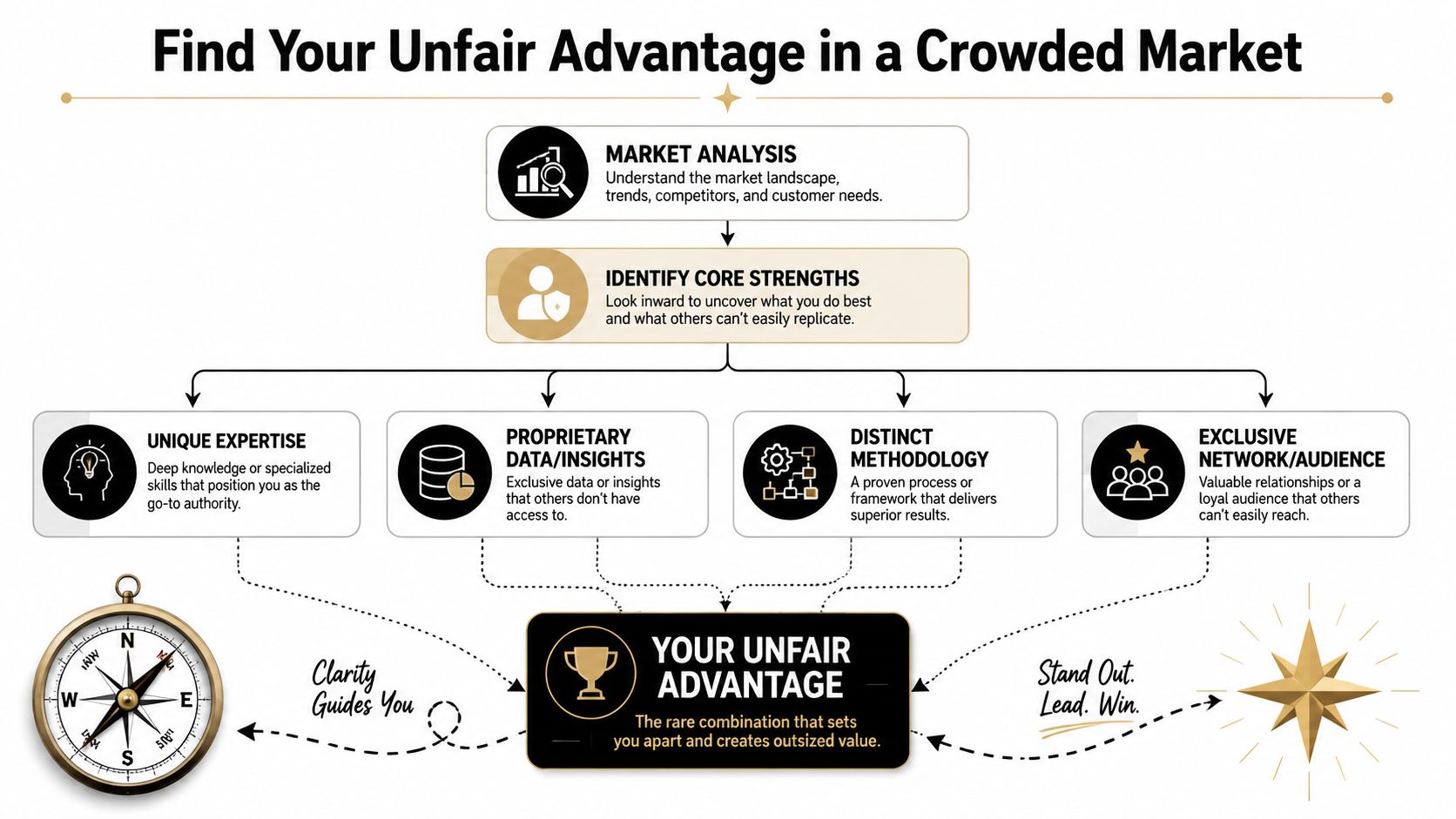
Research summarized by CMSWire shows that organizations with a clear, differentiated stance are 19% more likely to rate their thought leadership as very effective, and those who research their ideal customer are 24% more likely to report strong results in this breakdown of thought leadership effectiveness. Translation: broad positioning underperforms.
Founders usually resist specificity because they think it limits opportunity. It does the opposite. It gives buyers a reason to remember you.
Ask yourself:
A founder serving seed-stage SaaS companies has a weaker position than a founder helping technical SaaS CEOs turn product expertise into category authority on LinkedIn and email. One sounds like everyone. The other sounds useful.
Founders often overlook the strongest raw material because it feels ordinary to them.
Your advantage might be:
Practical rule: If a competitor could swap their logo onto your content and it still makes sense, you don't have a point of view yet.
If you need help pressure-testing that positioning, this resource on how to build your personal brand is useful as a complement to the sharper niche work founders need. I'd also recommend reading Legacy Builder's own guide on how to find your niche authentically and profitably, because most founders still define their niche far too broadly.
Write one sentence that finishes this phrase:
We help [specific audience] solve [specific painful problem] by using [specific belief, method, or insight others ignore].
If that sentence sounds safe, you're still hiding. Strong thought leadership starts with a clear position, not a content calendar.
Once your position is sharp, content gets easier. Not easy. Easier.
Most founders waste time because they treat every post like a new invention. That's amateur behavior. Serious thought leaders work from a small set of signature content pillars. These are the themes you want the market to associate with your name.
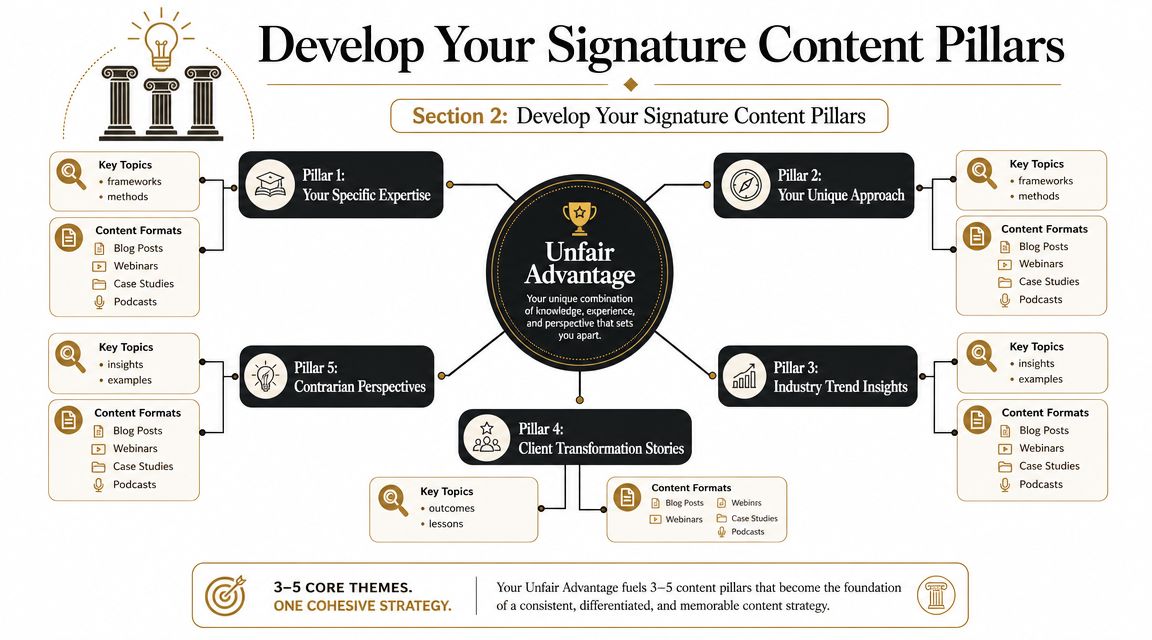
An effective workflow starts by defining a narrow audience, researching their challenges, and building a unique angle. Hinge Marketing also notes that original research significantly improves differentiation and that a single piece rarely moves the needle without sustained publication in this guide to thought leadership marketing for subject matter experts.
A content pillar is not a format. “Video” is not a pillar. “LinkedIn posts” is not a pillar.
A pillar is a repeatable idea territory where your expertise compounds.
For a founder, good pillars usually come from three places:
If you're a founder in B2B services, your pillars might look like this:
That's enough range to stay fresh without going random.
| Component | Pillar 1 Example: 'The Anti-Hustle Startup' | Your Pillar |
|---|---|---|
| Core idea | Sustainable growth beats performative grind | |
| Ideal audience | Burned-out founders building service businesses | |
| Contrarian angle | More output doesn't mean better company building | |
| Common topics | boundaries, hiring, focus, energy management | |
| Stories you can tell | founder burnout, bad growth decisions, team resets | |
| Proof source | operator experience, client patterns, internal observations | |
| Best formats | newsletter essays, short videos, podcast interviews | |
| CTA path | strategy consult, newsletter signup, speaking inquiry |
Fill out this table for three to five pillars. If you can't support a pillar with stories, proof, repeated buyer questions, and a real business offer, cut it.
Here's a useful gut check.
Strong pillars create repetition without repetition. You revisit the same core idea from different angles until the market associates that idea with you.
Place your educational material around one pillar. Put contrarian takes under another. Reserve one for proof, such as breakdowns of decisions, audits, frameworks, or before-and-after thinking shifts.
A short walkthrough can help if you're building this for the first time:
Founders get trapped by the “what should I post today?” question because they haven't done the work upstream. Once pillars are in place, that question changes to:
That's how you build authority instead of spraying opinions into the feed.
Inspiration is unreliable. Systems win.
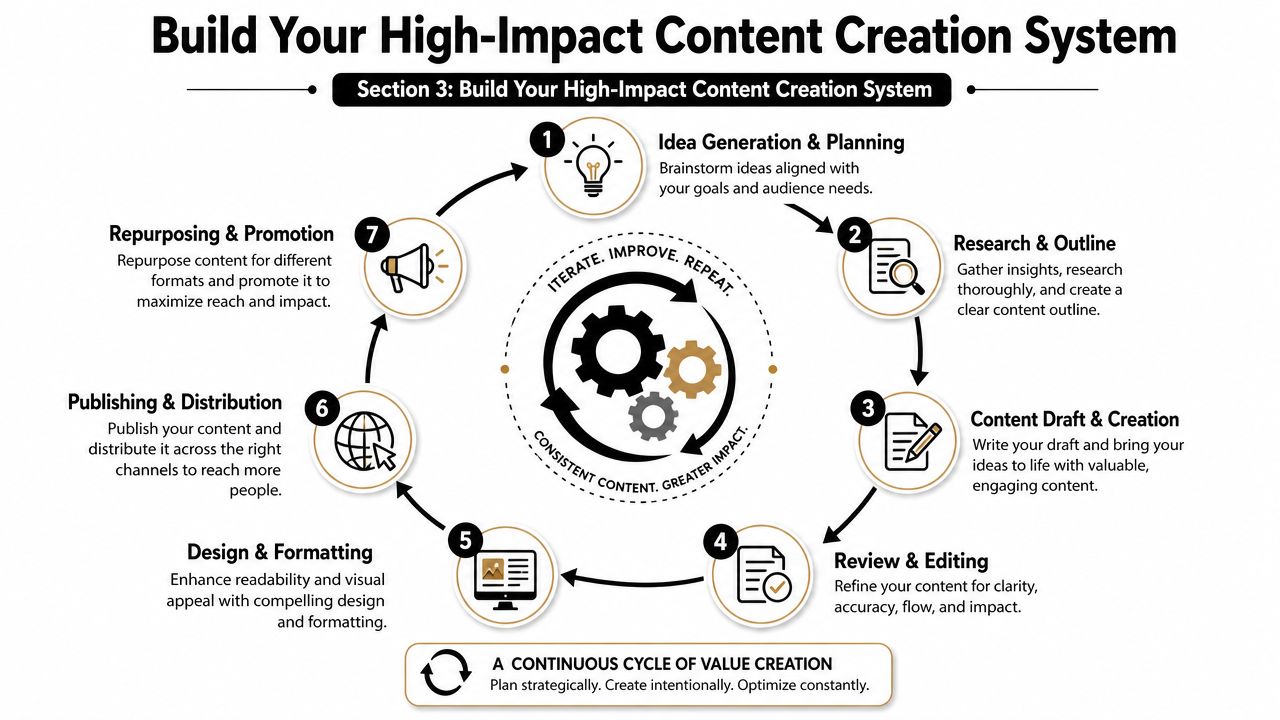
If your content depends on finding free time between meetings, launches, hiring issues, and customer fires, it won't last. That's why most founder-led content dies after a burst of enthusiasm. They don't need more ideas. They need an operating system.
The market got more crowded years ago. DSMN8 reported in 2020 that 66% of marketers already saw thought leadership as a top priority, and by 2025 industry commentary pointed to budgets expected to double over the next five years, with more focus on quality and strategic asset use in AI-saturated channels, as covered in this roundup of thought leadership statistics. That means random posting is even less defensible now.
Most founders spread themselves too thin. They try to do a newsletter, podcast, LinkedIn, YouTube, webinars, and guest articles all at once. That's how mediocre content gets made.
Choose one anchor format based on how you think best.
Your anchor format should generate raw material you can repurpose. One strong founder memo can become a LinkedIn post, carousel, short video script, email, webinar prompt, and sales enablement asset.
A content system needs named stages. Otherwise it lives in your head and collapses under pressure.
Use a simple production flow like this:
The biggest content mistake founders make is designing for an ideal week that never exists.
If you only have one focused block per week, batch your work. Record three videos in one session. Outline four posts after your sales review. Turn customer objections into a running note in Notion. Use Descript for editing, Notion for idea capture, and a simple calendar in Google Sheets or Airtable if your team doesn't need anything more complex.
If you don't want to run the machine yourself, you can delegate parts of it. A service like Legacy Builder handles founder-led content by turning stories, insights, and vision into published assets, while internal teams can still own strategy and approvals. That kind of setup works when the founder remains the source of insight.
The system doesn't need to be fancy. It needs to survive a hard month.
Consistency beats intensity because buyers don't remember one heroic burst of content. They remember the founder who keeps showing up with useful thinking.
A founder publishes a smart article on category positioning. It gets a few likes, one comment from a friend, and then disappears.
Another founder shares a tighter version of the same idea in three niche communities, mentions it in a client newsletter, discusses it on a partner webinar, and starts conversations with a handful of people already speaking to the same audience. That founder gets remembered.
The difference isn't content quality alone. It's distribution.
The niche expert doesn't try to “go viral.” She knows exactly where her buyers already spend attention. She comments on industry posts with actual insight, joins relevant conversations, and shares content only when it matches the room.
Her distribution looks like this:
That approach is slower than mass posting. It's also smarter.
The connector builds reach through relationships. He makes a list of operators, founders, journalists, podcast hosts, newsletter writers, and community leaders whose audiences overlap with his own. Then he earns attention before asking for any.
He might:
That's how distribution compounds. Not through begging for shares, but through becoming useful in other people's ecosystems.
Great content hidden in your own feed is still hidden.
A company page is rarely the engine. Founder voice, subject-matter expertise, and trusted relationships do the heavy lifting.
That's why repurposing matters. One strong idea should appear in multiple shapes across the week. A talk track from a podcast can become a short post. A blog section can become a client email. A sales objection can become a public insight. If you need a practical process for that, Legacy Builder's article on how to repurpose content and multiply your reach is worth using as a working checklist.
A lazy distribution plan sounds like this: publish, share once, move on.
A useful distribution plan sounds like this:
Founders who win with thought leadership don't just create. They circulate their thinking where trust can form.
The industry loves vanity metrics because they're easy to screenshot.
Likes feel good. Impressions look impressive. Follower growth flatters the ego. None of that tells you whether your thought leadership is creating buyer trust, stronger sales conversations, or better-fit inbound.

LinkedIn research summarized by Boral Agency found that 73% of decision-makers find a strong piece of thought leadership more trustworthy than a company's marketing materials, and 75% use it to vet organizations before engagement in this analysis of trust and pre-purchase influence. If trust is the value, your measurement should focus on signals that trust is forming before a buyer clicks “book call.”
You need a simple scorecard. Not a giant dashboard nobody updates.
Focus on signals like:
These are not vanity outcomes. They are evidence that your thinking is moving through the market.
You don't need perfect attribution. You need disciplined attribution.
Create a lightweight process:
| Signal to track | What to record |
|---|---|
| Inbound inquiry source | Which content piece they referenced |
| Discovery call notes | Whether they arrived pre-sold on your thinking |
| CRM tagging | Content-assisted opportunity or influenced conversation |
| Sales usage | Which content assets reps shared during deals |
| Partnership invites | Topic, audience fit, and resulting conversations |
Ask every serious lead one question: What did you read, watch, or hear before reaching out? Then log the answer.
If you also want to compare content contribution with search performance, tools for evaluating SEO performance ROI can help frame how organic visibility connects to business outcomes, especially when your thought leadership also supports search discovery.
A founder with a smaller audience can outperform a louder competitor if the content attracts the right buyers and shortens the trust curve.
That's why I'd rather see:
I would not trade that for a bigger pile of empty impressions.
For a more practical framework, Legacy Builder's guide on how to measure content performance for your personal brand gives founders a cleaner way to connect publishing effort to actual business movement.
Digital marketing thought leadership earns its keep when it changes buyer behavior. If your measurement can't show that, fix the measurement before you publish more content.
If you want help turning your expertise into a consistent thought leadership engine, Legacy Builder works with founders and professionals to turn their stories, insights, and market perspective into high-impact content that supports authority, reach, and real business conversations.


You could – but most in-house teams struggle with the nuance of growing on specific platforms.
We partner with in-house teams all the time to help them grow on X, LI, and Email.
Consider us the special forces unit you call in to get the job done without anyone knowing (for a fraction of what you would pay).
Short answer – yes.
Long answer – yes because of our process.
We start with an in-depth interview that gives us the opportunity to learn more about you, your stories, and your vision.
We take that and craft your content then we ship it to you. You are then able to give us the final sign-off (and any adjustments to nail it 100%) before we schedule for posting.
No problem.
We have helped clients for years or for just a season.
All the content we create is yours and yours alone.
If you want to take it over or work on transitioning we will help ensure you are set up for success.
We want this to be a living breathing brand. We will give you best practices for posting and make sure you are set up to win – so post away.
Subscribe to our newsletter and get insights on how to grow your personal brand.
