.svg)
Subscribe to our newsletter and get insights on how to grow your personal brand.
Thank you! Your submission has been received!
Oops! Something went wrong while submitting the form.
.svg)



Most cross promotion advice gets the core idea backward. It treats the tactic like a simple audience swap, when the actual value is credibility transfer, the moment one creator's trust gives another creator a better shot at being believed, clicked, and remembered. That's why a smart cross promotion strategy is less like a shoutout exchange and more like a controlled experiment with a clean scope, a measurable goal, and an exit path if the fit is off.
That shift matters for creators, consultants, and personal brands because solo growth often gets slower as the audience gets more selective. A bigger follower count doesn't fix weak distribution if the message still only reaches people who already know you. A stronger partner can open a new pocket of trust, but only if the audience overlap is real and the offer matches the next problem that audience wants solved, not just your core offer litCommerce guidance on cross-promotion workflows.
The best operators don't ask, “Who can repost me?” They ask, “Whose audience already cares about the next step my offer solves?” That question changes who you pitch, how you package the content, and how you measure success. It also keeps you from confusing reach with results, which is where a lot of creator partnerships fall apart.
Solo growth is clean, but it's slow to compound when you're building a personal brand from scratch or trying to move from attention to conversion. A well-chosen collaborator gives you borrowed context, not just borrowed visibility. That means the audience doesn't only see your name, they see your value through a trusted relationship, which is why cross promotion can outperform a random post cycle even when the raw reach looks similar.
The biggest mistake is treating partnership as exposure first. Exposure matters, but it's downstream of trust, and trust is what gets a new viewer to click, subscribe, or reply. Guidance for personal-brand businesses points to value alignment as the technical hinge, because when a partner's audience quality or brand quality is weak, reach can rise while conversion falls OptinMonster cross-promotion playbook.
That's why the question is never only “Do our audiences overlap?” It's also “Will their audience believe the introduction?” If the answer is shaky, the collaboration can inflate vanity metrics without creating durable demand. In practice, that means a smaller but more engaged partner can be worth more than a larger, colder one.
Practical rule: if the partnership can't explain why the other audience should care in one sentence, it's too fuzzy to launch.
Creators often try to solve distribution problems with more content, tighter posting schedules, or better hooks. Those are useful, but they don't change the fact that every post still starts at zero inside the same audience bubble. Cross promotion strategy expands the trust surface, which is especially helpful when the offer is service-led or tied to a next-step problem rather than a broad product pitch litCommerce guidance on adjacent audience needs.
The other advantage is speed of learning. A collaboration produces clearer feedback than another isolated post because you can see whether the partner's audience responds differently to the same idea. That's why a controlled partnership is better than a one-off shoutout. It gives you a cleaner read on what travels and what dies outside your own feed.
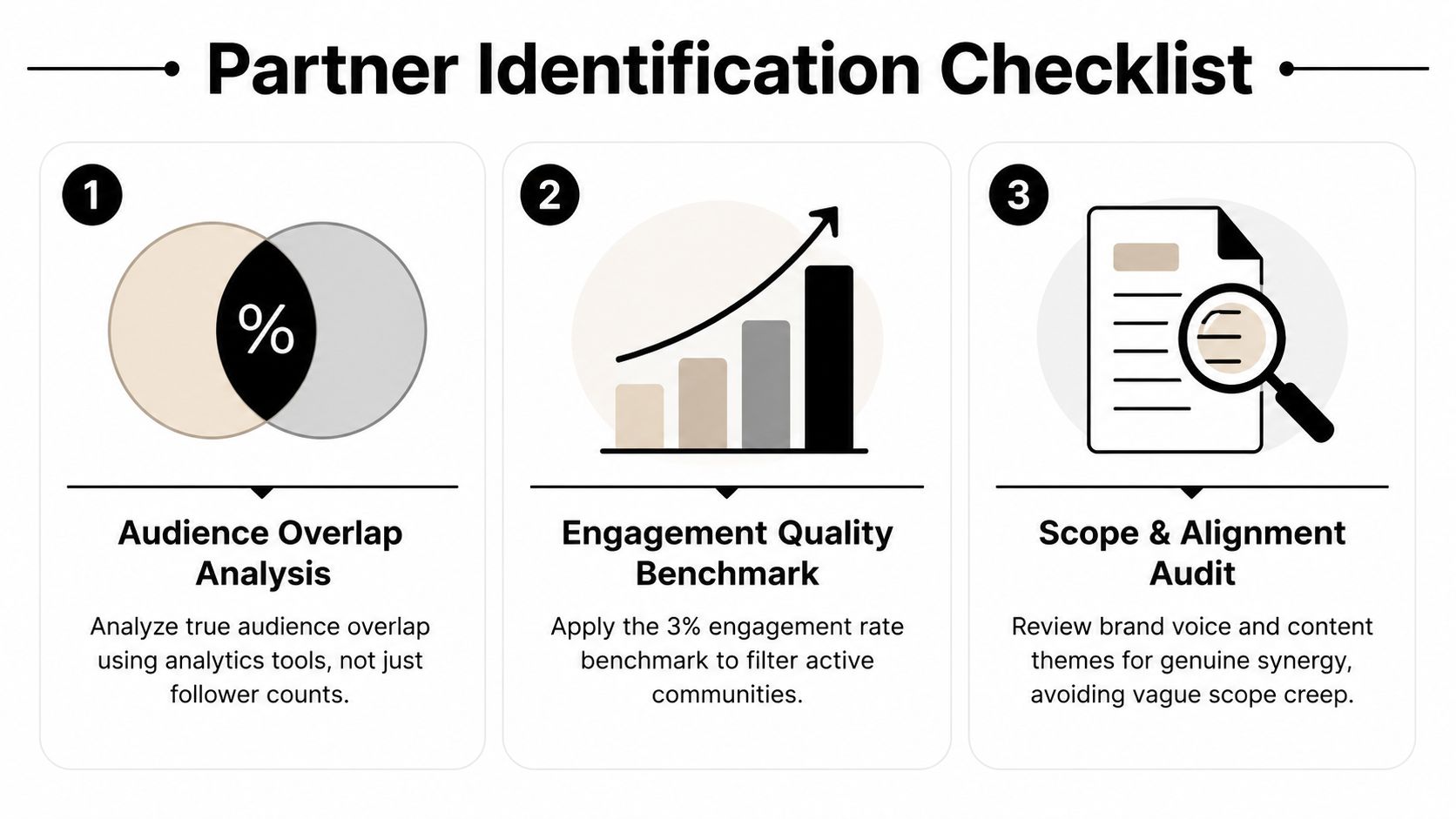
A shortlist built on follower counts will waste your time. What matters is whether the partner already speaks to people who need something adjacent to what you offer, and whether that audience is active enough to make the introduction worth the effort. A partnership with weak engagement can look large on paper and still produce little more than polite visibility. A tighter fit with stronger interaction usually creates better downstream conversion.
The strongest collaborations usually come from adjacent audience needs, not identical positioning. If your work helps people publish better content, the best partner may not be another content creator. It might be someone whose audience needs help with pre-purchase setup, post-purchase onboarding, or another step that sits next to your core offer.
That distinction changes conversion intent. When the offer solves the audience's next problem, the introduction feels useful instead of opportunistic. It also reduces mismatch, which matters for service-led brands where one bad fit can create a lot of noise and very little qualified action. For a closer look at how to separate broad reach from useful reach, use audience segmentation for personal brands.
Think in terms of a Dream 100-style list, but score people like a strategist, not a fan. Look at audience overlap, engagement quality, brand voice, review sentiment, and whether the content themes can support a real collaboration without stretching the message. A vague scope is the fastest way to ruin attribution, because if the partner, format, or KPI isn't defined up front, both sides end up guessing about what worked. LitCommerce's partner selection guidance is useful here because it keeps the decision tied to fit, not vanity.
Use a simple internal filter before outreach:
If you want to see that workflow in a partner-facing format, the checklist infographic outlining three essential steps for identifying potential business partners for cross promotion strategy gives a clean structure for the early screening stage. It works best when the goal is to separate promising names from pairs that only look compatible at a glance.
For service-led brands, the most effective pitch is often the adjacent service, not the core one. A content or brand service may convert better when paired with a pre-purchase or post-purchase problem the audience already feels. That lowers friction and keeps the collaboration grounded in a practical outcome instead of a broad brand handshake. In that same spirit, a partner like the ShortGenius AI ad creative tool at https://shortgenius.com can fit a creator audience better when the audience needs faster creative production, not a generic brand mention.
A spreadsheet becomes more than admin. The best partner sheet doesn't just list names, it ranks them by overlap, engagement, fit, and launch complexity. Once that's in place, outreach gets more specific, the collaboration ask gets cleaner, and you stop spending time on people who only look attractive on the surface.
A partner post that lands well on Instagram can fall flat on LinkedIn, and the reason usually isn't the idea. It's the packaging. The same collaboration needs different creative treatment depending on where it appears, because platform norms shape how people read the offer, how long they'll stay with it, and what kind of call to action feels natural OptinMonster platform guidance.
Instagram rewards native, visual-first assets. A story swap, reel mention, or carousel teaser tends to feel more natural there than a dense, text-heavy handoff. LinkedIn usually needs a more professional framing, which is why a co-authored carousel, founder perspective, or concise credibility-led post often works better than a casual casual-style repost LinkedIn Instagram-for-professionals guide.
The simplest rule is this, don't copy the same caption everywhere. On Instagram, lead with curiosity and a clean tap-through. On LinkedIn, lead with context, proof, and why the partnership matters to the reader's work or business.
A useful creative workflow is to build one joint asset, then remap it by channel:
Teams often make the mistake of exporting the same content everywhere, then wondering why one platform underperforms. The better move is to repurpose the idea, not the exact asset. A webinar recap can become a carousel on LinkedIn, a short clip on Instagram, and a targeted email feature, but each version needs its own opening, pacing, and CTA.
Tools help here, especially when you're moving fast. If you need to produce partner creative without starting from a blank page every time, ShortGenius AI ad creative tool is a useful reference point for turning one concept into multiple platform-ready variants. The point isn't automation for its own sake, it's keeping the message coherent while adapting the wrapper.
Cross promotion works best when the audience has time to respond, not just scroll past. That's why a scheduled drop should fit the channel's normal rhythm and the partner's approval process. If the post feels rushed, off-brand, or out of sequence with what the audience expects, the collaboration can look like a random interruption instead of a meaningful introduction.
The safest way to build a partnership is to earn the next step. Start with a mutual mention or story swap, move into a co-created asset like a webinar or newsletter feature, and only then consider deeper integrations such as referral programs or joint offers OptinMonster phased collaboration guidance. That sequence gives both sides time to see whether the audience reacts before anyone invests in a bigger commitment.
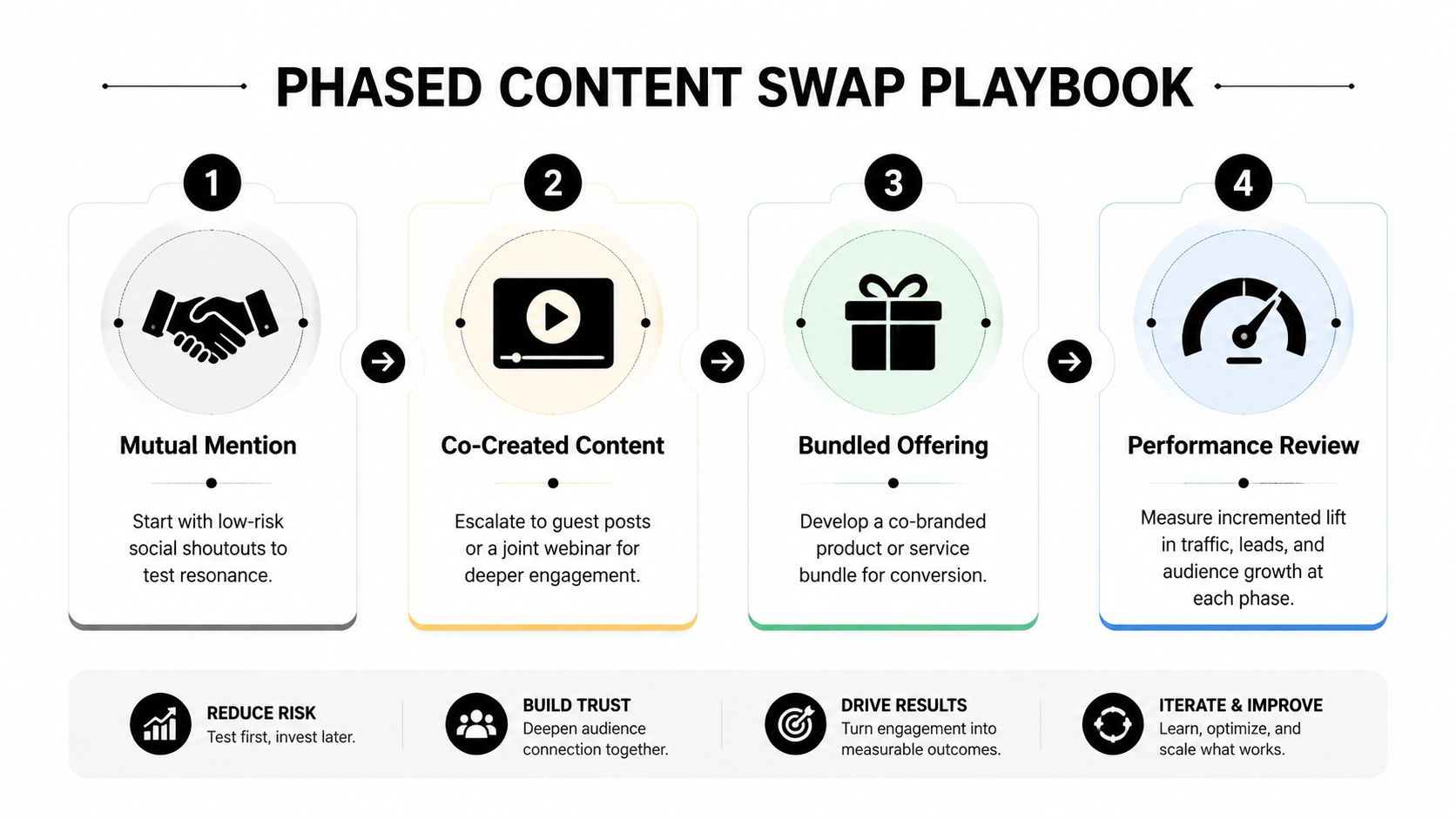
A phased playbook works because each step reduces risk. A mutual mention tells you whether the partner's audience notices. A co-created asset tells you whether they care enough to click. A bundled offer tells you whether the trust transfer is strong enough to support a transaction. That's a lot more useful than jumping straight to a joint offer and hoping the halo effect carries everything.
The same logic applies to your approvals. Set the review process before launch, not after someone spots a problem in the draft. Unclear approvals are one of the easiest ways to slow a campaign down, and they create friction that has nothing to do with audience response.
The strongest measures are downstream. Email signups, qualified clicks, and sales conversions tell you more than likes or reposts because they show whether the collaboration moved the right person to the right next step OptinMonster measurement guidance. If you're doing a small test, keep the scope narrow enough to read cleanly and make one change at a time.
What looks smaller can be smarter. A tight test with clear tracking often tells you more than a big partnership with fuzzy reporting.
A good joint newsletter can become a short clip, a carousel, or a quote-driven post if the message is strong enough. That's where a collaboration starts to act like an asset library instead of a one-time event. The point is to get one idea working in multiple formats without losing the credibility of the original exchange.
Outreach breaks down fast when the message reads like a one-sided favor. A better pitch makes the credibility transfer obvious, names the audience overlap, and shows the partner what they get in return. I write these scripts as controlled experiments, because the ask should be clear enough to measure and restrained enough to protect the relationship if the fit is off.
A strong first message is short, specific, and respectful of the other person's time. It should name the reason you reached out, point to a real audience fit, and suggest one collaboration format instead of asking them to sort through options on their own. That reduces decision fatigue and makes the reply easier to give.
A practical DM or email structure looks like this:
If your email copy tends to be blunt or gets ignored, a resource like get your business emails read and replied can help you tighten the opening and reduce wasted outreach. The goal is not cleverness, it is clarity that gets a human answer.
Cross promotion gets messy when nobody knows who owns the draft, who approves the final version, or how tracking gets attached. Write the workflow before launch. A lightweight agreement still helps both sides know what gets delivered, by when, and how success will be measured.
For the outreach side, networking email templates and tools for 2026 is a useful starting point. Use it as the operating system, then adapt the message to the partner's voice and the platform you are using.
A large-brand and small-brand mismatch needs extra scrutiny. Guidance from WiserNotify cross-promotion guide points out that when one side is much bigger, the larger partner can see weak returns, and the reputational downside can touch both sides. That is why audience-size ratio and sentiment deserve a check before you agree to anything.
Workflow clarity also protects the conversion attribution. Decide in advance who adds the UTM links, who applies the discount code, who verifies the landing page, and where the results will be logged. If those steps are vague, you end up with a nice-looking collaboration and no way to tell which part of it produced the downstream response.
Most collaborations don't fail because the content was bad. They fail because the team measured the wrong thing. Reach and follower growth can be useful context, but they don't tell you whether the campaign generated qualified interest, new subscribers, or actual revenue. The objective has to come first, then the KPI, then the attribution method LinkedIn cross-promotion measurement gap.
If the goal is list growth, track email signups. If the goal is consideration, track qualified clicks. If the goal is sales, track conversions. The cleanest attribution methods in practitioner guidance are UTM links, unique discount codes, and platform analytics, because they tie the response back to the specific collaboration instead of leaving you with guesswork LitCommerce tracking guidance.
| Cross Promotion KPIs and Attribution | ||
|---|---|---|
| Objective | KPI to Track | Attribution Method |
| Audience capture | Email signups | UTM links |
| Intent | Qualified clicks | Platform analytics |
| Revenue | Sales conversions | Unique discount codes |
That table is simple on purpose. The more complicated the dashboard gets, the easier it is to hide weak performance behind too many metrics. Start with one objective per collaboration and one primary KPI that reflects that objective.
A post can reach a lot of people and still produce little value. That's why downstream actions matter more than surface-level engagement when you're judging a cross promotion strategy. If the partner drove attention but not qualified action, the issue might be the offer, the audience fit, or the channel adaptation, not the raw visibility itself.
The best practice is to run a small test first, then optimize from KPI readouts before scaling the partnership LitCommerce workflow guidance. That approach keeps you from overcommitting to a relationship just because the first post looked good in the feed.
Every campaign should tell you something you didn't know before. Maybe one partner's audience clicks but doesn't subscribe. Maybe another one generates less reach but stronger downstream conversions. Those patterns are what help you decide whether to repeat, refine, or exit the relationship instead of pretending every partnership deserves a sequel.
A useful example is a creator who teaches content systems and a consultant who helps founders clean up their offer before launch. They don't sell the same thing, but their audiences sit next to each other. The creator opens with a mutual mention, the consultant shares a short story swap, and both sides watch for qualified clicks before moving into a co-created webinar. That's a much better test than asking both audiences to buy on day one.

The strongest takeaway is that cross promotion strategy works when it's designed as a credibility transfer, not a random exposure trade. The partner has to feel aligned, the content has to feel native to the platform, and the KPI has to reflect the outcome you care about. If any of those pieces are vague, the results will be hard to trust.
The second takeaway is that one good collaboration beats ten sloppy ones. A partner with real audience overlap, enough engagement to matter, and a clean workflow can teach you more about your market than another month of solo posting. That's the point of a measured partnership. It gives you a way to learn, not just a way to be seen.
If you're building a personal brand, treat the next partnership like a controlled test. Choose one aligned partner, define the next-step need, track the downstream action, and keep the scope tight enough to read. That's how you turn a shoutout into a growth system.
If you want help turning your own expertise into a sharper personal brand and a more disciplined collaboration plan, visit Legacy Builder. Their team focuses on authentic content, strategic distribution, and consistent brand growth, which makes them a strong fit for creators and founders who want cross promotion to support a real legacy, not just a temporary spike.


You could – but most in-house teams struggle with the nuance of growing on specific platforms.
We partner with in-house teams all the time to help them grow on X, LI, and Email.
Consider us the special forces unit you call in to get the job done without anyone knowing (for a fraction of what you would pay).
Short answer – yes.
Long answer – yes because of our process.
We start with an in-depth interview that gives us the opportunity to learn more about you, your stories, and your vision.
We take that and craft your content then we ship it to you. You are then able to give us the final sign-off (and any adjustments to nail it 100%) before we schedule for posting.
No problem.
We have helped clients for years or for just a season.
All the content we create is yours and yours alone.
If you want to take it over or work on transitioning we will help ensure you are set up for success.
We want this to be a living breathing brand. We will give you best practices for posting and make sure you are set up to win – so post away.
Subscribe to our newsletter and get insights on how to grow your personal brand.
