.svg)
Subscribe to our newsletter and get insights on how to grow your personal brand.
Thank you! Your submission has been received!
Oops! Something went wrong while submitting the form.
.svg)



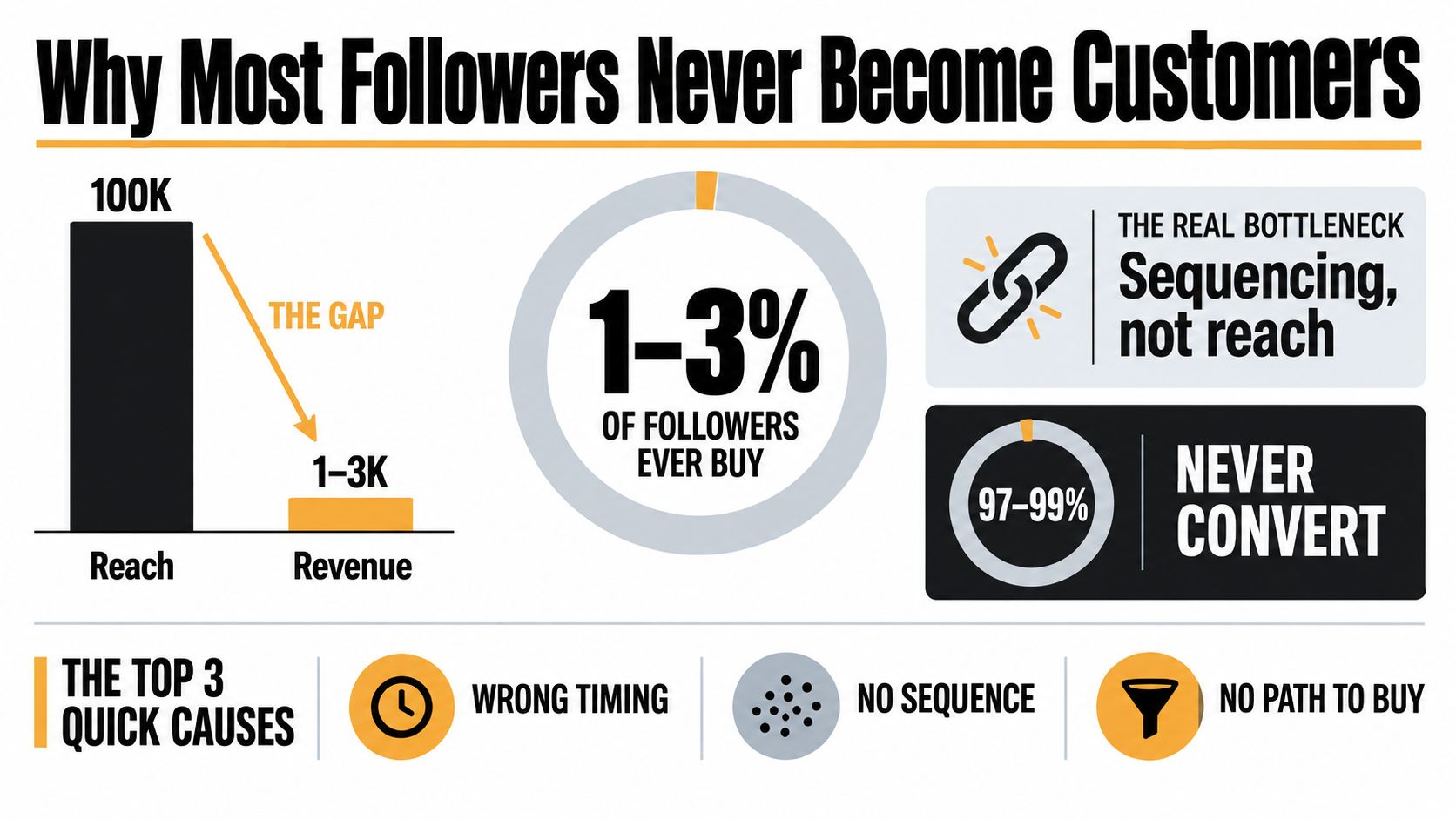
It's easy to think converting followers to customers is a traffic problem. It usually isn't. The default reality is that only about 1% to 3% of followers buy without a structured conversion system, while stronger funnel design, DM automation, and nurture can lift that range into 15% to 25% on engaged followers, according to CreatorFlow's benchmark roundup.
That should change how you think about growth. If your account isn't producing sales, the first diagnosis shouldn't be “we need more reach.” It should be “where are people losing trust, context, or momentum between seeing us and buying from us?”
I've seen the same mistake across founders, creators, consultants, and service businesses. They publish decent content, build some audience, get comments and replies, then wonder why revenue stays flat. The missing piece is usually not effort. It's the lack of a deliberate path from attention to intent to purchase.
Followers do not turn into customers because you posted often enough. They buy when your content builds credibility in the right order and gives them a clear next step.
The accounts that struggle with sales usually have the same gap. They create attention, but they do not create buying context. A follower can enjoy your content, agree with your ideas, even share your posts, and still never get close to a purchase decision.
1. The audience is larger than the market.
A lot of growth comes from broad, high-reach content. That brings in curious readers, peers, students, competitors, and casual fans. Useful for visibility. Weak for revenue. If your posts attract people who like the topic but do not have the problem, budget, or urgency to buy, follower count becomes a vanity number.
2. The offer stays fuzzy.
Founders often assume people will click around and figure it out. They will not. If a follower cannot tell what you sell, who it is for, what outcome it creates, and why your approach is different, they postpone the decision. In practice, postponed usually means lost.
3. Content and offer are disconnected.
This is one of the biggest leaks I see. The content gets attention, but it does not lead anywhere specific. A post about a problem should point to a diagnostic, a case study, a DM keyword, a call, or a low-friction offer. If every post ends at “hope that helps,” do not expect sales momentum.
4. Credibility arrives too late.
Many brands teach first and prove later. That sequencing hurts conversion. Buyers need enough evidence before they take the next step, not after. Proof can be client examples, strong pattern recognition, clear positioning, objections handled in plain language, or showing how you make decisions. Without that, even interested followers keep watching from a distance.
Revenue usually stalls because trust, relevance, and next steps are out of order.
Your job is to move people from passive agreement to purchase readiness.
That means treating conversion as a credibility and sequencing problem. Each piece of content should do one of four jobs.
Many audience-first strategies break. They optimize for reach, saves, and comments, then wonder why revenue stays flat. Revenue comes from a tighter map: problem-aware content, proof content, offer-linked content, then a simple action.
Run a hard audit on the last few weeks of posts.
If you cannot answer those quickly, the issue is not that you need more followers. The issue is that your content is not preparing people to buy.
A follower is not a lead. A lead is not a buyer. Treating all engagement as equal is one of the fastest ways to waste time.
Before you pitch, score people on fit, intent, and buying power.
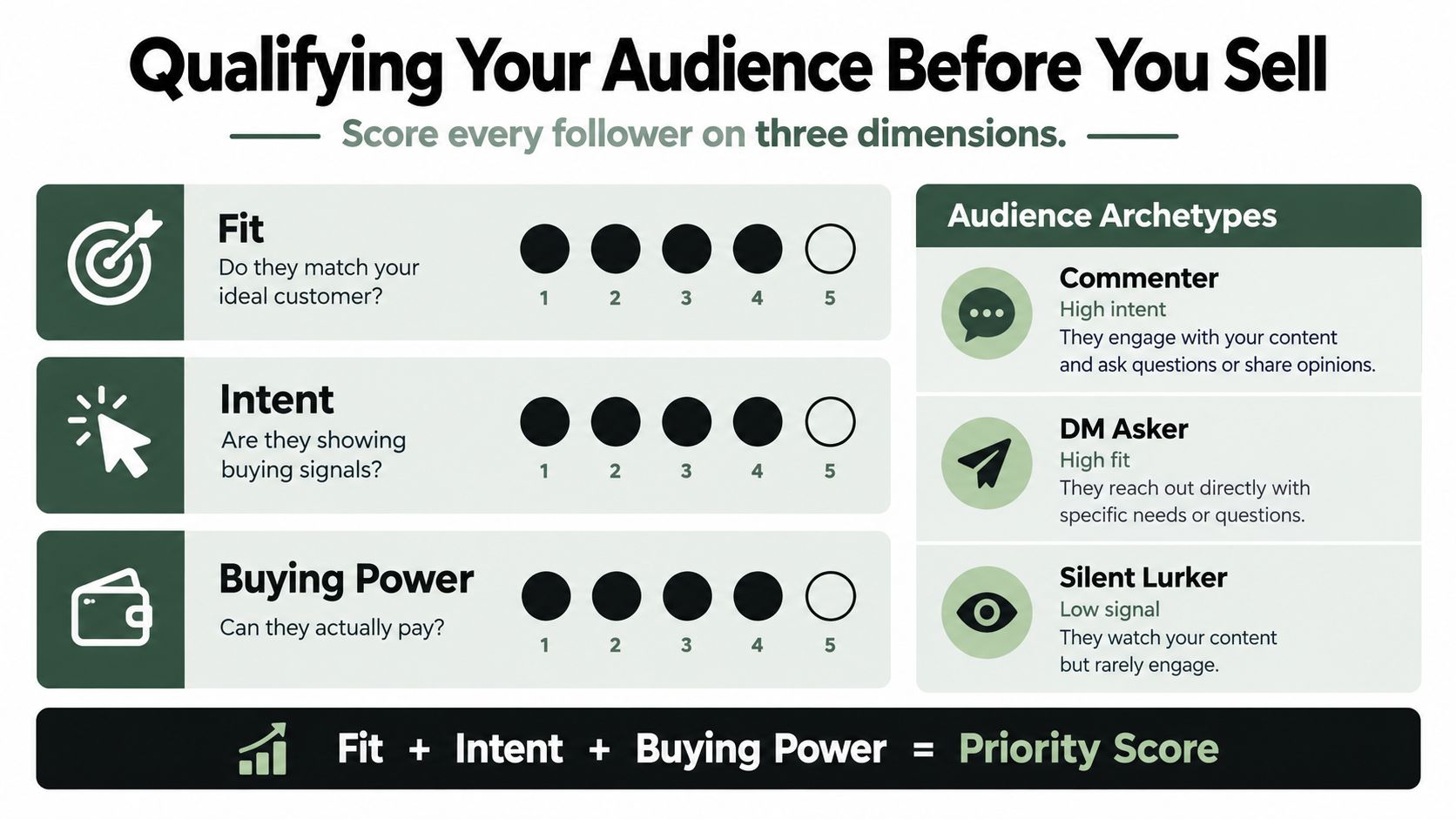
Use a 0 to 5 score for each category.
| Dimension | What it means | High score signals |
|---|---|---|
| Fit | How closely they match your ideal customer | Role, problem, market, stage, language |
| Intent | Whether they're showing buying behavior | Replies, saves, repeat comments, DM questions |
| Buying Power | Whether they can actually pay | Budget language, business maturity, authority |
This isn't theoretical. It's a practical sales filter. If someone scores high on fit but low on intent, nurture them. If they score high on intent but low on fit, don't force the sale. If they score low on buying power, route them to a lower-commitment offer or a content track.
On Instagram, pay close attention to saves, story replies, profile visits, comment quality, and DMs that include context. “How does this work for a service business?” is a stronger signal than “nice post.”
On TikTok, look at repeat commenters, viewers who move to your profile, and people who ask follow-up questions around process, timing, or use cases.
On LinkedIn, the strongest signs often come from profile alignment and comment specificity. Someone who says, “We're dealing with this right now in our sales team” is worth more than ten generic applauses.
On email, link clicks and replies matter more than opens by themselves. You're looking for signs that someone wants to go deeper, not just skim.
If you need a useful parallel from B2B sales, this breakdown of cómo cualificar leads en B2B is worth reading because the logic applies well to audience-based selling too. The principle is the same. Qualify before you chase.
Create a quarterly snapshot with three columns:
For the fit column, your buyer persona work matters. If yours is still fuzzy, tighten it before changing your funnel. This guide on creating buyer personas for founders is a useful reference point for sharpening that profile.
Practical rule: Don't qualify people by gut feel alone. Use visible behavior and actual language.
You don't need to sell to everyone. You do need to preserve goodwill.
Use a message like this when someone isn't a fit:
“Appreciate you reaching out. Based on what you shared, I don't think this offer is the right match for you right now. I'd rather be honest than push you into the wrong thing. If it helps, I can point you to the best starting resource.”
That does two jobs. It protects your positioning, and it builds trust.
A follower does not become a customer because they saw more posts. They convert when the next step feels credible, timely, and easy to take. That is a funnel problem.
I see the same mistake across founder brands, consultants, and small teams. They treat the funnel like a stack of assets instead of a sequence of commitments. A post exists. A lead magnet exists. A booking link exists. An email list exists. Revenue stays inconsistent because none of those pieces answer one practical question: what should this person do next, based on the signal they already gave you?
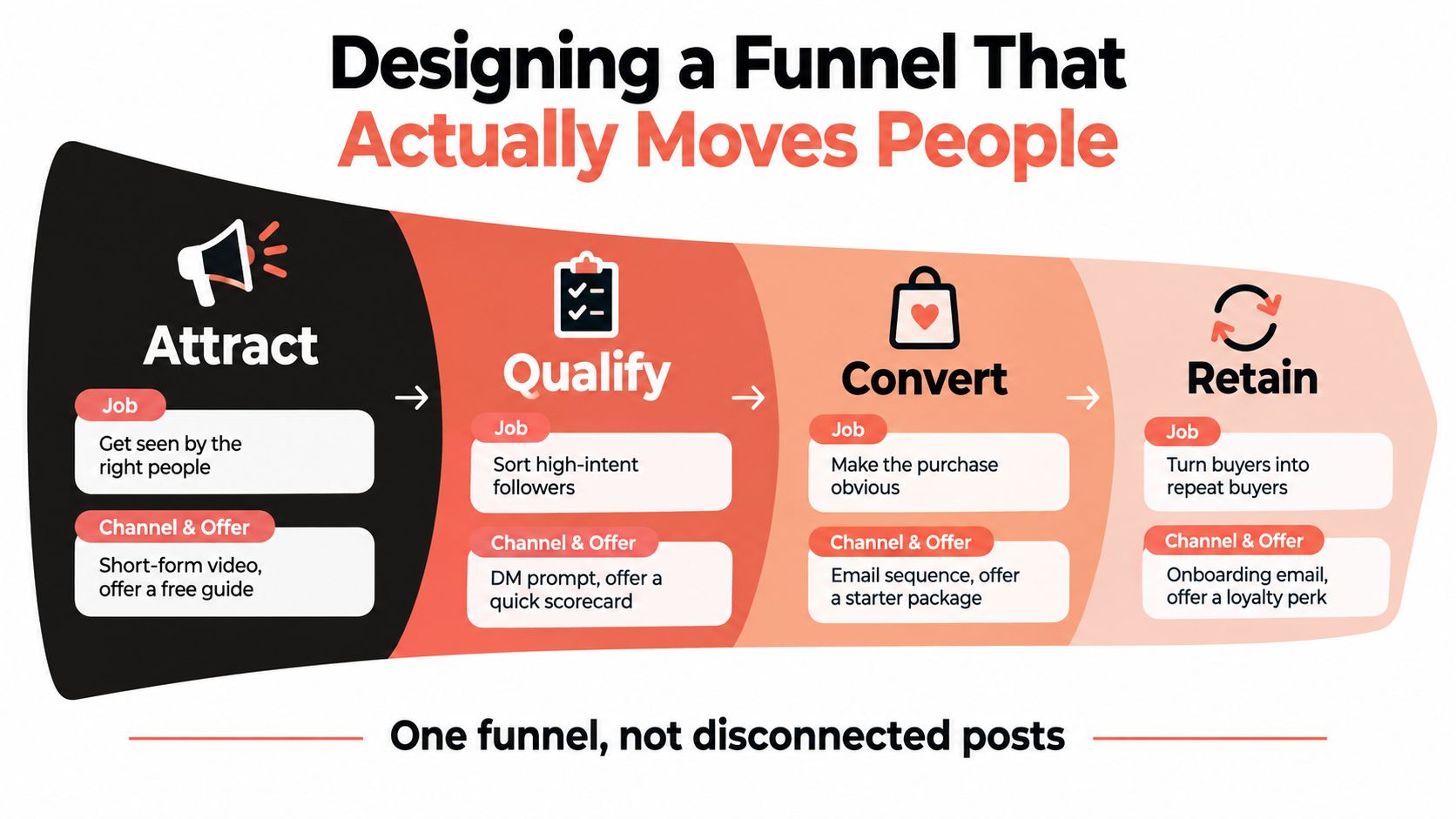
A working funnel assigns one job to each step and one step only.
Use four stages.
Attract
Publish content that earns attention from people with the problem you solve. Strong attract content usually names a costly mistake, shows a pattern your buyers recognize, or breaks down a result in plain language.
Qualify
Ask for a small action that reveals buying intent. A comment keyword, a reply to a Story, a DM response to one question, or an opt-in for a specific resource all work if the ask matches the problem.
Convert
Route people to one clear buying action. Send them to a checkout page, an application, or a booking page that matches the offer. Sending warm intent to a generic homepage kills momentum.
Retain
Follow through after the sale. Buyers need onboarding, reassurance, and a reason to keep going. Repeat purchases, referrals, and better testimonials usually come from this.
The middle of the funnel is where credibility gets won or lost. Someone who liked a post should not get the same next step as someone who replied with a detailed problem in DM. Treating both people the same is how founders end up saying their audience is “engaged” but not buying.
A clean path often looks like this:
That sequence matters because it reduces friction without forcing the sale too early.
Here's a helpful visual walkthrough of the kind of funnel logic that works in practice:
Low-ticket offers can handle a shorter path. A strong post, a direct CTA, and a clean checkout page are often enough.
Higher-ticket services need more proof and more context. In those cases, the funnel should do three things before a sales call ever happens: show the problem clearly, explain your method, and collect enough intent signal to tell serious buyers from curious followers. If you skip that work, the call becomes a qualification call disguised as a sales call.
That wastes time on both sides.
The first break point is a weak handoff from content to conversation. The post performs well, but the CTA is vague, the DM reply feels automated, or the lead magnet attracts general interest instead of buyer intent.
The second break point is poor routing. People ask for one thing and get sent somewhere else. They reply to a post about fixing low-quality leads and land on a page that talks broadly about growth. Message mismatch lowers trust fast.
The third break point is overcomplication. Too many links, too many offers, too many asks. If followers have to figure out your funnel, they leave it.
Use a simple operating rule: every asset should have one job inside the path. If a post attracts attention, let the CTA qualify. If a DM qualifies intent, route to the right offer. If a sales page converts, the onboarding should retain. That map is what turns content into revenue.
Content fails when it asks for commitment before it earns belief. A lot of founders post offers too early, then conclude their audience “doesn't convert.” Usually the audience just hasn't been walked through the right sequence.
The sequence I trust most has four content stages.
Start with proof. Not hype. Proof.
Use posts that show you understand the problem and can solve it. Good formats include a client-result breakdown, a before-and-after process shift, or a tight carousel that shows what changed and why.
A simple hook:
“Why most founders don't have a lead problem. They have a qualification problem.”
CTA:
“Reply ‘map' if you want the framework we use to sort signal from noise.”
People buy faster when they can explain your method back to themselves.
Use teardown posts, mini frameworks, annotated screenshots, or short videos that explain how your approach works. You move from “this person is smart” to “this might fit my situation.”
Example hook:
“The mistake isn't posting too little. It's posting content with no bridge to conversation.”
CTA:
“If you want the exact handoff we use from post to DM, comment HANDOFF.”
If you're refining monetization content, this article on measurable creator revenue strategies is useful because it pushes past surface-level engagement and toward commercial outcomes.
Many content calendars fall apart. They educate, but they never remove friction.
Address the actual stalls:
A strong format here is a “why my first attempt failed” post, or a candid post about when your method is not the right fit.
Buyers don't need endless persuasion. They need fewer unanswered questions.
Once the earlier stages have done their job, the direct offer feels natural.
Use one post with one offer and one CTA. Don't stack multiple products, booking options, and lead magnets in the same message. If you want people to take action, reduce decision load.
A direct post can say:
“If you want help turning your audience into a sales system, send ‘audit' and I'll point you to the right next step.”
I like a 70/20/10 mix here, drawn from practice and used as an editorial rule rather than a universal law.
A simple operating rule helps: mention the product only after at least three qualifying posts in the prior week have built context. Then the offer feels earned.
If you need help tightening those posts, this guide on how to create content that converts is a solid companion.
Repost winners in new packaging. Retire formats that get applause but never start conversations.
Most bad DMs fail in the first line. They sound automated, premature, or needy. The fix isn't writing “better sales copy.” It's starting a conversation that fits what the person already did.
There are three DM flows that work consistently when used with judgment.
Someone comments on a post with obvious interest. Good. Don't waste that signal with “check your inbox” and a naked link.
Open with this instead:
“Thanks for commenting. Quick question before I send it. Are you trying to fix this for yourself or for a team?”
That question does two things. It qualifies intent, and it gives you language to tailor the next reply.
If they answer in a way that maps cleanly to your offer, send the next step with context:
“Got it. Based on that, the fastest fit is this starter option because it solves the handoff problem first. Want the checkout link or a quick breakdown?”
That last sentence matters. It gives a choice, not a push.
These are people who have engaged before but haven't bought. Maybe they replied to stories, saved posts, or asked a light question and disappeared.
A clean reactivation opener is:
“Hey, you've engaged with a few of my posts on [topic], so I wanted to ask one thing. Are you still trying to solve that this quarter?”
That's better than “just checking in” and much better than “thought you might be interested.” If they say yes, ask one qualifying question before pitching:
“What's the main bottleneck right now. Traffic, lead quality, or conversion?”
Now you can route them appropriately. If the answer doesn't match your offer, don't force it.
When someone asks price, most founders panic and either under-explain or over-explain. Neither helps.
Use this:
“Happy to share pricing. Before I do, can I ask what outcome you're trying to get from this?”
That keeps the conversation anchored in the buyer's goal. If the fit is good, send pricing with framing:
“Based on that goal, this is usually the right entry point. Here's what it includes, who it's best for, and the next step if you want to move.”
Automation is useful for instant replies, tagging, routing, and reminders. It's harmful when it pretends to be personal and clearly isn't.
Avoid these mistakes:
A practical response rule helps keep momentum. No warm DM should sit unanswered for more than four business hours during the work week. Fast replies aren't just polite. They preserve buying intent.
Revenue usually becomes predictable before follower growth does.
I've seen accounts with modest reach close steady business because the right people trusted them and moved through a clear path. I've also seen large accounts stall for months because their content attracted spectators, not buyers. If your reporting starts with follower count, impressions, and likes, you are measuring distribution, not buying movement.
A useful dashboard stays small. It tracks credibility, intent, and progression.
Review these five metrics every week:
Qualified reach
The number of people who fit your buyer profile and saw your content.
Engaged qualified reach
The portion of that group who took a meaningful action. Saves, comments, replies, DMs, or strong clicks count. Passive views do not.
DM conversation rate
The percentage of qualified engaged people who moved into a real conversation.
Call or checkout rate from DM
The percentage of DM conversations that advanced to a buying step.
Customer acquisition cost by channel
What it costs to acquire a customer from LinkedIn, Instagram, email, partnerships, or paid distribution.
These metrics work because they match the actual conversion sequence. First, the right person sees the content. Then they show intent. Then they start a conversation. Then they take a buying action. If one stage is weak, you know where to fix the system instead of posting more and hoping volume solves it.
| Revenue-Predicting Metric | Vanity Metric It Replaces | Formula | What to look for |
|---|---|---|---|
| Qualified reach | Total reach | Viewers who match buyer profile | Consistent growth among the right audience |
| Engaged qualified reach | Total likes | Qualified people who save, reply, comment, click, or DM | Strong response by topic and format |
| DM conversation rate | Comment count | DM conversations ÷ qualified engaged people | Clear lifts from specific CTAs |
| Call or checkout rate from DM | Profile visits | Calls booked or checkouts started ÷ DM conversations | Which offer and message convert best |
| Customer acquisition cost by channel | Follower growth | Channel spend and effort ÷ customers acquired | Whether the channel fits your margins |
The trade-off is simple. Vanity metrics are easy to collect and easy to celebrate. Revenue metrics take manual tagging, a cleaner CRM, and honest review of where interest dies. The second option is the one that helps you make money.
Benchmarks help with calibration, not decision-making.
Earlier in the article, I noted typical email conversion rates around 2.8% for B2C and 2.4% for B2B. That gives you a reasonable expectation once a follower becomes an email subscriber. It does not tell you whether your content is attracting the right people in the first place, and that is where many founders misread the numbers.
For social buying behavior, analysts at Worldmetrics report that social platforms often influence both awareness and purchase activity, and that some purchase decisions happen quickly after engagement. That matters because speed affects conversion. If someone shows buying intent and your follow-up drifts for two days, the problem is not reach. The problem is sequencing and response time.
You do not need expensive software to run this well.
Use:
If LinkedIn is a major channel, these LinkedIn analytics tools can help you organize performance data without building a bloated reporting stack.
For the finance side, this guide on how to calculate marketing ROI that actually means something helps tie content activity back to profit instead of vague attribution.
One metric deserves extra attention. Save-to-DM ratio.
When a qualified person saves a post and then messages within your normal follow-up window, that pattern often predicts pipeline better than broad reach. Saves suggest private relevance. DMs confirm active intent. Track that relationship by topic, CTA, and offer.
Cut formats that create attention but no buying behavior. Keep the ones that bring the right people closer to a decision.
You don't need a quarter-long overhaul to start converting followers to customers. You need four weeks of disciplined fixes.
Pull a sample of followers and review them manually. Score each person on fit, intent, and buying power. Tag the strongest group as your focus segment.
At the end of the week, check:
This is also the point where a structured content-and-outreach service can help if execution is your bottleneck. Legacy Builder, for example, offers content strategy, profile optimization, and audience interaction systems that can support a more deliberate path from visibility to lead generation.
Audit your current content against four jobs: credibility, mechanism, objection handling, and direct offer.
Don't write more until you know what's missing. Most accounts have too much generic education and too little buyer movement. Rewrite the weakest stage first. If your audience likes your posts but never asks questions, your mechanism and objection content probably need work.
Checkpoint:
Use three entry points only. That keeps your process tight.
Keep every message short. Ask one qualifier before suggesting the offer. If someone replies with nuance, switch from automation to human response quickly.
Good DM flows don't feel clever. They feel timely and relevant.
Checkpoint:
Now track what matters. Review qualified reach, engaged qualified reach, DM conversation rate, buying-step rate, and channel cost.
Look for patterns by cohort, not just totals. Which content formats brought in the best-fit people. Which CTA produced the strongest conversations. Which offer created movement without confusing people.
Then make one operating habit a must. Every Friday, spend fifteen minutes reviewing which post moved buyers and which one only moved likes. That habit is where compounding starts.
You don't need more random activity this month. You need tighter qualification, stronger sequencing, cleaner handoffs, and a system that treats credibility as the asset that drives sales.
Legacy Builder helps founders and personal brands turn content into a real conversion system, with strategic content, audience positioning, and lead-generation workflows that connect visibility to revenue. If your audience is growing but sales feel inconsistent, visit Legacy Builder and see how they build content paths that move the right followers toward the right offer.


You could – but most in-house teams struggle with the nuance of growing on specific platforms.
We partner with in-house teams all the time to help them grow on X, LI, and Email.
Consider us the special forces unit you call in to get the job done without anyone knowing (for a fraction of what you would pay).
Short answer – yes.
Long answer – yes because of our process.
We start with an in-depth interview that gives us the opportunity to learn more about you, your stories, and your vision.
We take that and craft your content then we ship it to you. You are then able to give us the final sign-off (and any adjustments to nail it 100%) before we schedule for posting.
No problem.
We have helped clients for years or for just a season.
All the content we create is yours and yours alone.
If you want to take it over or work on transitioning we will help ensure you are set up for success.
We want this to be a living breathing brand. We will give you best practices for posting and make sure you are set up to win – so post away.
Subscribe to our newsletter and get insights on how to grow your personal brand.
