.svg)
Subscribe to our newsletter and get insights on how to grow your personal brand.
Thank you! Your submission has been received!
Oops! Something went wrong while submitting the form.
.svg)


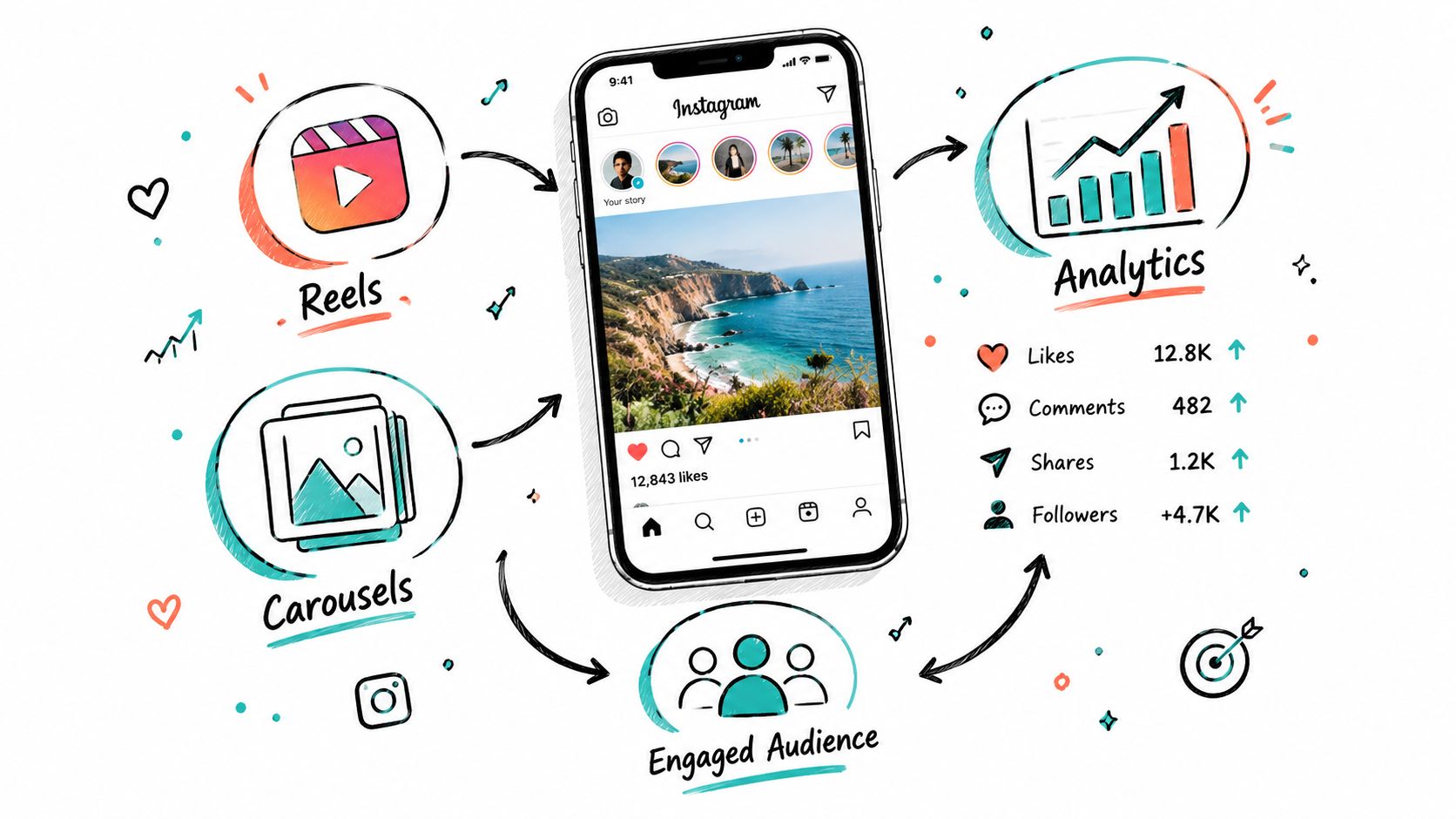
Posting more isn't a content strategy. It's a production schedule.
Instagram has matured into a crowded, globally distributed platform with more than 2 billion monthly active users, according to Buffer's Instagram statistics analysis. That scale creates opportunity, but it also makes generic publishing easy to ignore. Professionals who treat Instagram as a photo gallery usually end up measuring activity instead of business value.
The practical answer is a sharper content strategy for Instagram. Choose a defined audience, build around repeatable expertise, assign each format a job, and measure actions that can lead to trust, conversations, and revenue. Followers matter only when the people behind them understand your work and know what to do next.
Follower growth is a weak business goal. A large audience can still produce little trust, few qualified conversations, and no revenue. Build an Instagram presence that makes your expertise easier to find and easier to believe.
Instagram rewards content that earns a response. Socialinsider's Instagram benchmark report places overall organic engagement at 0.48%, reports a 24% year-over-year decline, and records 0.45% in Q2 2026 across formats. Treat those figures as a warning: attention is harder to earn, so every post needs a clear job.

A follower count makes a profile look active. It does not show why a prospect should hire you. Authority comes from repeated evidence: clear opinions, useful frameworks, relevant examples, and a point of view buyers can recognize.
Use Instagram to answer three questions quickly:
Carousels can make complex expertise easy to save and revisit. Reels can introduce your perspective to people who do not follow you. Search-friendly captions and profile language help buyers find that expertise when they are already looking for an answer. Give each format a role instead of publishing whatever is easiest to produce.
Visibility starts the relationship. Useful proof builds confidence. A clear next step turns that confidence into a profile visit, message, or sales conversation.
Business rule: If a post earns attention without strengthening your position, it is busywork.
Likes remain visible interaction. Treat them as signals, not the destination. The right content should make qualified prospects think, “This person understands my problem,” and give them a reason to keep paying attention.
Start with the buyer, not the camera.
A useful audience definition goes beyond age, location, or job title. Identify the professional pressure your audience feels, the language they use to describe it, the mistakes they fear, and the outcome they want badly enough to pay for. A founder may want more visibility, but the underlying need could be a reliable stream of qualified conversations. A CEO may want a stronger personal brand, but the commercial objective could be trust before a sales meeting.
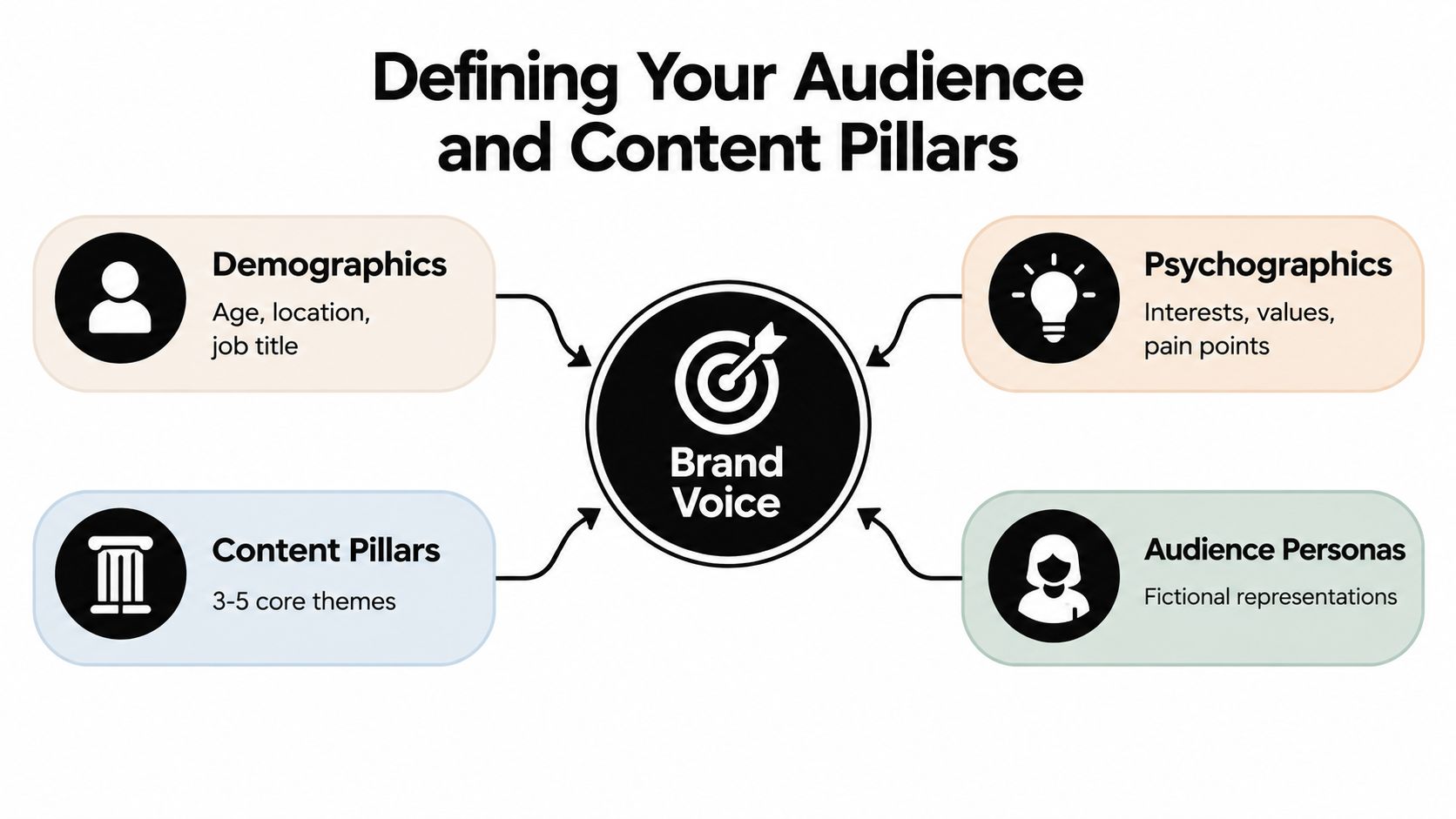
Write one primary persona in plain language. Include the work they do, the decision they're trying to make, the obstacle slowing them down, and the proof they need before taking action. Don't create five vague audiences to avoid choosing. A focused account can still attract adjacent buyers, but a scattered account rarely builds a strong association.
Then review competing accounts. Look for repeated topics, weak explanations, neglected objections, and opinions nobody is willing to state clearly. Your opportunity often sits in the gap between what everyone publishes and what buyers still need to understand.
Select three to five core themes. Each pillar should support your expertise and connect to a business outcome.
Use the pillars as filters, not cages. A post about a leadership mistake can also support authority and education. The key is that every post has a clear role rather than appearing because the calendar has an empty slot.
Instagram formats solve different business problems. Reels put a viewpoint in front of people who do not follow you. Carousels make complex expertise easy to understand, save, and revisit. Single images sharpen positioning. Stories keep an existing relationship active.
Choose the format by the job, not by fashion.
Buffer's analysis of 52 million-plus posts found that carousels earned roughly 109% more engagement per person reached than Reels, while single images slightly outperformed Reels by about 34% per person reached. Reels still matter for discovery. Reach and efficient engagement are different outcomes, so measure them separately.
| Format | Primary job | Professional application |
|---|---|---|
| Reels | Discovery | Lead with a sharp opinion, mistake, or explanation that earns attention from non-followers |
| Carousels | Depth | Break down a process, comparison, checklist, or contrarian argument |
| Single images | Positioning | Publish a concise belief, visual proof point, or memorable statement |
| Stories | Retention | Answer questions, show work in progress, and invite direct replies |
Use Instagram search as part of the format decision. Put the problem your buyer searches for in the spoken opening, on-screen text, slide headings, and caption. A useful post can keep attracting qualified attention after publication, especially when its wording matches a real question.
Do not produce Reels because they are fashionable. Use them when delivery, movement, demonstration, or a strong spoken hook improves the idea. Build carousels when the subject needs structure or deserves a saved reference.
Professionals with limited time should prioritize carousels for expertise, reserve Reels for discovery, and use Stories to turn attention into replies. The Instagram playbook for professionals provides a platform-specific reference for making that allocation practical. Your format mix should support inquiries, trust, and revenue, not a fuller content calendar.
Consistency matters because your audience needs repeated exposure to your ideas. But daily publishing isn't automatically disciplined. It can become a way to hide weak positioning behind volume.
Buffer's analysis of 2.1 million posts from 102,000 accounts identifies three to five feed posts per week as a practical cadence for sustainable growth. The same analysis found that this frequency can more than double follower growth compared with posting only one to two times per week, while increasing reach per post by about 12%. Treat that as an operating baseline, not a command to fill every slot.
Publish three to five strong feed posts, then add Stories when you have something useful to show or ask. A workable mix might include a carousel that teaches, a Reel that delivers a point of view, a proof-oriented post, and a conversation-led post. If your team can't maintain the quality, reduce the output before your audience learns to ignore you.
Captions should do more than repeat the graphic. Build them in three movements:
Question-led posts are especially useful for professional accounts. Metricool's Instagram study reports that question-led posts generated 36.70% more comments, while comment-focused calls to action drove 202.78% more comments. Use those findings to improve the quality of your prompts, not to manufacture empty discussion.
Ask, “Which part of your content process breaks first, planning or production?” That gives people a clear response path. Then reply with substance. A comment thread is valuable when it reveals objections, language, and buying context you can use in future content.
Professionals rarely suffer from a shortage of ideas. They suffer from failing to extract the full value from the ideas they already have.
Start with one substantial insight, such as a recorded presentation, client lesson, interview, or written argument. Keep the central claim intact, then change the delivery for the context. Repurposing works when you adapt the idea, not when you paste the same asset everywhere.
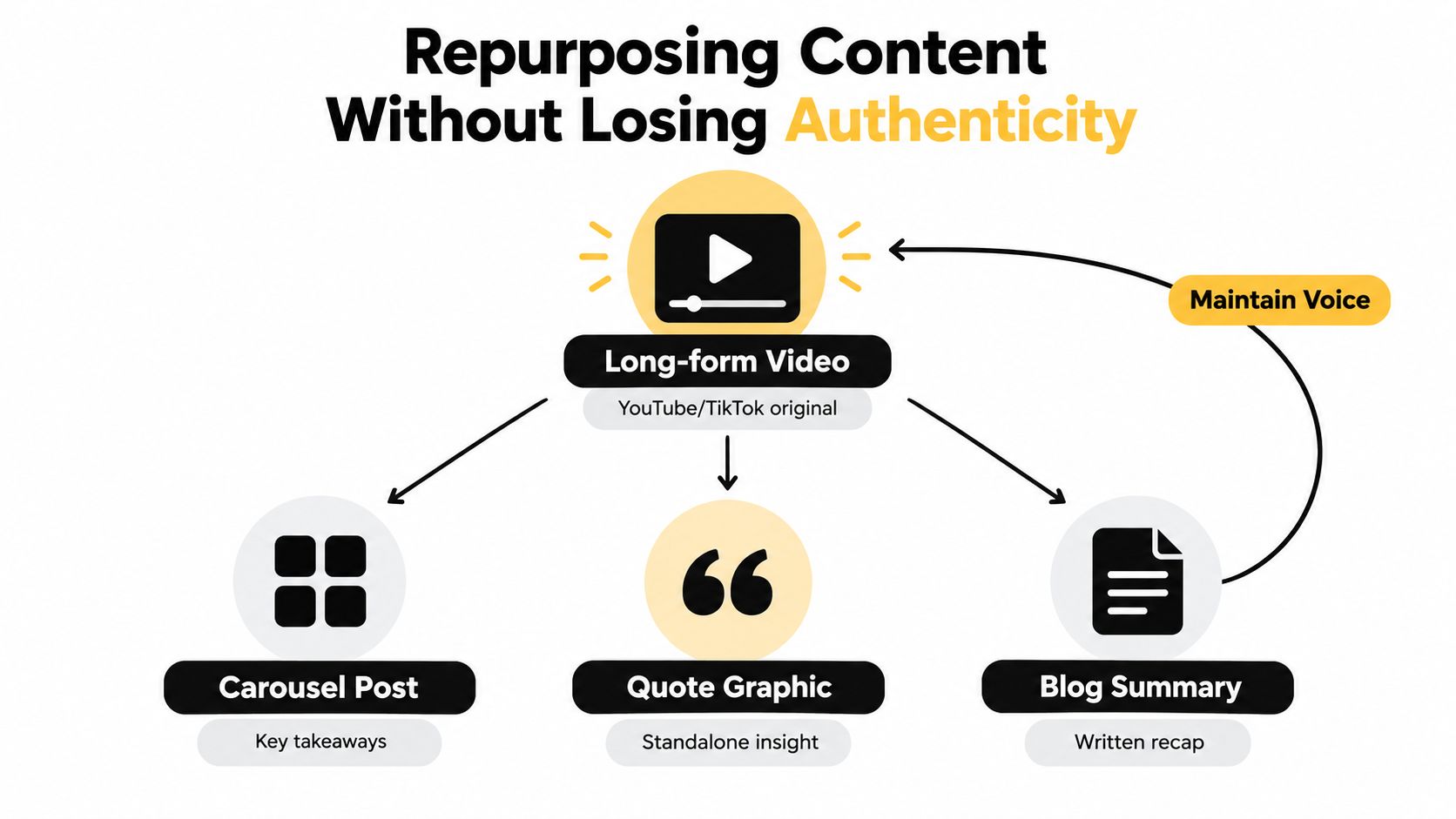
A long-form discussion about poor hiring decisions can become:
Each version should make sense without the original. Remove references such as “as I said earlier” and rewrite the opening for the format. That preserves authenticity because the source remains your actual expertise, while the packaging changes to fit how people consume the platform.
Use a repeatable review checklist. Does the post sound like you? Does it make a specific point? Does it help the audience make a decision? Does the visual support the message instead of distracting from it?
For video teams, tools that help with reframing and captions for Reels can shorten the editing process, but automation shouldn't choose your point of view. Review every clip for context, pacing, and accuracy before publishing.
A documented content repurposing framework helps turn this from an occasional tactic into an editorial system. The aim isn't to appear everywhere. It's to make one valuable idea easier for the right person to discover and remember.
Follower growth is a useful distribution indicator, but it doesn't tell you whether the audience is relevant or commercially valuable. A smaller account with strong profile visits, qualified messages, and thoughtful replies can be more useful than a larger account built on broad entertainment.
Benchmark the metric before judging the post. Hootsuite's cross-industry analysis reports an Instagram engagement-rate benchmark of 3%, with 2.7% for Reels, while Rival IQ-based reporting places the platform-wide median closer to 0.30% to 0.36%, depending on the sample and formula. Those differences show why you must record the calculation method alongside the result.
| Metric | What it tells you | What it can hide |
|---|---|---|
| Followers | Whether your audience is expanding | Relevance and buying intent |
| Reach | How widely a post traveled | Whether people understood your offer |
| Likes | Immediate approval or recognition | Passive consumption |
| Saves and shares | Practical or social usefulness | Whether the person will take action |
| Profile visits | Curiosity about the source | Whether the profile converts attention |
| Replies and messages | Active interest and objections | The quality of the conversation |
Review posts by pillar and format. If educational carousels produce saves and profile visits, make more of them. If opinion posts earn comments but attract no relevant profile activity, sharpen the connection between the opinion and your service.
For a more commercial view, use resources such as measure influencer ROI with Sup to separate audience size from measurable value. Then apply that discipline to your own account through a clear social media ROI measurement process.
Measurement rule: Don't ask which post performed best. Ask which post created the strongest next action from the audience you want.
A strategy becomes useful when it changes what you publish this week. Give yourself a defined setup period, then use the following months to remove weak formats, strengthen proven pillars, and connect attention to business outcomes.
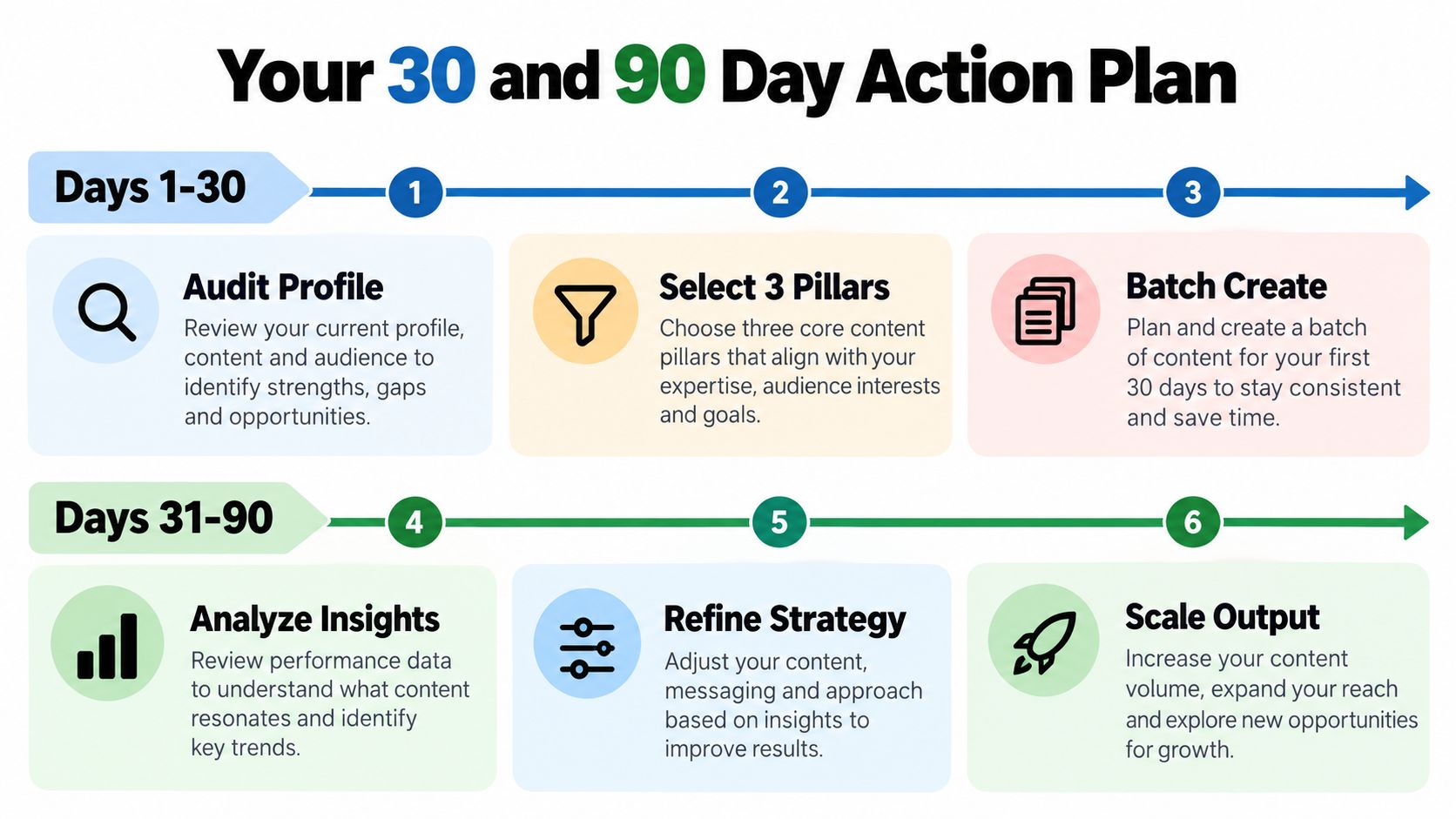
Days 1 to 5, audit the profile. Rewrite the bio so it states who you help, what problem you solve, and what action visitors should take. Review the profile image, link destination, pinned content, and recent posts. Remove confusion before you increase publishing.
Days 6 to 10, define the audience. Write the primary persona, the business problem they face, the language they use, and the proof they need. Review relevant accounts and record unanswered questions rather than copying their visual style.
Days 11 to 15, select three to five pillars. Give each pillar a commercial role. One should demonstrate expertise, one should teach, one should show judgment, and one can create conversation or invite the next step.
Days 16 to 22, batch the first content set. Draft feed posts around the pillars, with carousels carrying the most structured ideas. Record Reels only when motion or delivery adds value. Prepare Stories that ask real questions instead of filling space.
Days 23 to 30, publish and respond. Follow a three-to-five-post weekly baseline, monitor the quality of replies, and answer comments with useful detail. Track reach, saves, shares, profile visits, and messages by post.
Review the first month without protecting your favorite ideas. Identify which pillar and format create the strongest combination of attention and meaningful action. Keep the winners, revise the weak hooks, and stop publishing content that produces activity without positioning.
In the next phase, test one variable at a time. Change the opening of a Reel, the order of a carousel, the question in a caption, or the call to action. Don't change everything at once, or you won't know what improved the result.
Use the final weeks to build a reliable operating rhythm. Create a bank of audience questions, turn recurring objections into carousels, and route high-intent conversations to an appropriate next step. A practical guide to measure content ROI effectively can help you connect publishing data to broader marketing decisions.
Use the following video as a planning prompt while you build the system:
The objective after 90 days isn't a prettier feed. It's a clearer market position, a repeatable production process, stronger conversations, and evidence about which content supports the business.
Legacy Builder turns your expertise, stories, and point of view into a structured Instagram content system, including planning, writing, design, publishing, and audience interaction. If you want your brand to earn trust instead of collecting empty activity, visit Legacy Builder and start the conversation.


You could – but most in-house teams struggle with the nuance of growing on specific platforms.
We partner with in-house teams all the time to help them grow on X, LI, and Email.
Consider us the special forces unit you call in to get the job done without anyone knowing (for a fraction of what you would pay).
Short answer – yes.
Long answer – yes because of our process.
We start with an in-depth interview that gives us the opportunity to learn more about you, your stories, and your vision.
We take that and craft your content then we ship it to you. You are then able to give us the final sign-off (and any adjustments to nail it 100%) before we schedule for posting.
No problem.
We have helped clients for years or for just a season.
All the content we create is yours and yours alone.
If you want to take it over or work on transitioning we will help ensure you are set up for success.
We want this to be a living breathing brand. We will give you best practices for posting and make sure you are set up to win – so post away.
Subscribe to our newsletter and get insights on how to grow your personal brand.
