.svg)
Subscribe to our newsletter and get insights on how to grow your personal brand.
Thank you! Your submission has been received!
Oops! Something went wrong while submitting the form.
.svg)



You publish consistently, but the business still can't explain which content creates demand. Your founder posts earn thoughtful comments, your articles answer real questions, and your team keeps adding ideas to the calendar. Yet sales rarely knows what to share, marketing can't connect activity to pipeline, and every new month starts with the same question: what should we publish next?
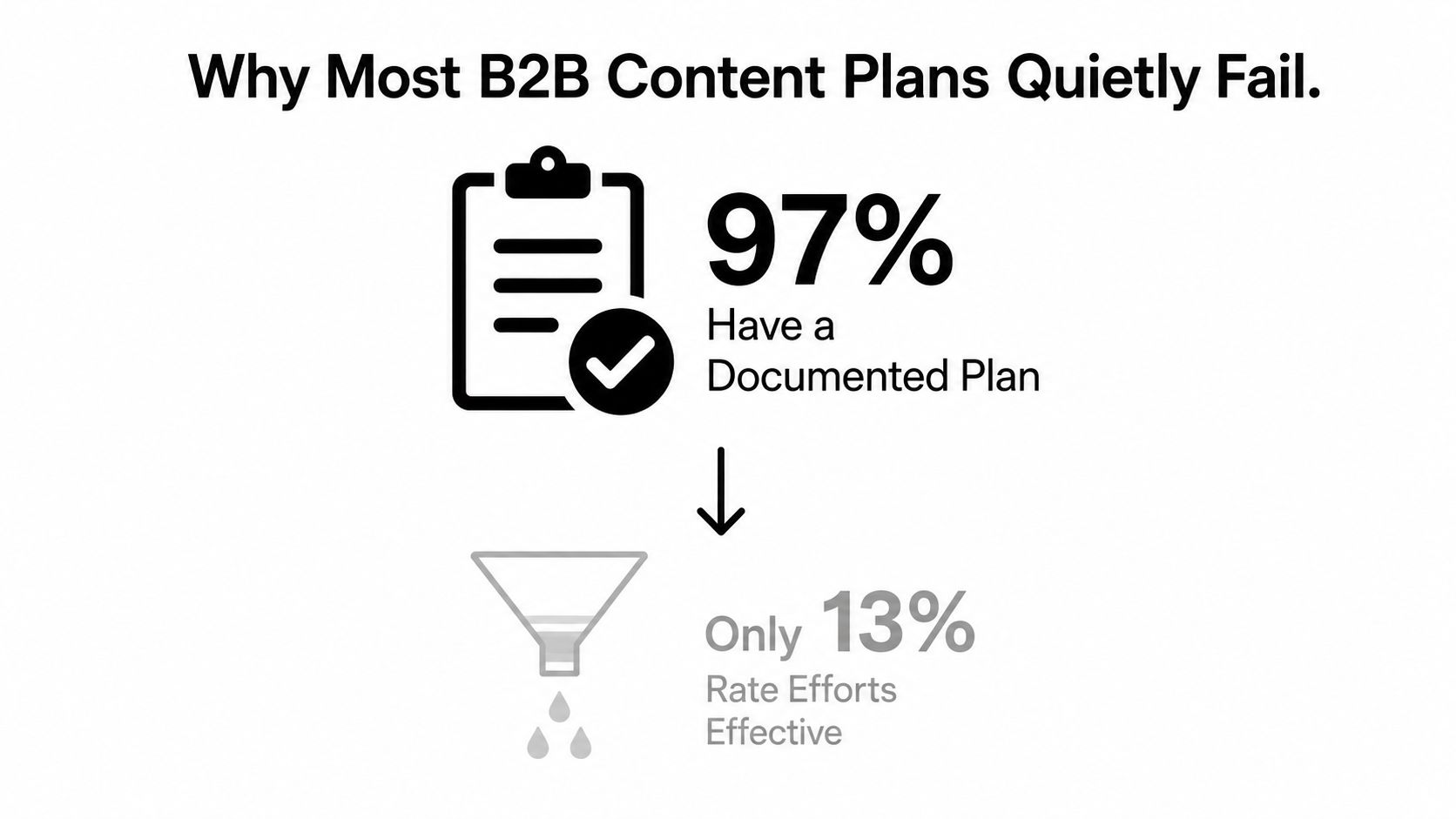
That's the operating failure behind modern B2B content. Recent benchmarking shows that 97% of marketers say they have a content strategy, but only 13% report that it significantly improved results and ROI. The gap isn't a shortage of ideas. It's a missing system that turns expertise into buyer preference, usable proof, and measurable commercial action. (Content Marketing Institute's B2B research)
A B2B team can publish every week and still leave sales without a usable point of view. The calendar may be full, yet no one can explain which buyer belief each asset should change, which commercial decision it supports, or how the founder's expertise becomes memorable.
The 97% versus 13% gap exposes the operating problem. Having a plan is common; turning that plan into results is not. B2B organizations allocate an average of 26% of total marketing budgets to content marketing, while the most successful teams allocate 40%, compared with 14% among the least successful teams, according to Content Marketing Institute benchmarking. Spending more does not create the system required to turn expertise into demand.
A founder-led content strategy should operate like an operating system for a personal brand. It captures the founder's knowledge, converts it into a consistent market position, sends it through channels buyers already use, and feeds performance data into the next decision. The publishing calendar is only the interface.
Operating rule: Don't ask what you should post next. Ask what your buyer needs to believe before a sales conversation becomes productive.
The framework has seven stages: audience, positioning, pillars, calendar, distribution, operations, and measurement. Each stage removes a specific source of waste and closes part of the gap between having a plan and seeing results. Follow the sequence, and you finish with a 30-day launch checklist instead of disconnected topics.
Your first content deliverable shouldn't be a blog post. It should be a usable Ideal Buyer Profile, written tightly enough that a founder, writer, or freelance editor can make the same judgment about relevance.
The reason is simple. Buyers complete about 60% of their journey through independent research before engaging a vendor, according to buyer-behavior research summarized by Directive Consulting. Your content competes for attention and shortlist position before sales has an opportunity to clarify the problem.
Start with the economic buyer's job title, not a broad department label. A VP of Revenue, a founder, and a demand generation manager may care about the same problem but evaluate risk differently.
Then document:
Use a one-page brief with sections for buyer, trigger, stakes, current workaround, desired outcome, objections, trusted sources, and next action. A practical customer-journey resource on how to map content to the customer journey can help you connect each buyer question to the right asset instead of forcing every visitor toward a demo.
You don't need a massive research project. Run eight five-minute customer interviews, review sales call notes, and collect recurring questions from your sales enablement platform. Ask what happened immediately before the buyer searched for help, what alternatives they considered, and what evidence they needed to feel safe moving forward.
Keep the brief beside every content request. Founders can also use this buyer persona guide for founders to turn scattered customer observations into a more consistent audience definition.
A tagline describes your business. A category point of view tells buyers how to interpret the problem.
Founders already have raw material for a strong POV. They've made tradeoffs, watched customers fail with common approaches, and learned which advice survives contact with reality. The mistake is leaving those lessons as anecdotes instead of turning them into a defensible market position.
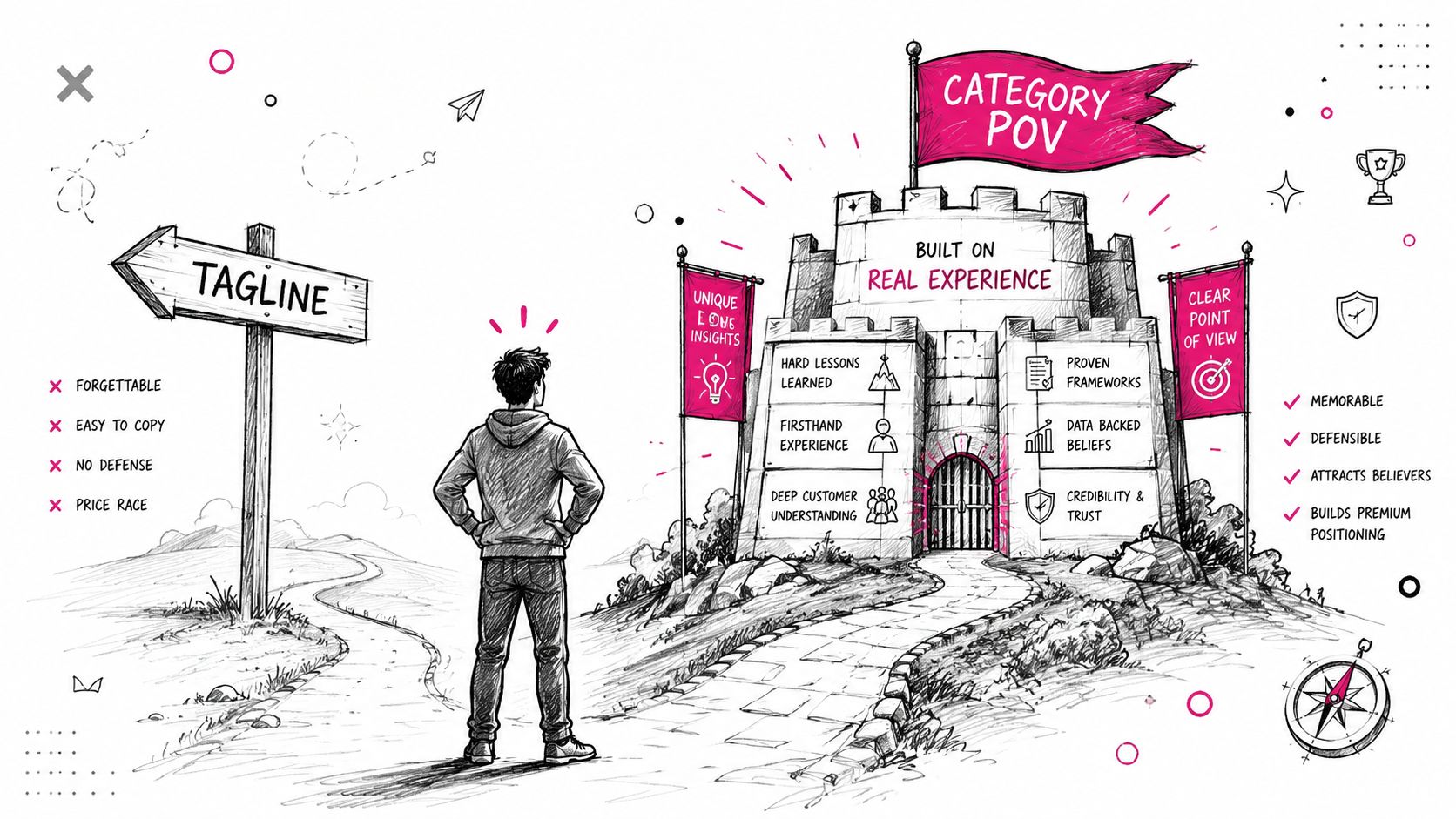
Use this sequence:
A RevOps founder might argue that revenue leakage is usually an operating-design problem, not a dashboard problem. Their proof could come from repeated failures caused by disconnected lifecycle definitions, inconsistent handoffs, and reports that hide ownership. That POV can guide content without turning every post into a product pitch.
Use exactly three pillars:
Don't define pillars as “blogs, videos, and carousels.” Those are formats. Pillars should represent buyer intent and the belief your content reinforces. For additional context on structuring content pillars for SEO and social, focus on the relationship between a core idea and its distribution, not on a list of formats.
Your content pillars guide to authority growth can serve as a working reference while you turn the POV into repeatable editorial decisions.
A useful calendar is a production system, not a list of publication dates. It starts with commercial questions and creates enough structure that one strong idea can travel across channels without being diluted.
Choose 12 cornerstone ideas, with one tied to each week. Every idea should connect to a buyer problem, a category belief, or a commercial outcome. Avoid topics that merely sound relevant. If the founder can't explain what the reader should believe or do differently afterward, the idea isn't ready.
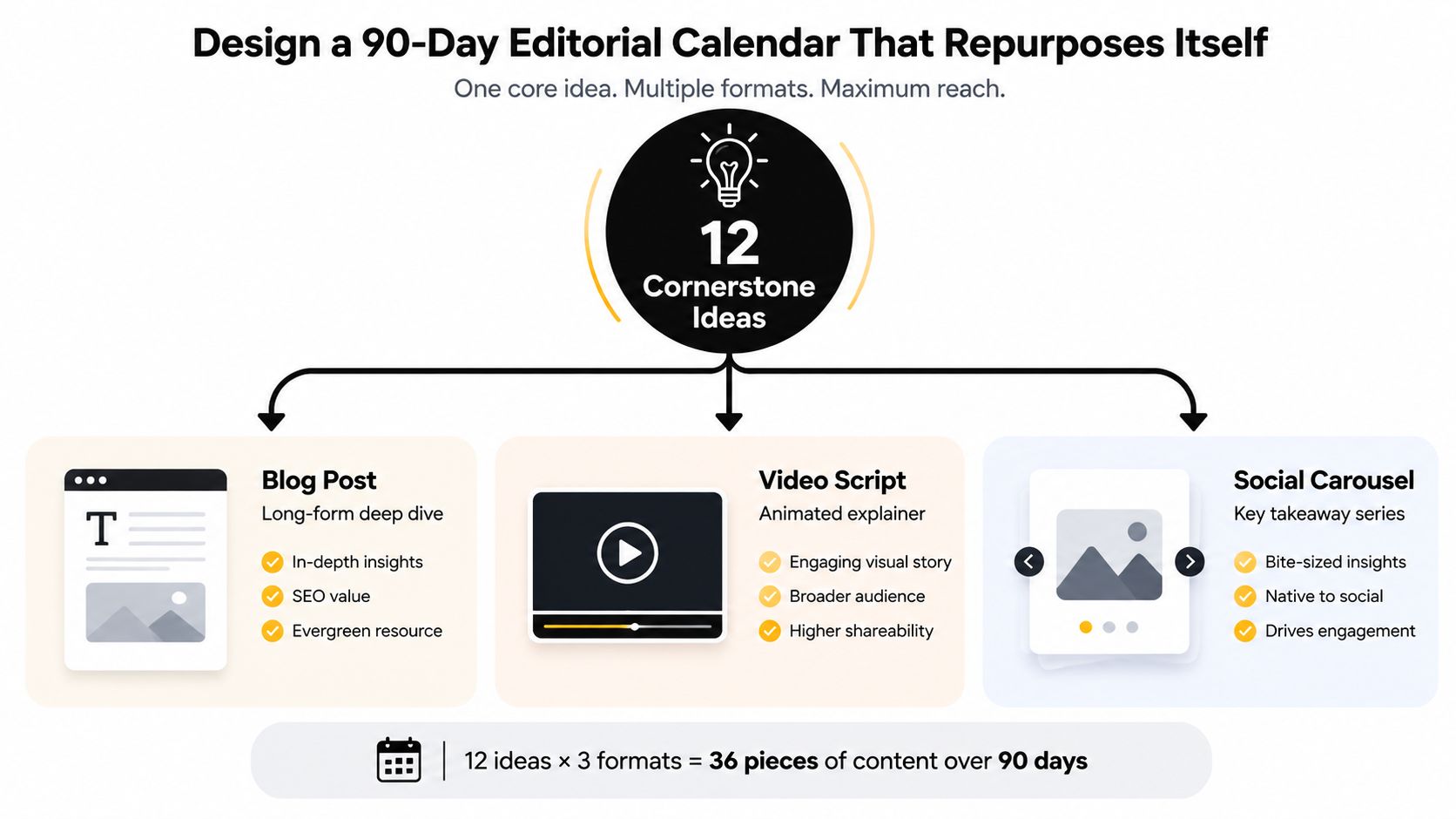
Group the ideas into 30-day campaigns. Assign each campaign a single job:
Then create a one-to-many sequence. One long-form article can become a founder post, short video, carousel, newsletter, podcast discussion, webinar outline, and sales conversation starter. Each derivative asset needs a distinct role, not a shortened copy of the original.
A reusable brief should include the target reader, desired action, core claim, proof, CTA, source material, owner, and due date. Batch research, drafting, recording, editing, and scheduling in weekly blocks. Reserve roughly 20% of capacity for timely responses, customer questions, and sales follow-up, as recommended in the operating approach for a small team.
Practical rule: Track the cost of producing an original and the number of useful downstream applications. Post count is an output metric, not an operating metric.
Distribute each cornerstone through owned, earned, and partner channels before considering paid amplification. This content repurposing framework is useful when you need to turn founder interviews and long-form thinking into a coherent set of assets.
Distribution is a portfolio decision. Compare each channel by buying influence, cost, speed, control, and learning value, then choose a narrow starting mix that a small team can operate consistently.
Organic distribution builds memory. Founder-led LinkedIn posts, newsletters, search content, and community participation let you test language in public and collect direct buyer feedback. The tradeoff is patience. Organic channels can compound, but they won't rescue unclear positioning.
Paid distribution buys speed. Use it after a message has earned attention or produced qualified engagement organically. Retargeting, sponsored placements, and creator whitelisting can extend a validated argument, but paid spend won't repair a weak offer or generic creative.
Partnerships create borrowed credibility. Customers, consultants, associations, and complementary software companies can add context and reach an audience that already trusts the host. The cost is coordination, and the message must benefit both sides.
| Channel | Best Use | Primary Strength | Primary Tradeoff |
|---|---|---|---|
| Organic | Building founder authority and learning buyer language | Compounds trust and creates feedback | Slower and dependent on consistency |
| Paid | Accelerating validated content and retargeting engaged visitors | Fast reach with controllable targeting | Requires budget and disciplined testing |
| Partners | Adding proof, distribution, and third-party credibility | Access to established trust and audiences | More coordination and shared ownership |
Start with one primary channel, one owned conversion path, and one partner motion. For example, publish a founder framework on LinkedIn, adapt it for email, retarget engaged readers with a case-study asset, and invite three customers to contribute perspective or co-host a session. Don't distribute everywhere because the calendar makes it possible.
Assign a channel owner, define a weekly testing budget, and establish a stop rule based on qualified visits, engaged accounts, or assisted pipeline. Organic builds memory, paid buys speed, and partnerships create trust. Your sales cycle, margin, and founder visibility should determine the mix.
Content fails operationally when nobody knows what happens next. You don't need three separate hires to create accountability, but you do need three distinct responsibility layers: strategist or owner, editor or producer, and creator or distributor.
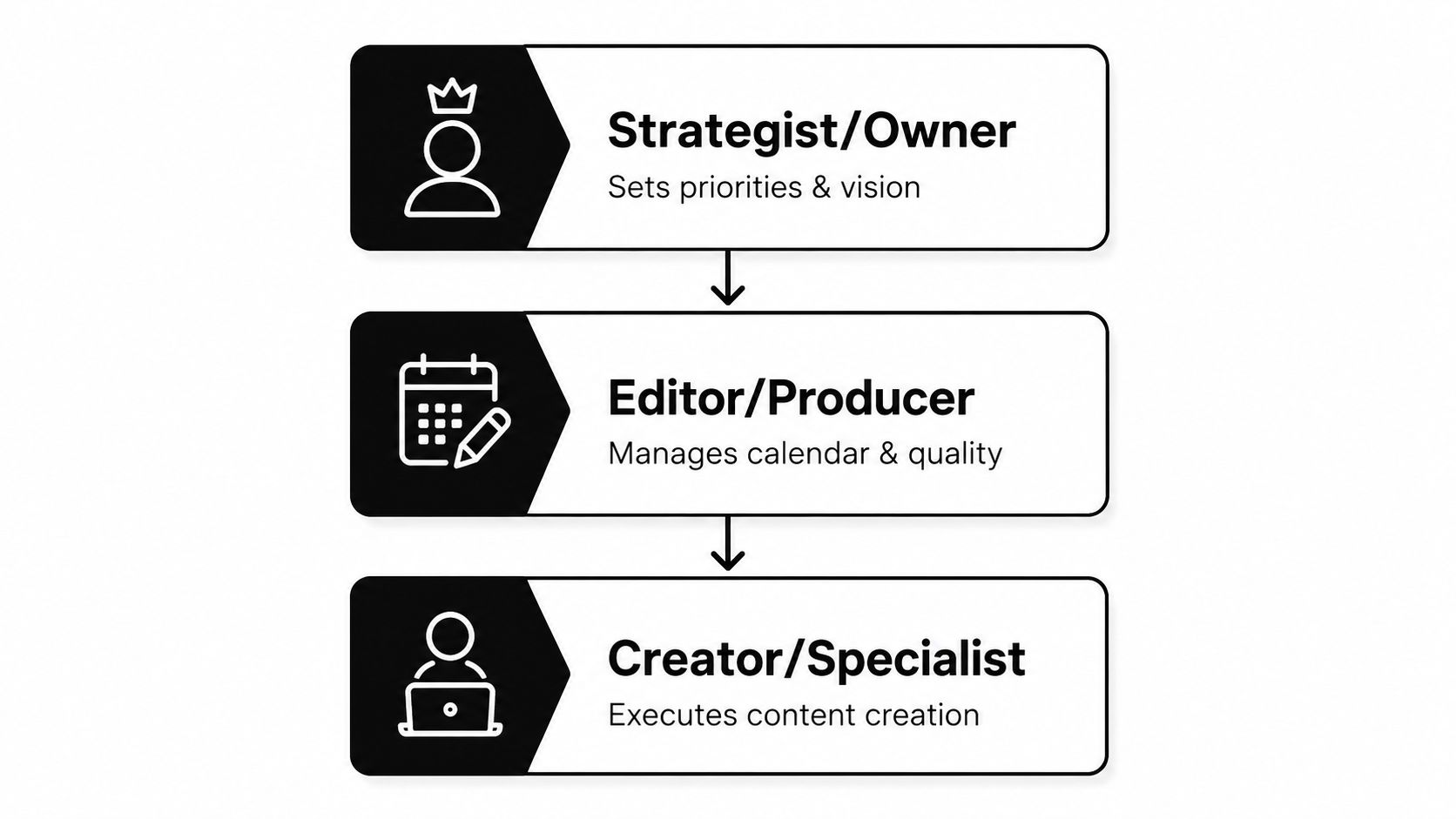
The strategist sets priorities, protects the POV, and approves claims. The editor turns ideas into briefs, manages quality, and keeps deadlines visible. The creator records, writes, publishes, and engages with the audience.
On a one-person team, the same founder may wear all three hats. That's fine, but don't perform all three jobs in the same hour. Switching between strategic judgment, editing, and production creates avoidable fatigue and inconsistent decisions.
A workable weekly rhythm looks like this:
Use a research repository for customer language, a planning board for briefs and status, a document editor for approvals, a scheduler for distribution, an analytics dashboard, and a CRM field for source and influence. Notion, Airtable, Google Docs, Buffer, HubSpot, or a comparable combination can cover the workflow without creating tool sprawl.
AI can handle transcription, idea clustering, repurposing, and first drafts. A human must review factual accuracy, point of view, customer confidentiality, and brand safety. Automation should remove repetitive work, not outsource judgment.
Document owners, turnaround times, approval rules, escalation paths, and the minimum viable cadence. For founders who need help extracting positioning and voice from interviews, Legacy Builder offers a monthly content strategy service that turns founder conversations into content for LinkedIn, X, and newsletters, with planning and conversion support. Treat that kind of service as an operating layer, not a substitute for commercial clarity.
Governance test: Every asset should have one owner, one intended action, one approval path, and one place where its performance is recorded.
A content engine can publish every week and still produce no commercial value. The fix starts with a stricter definition of performance: content must create qualified conversations, support active opportunities, or help buyers reach a decision. Impressions, traffic, and follower growth measure attention. They do not prove pipeline impact.
Connect every meaningful content interaction to your revenue process. Add consistent UTM parameters, preserve the first known source in your CRM, and record influential content touches before an opportunity is created. Prospects may discover a post through a private Slack group, a forwarded newsletter, or a colleague's recommendation. Ask new leads what they read, watched, or discussed, then store the answer in a structured field instead of leaving it in scattered call notes.
The b2b lead generation strategies you use should match the buyer journey. A high-intent comparison page needs a different conversion path from an opinion post, an executive interview, or a customer proof asset.
| Metric Type | Examples | What It Tells You | When to Review |
|---|---|---|---|
| Lagging indicators | Traffic, impressions, followers | Whether distribution created visible attention | Monthly |
| Leading indicators | Saves, replies, qualified visits, content-assisted conversations | Whether the message is earning buyer engagement | Weekly |
| Pipeline indicators | Qualified leads sourced, opportunities assisted, revenue influenced | Whether content is connected to commercial movement | Monthly |
Keep the founder dashboard small enough to review consistently. Track qualified visits, content-sourced leads, opportunities with meaningful content engagement, and influenced pipeline. Use the metrics to make editorial decisions, not to manufacture a perfect attribution model. If a post attracts broad reach but no relevant conversations, change the audience, angle, or distribution. If a modest post appears in several qualified sales conversations, produce more work around its underlying belief.
A useful measurement program also separates source, influence, and assistance. Source identifies the first trackable interaction. Influence records content engagement during the buying process. Assistance captures content that helped sales answer a question, overcome doubt, or advance an opportunity. That distinction gives founders a clearer view of how a personal brand contributes before a form submission appears.
Start Monday with the buyer brief. By Friday, you should have one approved POV, one publishable asset, and a measurement path attached to its intended action. Repeat that cycle for 30 days before changing the strategy. The goal is a content operating system that makes expertise easier to find, trust, and act on, while showing which ideas create commercial momentum.
Legacy Builder helps founders turn positioning, voice, and personal expertise into a practical content operating system, including interviews, content pillars, and recurring LinkedIn, X, and newsletter content. Visit Legacy Builder to review a founder-led service that connects consistent publishing with audience engagement and conversion paths.


You could – but most in-house teams struggle with the nuance of growing on specific platforms.
We partner with in-house teams all the time to help them grow on X, LI, and Email.
Consider us the special forces unit you call in to get the job done without anyone knowing (for a fraction of what you would pay).
Short answer – yes.
Long answer – yes because of our process.
We start with an in-depth interview that gives us the opportunity to learn more about you, your stories, and your vision.
We take that and craft your content then we ship it to you. You are then able to give us the final sign-off (and any adjustments to nail it 100%) before we schedule for posting.
No problem.
We have helped clients for years or for just a season.
All the content we create is yours and yours alone.
If you want to take it over or work on transitioning we will help ensure you are set up for success.
We want this to be a living breathing brand. We will give you best practices for posting and make sure you are set up to win – so post away.
Subscribe to our newsletter and get insights on how to grow your personal brand.
