.svg)
Subscribe to our newsletter and get insights on how to grow your personal brand.
Thank you! Your submission has been received!
Oops! Something went wrong while submitting the form.
.svg)


Most content strategy advice starts in the wrong place. It tells you to build a calendar, choose a few channels, and publish consistently. That sounds organized, but it can turn a small team into a content factory producing assets nobody needs, approves, or measures.
A useful content strategy and planning system is a decision system. It tells you what deserves resources, what should be updated, what should be removed, and how each asset supports a business outcome. It also accounts for a harder reality: buyers may discover your expertise through search engines or AI answer engines without ever visiting your website.
A documented strategy isn't the same as an effective strategy. Many teams have a polished presentation covering personas, pillars, channels, and publishing themes, yet the document never influences a weekly decision.
The evidence is uncomfortable. In CMI's 2025 B2B benchmark, only 29% of marketers with a documented strategy rated it extremely or very effective. 58% called it moderately effective, while 13% rated it not very or not at all effective, according to the CMI benchmark on documented strategy effectiveness.
Documentation has become the endpoint. It should be the starting line.
A strategy sitting in a slide deck can't decide whether an underperforming article should be consolidated. It can't resolve an approval dispute. It can't tell a founder which audience question deserves attention this week. Those decisions require operating rules, clear ownership, and a measurement habit.
A strategy describes direction. An operating model turns that direction into repeatable behavior.
A working model answers practical questions:
Without those answers, teams confuse activity with progress. A full calendar can hide weak positioning, duplicated topics, poor distribution, and content that attracts attention without prompting action.
Practical rule: If your strategy doesn't help someone say “no” to a content idea, it isn't specific enough.
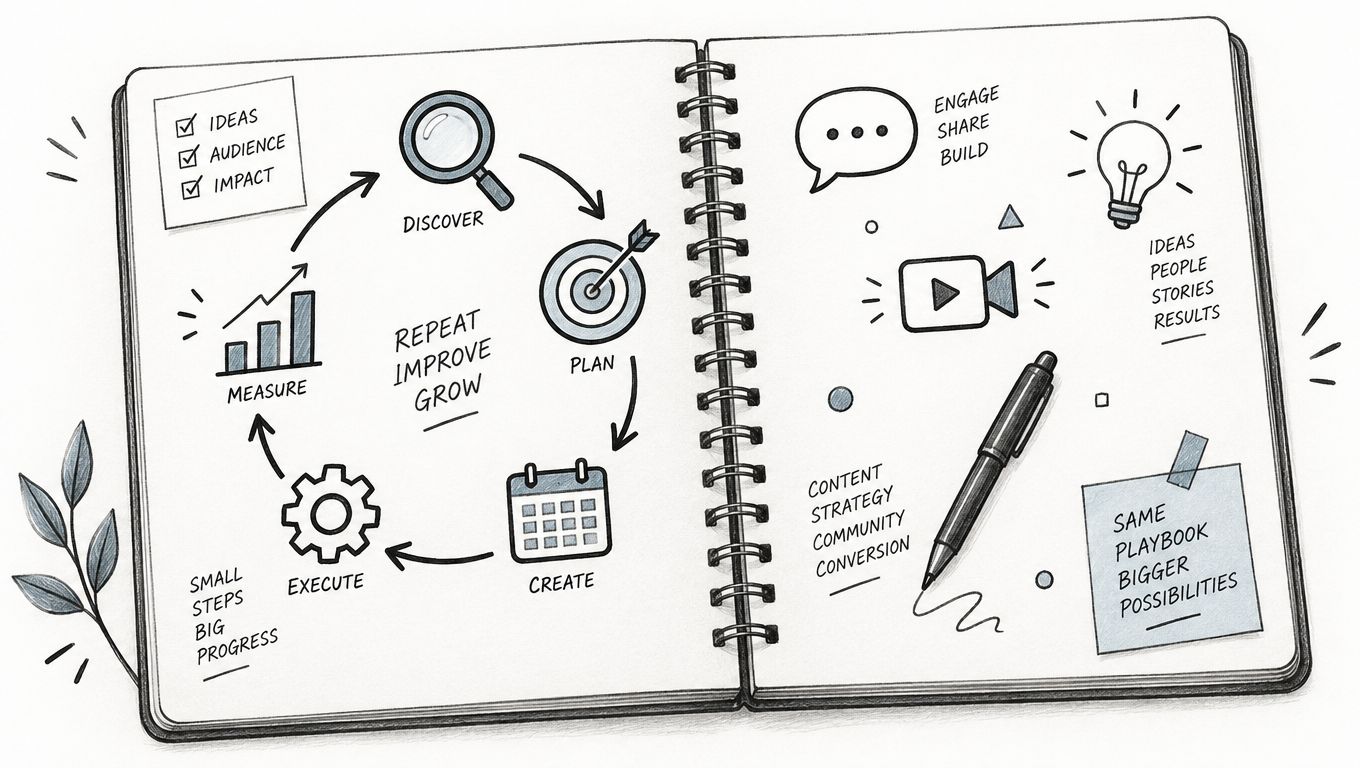
The playbook is simple. Audit what exists, create a cut list, define success, map buyer questions, build a calendar around reusable themes, remove workflow friction, and measure visibility across both traditional search and AI-generated answers. That sequence gives content a job beyond filling publishing slots.
The fastest way to waste a content budget is to publish another article before checking what already exists. A calendar filled with new topics can hide duplicated pages, buried expertise, and assets that no longer support the business.
Build an inventory with each asset's URL, format, audience, funnel stage, primary topic, owner, last meaningful update, business purpose, and available performance signals. Include articles, landing pages, newsletters, videos, social posts, sales materials, and useful internal documents. Add visibility in traditional search and AI-generated answers where you can assess it. Buyers may find an answer without visiting your site, so a page's value cannot depend only on sessions.
The inventory does not need to become a perfect database. It needs to show where production time goes, which questions your library answers, and where valuable work is difficult for search engines, AI answer engines, sales teams, or customers to find.
Score every asset against two tests:
The 2026 global marketer survey shows why this review deserves a fixed place in planning. 40% of respondents identified creating content that prompts action as a top challenge, 39% cited resource constraints, and 33% named measurement. Only 16% selected developing a content strategy and plan, according to CMI's 2026 B2B research.
An expensive asset is not automatically useful, and a low-traffic page is not automatically disposable. Judge each item by its strategic role, evidence of demand, and realistic improvement potential.
| Asset Signal | Recommended Action | Why It Works |
|---|---|---|
| Strong audience response, clear business relevance, and room to expand | Commit further | Invest in updates, stronger calls to action, internal links, distribution, and planned adaptations |
| Several weak or overlapping assets answer the same question | Consolidate | Combine authority, reduce maintenance, and give readers one stronger destination |
| Outdated, inaccurate, off-topic, or disconnected from any current goal | Cut | Removes maintenance cost and prevents weak pages from diluting the experience |
| Useful insight trapped in one format | Repurpose | Extends the original thinking into email, social, sales, video, or community distribution |
Cut obvious waste first. Consolidate overlapping pages next. Commission new work only after those decisions. Use a content repurposing framework that actually scales to turn a strong source asset into coordinated distribution rather than disconnected posts.
When capacity is tight, pause broad, generic awareness content before cutting material tied to buyer decisions or customer success. Generic topics demand substantial research, compete in crowded spaces, and provide weak evidence that they will lead to action.
Protect content that answers a high-intent buyer question, supports sales conversations, helps customers succeed, or demonstrates expertise competitors cannot easily copy. Pause formats requiring specialist production your team cannot sustain. Combine adjacent articles when readers must visit several pages to get one complete answer.
Review the cut list on a fixed cadence. The audit should control what survives the next planning cycle, what gets updated, and what the team stops producing.
A content calendar cannot rescue a vague objective. “Publish about leadership” names a subject, while a useful strategy decides what the content must change for the business.
Choose one primary outcome for the planning period: qualified conversations, product education, customer retention, email subscriptions, sales enablement, or authority in a defined category. Add one audience action that supports it, such as downloading a resource, comparing approaches, replying to a message, or booking a call.
Write the goal in one sentence:
We need [audience] to take [action] because it supports [business outcome].
Then define how you will recognize progress. Track indicators that connect visibility with behavior. Rankings and impressions show discovery, but they do not prove that content helped someone choose, subscribe, contact sales, or remain a customer. Apply the same standard across traditional SEO and AI answer engines, where a buyer may see your recommendation without visiting your site.
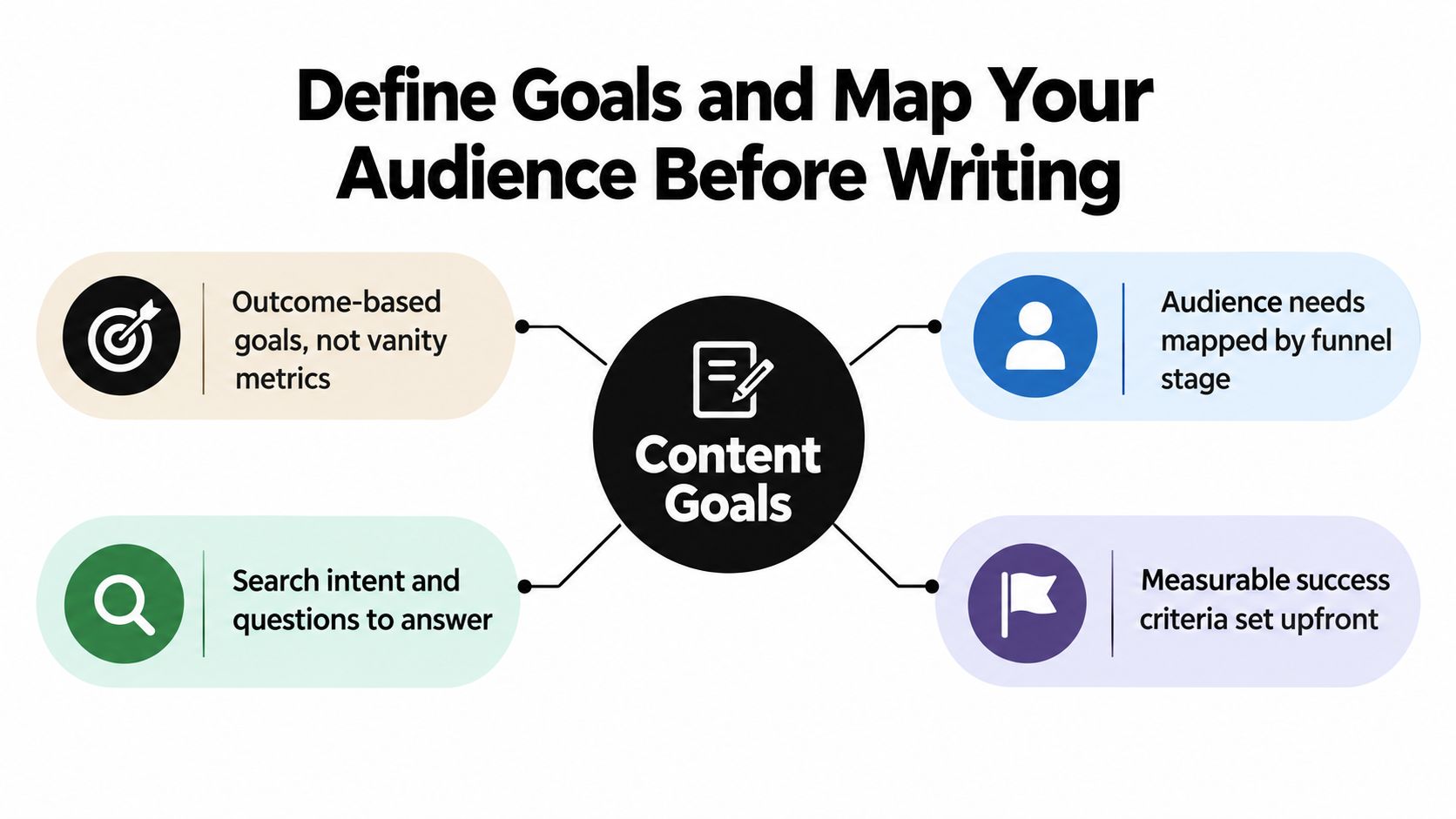
Personas become decorative when they list demographics without recording decisions. Build an audience map around the questions people need answered at each stage.
An emerging founder may first ask whether a problem deserves attention. Later, that person may compare methods, providers, or implementation risks. An existing customer needs content about adoption, troubleshooting, and expansion. These questions should determine which topics you keep, consolidate, or develop.
Create a matrix with these fields:
Audience research is rarely complete. Research on content challenges and resources highlights how frequently teams work with incomplete audience information, as shown in the CMI research on content challenges and resources. State assumptions plainly, then create content that tests them through responses, conversions, sales feedback, and search behavior.
Before writing begins, complete a one-page brief covering the target audience, question, desired action, angle, evidence, distribution channels, and success signals. If the team cannot complete it, reject or revise the idea.
This rule prevents a common failure: publishing an interesting article and searching for its business purpose afterward. Decide the job first, then choose the format and distribution path.
A calendar fails when it records publication dates but not decisions. “Blog post, Tuesday, owner unknown” is a reminder, not a plan.
Build the calendar around themes and source assets. Choose a small group of priority problems, then assign each one a substantial asset and a reuse path. The source asset might be a detailed article, founder interview, customer lesson, webinar, or original point of view. Supporting pieces should clarify, distribute, or extend that core idea.
A 2025 industry survey found that 69% of content marketers follow a documented strategy, 61% of in-house teams build quarterly calendars at least one month in advance, and 52% include post types, channel-specific goals, and reuse plans in their calendars, according to the survey data on content strategy and calendar planning.
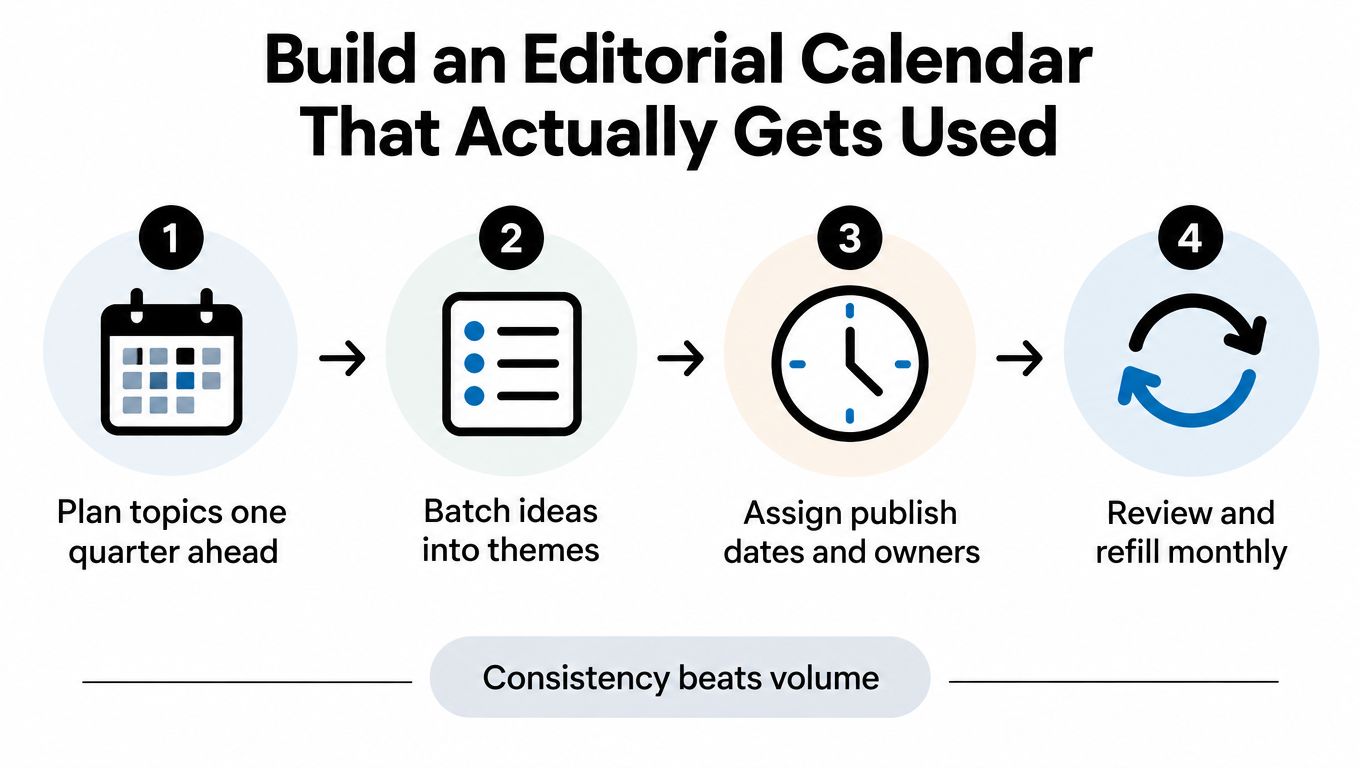
Your working calendar should include:
A solo founder doesn't need a complex production board. The founder can choose one core question, publish the main answer, extract several short insights for social distribution, and turn the strongest point into a newsletter section. A two-person team can divide the work between subject-matter input and editing, while batching similar tasks to reduce context switching.
The mistake is treating every channel as a separate editorial universe. Plan the idea once, then adapt its expression to the audience and mechanics of each channel.
Build the quarter far enough ahead that owners can prepare properly, while leaving room for timely ideas. Review the calendar monthly and remove anything that no longer supports the priority outcome. Refill only the gaps that matter.
If scheduling mechanics are slowing you down, this guide on how to schedule posts like a pro offers practical support. For teams comparing planning software, the list of content calendar software for 2026 can help you evaluate tools against your actual workflow.
A calendar should make the next action obvious. If it requires a meeting to understand, simplify it.
Most content plans don't fail because the team lacks ideas. They fail in review.
A draft waits for a subject-matter expert. The expert asks for a new angle. The editor changes the structure. A stakeholder adds another approver. The publishing date passes, and the team starts a new piece before finishing the old one.
CMI's 2025 B2B research found that 33% of marketers cited workflow issues and content approvals as a challenge, down from 41% the year before. The same research found that 54% of teams with dedicated content staff operate with only two to five people, as detailed in CMI's research on B2B content marketing trends.
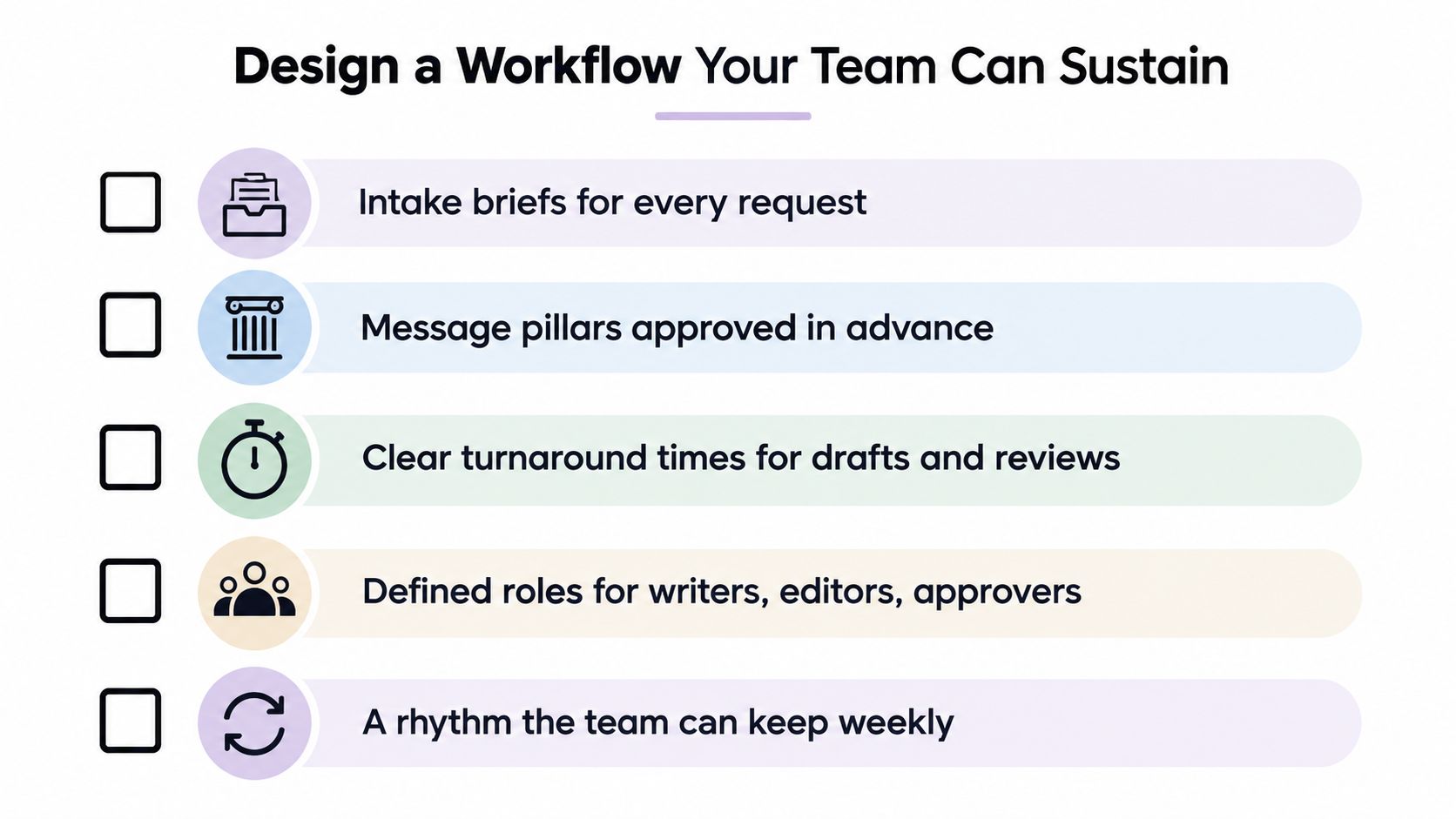
Use an intake brief for every request. It should capture the audience, business purpose, source material, required format, deadline, approver, and distribution plan. Reject requests that arrive as “can you write something about this?” without a defined reader and action.
Approve message pillars before assigning drafts. Stakeholders should debate the position early, not rewrite finished copy because they disagree with the premise. Give writers a clear boundary and enough context to make decisions independently.
Set turnaround expectations for every stage. The exact timing will vary by team, but the sequence should be visible: brief, draft, subject-matter review, edit, approval, scheduling, publication, and measurement.
Small teams can't run many major initiatives at once without creating a review queue. Choose a narrow set of active priorities, assign one accountable owner to each, and pause new requests when the queue reaches capacity.
Use a single approver for final editorial decisions. Legal, product, sales, and leadership can provide input, but one named person must decide what gets published. Otherwise, consensus becomes an invisible deadline killer.
A sustainable workflow also includes a feedback rule. Reviewers should comment on accuracy, audience fit, strategic alignment, and risk. They shouldn't rewrite every sentence to match personal taste.
Workflow rule: Approve the idea early, assign ownership clearly, and make late-stage changes expensive.
Traditional SEO reporting answers whether people find and visit your content. That still matters, but it no longer covers the full discovery environment.
An industry analysis argues that teams need to audit two search surfaces because organic performance and LLM visibility don't always correlate. The recommended framework tracks clicks, rankings, and conversions alongside citation frequency, mention consistency, and platform coverage, as explained in Search Engine Land's guide to content strategy in 2026.

Track metrics in four groups:
Don't treat an AI answer mention as a replacement for conversion measurement. It can indicate that your expertise is entering a buyer's consideration set, but you still need to monitor downstream actions where those actions are observable.
The stronger planning question isn't only “Which keyword should we target?” Ask instead: “Can this idea survive in search results, an AI answer, a newsletter, a sales conversation, and a social post?”
That changes how you write. Define terms clearly. State the answer early. Support important claims with credible evidence. Use consistent language for your category, method, and point of view. Make the content easy for a human reader and a retrieval system to understand without stripping away the expert reasoning.
Choose tools that fit the reporting habit you can maintain. If you need a simpler SEO reporting workflow, this Raven Tools alternative is one option to assess. The right tool is the one your team opens, understands, and uses to make a decision.
For personal-brand teams, this guide to measuring content performance for your personal brand provides another way to connect visibility signals with audience and business outcomes.
Review the dashboard monthly. Use the findings during the next audit to decide what to cut, consolidate, or expand. Measurement is useful only when it changes the next plan.
Don't begin by filling every publishing slot. Begin by reducing uncertainty.
During the first week, inventory the existing library, identify duplicated and outdated assets, and create the cut list. In the next planning block, select the priority audience, define the business outcome, and map the questions that audience needs answered. Then choose the strongest source themes and build a calendar with owners, channels, reuse paths, and calls to action.
Set up the workflow before production accelerates. Create the intake brief, approve the message pillars, define the review sequence, and name the final approver. A small team can move quickly when it has fewer active initiatives and fewer ambiguous handoffs.
Use the remaining period to publish, distribute, and review. Keep the monthly rhythm light: inspect the dashboard, capture audience questions, update the calendar, and remove ideas that no longer support the goal. Use the quarterly review to repeat the audit and make harder allocation decisions.
External support can be useful when your team needs strategic direction, production capacity, or stronger search alignment. For a specialized option, review these content SEO services and compare the scope against the gaps your audit identified.
The decision rules are straightforward. Cut work with no audience or business role. Consolidate overlapping assets into one stronger answer. Double down on content that earns attention, supports action, and can travel across discovery surfaces. Publishing less with tighter ownership will beat filling a calendar with work nobody can sustain.
Start today with three actions:
Legacy Builder helps founders and professionals turn their expertise into a structured content roadmap, recurring content plan, and consistent distribution workflow. If your team needs help connecting authentic personal-brand content to clear goals and repeatable execution, visit Legacy Builder and explore the service.


You could – but most in-house teams struggle with the nuance of growing on specific platforms.
We partner with in-house teams all the time to help them grow on X, LI, and Email.
Consider us the special forces unit you call in to get the job done without anyone knowing (for a fraction of what you would pay).
Short answer – yes.
Long answer – yes because of our process.
We start with an in-depth interview that gives us the opportunity to learn more about you, your stories, and your vision.
We take that and craft your content then we ship it to you. You are then able to give us the final sign-off (and any adjustments to nail it 100%) before we schedule for posting.
No problem.
We have helped clients for years or for just a season.
All the content we create is yours and yours alone.
If you want to take it over or work on transitioning we will help ensure you are set up for success.
We want this to be a living breathing brand. We will give you best practices for posting and make sure you are set up to win – so post away.
Subscribe to our newsletter and get insights on how to grow your personal brand.
