.svg)
Subscribe to our newsletter and get insights on how to grow your personal brand.
Thank you! Your submission has been received!
Oops! Something went wrong while submitting the form.
.svg)



You're probably in a familiar spot. You know your craft. Clients trust you. Peers ask for your opinion. But online, your presence looks thin, inconsistent, or strangely generic.
You post when you have time. Then the business gets busy, content slips, and your profile starts looking like an abandoned side project instead of the public record of your expertise. Worse, when someone on your team or an outside freelancer does publish something, it often sounds polished but empty. It reads like marketing copy, not like you.
That's where content marketing strategy services become useful. Not as a content factory. Not as a vanity play. As a system for translating real expertise into a body of work people can find, trust, and remember.
The market has already moved in this direction. One industry summary projects the global content marketing market at about $72 billion in 2023 and over $107 billion by 2026, a projected 33% growth over that period, while 90% of organizations report having a content marketing strategy and 83% of marketers say content marketing is the most effective method for demand generation, according to this Salesgenie industry summary. Founders should read that for what it is. Content strategy is no longer optional reputation management. It's part of how modern authority gets built.
Most founders don't have a knowledge problem. They have a translation problem.
You can explain your market in a client call. You can see around corners in your industry. You know which mistakes cost buyers time and money. But none of that automatically turns into a visible, trusted digital presence. Expertise in your head is not authority in the market.
Posting more won't fix that. Random output creates random results.
What you need is a service that turns scattered insight into a clear public narrative. That means deciding what you should be known for, which ideas deserve long-form treatment, what belongs on LinkedIn versus your site, and how each asset moves a buyer closer to trust.
Founders often make one of three bad moves:
Practical rule: If your content could be published under another CEO's name with only minor edits, it isn't building your authority.
A real content strategy service should protect your voice, sharpen your positioning, and create repeatable publishing discipline. It should also help you stop talking about everything. Strong authority comes from selective clarity, not broad noise.
For a founder or CEO, the right partner doesn't start with “How many posts per month do you want?” That's the wrong first question.
They start with questions like:
That shift matters. You're not hiring for content volume. You're hiring for strategic memory in the market.
A founder hires a writer, approves a few LinkedIn posts, publishes one polished article, then wonders why none of it changes market perception. The problem is rarely effort. The problem is the missing blueprint.
Authority does not come from scattered content. It comes from a clear point of view repeated across the right formats, for the right audience, with enough discipline that buyers start associating your name with a specific set of ideas. That is what strong content marketing strategy services are supposed to build. If you want a deeper primer on the mechanics, this comprehensive guide for content marketing offers useful background.
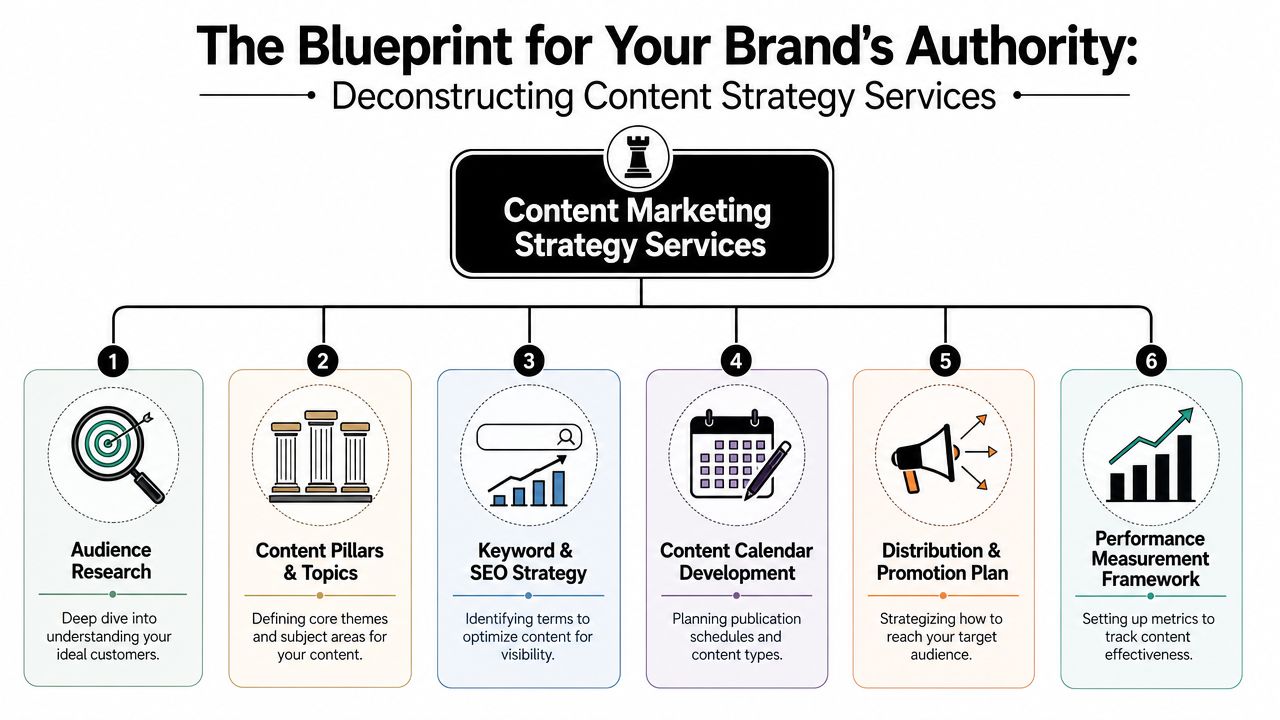
If you are a founder building a personal brand, a strategy service should produce decisions, not just ideas. You need a plan that answers what you will be known for, who needs to trust you first, and how your content will prove credibility over time.
A serious provider should define:
Documentation matters because undocumented strategy turns into reactive publishing. The Content Marketing Institute's B2B content marketing benchmarks and trends show that documented strategy remains a differentiator for stronger content performance. For founder-led brands, that gap usually shows up as inconsistency. Good ideas exist, but they never turn into a body of work people remember.
Posting often does not build authority. Clear pillars do.
For founders and CEOs, the right pillars usually sit at the intersection of four things:
| Brand element | What it answers |
|---|---|
| Core expertise | What do you know from direct experience that your market values? |
| Market perspective | What do you believe that cuts against lazy industry thinking? |
| Personal motivation | Why are you publicly attached to this problem? |
| Commercial fit | Which topics attract the clients, partners, and opportunities you actually want? |
Many agencies miss the point. They build content around keywords alone, then wonder why the output feels interchangeable. Your audience is not only judging whether your content is useful. They are judging whether it sounds lived-in, specific, and credible enough to trust.
That is the standard.
A content plan without structure creates clutter. A founder's authority grows faster when each piece has a job and supports the others.
That usually means a core page or flagship article for each authority pillar, supported by narrower pieces that answer specific questions, objections, or use cases. It also means separating ideas by intent. Your thought leadership should not carry the same burden as your service pages. Your personal story should not be buried inside a page trying to rank for a commercial term.
If one page tries to explain your philosophy, your offer, your proof, your process, and every buyer question at once, it usually performs poorly for both trust and conversion.
A capable partner should also define governance. Who approves ideas. How your voice gets protected. Which claims need proof. How often pillars get reviewed. If you want a practical example of that structure, this article on what a content marketing strategy blueprint looks like for lasting authority is worth reading.
For founders building a long-term reputation, that blueprint is the asset. The posts, articles, interviews, and emails come after.
Not every founder needs the same engagement.
Some need a strategic reset. Others need a partner who can keep the engine running month after month. If you don't choose the right model, you'll either overpay for work you aren't ready to use or underbuy and end up with a beautiful document no one executes.
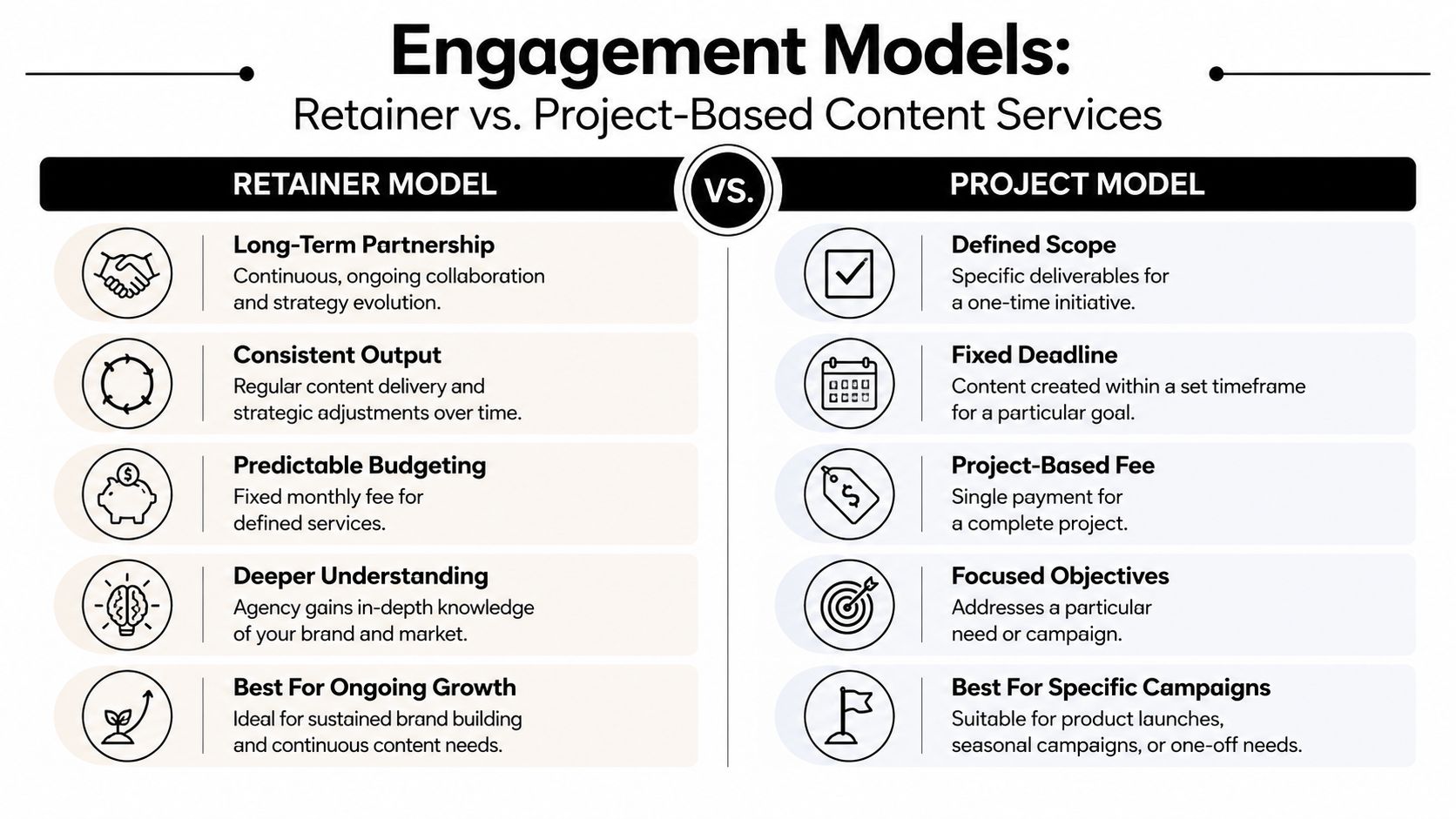
A project-based engagement works well when you need foundational work, such as:
This model is useful if you already have internal execution capacity. You hire the strategist to build the plan, then your team carries it out.
A retainer is usually the better fit when the challenge isn't knowing what to do. It's doing it consistently at a high level.
That matters because content now has to travel across multiple channels. The Content Marketing Institute reports that 89% of B2B marketers use organic social media, 84% use blogs on corporate websites, and 71% use email newsletters, according to CMI's content marketing statistics. That kind of coordination is hard to manage through one-off projects.
Here's the blunt version:
| Model | Best use case | Main risk |
|---|---|---|
| Project | Strategy, audits, launches, architecture | The plan sits unused |
| Retainer | Ongoing creation, distribution, optimization | You keep paying for output without strategic challenge if the partner is weak |
The more channels you need to manage, the more a retainer starts to make sense.
If you're still sorting out what a healthy planning process should include, this overview of an effective content marketing plan gives a practical baseline.
If you're building a personal brand tied to your company, reputation, or future opportunities, don't think in campaign terms only. Think in systems.
A short project can be the right first move if your message is messy. But if you want sustained authority, the long-term value usually comes from a retainer with clear deliverables, clear editorial ownership, and regular strategic review.
Three weeks into an engagement, you should not be chasing updates or staring at a first draft that sounds like a junior marketer wearing your name tag.
A strong content partner makes the process visible. You should know how they gather insight, how they shape your point of view, who reviews what, and what happens before anything goes live. Founders hiring for personal-brand content need that clarity because the risk is not just wasted budget. It is public dilution. Weak process produces polished content that says nothing memorable about you.
Early onboarding sets the tone. A real kickoff goes far beyond goals, channels, and publishing cadence.
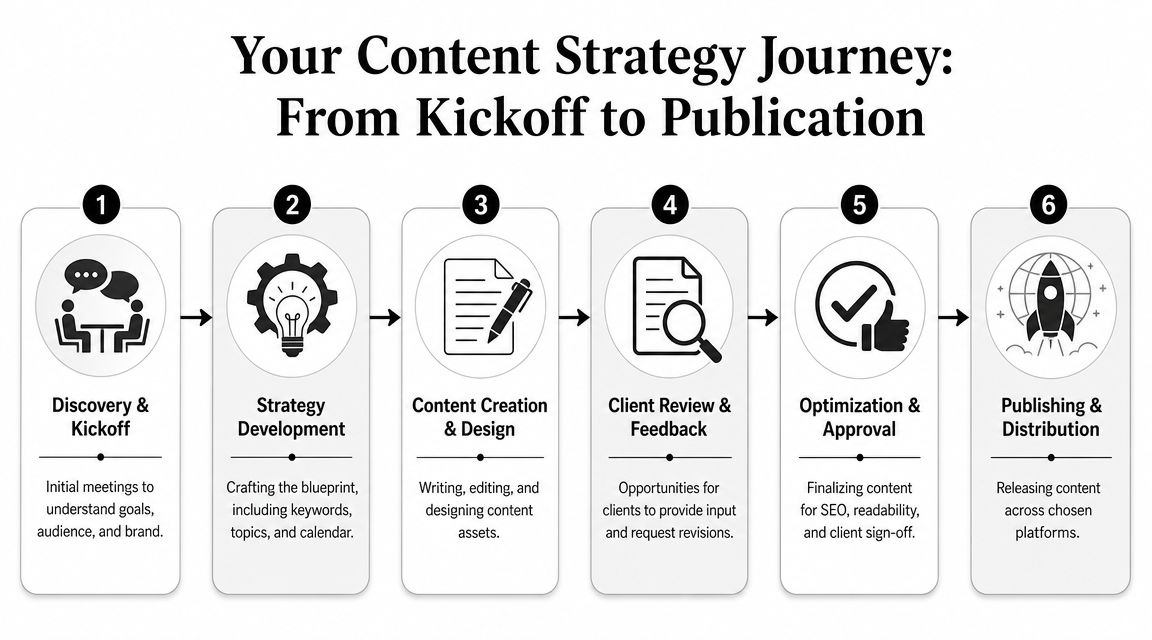
The first phase should pull out the material generic agencies never find. Your convictions. Your stories. The phrases you repeat in interviews. The sharp opinions your buyers remember after the call.
Expect a process like this:
This stage decides whether the work builds trust or produces filler. If a provider rushes discovery, they will miss the substance that makes a founder worth following.
You also need editorial discipline once ideas start turning into assets. This guide to building a powerful brand through content governance explains how clear roles, standards, and approvals keep quality high without slowing everything down.
After discovery, the provider should translate raw material into a content system. Not a pile of disconnected topics. A system.
That usually means a clear set of core themes, a defined audience by buying stage, and a topic structure that connects big reputation-building ideas to more specific pieces your audience can act on. The mechanics matter, but the bigger question is simpler. Does this plan make it easier for the market to understand what you stand for and why your perspective deserves attention?
Then the production work starts. Briefs. Drafts. Editorial review. Founder review. Optimization for search and readability. Adaptation across channels. One strong idea can become a bylined article, a LinkedIn post series, an email, and talking points for a video or podcast appearance.
This overview is useful if you want a visual sense of how content production moves from plan to publish.
You do not need to write the drafts. You do need to supply judgment.
That means correcting weak claims, adding lived experience, rejecting language that sounds borrowed, and pushing the work toward what you believe. Their role is to capture, shape, edit, and publish that thinking with consistency.
The best partnerships save you time while protecting your identity. If the service removes your workload but also removes your voice, it is not strategy. It is content assembly.
Most founders ask weak buying questions.
They ask about package options, posting volume, or turnaround time before they ask whether the provider can represent them well in public. That's backwards. If the voice is wrong and the strategic thinking is shallow, a lower fee won't save you. It will just buy you more forgettable content.
The first filter is simple. Can this partner turn expertise into authority without sanding off your point of view?
Ask these in the sales process and pay close attention to the answers.
How do you capture a founder's authentic voice?
If the answer is “we have great writers,” keep digging. You want to hear about interviews, transcript analysis, revision loops, and editorial standards.
How do you decide what I should be known for?
Strong providers talk about positioning, audience needs, and strategic focus. Weak ones jump straight to content types.
How do you structure topics across the funnel?
They should be able to explain awareness, consideration, and decision-stage content in plain English.
How do you prevent generic thought leadership?
If they don't have a method for extracting sharp opinions, stories, and differentiated claims, you'll get recycled industry commentary.
How do you balance classic SEO with AI discoverability?
This now matters. A modern agency review discussed content strategy services across SEO, GEO, and content marketing, and Google said AI Overviews reached more than 1.5 billion monthly users in 2025, as noted in Siege Media's content strategy agency review. If a provider is still planning only for blue-link search, they're behind.
You don't need to be unfair. But you do need standards.
| Red flag | What it usually means |
|---|---|
| They lead with volume packages | They sell output, not positioning |
| They can't explain voice capture | You'll sound generic |
| They show polished samples but no strategic rationale | They optimize for appearance |
| They avoid measurement questions | They don't want accountability |
| They treat your personal brand like a company blog | They don't understand founder-led trust |
One provider in this category is Legacy Builder's founder brand content service, which focuses on capturing a client's stories, insights, and vision through ongoing content production. That kind of model fits founders who need both strategic interpretation and consistent execution.
Price matters. But misalignment costs more.
I'd rather hire a more expensive team that can preserve your voice and challenge weak positioning than a cheaper one that floods the internet with polished filler under your name.
Good founder content should make a reader think, “That sounds like exactly how this person sees the world.”
That's the test. Not whether the agency can post every day. Whether they can help the market understand what only you can say.
If your content team reports page views, impressions, and likes without connecting any of it to business outcomes, you don't have a measurement system. You have a dashboard.
That's a problem because founder content often creates indirect value before direct value. Someone reads your article, follows you for months, joins your email list, refers a client, invites you to speak, or finally books a call after seeing the same core idea in three places. If you don't measure properly, you'll either kill good content too early or keep funding bad content because it looks active.
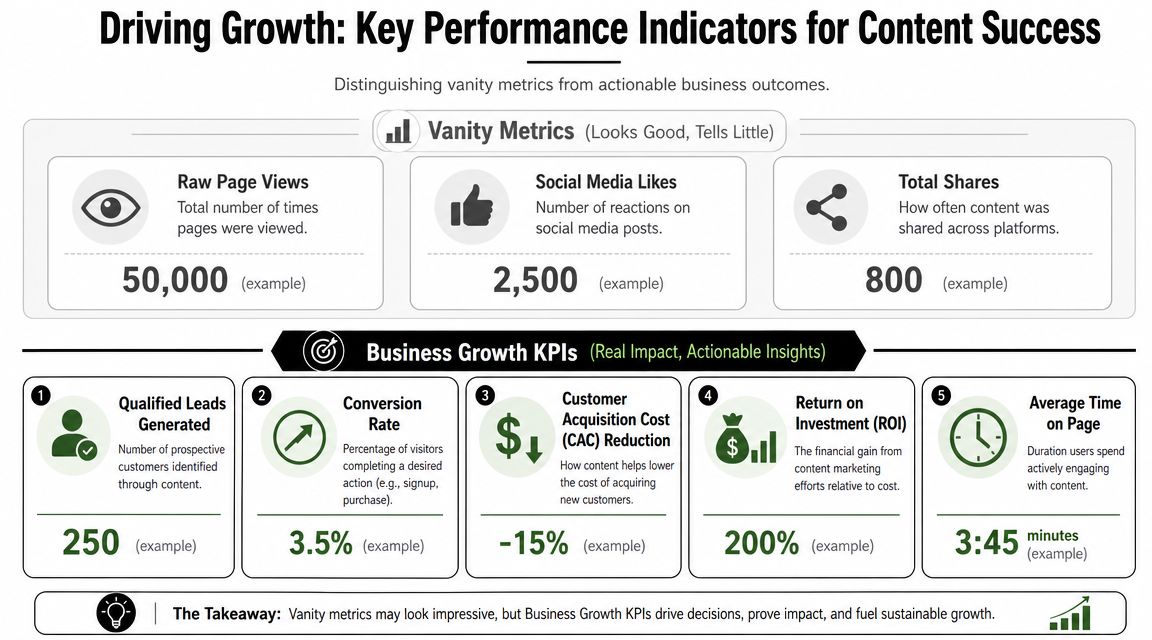
Heretto's guidance on digital content strategy recommends defining explicit KPIs and tracking page views, time on page, search queries, repeat visits, on-site actions, and journey sequencing from first touch to conversion, as outlined in their article on effective digital content strategy. That's the right direction.
Strong services use that framework to identify the 20% of assets driving 80% of the results. That's where optimization belongs.
Here's the distinction that matters:
For personal-brand-driven content, I'd want reporting that answers these questions:
Which topics attract the right audience?
Not all traffic is useful. You want relevance.
Which assets create hand-raisers?
Track inquiry forms, newsletter signups, booked calls, and meaningful replies.
Which pages assist conversion paths?
A page doesn't need last-click credit to be valuable.
Which themes earn repeat engagement?
Repeat visits and returning readers are strong trust signals.
Which pieces deserve iteration?
Don't expand production evenly. Improve the assets already delivering results.
If your team uses AI in drafting, make sure the final output still sounds human. This article on how to convert AI drafts into natural prose is a useful reminder that readability and authenticity still matter if you want content to hold attention.
A strong report doesn't just say what happened. It tells you what to do next.
Ask for monthly or periodic review around questions, not just metrics:
That's how content becomes a managed asset instead of an expensive habit.
For a founder, content isn't just marketing collateral. It's your public thinking. It's the archive of your values, your standards, your insight, and your body of work.
That's why generic content is more dangerous for personal brands than for faceless companies. Bad founder content doesn't just get ignored. It misrepresents you. It turns hard-earned judgment into soft, interchangeable noise.
The right content marketing strategy services protect against that. They help you decide what you stand for, how to express it clearly, where to publish it, and how to build trust across time instead of chasing short-term visibility. They create structure around your expertise so your audience can see it.
Don't hire a content vendor if what you really need is a strategic interpreter. Don't hire a content mill if your reputation is on the line. And don't confuse a full calendar with a meaningful brand.
Choose a partner that can do three things well:
That's the difference between producing content and building a legacy.
If you want help turning your expertise into a coherent, trust-building content system, Legacy Builder offers a founder-focused approach built around capturing your stories, insights, and vision, then turning them into consistent content across the channels that matter.


You could – but most in-house teams struggle with the nuance of growing on specific platforms.
We partner with in-house teams all the time to help them grow on X, LI, and Email.
Consider us the special forces unit you call in to get the job done without anyone knowing (for a fraction of what you would pay).
Short answer – yes.
Long answer – yes because of our process.
We start with an in-depth interview that gives us the opportunity to learn more about you, your stories, and your vision.
We take that and craft your content then we ship it to you. You are then able to give us the final sign-off (and any adjustments to nail it 100%) before we schedule for posting.
No problem.
We have helped clients for years or for just a season.
All the content we create is yours and yours alone.
If you want to take it over or work on transitioning we will help ensure you are set up for success.
We want this to be a living breathing brand. We will give you best practices for posting and make sure you are set up to win – so post away.
Subscribe to our newsletter and get insights on how to grow your personal brand.
