.svg)
Subscribe to our newsletter and get insights on how to grow your personal brand.
Thank you! Your submission has been received!
Oops! Something went wrong while submitting the form.
.svg)



You've been publishing consistently. Your founder insights are thoughtful, your audience responds on LinkedIn, and your team keeps adding useful articles to the site. Yet when a potential customer searches for the problem you solve, your best thinking is nowhere near the conversation.
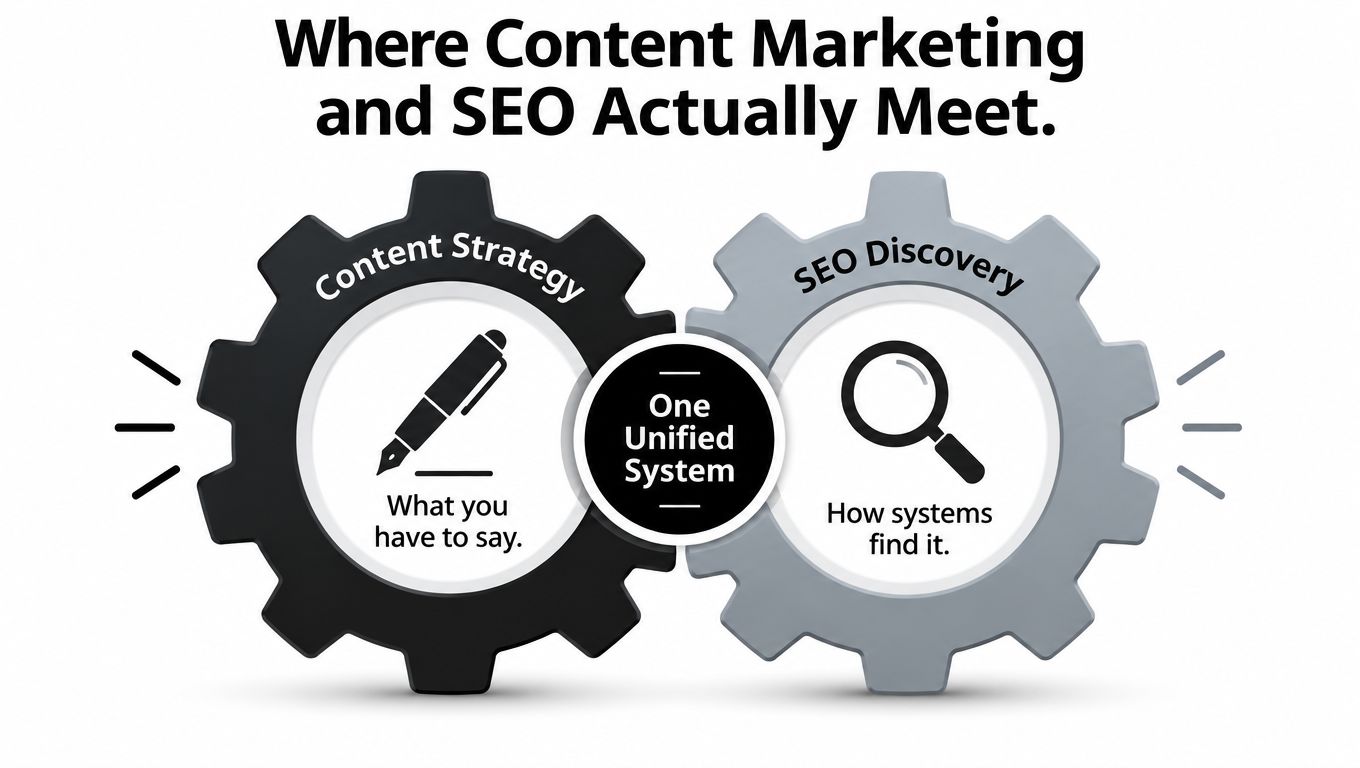
That gap rarely comes from a lack of effort. It usually comes from treating content as output instead of as a system that connects expertise, search intent, site structure, authority, and business measurement. A strong content marketing SEO strategy turns personal knowledge into discoverable resources, then gives those resources a path toward trust and commercial action.
A founder can spend months sharing practical lessons about hiring, product strategy, or building a company. The posts may earn comments from existing followers, but they don't necessarily answer the structured questions people type into search engines. The website then accumulates disconnected articles, each competing for attention without a clear topic relationship or internal route toward a meaningful next step.
Search visibility makes that problem more severe. A 2023 analysis cited by Semrush found that the first organic Google result generated a 39.8% click-through rate, compared with 18.7% for the second result and 10.2% for the third. The top three organic listings captured 68.7% of all clicks, while the first result received roughly 10 times as many clicks as the result in position 10, according to Semrush's analysis of SEO statistics.
Practical rule: Publishing more pages doesn't compensate for publishing pages that target the wrong question, miss the searcher's intent, or can't be understood easily by users and search systems.
A personal-brand article can contain excellent advice and still fail because its topic is too broad, its title reflects the writer's language rather than the audience's language, or its strongest evidence is buried in unstructured prose. A profile page can communicate credibility to a referral while remaining invisible for the searches that could introduce the founder to new people.
That's why a founder's organic search traffic growth playbook should begin before writing. Identify a specific audience, define the problem that audience is trying to solve, and connect the founder's experience to a discoverable topic. Then build the page so readers and crawlers can understand its purpose quickly.
The work isn't as easy as “writing an article about leadership.” It might be a practical guide for startup founders evaluating fractional leadership, a comparison of executive coaching approaches, or a detailed explanation of how a CEO built a decision-making system. Each version serves a different intent and attracts a different audience.
The system developed in this article has four connected parts:
A founder can publish a sharp point of view and still remain difficult to find. The gap usually sits between the insight and its presentation: search systems need crawlable text, descriptive structure, consistent terminology, and evidence that connects the author's experience to a real audience question.
Google recommends making key information available as crawlable text, using descriptive headings, and publishing helpful, reliable, people-first content informed by relevant expertise or experience, as explained in Google's guidance for making content accessible to search systems. These recommendations affect both discovery and comprehension. If the main explanation exists only in an image, animation, or vague headline, readers and search engines have less information to interpret.
Personal brands have an advantage over generic publishing operations: first-hand experience. A founder can describe what happened, which decision failed, what changed, and what they would do differently. That experience supports authority only when the page presents it clearly.
Use a specific author byline and explain the relevant background. Distinguish personal observation from broader guidance. Support important claims with visible examples, original frameworks, or references that allow readers to assess the advice. The voice should feel personal, while the page maintains a clear hierarchy.
A useful page typically includes:
These elements also help build an authority system beyond individual articles. Consistent terminology connects related ideas into topic clusters, while useful frameworks give other writers, publishers, and communities a reason to cite the founder. Those citations can strengthen recognition even when a searcher does not click immediately.
Automation can support research, briefs, content updates, and publishing workflows. It should not determine what the founder believes or reduce a distinctive point of view to interchangeable copy. Teams comparing systems can use a practical content marketing automation guide to understand where automation supports production without replacing editorial judgment.
A sound content marketing SEO strategy connects what the expert knows with what an identifiable audience searches for. SEO makes valuable thinking retrievable and understandable. Authority comes from the quality of the thinking, the evidence around it, and the repeated connections that make the founder recognizable across search results, citations, and AI-generated answers.
The most expensive content mistake is often a mismatch, not a writing flaw. A page can target a relevant phrase while answering the wrong question, or answer an important question without using the language that signals its relevance.
Start with the searcher's desired outcome. Most queries lean toward one of three broad intentions:
These categories aren't rigid, but they create a useful first decision. A query about building a personal brand may need an educational guide. A query comparing personal-brand agencies needs decision criteria and evidence. A query about personal-brand services may need a clear service page, proof, process, and call to action.
Review the pages already ranking for the target query. Don't copy their wording. Study the format, depth, audience, and promise. If the results are mostly definitions, a sales page will probably feel premature. If the results are comparison guides, a generic opinion article won't satisfy the evaluation task.
Consider a founder who drafts “Why Every CEO Needs a Personal Brand.” The idea may be sound, but the angle is broad and self-focused. An intent-matched version might become “How CEOs Can Build a Personal Brand Without Becoming Full-Time Influencers.” That page speaks to a specific concern, gives the writer room for first-hand experience, and sets expectations about the practical answer.
Another example involves a SaaS leader writing “Our Approach to Product-Led Growth.” That may work as a company perspective, but someone searching for a practical implementation guide needs definitions, operating decisions, examples, and common failure points. The company viewpoint can remain, but it should support the answer rather than replace it.
Assign each page one primary search intent, one central topic, and one next step. A page can mention adjacent questions, but it shouldn't try to be an encyclopedia, comparison page, sales pitch, and founder memoir at the same time.
Use a simple brief:
Keyword research still matters, but it should inform the brief rather than dictate awkward repetition. A founder's experience gives a page its differentiation. Intent gives that experience a destination.
A personal brand often has several valuable themes, such as executive decision-making, hiring, category creation, SaaS growth, or leadership communication. The mistake is treating each theme as a stream of isolated posts. A stronger structure turns one theme into a pillar page, supporting resources, and contextual internal links that reinforce one another.
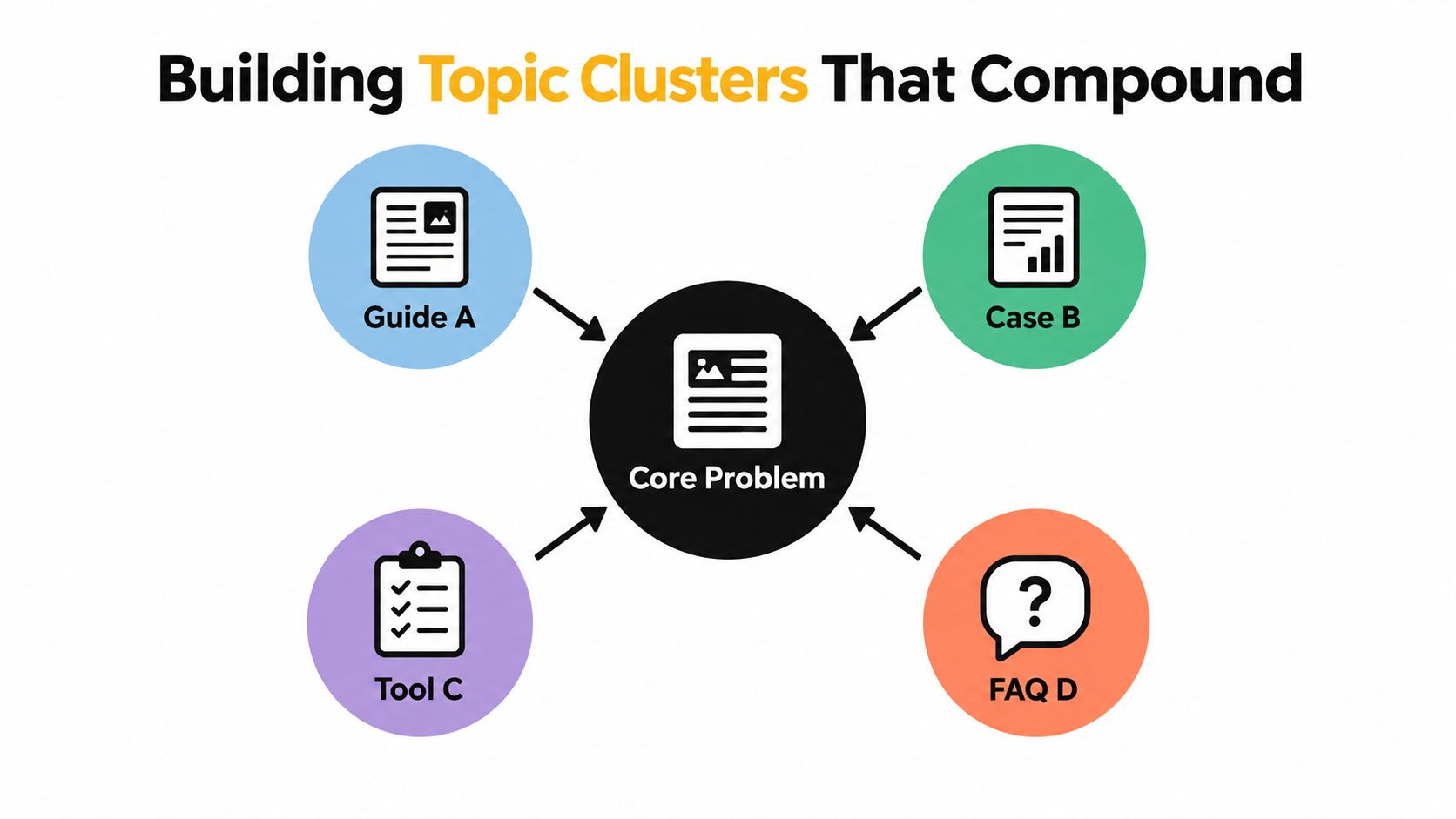
Suppose the core theme is founder authority. The pillar page addresses the overall problem, such as how founders build credibility through expertise and consistent publishing. Supporting pages then answer narrower questions, perhaps how to develop thought-leadership topics, how to turn interviews into content, how to optimize an executive profile, and how to measure authority when conversions happen later.
A cluster works only when its pages add different value. Four articles that repeat the same introduction and advice create volume without depth. Four pages that answer different questions create a useful route through the subject.
Use this architecture:
Assign a primary entity or topic to every URL. Use consistent terminology in headings, body copy, titles, and links. Descriptive anchor text is more useful than vague labels because it tells readers what they'll find next.
A cluster isn't a publishing calendar. It's a retrieval system that helps a reader move from a broad problem to the specific answer they need.
Every supporting page should connect naturally to the pillar when the broader context helps. The pillar should link back to the strongest supporting pages at the point where a reader needs more depth. Don't add a block of unrelated links at the bottom and call the architecture complete.
Author credentials matter, especially for experience-led content. Make the person behind the advice clear, explain why their experience is relevant, and distinguish personal observations from externally supported information.
Structured data can help systems understand a page and may make it eligible for rich results, but it must accurately describe visible content. It isn't a substitute for useful writing, clear headings, or evidence. The same principle applies to templates and publishing tools. A guide to content pillars and authority growth can help teams plan the structure, but editorial judgment still determines whether each page deserves to exist.
A topic cluster compounds because every strong page creates another useful entry point and another internal route. Disconnected posts make readers and crawlers reconstruct the relationship themselves.
A polished website doesn't control every factor that affects discoverability. Other people decide whether to mention, cite, share, or link to your work. The practical question isn't how to collect links at any cost. It's how to create something relevant people would naturally want to reference.
A large Semrush analysis examined 300,000 ranking positions across 16,298 English-language keywords with more than 100 monthly searches. It evaluated content relevance, backlink profiles, direct or branded traffic, user-behavior metrics, technical setup, and page-speed signals as ranking correlates, according to the Semrush ranking factors analysis. The finding supports a balanced approach. Authority matters, but it operates alongside relevance, usability, technical delivery, and audience behavior.
Generic advice rarely earns a durable reference because another site can reproduce it without adding anything. Distinctive assets give publishers and professionals a reason to point to your work.
Strong candidates include:
The personal brand has a natural advantage here. A founder's operating experience can supply details that generic content cannot, provided the story contains a useful lesson rather than only self-promotion.
Publishing is only the first handoff. Share the asset with professional communities, newsletters, founder networks, industry groups, and existing relationships where the topic belongs. Invite informed disagreement. Ask a subject-matter expert to review a framework. Give sales and partnerships teams a concise explanation of who the resource helps.
Avoid manufactured exact-match anchor text, low-quality link volume, and outreach that treats every recipient as interchangeable. A diversified set of relevant referring domains is more defensible than repetitive links from sites with no meaningful relationship to the subject.
Technical delivery still matters. Keep pages indexable, load them efficiently, write clear metadata, and ensure the linked resource supports the surrounding claim. Distribution increases the chance of discovery and citation. It can't rescue a page that doesn't deserve either.
A ranking report can tell you where a page appears. It can't tell you whether the right executive remembers the founder, whether a sales conversation began with an article shared internally, or whether a prospect returned through a branded search after reading an email.
Current B2B research shows that 56% of marketers report difficulty attributing ROI, 56% struggle to track customer journeys, 44% can't tie performance to business goals, and 39% lack clear KPIs, according to Content Marketing Institute's 2025 B2B research. Among enterprise teams, 66% have difficulty tracking customer journeys and 63% struggle with ROI attribution. Those gaps make a layered model more useful than a single conversion number.
Measure the content at several levels. Each level answers a different question, and none should be mistaken for the whole story.
| Metric Tier | Business Question It Answers | Example Metric |
|---|---|---|
| Discovery | Can search systems and audiences find the work? | Indexed pages, impressions by topic cluster |
| Relevance | Does the content appear for the intended need? | Query coverage, non-branded clicks |
| Engagement | Does the audience find enough value to continue? | Qualified visits, return visits, email shares |
| Influence | Does content assist a commercial conversation? | Assisted conversions, consultation requests, sales conversations |
| Business impact | Does the program contribute beyond acquisition? | Pipeline influence, customer retention |
The discovery layer catches technical and coverage problems. The relevance layer tests whether your topic and intent decisions are working. The influence layer recognizes that a content asset may support a deal without receiving the final click.
Executive thought leadership, comparison research, and email shares often build trust before a buyer fills out a form. A prospect may read an article, discuss it with colleagues, return through a branded query, and mention it during a call. Last-touch reporting may credit the final landing page while hiding the earlier content that made the conversation possible.
Set up consistent campaign and content labels. Connect organic landing pages to CRM records where practical. Ask new prospects how they heard about you, and preserve the answer as qualitative evidence rather than forcing it into an inaccurate channel category.
Don't discard traffic or rankings. Use them as diagnostic inputs. A cluster with impressions but weak qualified engagement may need a better promise or stronger internal path. A page with modest clicks but repeated sales references may be commercially valuable. The point isn't to make every asset produce a direct conversion. The point is to understand the role each asset plays in progressing a qualified audience.
You can use a practical framework such as how to calculate marketing ROI that actually means something to connect channel activity to business decisions without pretending attribution is perfectly observable.
Traditional rankings still matter, but a top position no longer guarantees the same number of visits when search engines summarize answers directly. A 2025 analysis of more than 200,000 keywords across 30 sites found that Google's top organic click-through rate fell from 28% to 19% as AI Overviews expanded, while positions one through five experienced an average 17.92% decline, according to Search Engine Journal's analysis of AI Overview click-through changes.
That changes the objective. Your content must still earn traditional visibility, but it also needs to make the person or company worth citing and remembering. First-party research, verifiable experience, distinctive viewpoints, clear authorship, and specific operating detail give both human readers and answer systems material that generic summaries can't easily replace.
Days 1 through 30: Audit existing content against search intent. Identify pages that target the same question, pages with no clear audience, and strong founder insights trapped in social posts or thin articles. Consolidate where necessary, clarify page roles, improve headings, and add relevant internal links.
Days 31 through 60: Build one topic cluster around a commercially meaningful expertise area. Publish or strengthen the pillar, create supporting resources for distinct questions, and document the founder's experience through examples, decisions, and evidence. Use practical framework selection tips for strategy when choosing the cluster's central business problem and supporting angles.
Days 61 through 90: Create one citable asset and distribute it through relevant professional networks, newsletters, communities, and partner relationships. Set up reporting for indexed pages, cluster impressions, non-branded clicks, qualified visits, assisted conversions, sales conversations, and pipeline influence.
The aim isn't to publish everywhere. It's to make a small part of your expertise easier to find, easier to trust, easier to reference, and easier to connect to business outcomes.
Legacy Builder helps founders and professionals turn their stories, insights, and operating experience into content written in their voice, published consistently, and organized for organic discovery. If your expertise is strong but your content system is scattered, visit Legacy Builder to build a more coherent authority and search strategy.


You could – but most in-house teams struggle with the nuance of growing on specific platforms.
We partner with in-house teams all the time to help them grow on X, LI, and Email.
Consider us the special forces unit you call in to get the job done without anyone knowing (for a fraction of what you would pay).
Short answer – yes.
Long answer – yes because of our process.
We start with an in-depth interview that gives us the opportunity to learn more about you, your stories, and your vision.
We take that and craft your content then we ship it to you. You are then able to give us the final sign-off (and any adjustments to nail it 100%) before we schedule for posting.
No problem.
We have helped clients for years or for just a season.
All the content we create is yours and yours alone.
If you want to take it over or work on transitioning we will help ensure you are set up for success.
We want this to be a living breathing brand. We will give you best practices for posting and make sure you are set up to win – so post away.
Subscribe to our newsletter and get insights on how to grow your personal brand.
