.svg)
Subscribe to our newsletter and get insights on how to grow your personal brand.
Thank you! Your submission has been received!
Oops! Something went wrong while submitting the form.
.svg)


Most advice on content marketing for professional services is wrong for one simple reason. It assumes your firm has spare time, willing subject-matter experts, and a marketing team that can feed multiple channels every week.
You probably don't.
If you run a consultancy, law firm, advisory practice, agency, or specialist B2B service business, volume is usually the fastest route to weak content and internal resentment. Partners stop replying. Drafts stall. Marketing starts publishing generic articles just to keep the calendar full. Nobody can tie any of it back to pipeline.
That's not a content strategy. It's admin disguised as growth.
A better approach is leaner and far more effective. Build a small system that captures real expertise, turns it into a few high-trust assets, and distributes those assets where your buyers already pay attention. That's what makes content marketing for professional services work. Not more output. Better advantage.
More content is usually a waste of expert time.
The standard playbook tells professional services firms to publish everywhere. Blog posts, LinkedIn, email, webinars, podcasts, videos, lead magnets. That advice sounds ambitious, but it breaks fast inside a real firm. Partners are busy. Subject-matter experts are harder to pin down than any editorial calendar admits. Marketing teams end up chasing output instead of building assets that influence deals.
The result is predictable. Half-finished drafts. Recycled opinions. Generic posts that sound polished but say nothing buyers would remember or repeat.
Content marketing for professional services should run like an efficient operating system, not a publishing treadmill. Your job is to capture expertise once, shape it into a small number of strong assets, and use those assets to support sales conversations. If senior advisers have to write every piece from scratch, the model is inefficient. If marketing fills the gap with bland AI summaries, the firm loses distinction.
The market data explains why firms keep putting budget into content. According to the Content Marketing Institute and MarketingProfs B2B Content Marketing Benchmarks, content marketing remains a standard part of the mix for most B2B organizations. Research from Statista on content marketing market size worldwide shows the category itself continues to grow. And Demand Metric's content marketing benchmark summary reports that content marketing costs less than traditional outbound marketing while generating more leads. The problem is not whether content works. The problem is that firms copy high-volume tactics built for media brands and SaaS teams with larger production capacity.
That mistake creates an operational bottleneck that many guides ignore. Experts become the choke point. Reviews drag on. Publishing slows down. Quality drops because the system depends on heroic effort instead of a repeatable process.
Use a stricter rule.
Practical rule: If your team cannot explain the commercial job of a content asset, do not produce it.
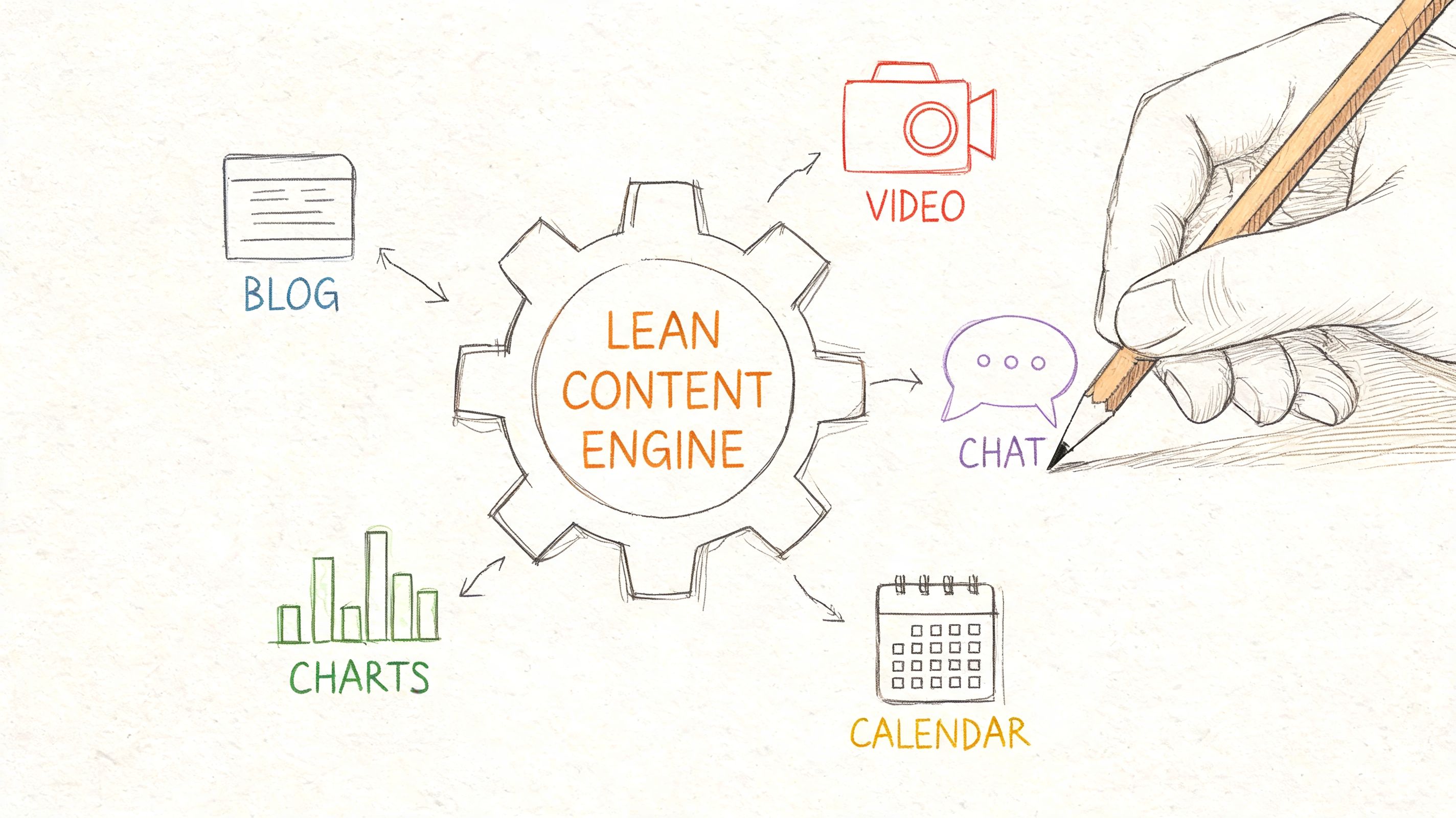
A firm does not need more content. It needs a tighter content engine. In many cases, one sharp point of view each month is enough. Turn that into a cornerstone article, a few strong LinkedIn posts, a short email, and sales enablement material your team can use in live opportunities. That is how time-poor experts build authority without turning content into a second job.
If you want a cleaner way to make those decisions, this guide on developing a content strategy to build authority and trust lays out the planning discipline firms usually skip.
Most content fails before anyone writes a headline. The problem isn't execution. The problem is the firm has never documented who it wants to attract, what problems it wants to own, and what it believes that competitors won't say clearly.

A mature content program starts with documented ICP and buyer-journey mapping. That sounds basic, but it's still uncommon. According to a benchmark cited in Malota Studio's breakdown of professional services content strategy, only 40% of organizations have a documented content strategy. That gap explains why so much firm content feels random. There's no operating logic behind it.
Don't write for “business owners” or “mid-market companies.” That's lazy positioning. Document an ICP that a partner could recognize on a call.
A useful ICP should answer:
A consulting firm might define its ICP as PE-backed software companies preparing for post-acquisition integration. A financial adviser might focus on owner-led firms approaching succession decisions. Those are contentable markets. “Founders” is not.
You don't need a 40-slide strategy deck. You need clarity on what buyers ask before they contact you.
Use a simple map:
| Buyer stage | What they're asking | Content that helps |
|---|---|---|
| Early research | What's going wrong, and how serious is it | Clear diagnostic articles, opinion pieces, short videos |
| Active evaluation | What options exist, and who understands this best | case studies, webinars, deeper guides |
| Shortlist stage | Why should we trust this firm | proof-led narratives, partner insights, process explainers |
One cited benchmark says 71% of B2B buyers consume multiple pieces of content before contacting a sales representative, according to the source above. That means your content can't just attract attention. It has to build confidence progressively.
Most firms falter at this stage. They describe their services, avoid taking a definitive stance, and ultimately sound interchangeable.
Your POV should answer questions like these:
Strong content starts with a strong opinion. If your content could sit on a competitor's site unchanged, your positioning is weak.
If you need help sharpening that difference, Legacy Builder's piece on strategic positioning and finding your market edge is worth reading.
Once your foundation is clear, stop brainstorming random post ideas. Build two to three signature content pillars and stay disciplined.
That's enough. More than that usually means your strategy is still unfocused.
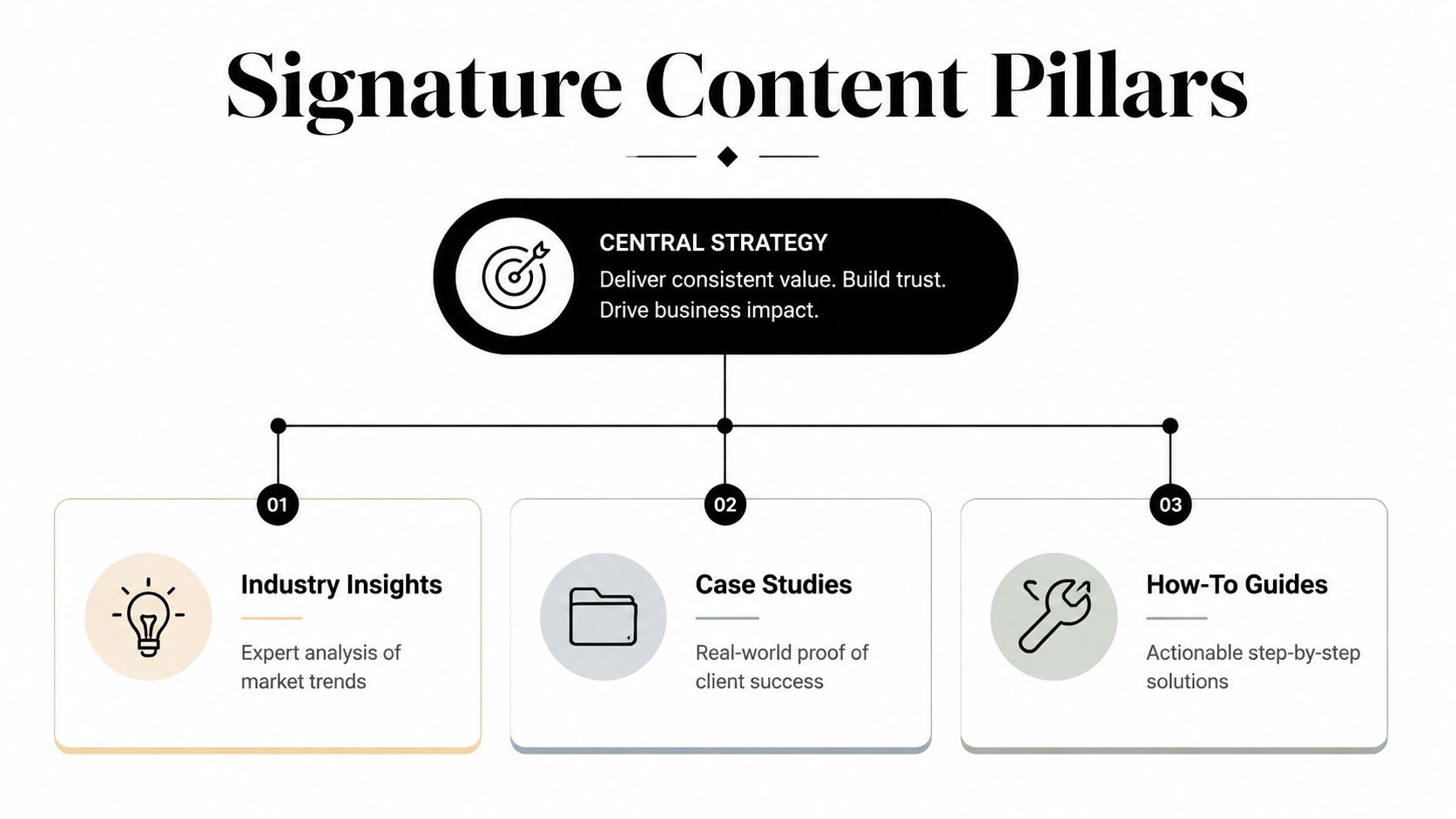
Your pillars should sit at the overlap of three things:
For a law firm, that might look like regulatory interpretation, case-based risk prevention, and sector-specific client guidance. For an agency, it might be category strategy, conversion analysis, and post-launch performance lessons.
The key is not the label. The key is whether the pillar creates authority.
Generic blog content is getting swallowed by sameness. That's not just a creative problem. It's now a positioning problem.
As noted in Circles Studio's advice for professional service firms, the market is becoming flooded with AI-generated content and low-quality articles. Their core recommendation is the right one. Originality is now the advantage. For professional services, the content that still stands out is author-led perspective, original research, client-specific observations, and tightly edited point-of-view pieces that are difficult to replicate.
A good pillar doesn't produce “tips.” It produces recognizable thinking.
Each pillar should have a default format. That reduces friction and builds audience expectation.
Try a structure like this:
Publish the same kind of smart thing repeatedly. Familiarity builds authority faster than novelty.
Before your team creates anything, ask:
If the answer to the last question is yes, the topic needs a stronger angle.
A lean content engine doesn't need more ideas. It needs stricter standards.
Professional services firms rarely have a creativity problem. They have a capture problem. The expertise exists. It's trapped inside billable people with no time to draft polished articles.
So stop asking experts to write.

The leanest system is built around structured expert interviews. A strategist, marketer, or editor asks sharp questions. The expert talks for a short session. The team turns that conversation into finished assets.
This works because it fits how senior professionals already think. They can explain a client pattern, challenge a bad assumption, or react to market news far faster than they can write a first draft.
A good monthly workflow looks like this:
Pick one commercial topic
Choose something tied to active buyer demand, a recurring client issue, or a sharp market opinion.
Run a short interview
Keep it focused. Ask for examples, objections, mistakes buyers make, and what the expert recommends.
Turn the transcript into one flagship asset
Usually this is a long-form article, a case-led narrative, or a substantive newsletter issue.
Repurpose into smaller assets
Pull out clips, quotes, short posts, sales follow-up content, and talking points for business development.
According to Yodelpop's guide for professional service firms, many strategies fail because they ignore operational constraints and limited SME bandwidth. Their recommendation aligns with what works in practice. Build a lean, distribution-first system that uses efficient workflows like repurposed expert interviews instead of overwhelming senior professionals.
A lean engine still needs ownership. The minimum viable team usually includes:
That mix can be internal, external, or hybrid. Legacy Builder is one example of a service model built around capturing monthly interviews and turning them into ongoing brand content for busy professionals. For teams that want to tighten the transcript-to-article workflow, this SpeakNotes guide for content marketers is also useful.
Repurposing is valuable only when each output has a job.
A single interview can become:
| Asset | Job |
|---|---|
| Flagship article | Rank, educate, support sales conversations |
| LinkedIn posts | Start discussions and test angles |
| Newsletter note | Stay top of mind with warm prospects |
| Short video clips | Put the expert's face and voice into the market |
| Case-study excerpt | Build proof for active deals |
Here's a useful example of the broader approach in action:
If your expert spends thirty minutes talking and your team gets a month of usable content, the system is efficient. If your expert spends three hours writing and still misses the deadline, it isn't.
Publishing isn't distribution. Too many firms still treat it that way.
They upload an article, share it once on LinkedIn, and assume the market has been informed. It hasn't. Content only works when the right people encounter it repeatedly in the right context.

Most professional services firms should focus on one primary channel and one supporting channel.
For many B2B expert-led businesses, that means LinkedIn plus email. For some niche practices, it might mean industry publications plus email, or webinars plus direct outreach. The right choice depends on where your ICP already pays attention, not where your team feels obligated to show up.
The broader point is clear. Strategy must include effective distribution. The Content Marketing Institute reports that 89% of B2B marketers use organic social media and 84% use paid channels to distribute content, according to their content marketing statistics roundup. Creation alone isn't enough.
You don't need a sprawling social calendar. You need a repeatable cadence.
A practical weekly distribution plan:
That's manageable. More to the point, it gives the same idea multiple chances to reach the right people.
A lot of firms broadcast and never engage. That's a mistake.
Your team should build a simple Dream 100 list of target accounts, referral partners, industry voices, and ideal buyers. Then use content as the reason to interact. Not to pitch. To contribute.
That can mean:
The purpose of distribution isn't reach by itself. It's relevance in front of the people who can hire you, refer you, or remember you.
Many firms get better results from less activity by changing this approach. They stop trying to “grow audience” in the abstract and start creating repeated touchpoints with a defined set of decision-makers.
Professional services firms waste months on the wrong scorecard.
If your reporting starts with impressions, reach, follower growth, or page views, you are measuring publishing activity, not commercial impact. Visibility metrics have diagnostic value. They do not tell you whether content is helping your firm win trust, enter consideration, or close work.
Measure content the same way leadership evaluates any other growth investment. Track whether it creates qualified conversations, supports live opportunities, and shortens the path to revenue. As noted earlier, strong content programs often outperform traditional marketing on lead quality and acquisition efficiency. The true test is simpler. Did your content influence pipeline and revenue, or did it just attract attention?
A useful model for professional services has four layers:
| Layer | What to track | Why it matters |
|---|---|---|
| Attention | qualified traffic to service pages, insight pages, and case studies | Confirms the right audience is finding you |
| Engagement | replies, newsletter responses, repeat visits, webinar attendance, booked calls | Shows rising trust and real interest |
| Pipeline | opportunities where content was viewed, shared, or referenced | Connects content to active deals |
| Revenue | closed deals influenced by content | Shows whether content contributes to growth |
Revenue gets leadership's attention. Pipeline earns budget.
That means your CRM should be the center of your measurement system. Your social dashboard can show what got a reaction. Your CRM shows what moved a buyer.
A post can perform well on LinkedIn and still do nothing for the business. A niche article can pull modest traffic and still influence several high-value opportunities because it answered the exact question a buyer was asking.
Track that difference.
If a prospect reads a case study, attends a webinar, opens three newsletters over a month, then books a consultation, those touches matter. Log them. Review them. Look for patterns in the topics, formats, and objections that keep appearing before qualified sales conversations.
These are the KPIs worth watching:
If your team needs a clearer framework, this guide on how to measure content performance for your personal brand is a useful reference.
Do not scale because the team is busy. Do not scale because a competitor launched a podcast. Do not scale because someone wants “more visibility.”
Scale after you see repeatable commercial signals.
Increase investment when a small set of topics keeps showing up in qualified calls, when sales uses the same assets in active deals, when referral partners share your content without being asked, and when your production process runs on schedule without draining senior experts. Those are signs you have an engine, not a content habit.
Hold the line when output is rising but pipeline influence is unclear. More volume will not fix weak positioning, poor topic selection, or a broken follow-up process. It usually makes those problems more expensive.
The firms that win with content marketing for professional services are not the busiest publishers. They run a tight system. They know which expertise drives trust, which content supports revenue, and which activities deserve more time.
If your firm has expertise but no repeatable system for turning it into content, Legacy Builder helps capture insights from busy professionals and turn them into consistent brand content and strategic distribution. It's a practical fit for leaders who need a content engine without becoming full-time content operators.


You could – but most in-house teams struggle with the nuance of growing on specific platforms.
We partner with in-house teams all the time to help them grow on X, LI, and Email.
Consider us the special forces unit you call in to get the job done without anyone knowing (for a fraction of what you would pay).
Short answer – yes.
Long answer – yes because of our process.
We start with an in-depth interview that gives us the opportunity to learn more about you, your stories, and your vision.
We take that and craft your content then we ship it to you. You are then able to give us the final sign-off (and any adjustments to nail it 100%) before we schedule for posting.
No problem.
We have helped clients for years or for just a season.
All the content we create is yours and yours alone.
If you want to take it over or work on transitioning we will help ensure you are set up for success.
We want this to be a living breathing brand. We will give you best practices for posting and make sure you are set up to win – so post away.
Subscribe to our newsletter and get insights on how to grow your personal brand.
