.svg)
Subscribe to our newsletter and get insights on how to grow your personal brand.
Thank you! Your submission has been received!
Oops! Something went wrong while submitting the form.
.svg)


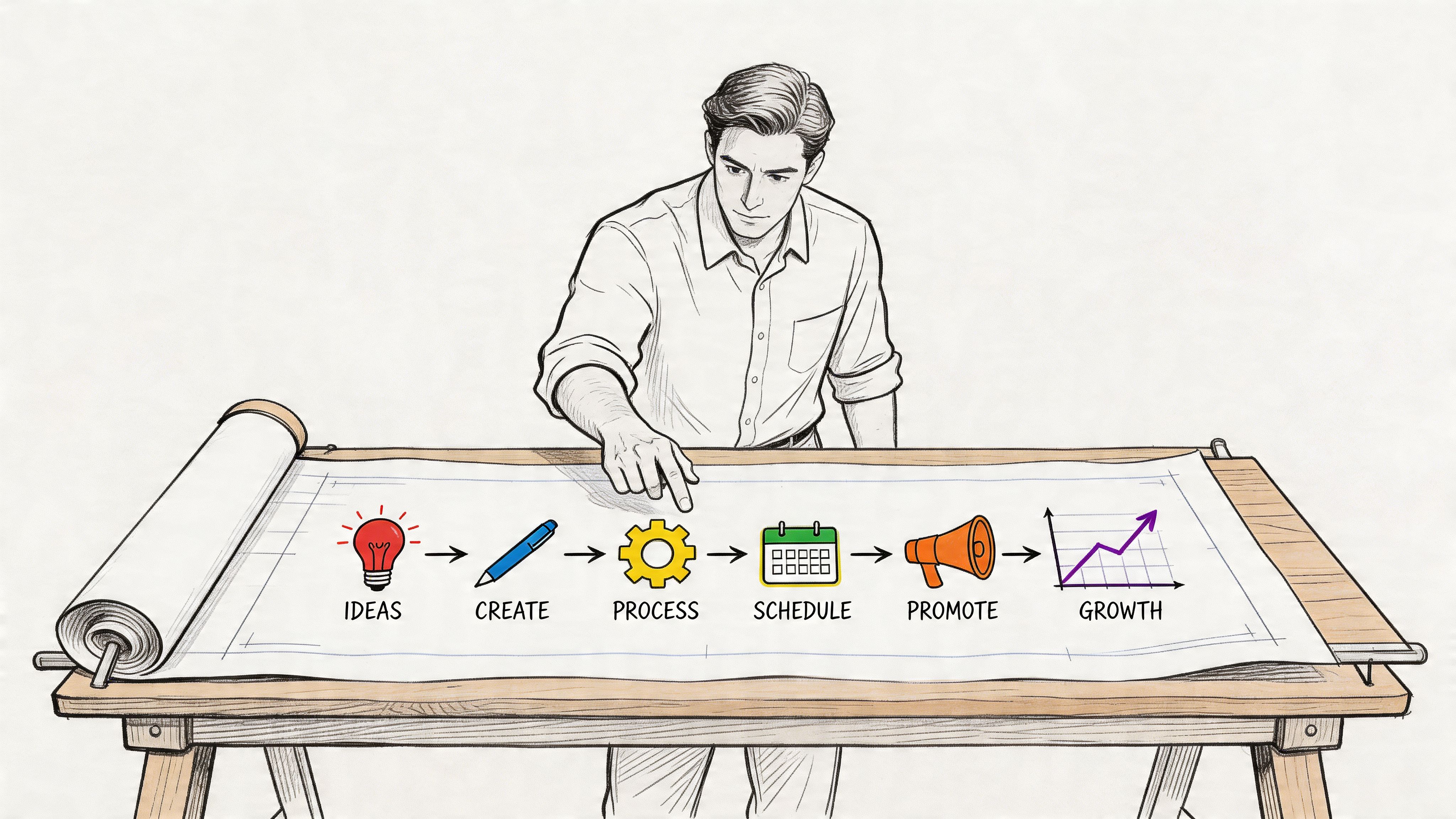
Your week probably looks like this. Client work spills into the evening. Sales calls eat the morning. Your phone reminds you to “post something” and you either publish a rushed thought, recycle a half-finished draft, or skip it again.
That’s not a content strategy. That’s marketing debt.
Most founders don’t fail at content because they lack ideas. They fail because they run content like a side quest. Random posts. No message discipline. No system. No link between what they publish and what they sell. Then they assume content marketing for entrepreneurs is fluffy brand work that only matters if you want attention online.
That’s wrong. Content is how a founder scales trust before the next call, the next pitch, and the next introduction. It’s how your reputation keeps working when you’re offline.
I see the same pattern all the time. A founder starts strong. They post on LinkedIn for two weeks, record a few videos, save a folder full of ideas, then disappear. Not because they got lazy. Because they built a workload, not a system.
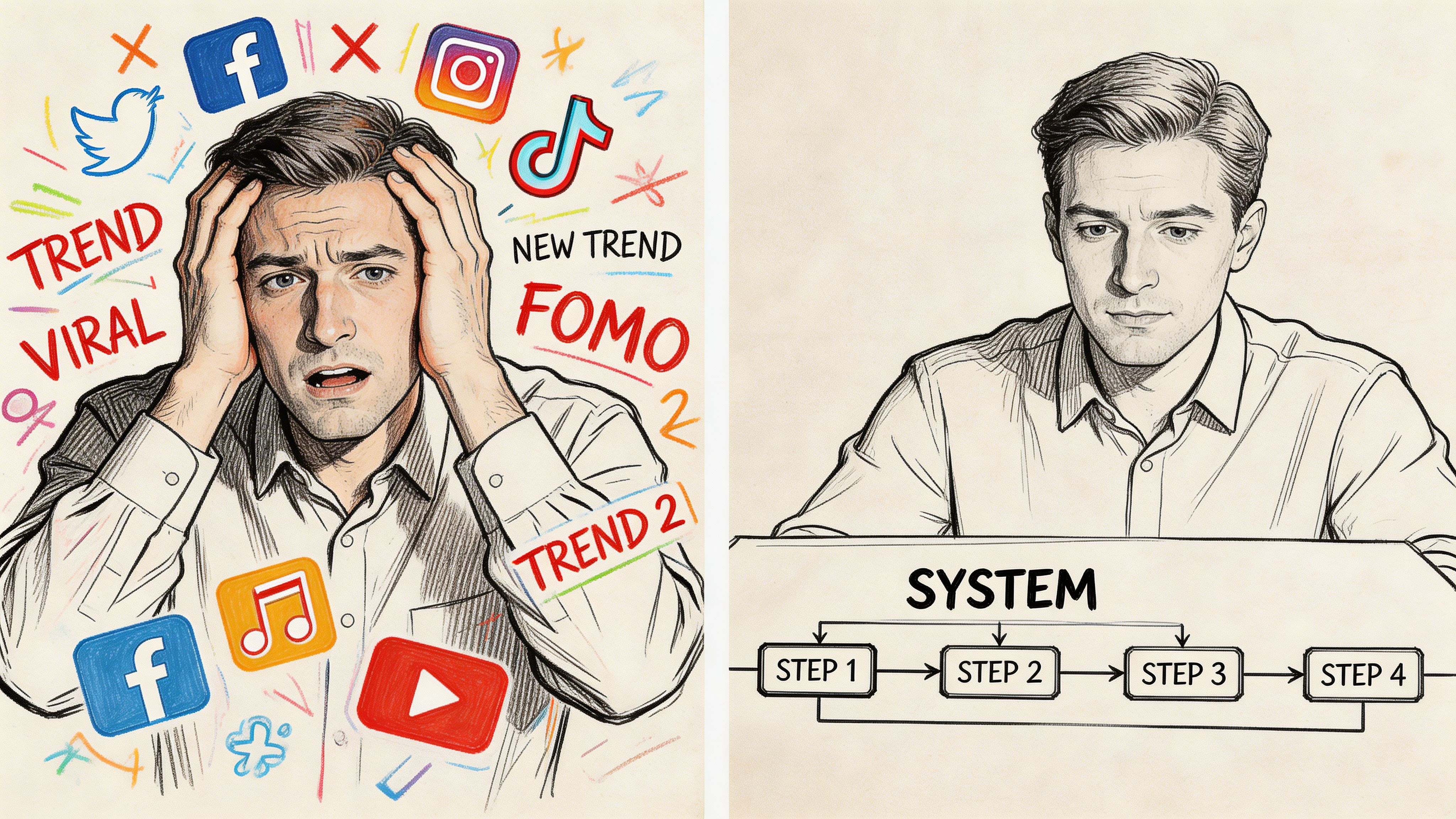
The fix is simple to say and hard to follow. Stop trying to be everywhere. Start building one repeatable engine.
Content is no longer optional founder polish. The global content marketing industry is projected to grow from $72 billion in 2023 to $107 billion by 2026, and for B2B entrepreneurs, content efforts drive 87% of brand awareness and 74% of lead generation according to Salesgenie’s content marketing statistics. Founders who ignore that shift don’t stay invisible. They hand authority to louder competitors.
Content chaos has obvious symptoms:
That approach burns time because every post starts from zero.
A founder content system does four jobs:
Practical rule: If your content can’t survive a busy week, you don’t have a strategy. You have good intentions.
A lot of founders need a model built for limited time, not a full in-house media machine. If that’s you, this guide on a realistic content strategy for small marketing teams is worth your time because it treats bandwidth like a real constraint.
You don’t need more content. You need fewer moving parts and stronger source material.
Your best content won’t come from chasing platform trends. It will come from turning your perspective, client lessons, decisions, failures, standards, and stories into an asset library you can reuse for years. That’s how founders build a legacy instead of a posting habit.
Most entrepreneur content fails before the first post. Not because the writing is weak, but because the founder sounds interchangeable.
If your content could be copied, logo swapped, and reposted by someone in your category, you don’t have a brand. You have generic business advice.

The most overlooked move in content marketing for entrepreneurs is finding your tilt. That’s your unique point of view where your expertise overlaps with a specific audience need. It’s what makes your content hard to replace.
A critical, often-overlooked strategy is finding a tilt because it builds audience ownership and reduces competition. Marketers who prioritize blogging from a unique angle see 13x positive ROI according to this analysis on ignoring content marketing and the value of a tilt.
Your tilt is not your industry.
“Leadership” is not a tilt.
“Marketing” is not a tilt.
“Startup advice” is not a tilt.
A tilt sounds more like this:
That specificity is where authority starts.
Don’t brainstorm content topics yet. Answer these first.
| Question | What to write |
|---|---|
| What have you lived through that your audience is still trying to understand? | List painful lessons, turning points, and unfairly expensive mistakes. |
| What do you believe that your industry gets wrong? | Write the opinions you usually hold back in public. |
| What kind of buyer are you best equipped to help? | Name the exact role, stage, and problem set. |
| What outcomes do you help create? | Focus on business change, not motivational language. |
| What stories only you can tell? | Client patterns, personal decisions, operating principles, failures, recoveries. |
Write raw answers. Don’t polish them.
Then look for patterns. The overlap between your strongest beliefs and your audience’s most urgent problems becomes your message.
The strongest founder brands don’t start with “What should I post?” They start with “What do I know that my market keeps misunderstanding?”
Skip the shallow persona exercise. You don’t need to know your buyer’s favorite coffee order. You need to know what makes them hesitate, what they’re trying to fix, and what they’re tired of hearing.
Define your audience using five filters:
Story transforms into strategy. If you need a sharper way to shape that narrative, use this storytelling framework from Legacy Builder on how to build your brand storytelling framework that wins hearts.
Once your audience is clear, write three statements.
Finish this sentence:
“I help people stop doing X so they can do Y.”
Make it specific. “I help founders stop publishing generic thought leadership so they can build authority from real operating insight.”
Finish this sentence:
“I believe the best way to solve this is…”
This is your philosophy. It shapes every post, article, interview, and pitch.
List the experiences that give you the right to speak. Not inflated credentials. Real proof. Years in the trenches, categories served, decisions made, outcomes led, mistakes survived.
A useful way to pressure-test your voice is to watch how others explain positioning and differentiation, then compare that to how you naturally speak in a sales call. This breakdown is a solid reference point:
Founders usually weaken their content at this stage in three ways:
If you want people to remember you, your content needs a recognizable center of gravity. That center is your tilt, your lived story, and a sharply defined audience.
Once your message is clear, the next problem shows up fast. You know what you stand for, but you still don’t know what to publish next Tuesday.
Most founders solve that badly. They dump ideas into Notes, ask AI for prompts, or post whatever happened that day. That creates noise, not momentum.
Your content needs a small set of core pillars. Not ten. Not a giant spreadsheet of categories. Usually three to five is enough.
Each pillar should come directly from your story, your audience, and what you sell.
Here’s a clean way to structure them:
| Pillar | What it covers | Why it matters |
|---|---|---|
| Perspective | Contrarian takes, founder beliefs, category myths | Builds authority |
| Process | How you work, frameworks, behind-the-scenes decisions | Builds trust |
| Proof | Client stories, lessons learned, before-and-after thinking | Builds credibility |
| Problems | Questions, objections, pain points, common mistakes | Builds demand |
| Personal leadership | Standards, discipline, team decisions, personal lessons | Builds connection |
Not every founder needs all five. Pick the ones that match your business.
A personal brand strategist might use Perspective, Problems, and Proof. A SaaS founder might lean on Process, Perspective, and Personal leadership. A service business owner might focus heavily on Problems and Proof.
Entrepreneurs must get serious. Content should support revenue in different ways, not just attract applause.
Ask this for every pillar: What business result should this help produce?
For example:
That’s the bridge between storytelling and business development.
If a content pillar doesn’t support trust, clarity, or conversion, it’s probably a hobby topic.
Don’t overbuild your calendar. Use a one-page grid with these columns:
That last column matters. If a topic can become a post, short video, email, and sales asset, it belongs on your calendar.
Content works better when it teaches first. Content marketing costs 62% less than traditional marketing and generates three times as many leads. Entrepreneurs also see real ROI, with 78% of marketers reporting sales increases, especially when they focus on quality informational content over promotions and publish consistently, including 2 to 6 times weekly according to this roundup of content marketing statistics in 2025.
That doesn’t mean you need to flood every channel. It means the market rewards useful substance more than self-congratulation.
If you’re time-poor, use this mix:
One flagship teaching piece each week or every two weeks
This can be a long LinkedIn post, article, video, or podcast.
Two trust-building follow-ups
Pull out a story, objection, or lesson from the flagship piece.
One conversion-oriented asset
Share a client question, buying mistake, or decision framework tied to your offer.
This keeps your content balanced. You’re not just broadcasting insight. You’re guiding people toward a buying decision.
Likes are not useless, but they are a terrible management system.
A post can get praise from peers and produce no business movement. Another can get modest engagement and bring the exact prospect you want. Founders who understand that stop writing for applause and start writing for alignment.
The right content plan doesn’t ask, “What should I post more often?” It asks, “What repeated message will make the right buyer trust me faster?”
At this stage, most founders either gain an advantage or give up.
You do not have time to create fresh content from scratch every day. If that’s your model, consistency will collapse the moment the business gets busy. The answer is not more discipline. The answer is production design.
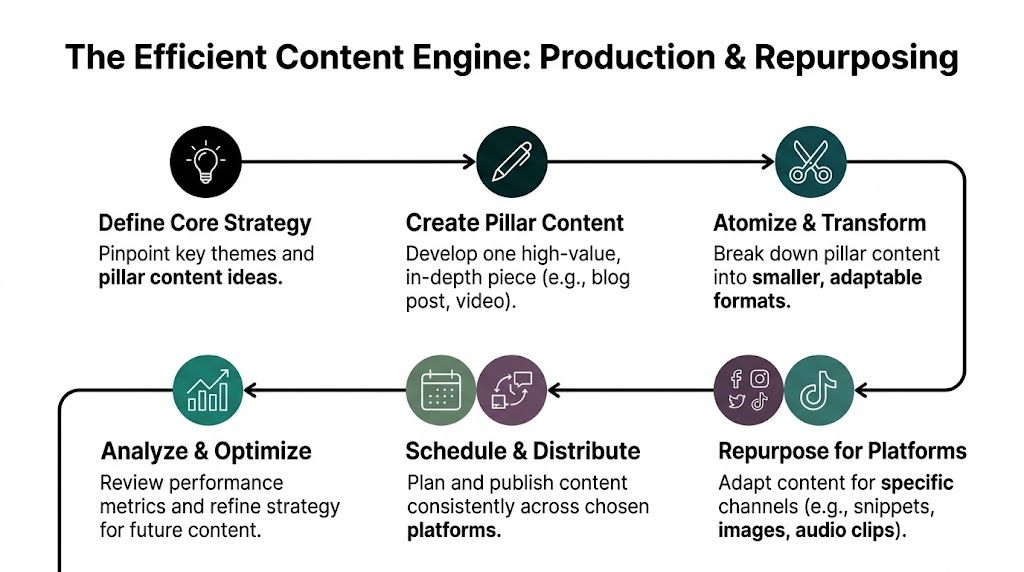
Every efficient system begins with one strong source asset. Pick the format that fits how you think best:
Don’t force yourself into a format you hate. The best source material comes from the medium where you speak with the least friction.
A good pillar asset usually contains:
That one asset becomes the raw material for everything else.
Once the pillar piece is done, break it apart. Don’t summarize it lazily. Transform it.
Take one long-form video. Pull out:
| Derived asset | What to extract |
|---|---|
| LinkedIn post | strongest argument or contrarian take |
| Short video clip | one sharp lesson or story moment |
| direct takeaway with a call back to the full piece | |
| Carousel | step-by-step framework |
| Sales enablement note | objection handling point |
| Website article | expanded version of the main theme |
| Founder quote graphic | one memorable sentence |
| Q and A post | one audience objection answered clearly |
That’s how one idea becomes a content batch instead of a one-day event.
Most entrepreneurs need a system with low decision fatigue. Here’s a practical rhythm:
Record your thoughts. Use your phone camera, Zoom, Riverside, or even a voice memo. Don’t script heavily. Work from bullet points.
Turn the raw material into one primary piece. Clean the argument. Tighten the hook. Add examples.
Extract smaller pieces for each platform. Founders often waste time in this step without templates.
Load everything into Buffer, Hypefury, Metricool, or your scheduler of choice. Assign publish dates before the week gets messy.
Reply to comments, answer DMs, and note what people react to. Audience response is idea fuel.
Operator move: Your content calendar should be built around production days, not posting days. Posting is distribution. Production is the real bottleneck.
You don’t need to reinvent the structure every time. Build repeatable templates for:
That turns content into a managed process.
If you want practical options for speeding up drafting, editing, clipping, and repurposing, this list of AI tools for content marketers is useful because it shows where AI can remove friction without replacing your voice.
AI is a production assistant, not your brand strategist. It can help with transcript cleanup, headline options, first-draft outlines, repurposing prompts, and clip summaries. It should not be trusted to invent your opinions.
If your raw material is generic, AI will make it faster and more generic.
One practical option for founders who want help turning expertise into a repeatable publishing system is Legacy Builder’s guide on how to repurpose content and multiply your reach. The core idea is simple. Capture once, reuse intelligently, and keep your original voice intact.
Boring is good. Predictable beats heroic.
A clean schedule might look like this:
Founders often think variety keeps an audience engaged. Usually, message repetition does the heavier lifting. People need to hear the same core ideas several times before they associate them with you.
The content engine works when your effort goes into thinking once and distributing many times. That’s the only model that respects your calendar and still compounds authority.
A lot of entrepreneurs create decent content and then sabotage it in two ways. They spread it across too many platforms. Then they measure the wrong things.
That combination makes smart founders feel like content “isn’t working” when the core issue is poor distribution discipline and vague performance tracking.
You do not need a presence everywhere. You need a presence where your buyers already pay attention and where your content format fits.
Pick one primary channel and one support channel.
For many founders, that looks like this:
Your website matters because it’s owned ground. Your email list matters because it’s direct access. Social platforms matter because they create discovery. Don’t confuse those roles.
Here’s a simple way to choose:
| Channel type | Use it for | Avoid this mistake |
|---|---|---|
| Website | long-term authority, search visibility, conversion | treating it like a static brochure |
| audience ownership, direct trust, repeat attention | only sending promotions | |
| professional reach, ideas, conversations, credibility | posting broad inspiration | |
| YouTube | deep education, searchable expertise, long shelf life | overproducing too early |
| X or Instagram | fast distribution, perspective, clips, visibility | expecting them to carry the whole strategy |
Every piece of content should have a distribution plan before it goes live.
Ask:
That last question matters more than founders think. Great content should not vanish into a social feed and die.
Good distribution is not “post and pray.” It’s deciding who needs this, where they already pay attention, and how many times they need to see it before acting.
Most founders over-measure the top of the funnel and ignore decision signals.
The gap between effort and outcome usually comes from weak measurement. Only 22% of B2B marketers consider their strategies very successful, often because the work is disconnected from the customer journey and from data. Top performers succeed by mastering their audience (82%), measuring what matters (53%), and tracking core metrics like traffic (86%), engagement (83%), and leads (74%) according to Content Marketing Institute’s content marketing statistics.
That data points to something founders need to hear. Measurement is not a reporting chore. It’s how you stop wasting months on the wrong message.
You don’t need a giant dashboard. Use a simple review every month.
Track these five categories:
Traffic quality
Are the right people visiting your website or key content pages?
Engagement quality
Are people replying, sharing, saving, or asking sharper questions?
Lead signals
Are inquiries mentioning your content? Are better-fit prospects appearing?
Sales support
Is your content helping close conversations faster or answer objections earlier?
Message resonance
Which themes keep getting attention from your target audience?
A lightweight dashboard might look like this:
| Metric | What to ask |
|---|---|
| Traffic | Did visits to key content pages increase from the right channels? |
| Engagement | Which posts sparked real conversation, not just reactions? |
| Leads | Which content pieces were mentioned in forms, DMs, or calls? |
| Conversion support | Which assets helped move buyers toward a next step? |
| Repeat themes | What message keeps landing with the right audience? |
If content underperforms, don’t jump straight to “post more.”
Use this sequence:
That diagnosis matters because content often gets blamed for sales problems it didn’t create.
If you want a tighter approach to evaluation, this resource on how to measure content performance for your personal brand is useful because it frames metrics around business outcomes instead of vanity reporting.
Pay closest attention when prospects say things like:
That’s content doing its real job. Reducing friction before the sale.
There comes a point where doing all your own content becomes expensive. Not just tiring. Expensive.
The cost isn’t only your time. It’s the missed opportunities created when your visibility depends on whether you had a free afternoon. Founders usually wait too long to scale because they think outsourcing means losing authenticity.
That fear is valid. It’s also fixable.
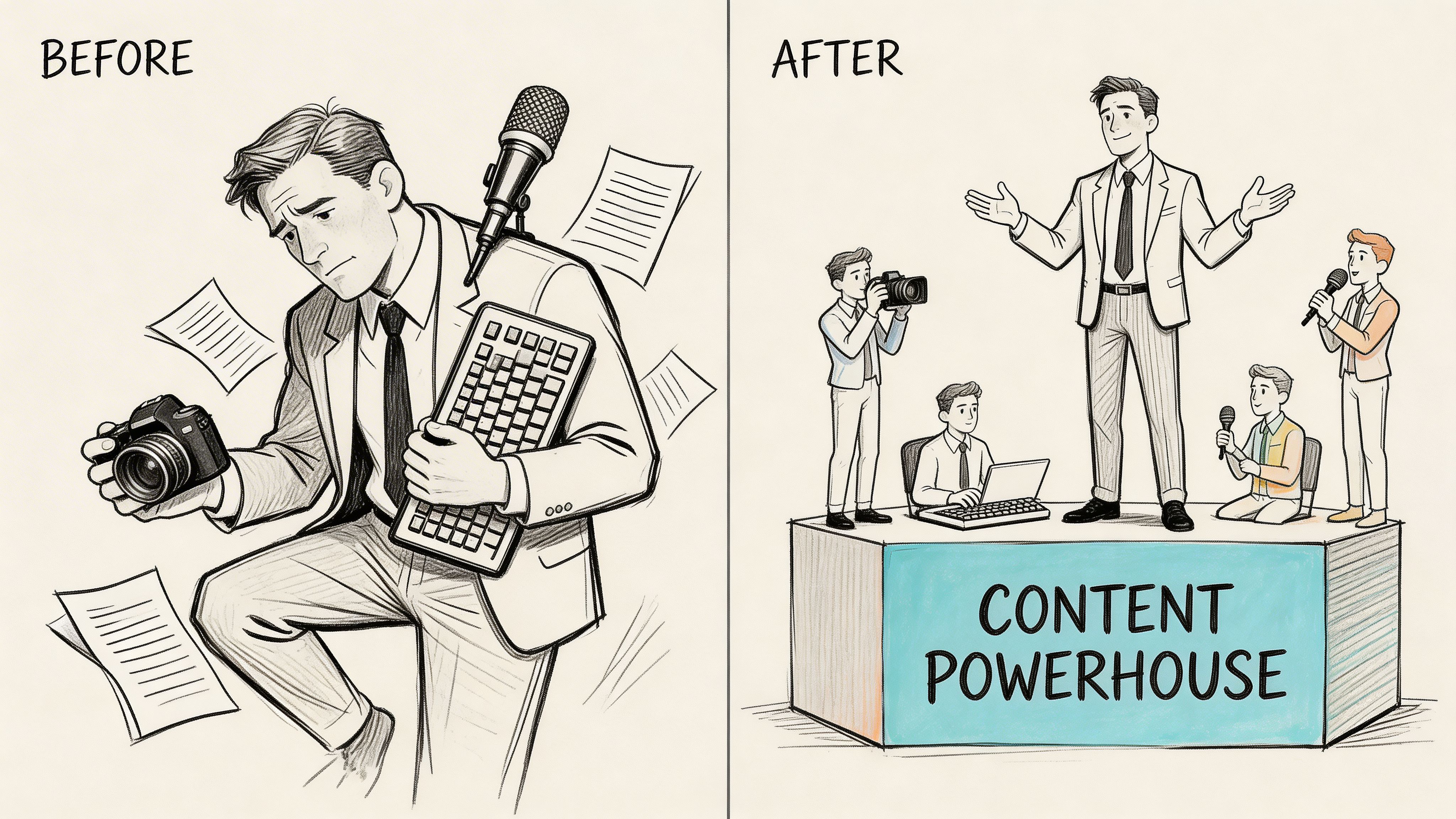
You’re ready to scale when these signs show up consistently:
At that point, you don’t need more motivation. You need support.
You have two practical options. Freelancers or an agency partner. They solve different problems.
| Option | Best for | Watch out for |
|---|---|---|
| Freelancers | founders with a clear strategy who need execution help | fragmented workflow and constant management |
| Agency partner | founders who need strategy, creation, distribution, and accountability | generic service with no founder voice |
| Hybrid model | founders who want one strategist plus specialist contractors | unclear ownership if roles are muddy |
This works if your message is already sharp and you mostly need hands.
You might hire:
This route gives flexibility. It also creates management overhead. If you hire freelancers, you become the editor-in-chief whether you planned to or not.
This works when you want a system, not just outputs.
A good agency should be able to capture your voice, shape strategy, build content workflows, manage distribution, and keep the machine moving without turning your brand into corporate mush.
The wrong agency will flood you with generic calendars, trend posts, and performance reports that say plenty and explain nothing.
Decision filter: If a partner doesn’t spend serious time extracting your story, beliefs, and voice, they can’t build authentic founder content. They can only manufacture volume.
Most founders ask weak questions when hiring content help. They ask about packages. They should ask about process.
Use questions like these:
If the answers sound vague, keep looking.
A lot of founders make the same scaling mistake. They delegate content before they document their thinking.
Fix that first. Build a brand source file with:
This file becomes the operating manual for anyone helping you.
Then keep your role narrow and high-value. You should focus on:
You should not be formatting posts, rewriting captions, and chasing every publish deadline yourself.
A founder-led content system should eventually outgrow founder-only execution.
That doesn’t mean removing yourself from the brand. It means moving from creator of every asset to source of the insight. Your experience stays at the center. The team builds around it.
That's the core scaling move. You stop acting like a stressed solo content department and start operating like a media-backed authority in your category.
If you want help turning your experience, stories, and expertise into a repeatable content system without losing your voice, Legacy Builder is one option to consider. It works with founders and professionals who need strategy, content creation, and consistent distribution built around authentic personal branding rather than generic posting.


You could – but most in-house teams struggle with the nuance of growing on specific platforms.
We partner with in-house teams all the time to help them grow on X, LI, and Email.
Consider us the special forces unit you call in to get the job done without anyone knowing (for a fraction of what you would pay).
Short answer – yes.
Long answer – yes because of our process.
We start with an in-depth interview that gives us the opportunity to learn more about you, your stories, and your vision.
We take that and craft your content then we ship it to you. You are then able to give us the final sign-off (and any adjustments to nail it 100%) before we schedule for posting.
No problem.
We have helped clients for years or for just a season.
All the content we create is yours and yours alone.
If you want to take it over or work on transitioning we will help ensure you are set up for success.
We want this to be a living breathing brand. We will give you best practices for posting and make sure you are set up to win – so post away.
Subscribe to our newsletter and get insights on how to grow your personal brand.
