.svg)
Subscribe to our newsletter and get insights on how to grow your personal brand.
Thank you! Your submission has been received!
Oops! Something went wrong while submitting the form.
.svg)


You've got a strong idea, a half-written draft, and three unanswered messages from the person waiting to approve yesterday's post. By the time you finish the caption, find the image, check the facts, format the asset, and schedule it, the day is gone. Tomorrow starts with the same scramble.
That pattern isn't a talent problem. It's a content creation workflow problem. Founders rarely run out of insight. They lose time in planning, handoffs, approvals, production, distribution, and the constant decisions that sit around the actual writing.
A scalable system doesn't remove the founder's perspective. It protects it. The right workflow gives AI a defined role, gives people clear ownership, and creates feedback loops that improve the next piece instead of treating every post as a fresh emergency.
A founder can be an excellent writer and still publish inconsistently. The problem usually appears earlier, when ideas live in scattered notes, voice guidance exists only in the founder's head, and every post requires a new conversation about what should happen next.
I've seen this pattern repeatedly when helping personal brands scale with small teams. A founder records a useful insight during a call. The writer turns it into a draft, but the angle isn't clear. The founder rewrites half of it, the designer waits for approval, and the post misses its intended publishing window. Nobody failed at writing. The workflow failed to preserve momentum.
The hidden cost sits outside production. In 2023, content creators spent an average of 6.5 hours per week on ideation and planning, according to Averi's 2026 content marketing benchmarks. The same source reports that full-time creators work an average of 36.5 hours per week, while only 46% of that time goes to creating content. Planning, administration, distribution, and marketing absorb the rest.
Practical rule: If the founder is still making every small decision, the team hasn't scaled the workflow. It has only added more hands around the bottleneck.
Daily publishing doesn't require daily improvisation. It requires a reliable path from raw expertise to approved content.
That path might begin with a founder interview, a customer question, a sales-call observation, or a product lesson. Once captured, the idea needs a brief, a clear owner, a draft, a review path, production support, and a distribution plan. Each stage should answer one question before the next person begins:
A documented process reduces the number of decisions that interrupt creative work. It also makes accountability visible. When a post stalls, the team can identify whether the issue is an unclear brief, slow approval, missing source material, or late design request.
Strong ideas and sharp writing remain valuable. They produce more when the system protects them from repetitive coordination.
The goal isn't to turn a founder into a content machine. It's to reserve the founder's time for judgment, experience, and original thinking, then build a process that carries those inputs through publication without flattening them into generic marketing language.
A practical workflow separates production into six stages: brief and research, subject-matter capture, drafting, review, production, and QA. Writing is only one part of publishing. A benchmark from YourWebTeam's website content production guide places typical article writing at 3 hours and 48 minutes, while a solo writer's full process can reach 5.5 to 10 hours after research, editing, SEO, design, and formatting are included.
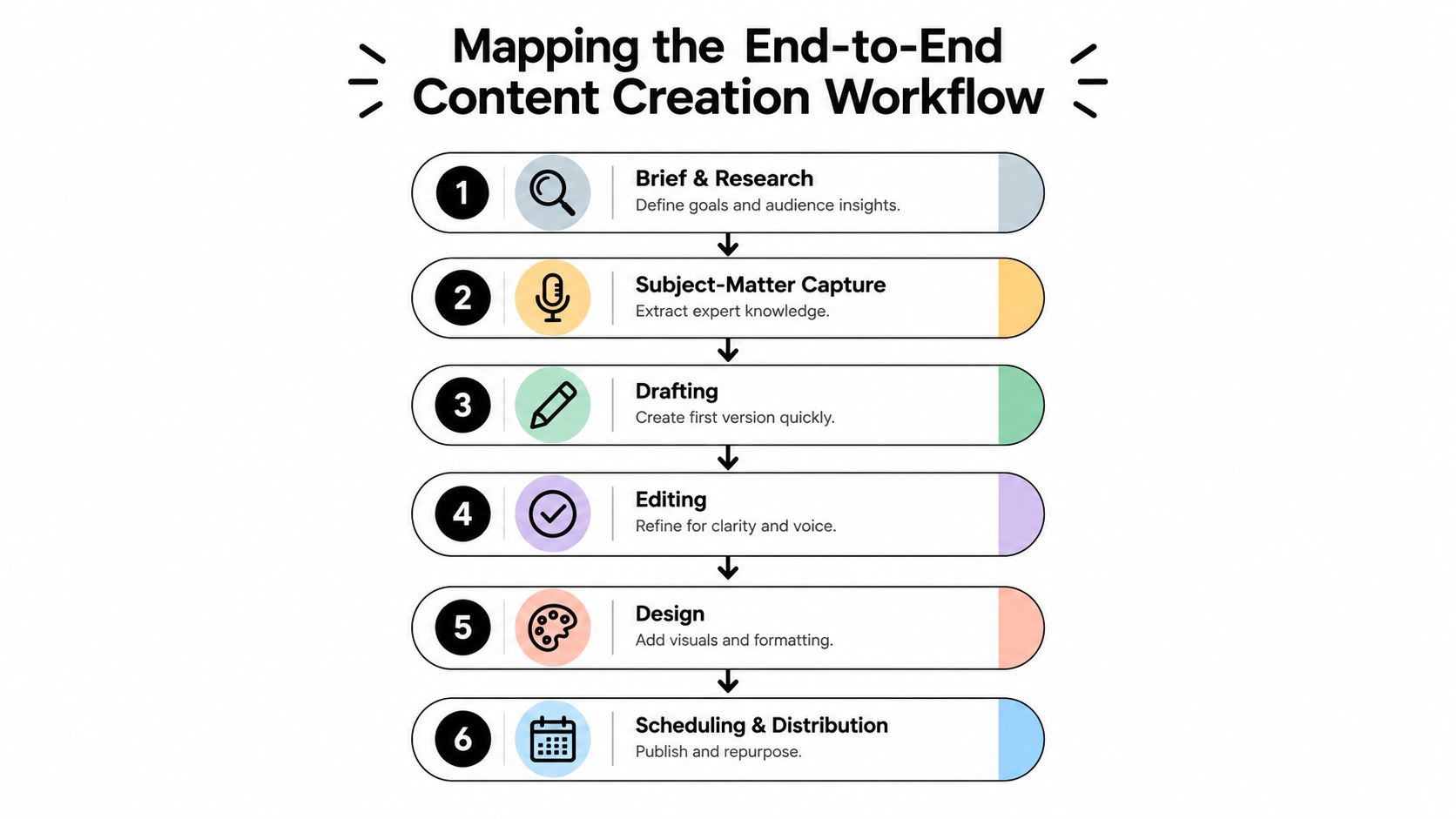
The brief should define the audience, core problem, desired response, point of view, format, channel, and evidence required. Research then supplies the material that keeps the content useful and defensible.
For founder-led content, the brief should also identify the personal asset behind the idea. That might be a hard-earned lesson, a contrarian position, a customer pattern, or a specific operating principle. Without that anchor, a writer can produce something polished that could have come from anyone.
This stage extracts the founder's actual language and reasoning. Use recorded interviews, voice notes, call transcripts, structured questionnaires, or a short list of prompts.
The capture shouldn't ask, “What should we post this week?” It should ask questions that reveal judgment:
The writer needs raw thinking, not a finished paragraph.
The first draft turns the source material into a usable argument. It should establish the hook, develop one central idea, support it with relevant detail, and end with a clear next step or conclusion.
AI can help organize notes or produce rough alternatives, but the draft should remain tied to approved source material. Writers should flag unsupported claims rather than smoothing over uncertainty.
Review is not one generic approval step. Separate it into factual review, brand review, compliance review, and founder approval. A fact-checker verifies claims and sources. A brand reviewer checks tone and positioning. The founder confirms that the content reflects their actual view.
This separation prevents the founder from becoming the only quality-control mechanism.
Production adapts the approved idea into the final format. A designer may create a carousel, a video editor may cut a clip, or a content manager may format a newsletter and add links.
Templates help, but they shouldn't dictate the message. Build visual systems around recurring formats while allowing the content's strongest point to determine the treatment.
QA catches the mistakes that survive creative review. Check links, formatting, mobile presentation, accessibility basics, image crops, captions, names, dates, and platform-specific requirements.
The benchmark above explicitly treats factual, brand, compliance, mobile, accessibility, and final sign-off checks as distinct tasks. Use the content approval workflow guide for faster reviews to formalize those gates, then track the actual time spent on the last five pieces.
Audit the last five posts stage by stage. The slowest stage is your real bottleneck, even if drafting feels like the most visible work.
A useful companion resource on scalable content with AI can help teams think about automation as part of the system rather than as a replacement for the system.
Here's a visual walkthrough of how the stages connect in practice:
A workflow becomes scalable when ownership is explicit. Small teams don't need a large department, but they do need distinct responsibilities. One person may hold more than one role, yet every stage should have a named owner and a defined handoff.
For a personal brand, the lean structure usually looks like this:
The founder remains the source of expertise and the final authority on personal perspective. That doesn't mean the founder should edit every comma. It means the workflow should make it easy for them to approve meaning, voice, and risk without forcing them to manage production details.
A useful SOP doesn't say “create a post.” It defines what someone does, what they need, what good looks like, and what happens when the input is incomplete.
For example, a founder interview SOP can specify the preparation questions, recording method, transcript location, tagging convention, and review deadline. A drafting SOP can define the approved voice traits, banned phrases, source requirements, post structures, and escalation rules for uncertain claims.
A content brief template should include:
A review template should separate accuracy, voice, positioning, compliance, and publishing readiness. Reviewers should comment against those categories instead of leaving vague feedback such as “make it stronger.”
| Stage | Primary owner | Founder involvement | Approval gate |
|---|---|---|---|
| Brief and research | Strategist | Direction and priorities | Angle approved |
| Subject-matter capture | Success manager | Expertise and examples | Source captured |
| Drafting | Writer | Questions resolved | Draft ready for review |
| Review | Writer or editor | Voice and meaning | Final copy approved |
| Production | Designer | Only if visual meaning changes | Asset approved |
| QA and distribution | Success manager | Escalations only | Published version checked |
Documentation reduces dependency on memory. Research from WriteBros on human and AI content workflows reports that organizations with documented workflows see fewer bottlenecks, while editorial checklists improve consistency across AI-assisted content. The operational lesson is straightforward: write down the path before adding more volume.
Legacy Builder's interview-to-content model is one example of this division of labor. It gathers a founder's stories, insights, positioning, voice, and content pillars, then supports drafting, approval, scheduling, and daily publishing through a team-based process.
A template should remove repetitive decisions, not remove editorial judgment.
AI belongs in the content creation workflow wherever the task is structured, repetitive, and easy for a human to verify. It becomes risky when the task depends on lived experience, nuanced judgment, personal history, or factual authority.
By 2026, an estimated 38% of business-published web content involved AI assistance at some point, up from 14% in 2024 and 26% in 2025, according to Presence's AI content creation statistics. The same source reports that 72% of publishers use AI tools in editorial workflows, with 31% using AI for first-draft generation and 41% using it for research or outline support only. Those patterns point toward assistance at the front of the process, not full replacement of editorial control.
AI is useful for:
These tasks have clear inputs and observable outputs. They also leave room for a person to reject weak suggestions before publication.
AI shouldn't invent a founder's experience, create a personal story from thin notes, make unsupported claims sound certain, or decide whether a controversial statement accurately represents the founder. Those decisions require context that a prompt rarely contains.
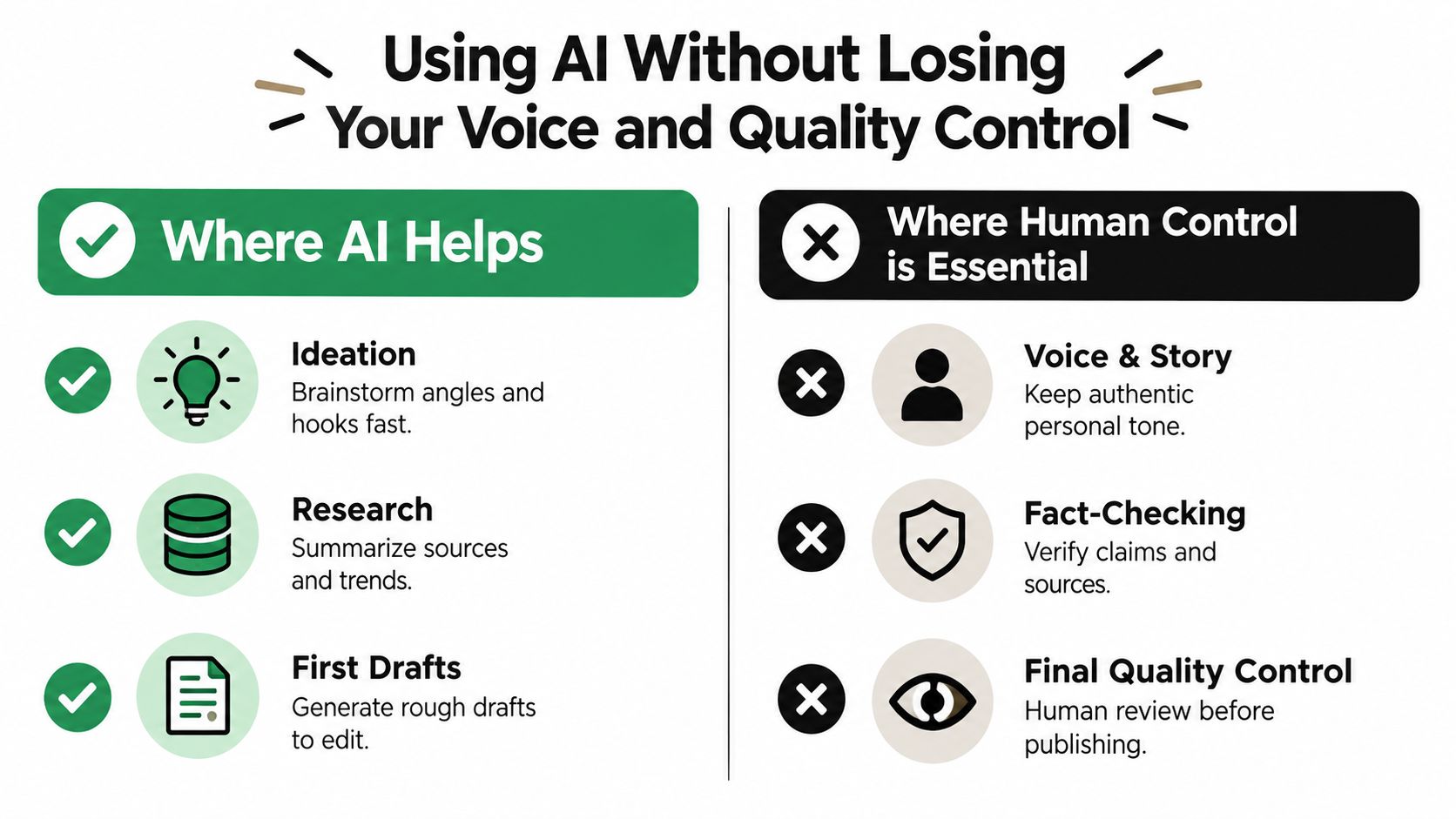
Human review should happen after AI produces a meaningful transformation, not only at the final click. A reviewer should verify the source material, challenge factual claims, compare the draft with voice guidelines, and inspect the final asset in its publishing context.
Independent workflow research reports that 92% of teams still require human review before publication, while human fact-checking is the most common post-generation task at 81%. The same dataset reports that editors spend the largest share of their effort on refinement rather than drafting, at 61%. These figures support a practical operating model: AI can accelerate the rough work, but people remain responsible for truth, taste, and trust.
Use this decision rule:
| Task | AI role | Human requirement |
|---|---|---|
| Ideation | Generate options | Select the angle |
| Research | Organize and summarize | Verify every meaningful claim |
| Drafting | Create a rough version | Rewrite for voice and accuracy |
| Personal stories | Do not fabricate | Founder supplies and confirms details |
| Voice refinement | Detect patterns | Founder or senior editor decides what sounds authentic |
| Final QA | Flag possible issues | Human signs off before publication |
The AI-assisted content creation guide for authentic brand scaling is useful when defining these boundaries for founder-led publishing.
The strongest governance rule is also the simplest: AI may suggest, but it may not decide. Store prompts, source documents, review notes, and approved versions where the team can find them. If a claim changes, record why. If a phrase becomes part of the founder's voice guide, add it deliberately rather than letting it spread by accident.
Publishing is not the finish line. It's the point where the workflow starts collecting audience feedback.
A reliable cadence begins with a content buffer. Capture founder insights in batches, prepare several briefs together, schedule review windows in advance, and keep production ahead of publication. The exact cadence depends on the founder and channel, but the principle is stable: don't make approval a same-day emergency unless the content is time-sensitive.

Repurposing works when the team preserves the underlying idea while changing the entry point. One founder interview can produce a long-form article, several opinion posts, a newsletter section, a short video script, and a visual explanation. Each derivative should make sense on its own, rather than repeating the same caption with different formatting.
A useful repurposing map looks like this:
The source asset should remain the authority. If a derivative introduces a new claim, send it back through research and review instead of assuming the original approval covers it.
For a deeper operating model, Legacy Builder's content repurposing framework shows how to connect formats without turning reuse into duplication.
Assign someone to schedule, publish, respond, and record useful audience signals. Profile optimization also belongs here. The profile should make the founder's expertise, audience, and next step clear before distribution sends new people to it.
Engagement shouldn't mean replying to everything. Focus on thoughtful responses to relevant conversations, questions that reveal audience language, and recurring objections that deserve future content. Those interactions become research inputs for the next brief.
A creator workflow survey summarized by Airops in its state of content teams report identifies research and ideation, outlining and first drafts, editing and approvals, and promotion and performance tracking as major time-consuming stages. That's why distribution can't remain an afterthought. A post that ships without measurement gives the team no evidence for what to repeat, revise, or stop.
Resources on social media content recycling can help teams extend the useful life of published ideas while keeping each adaptation native to its channel.
A content creation workflow is healthy when it helps the team learn, not merely publish. Track operational measures alongside audience outcomes, because a post can perform well while the process behind it remains fragile.
Start with four categories:
Avoid treating likes as the only verdict. A founder's post may attract modest public engagement while prompting valuable private conversations. The team should record those signals without forcing every outcome into a single score.
At the end of a publishing cycle, review the work while the details are still visible. A short 30-minute after action review can structure the conversation around four questions:
Bring examples to the review. Compare the original brief with the final post. Look at edits that repeated across drafts. Note approval questions that arrived too late, formatting issues caught during QA, and audience comments that reveal a new content angle.
Don't leave the retro as a list of complaints. Convert each useful observation into an update:
The teams that improve fastest aren't necessarily the teams generating drafts fastest. They're the teams that close the loop between publication and the next decision. Independent workflow research reports that hybrid editorial workflows achieve publishing consistency at 74%, while AI-assisted drafting can reduce first-draft production time by 58% and average turnaround time by 39%, according to the WriteBros workflow data. Those gains only matter when the team protects review quality and uses the saved time to improve the system.
Your next advantage won't come from removing every human step. It will come from making every human step more deliberate.
Audit the last five pieces, document the stages, assign ownership, and introduce one checklist this week. Then set a realistic 30-day consistency target and review the evidence before changing tools. A workflow that learns will outperform a content factory that only produces more drafts.
Legacy Builder helps founders turn interviews, stories, expertise, and positioning into approved, scheduled content through a structured team workflow. If you need help protecting your voice while building a consistent publishing system, visit Legacy Builder and explore how its strategists, writers, designers, and success managers can support the process.


You could – but most in-house teams struggle with the nuance of growing on specific platforms.
We partner with in-house teams all the time to help them grow on X, LI, and Email.
Consider us the special forces unit you call in to get the job done without anyone knowing (for a fraction of what you would pay).
Short answer – yes.
Long answer – yes because of our process.
We start with an in-depth interview that gives us the opportunity to learn more about you, your stories, and your vision.
We take that and craft your content then we ship it to you. You are then able to give us the final sign-off (and any adjustments to nail it 100%) before we schedule for posting.
No problem.
We have helped clients for years or for just a season.
All the content we create is yours and yours alone.
If you want to take it over or work on transitioning we will help ensure you are set up for success.
We want this to be a living breathing brand. We will give you best practices for posting and make sure you are set up to win – so post away.
Subscribe to our newsletter and get insights on how to grow your personal brand.
