.svg)
Subscribe to our newsletter and get insights on how to grow your personal brand.
Thank you! Your submission has been received!
Oops! Something went wrong while submitting the form.
.svg)



Most advice about content creation vs content writing starts with a harmless definition exercise: writing means words, creation means everything else. That's accurate, but it's not useful enough for a founder deciding where to spend limited time and budget.
The decision is sharper. Is a strong written idea enough to earn attention and trust from your buyers, or does that idea need to become video, audio, visual content, and distributed conversation? Choosing the wrong answer creates expensive activity without authority. A founder may publish polished articles nobody discovers, or produce attractive clips that never explain a meaningful point.
The distinction has become commercially important because content writing now sits inside a much larger operating system. Pew Research found that 44% of adult American internet users, more than 53 million people, had contributed material online in 2004, a milestone that marked the expansion from professional publishing to a broad creator ecosystem (Reboot Online's content marketing statistics summary). Today, writing is one production layer among ideation, editing, design, distribution, and optimization.
The content creation versus content writing debate is usually framed as a job-title comparison. That framing misses the business decision. Founders need to decide whether a strong written idea can carry their authority and lead flow, or whether adapting it into multiple formats will materially increase trust and reach.
A good writer can build an argument, choose precise language, and make a complex subject clear. A content creator must also determine how that idea becomes a video, carousel, podcast segment, thumbnail, caption, and distribution sequence. Those responsibilities require different skills and create different bottlenecks.
The practical rule: Hire for the constraint slowing growth, not for the label that sounds familiar.
Writing alone is often enough when your audience searches for detailed answers, subscribes to email, or evaluates expertise through long-form material. If your founder-led brand has strong ideas but weak organic visibility, improve the written layer first. If useful articles exist but your buyers rarely encounter them in social feeds or creator channels, production and distribution are the constraint.
The distinction changes three decisions:
The market adoption figures reinforce the need for a system decision. According to Reboot Online's summary, 73% of B2B marketers and 70% of B2C marketers used content marketing as part of their overall strategy. That does not mean every company needs a full production department. It means founders must identify which part of the system will create the next commercial gain.
A writer is not automatically a cheaper creator, and a creator is not automatically a more advanced writer. Choose based on how buyers discover you, what proof your offer requires, and whether one idea needs repeated adaptation to build authority, trust, and leads.
Content writing is the disciplined production of text. It includes blog posts, newsletters, white papers, case studies, landing pages, sales pages, LinkedIn posts, email sequences, SEO pages, and scripts. The writer's core job is to turn information into a clear, useful, persuasive structure that a reader can understand and act on.
That job involves more than typing. A capable content writer researches the audience, identifies the question behind the question, chooses an angle, builds an outline, makes claims responsibly, and edits for clarity. For a founder, the best writer also extracts original thinking through interviews or prompts instead of filling pages with generic industry language.
You can sharpen that written layer with this guide to content writing best practices, especially when your ideas are strong but your drafts lack structure or consistency.
Content creation is the broader pipeline that makes an idea usable across channels. It can include:
A writer might deliver a detailed article. A creator might turn the same founder interview into that article, a video script, several short clips, a visual summary, and social posts. The creator owns the packaging and movement of the idea, not just the sentences.
Audio choices illustrate the difference. If a podcast or video is part of your content system, you'll need usable music and sound assets alongside the script, so it's sensible to browse licensing plans before publishing commercially.
The most important distinction is ownership. Writing owns the text. Creation owns the journey from idea to audience.
The cleanest way to choose is to compare the work by operating requirement, not by job title.
| Dimension | Content Writing | Content Creation |
|---|---|---|
| Primary goal | Build clarity, discoverability, trust, and written demand | Expand reach, recognition, engagement, and channel presence |
| Core skills | Research, positioning, outlining, argument, SEO, editing, voice | Ideation, scripting, design, recording, editing, packaging, distribution |
| Typical deliverables | Articles, newsletters, case studies, white papers, landing pages | Videos, podcasts, carousels, clips, thumbnails, posts, campaigns |
| Workflow intensity | Thinking, research, drafting, review, optimization | Planning, coordination, production, editing, approval, publishing |
| Main bottleneck | Quality of thinking and subject-matter access | Production logistics and consistency across formats |
| Best fit | Search, email, LinkedIn text, complex buying decisions | Visual discovery, creator channels, social distribution, community |
Content writing usually has a thinking bottleneck. The writer needs access to expertise, evidence, customer language, and a clear business objective. Without those inputs, faster drafting only creates more generic copy. A useful comparison article, for example, should focus on a small set of relevant options and explicit criteria that help different audiences identify fit, rather than dumping feature lists into a page (Draft.dev's guidance on technical comparisons).
Content creation has a production bottleneck. A single idea may require a subject expert, writer, designer, videographer, editor, scheduler, and reviewer. Even when one person performs every role, those tasks still consume different kinds of attention. A founder who enjoys writing may resent filming. A founder who speaks naturally on camera may struggle to turn an unstructured recording into a search-focused article.
Cost follows this complexity. Writing-only work usually requires fewer tools, fewer handoffs, and less coordination. Creation expands the workload through recording, design, editing, asset management, and channel adaptation. There isn't a universal cost range that applies responsibly to every solo founder, small team, or agency, so don't choose based on a generic package price. Compare the total production burden, including your own interview time, review time, filming time, and approval delays.
A monthly Social Media Scheduler content plan can help a small team map formats and publishing responsibilities before it commits to a broader production workflow. That planning step exposes whether you need a writer, an editor, a designer, or someone to own the full system.
For a practical view of how a smaller operation can build the wider workflow, review this guide to content creation for small businesses. The right service isn't the one with the longest deliverables list. It's the one that removes your actual constraint without creating a new approval burden.
A founder's channel and offer determine the answer more reliably than ambition does. Five common scenarios make the trade-offs clear.
| Founder Scenario | Dominant Path | Primary Format | Trade-off Accepted |
|---|---|---|---|
| B2B SaaS founder targeting procurement managers | Writing-first | LinkedIn posts, case studies, search content | Slower visual reach in exchange for depth and credibility |
| Consumer wellness founder selling through Instagram and TikTok | Creation-first | Short-form video, carousels, behind-the-scenes reels | Higher production demand in exchange for attention and familiarity |
| High-ticket advisory consultant | Hybrid | Authority articles, podcast clips, threads, quote cards | More coordination, with broader trust signals |
| Early-stage pre-revenue founder | Writing-first | SEO pages, essays, email | Lower distribution breadth while building a durable foundation |
| Funded DTC brand competing for attention | Creation-first team | Video, creator assets, visual campaigns, social content | Larger operational overhead and stricter production management |
A B2B SaaS founder selling into procurement managers usually benefits from writing-first authority. Buyers need clear explanations, implementation detail, risk reduction, and proof that the vendor understands the operating environment. Long-form LinkedIn posts and case studies can carry more decision-making weight than a stream of attractive clips. The founder accepts slower visual reach because the content must support a considered purchase.
A consumer wellness founder faces the opposite constraint. Instagram and TikTok depend heavily on visual demonstration, personality, routine, and repeated exposure. Written captions still matter, but they rarely carry the whole acquisition job. This founder needs creation-first production and accepts the cost of filming, editing, and maintaining a recognisable visual language.
The high-ticket consultant needs both. A deep article can establish a point of view, then become a podcast discussion, short video clips, a thread, and quote cards. The consultant accepts more coordination because one idea must appear in several trust-building environments without losing its original argument.
The more expensive or personal the purchase, the more valuable it becomes to show both what you know and how you think.
A pre-revenue founder should resist building a full media operation too early. Writing can establish a search and email foundation while the founder learns which questions buyers actually ask. A funded DTC brand competing for attention has a different mandate. It needs a production team capable of creating and adapting assets continuously, because one well-written page won't occupy enough of the buyer's attention.
The distinction is strategic, not hierarchical. Writing-first isn't a lesser version of creation. Creation-first isn't automatically more advanced. Each path buys a different kind of market presence.
Use four questions before you hire anyone. Answer them quickly and candidly, without choosing the model you wish you could sustain.
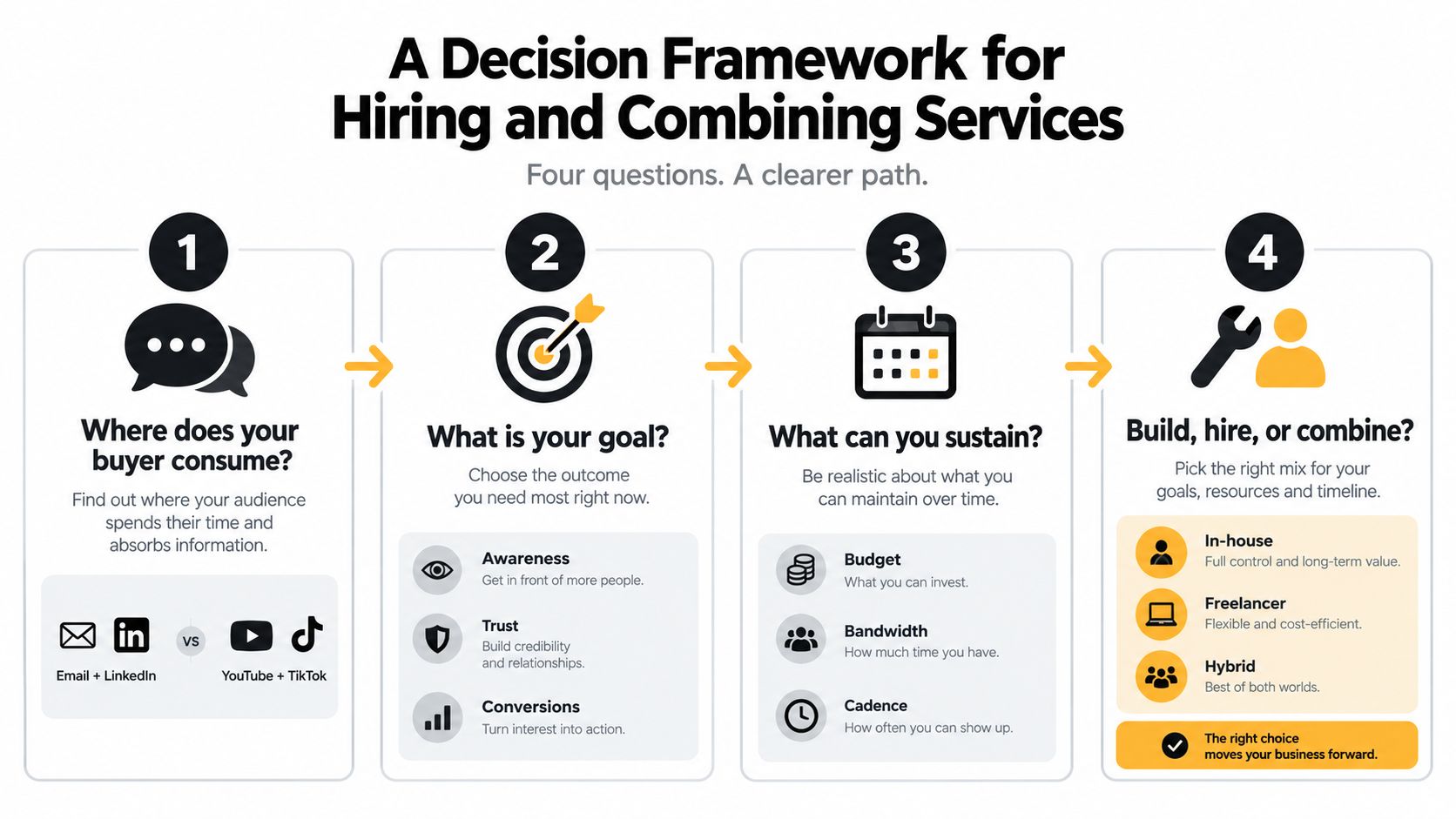
Where does your buyer consume information? If the answer is email, Google, LinkedIn, or detailed sales material, start with writing. If the answer is YouTube, TikTok, Instagram, or creator-led communities, creation deserves priority.
Next, identify the growth lever. Search and inbound favour structured, durable writing. Community, recognition, and shareability usually require more visual, vocal, and interactive formats. Don't let your preferred medium override buyer behaviour.
What can you sustain? A writing-first stack may involve a founder interview, research, drafting, editing, and publication. A broader creation stack adds filming, design, post-production, captions, thumbnails, scheduling, and approvals. If your team can't provide timely feedback, a larger service won't solve the problem. It will create a queue.
Your budget ceiling matters, but avoid treating budget as a simple price bracket. Calculate what you can fund and review consistently. A smaller, reliable writing system will outperform an ambitious multimedia plan that repeatedly misses publication because nobody owns approvals.
Use the answers to route yourself into one of three models:
A strong repurposing workflow turns one pillar article into eight derivative assets, such as a founder post, short video scripts, a carousel, an email, a quote graphic, a podcast outline, a sales enablement note, and a community prompt. The exact mix should follow channel behaviour, not a fixed checklist.
Set a cadence that protects quality. Record founder input in batches, approve a group of related assets together, and maintain a short backlog of topics. A weekly review should answer three questions: what earned qualified attention, what created demand, and what should stop.
Likes and impressions can indicate distribution, but they don't prove that your content is strengthening authority or creating commercial demand. Measure the system against the job you hired it to do.
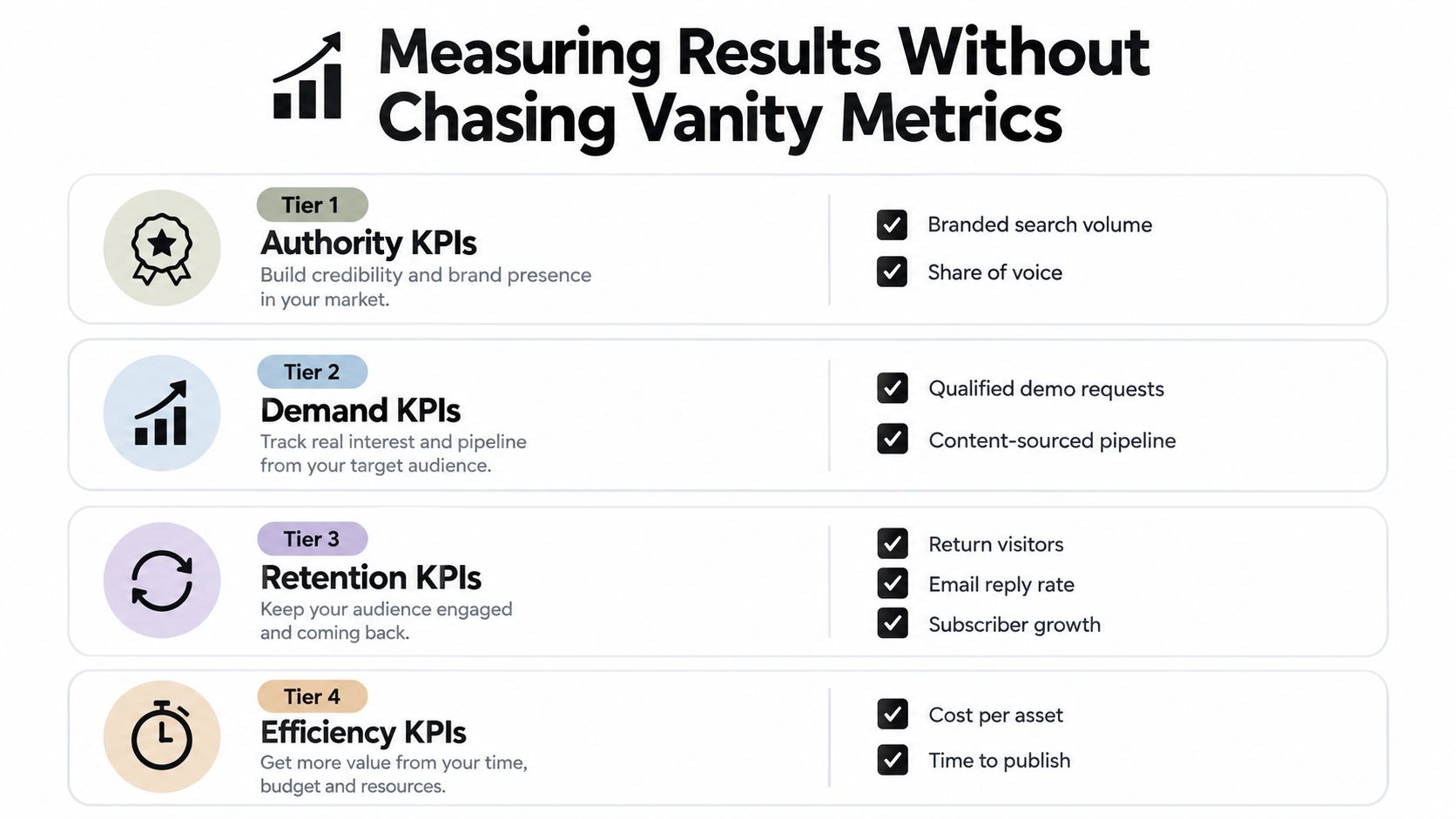
A writing-first strategy should place more weight on organic sessions, search rankings, citations, and assisted revenue. Those are appropriate downstream measures for blog posts, white papers, and case studies that build demand over time (The Write Direction's overview of content-writing formats and KPIs). A creation-first strategy should add format-specific indicators such as qualified viewer retention, meaningful replies, and the rate at which viewers take the next commercial step.
A hybrid system needs both, but don't create separate reporting worlds. Connect the source idea to its derivatives and then to the resulting conversations. The guide to content metrics that matter can help you build a more disciplined measurement approach.
Review performance every thirty days. Identify the assets that generated qualified attention, compare their production burden, and decide what to repeat, revise, or remove. For a broader financial view, use this framework for calculating marketing ROI, particularly when content contributes to a sale without being the final click.
For most early-stage founders, start with a skilled strategic writer. Writing usually builds the deepest authority per dollar because it forces you to clarify your position, answer buyer questions, and create assets that can keep working in search, email, and sales conversations.
Add creation layers when writing alone plateaus. If your ideas are solid but your reach is narrow, turn the strongest written concepts into video, audio, visual assets, and platform-native posts. If your business already depends on visual discovery, skip the writing-only phase and build creation capacity from the start.
Can a writer become a creator? Yes, especially if they learn scripting, basic design, recording, and distribution. But learning those skills doesn't remove the production workload, so set priorities instead of assuming one person can do everything indefinitely.
What's the cost gap? Writing generally involves fewer production steps. Creation adds equipment, editing, design, coordination, and approvals. Compare total hours and management effort, not just the contractor's fee.
How does AI change the decision? AI can accelerate research, outlines, variations, and repurposing. It doesn't replace founder expertise, editorial judgment, authentic experience, or the need to choose the right channel.
What if a small team needs both? Use one pillar workflow. Let a writer own the argument, then use templates and specialist support for the formats that matter most. That keeps the brand coherent without forcing two separate content strategies.
Legacy Builder helps founders turn interviews, expertise, and personal stories into written content, video, and newsletters through a structured approval workflow. If you need a content system that preserves your voice while expanding beyond articles, visit Legacy Builder and assess whether its approach fits your authority-building goals.


You could – but most in-house teams struggle with the nuance of growing on specific platforms.
We partner with in-house teams all the time to help them grow on X, LI, and Email.
Consider us the special forces unit you call in to get the job done without anyone knowing (for a fraction of what you would pay).
Short answer – yes.
Long answer – yes because of our process.
We start with an in-depth interview that gives us the opportunity to learn more about you, your stories, and your vision.
We take that and craft your content then we ship it to you. You are then able to give us the final sign-off (and any adjustments to nail it 100%) before we schedule for posting.
No problem.
We have helped clients for years or for just a season.
All the content we create is yours and yours alone.
If you want to take it over or work on transitioning we will help ensure you are set up for success.
We want this to be a living breathing brand. We will give you best practices for posting and make sure you are set up to win – so post away.
Subscribe to our newsletter and get insights on how to grow your personal brand.
