.svg)
Subscribe to our newsletter and get insights on how to grow your personal brand.
Thank you! Your submission has been received!
Oops! Something went wrong while submitting the form.
.svg)



If you think effective content creation for small business is about chasing trends or just posting whenever you feel like it, you're already behind.
It all starts with a rock-solid brand foundation. Before you write a single caption or record a single video, you have to get brutally honest about who you are, who you're serving, and why anyone should care. Getting this right from the jump is the difference between content that actually connects and content that just adds to the noise.
Jumping straight into making content without a clear brand identity is like trying to build a house without a blueprint. Sure, you might throw something together, but it’ll be wobbly, confusing, and won't last.
For a small business—especially one built around a personal brand—your unique identity is your single biggest advantage. Authenticity isn't just some fluffy buzzword; it's a core business strategy.
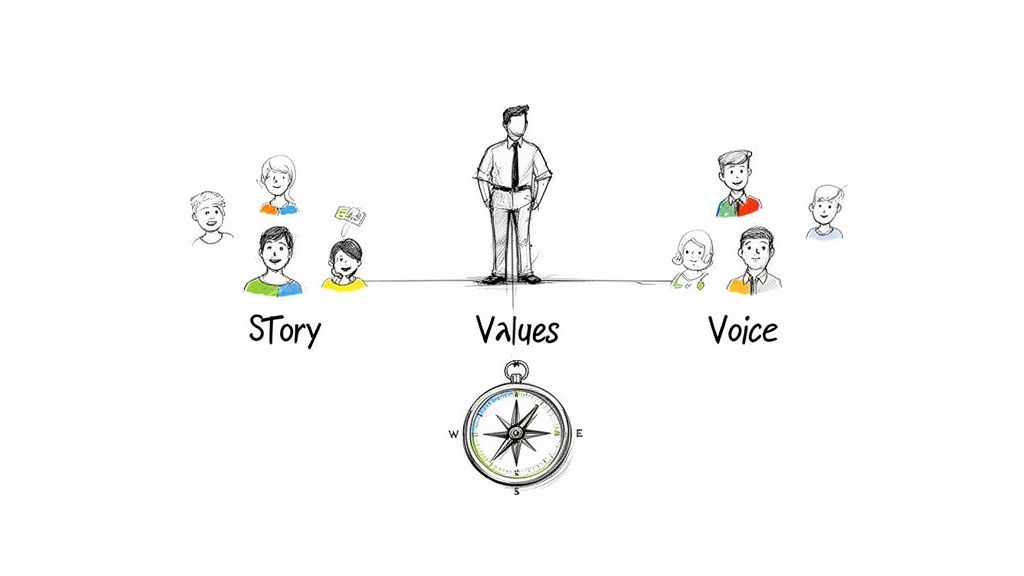
This foundational work is what makes every blog post, video, and social media update feel real. It’s how you stop just selling a product and start building a loyal community that actually wants to hear from you.
Let's break it down. To get this foundation right, you need to nail three things: your story, your values, and your voice. Think of these as the heart of your brand.
Your brand is what other people say about you when you're not in the room. This initial work is your chance to influence that conversation from the very beginning.
Don't just keep this stuff in your head. It needs to be written down and shared with your team. For a step-by-step guide on how to do this, check out our blueprint on how to create brand guidelines. It’s the exact process we use.
Okay, once you know who you are, it’s time to get laser-focused on who you're talking to.
And I don't mean vague demographics like "women aged 25-40." That's useless. You need to go deeper into their psychographics—what are their real-world challenges, their biggest dreams, and what’s keeping them up at night?
The best way to do this is to create a detailed customer avatar. Give them a name. A job. A story. What are they really struggling with in your industry? What does success look like for them?
Let’s say you’re a business coach. Your ideal customer might be:
When you understand "Stuck Sarah" on this level, everything changes. You stop creating generic "business tips" and start creating content that speaks directly to her deepest fears and biggest goals. This is non-negotiable if you want to create content that truly resonates and builds a brand that lasts.
Alright, with your brand foundation locked in, it's time to stop throwing content spaghetti at the wall and hoping something sticks. Let's get focused.
The secret to moving away from those last-minute, panicked content ideas is to define your core content pillars. Think of these as the 3-5 main topics you absolutely want to own in your space. These are your conversational territories.
Pillars aren’t just random categories you pull out of thin air. They should flow directly from your brand’s story, its values, and the voice you've worked to define. They’re a filter for every single idea, making sure whatever you create is on-brand, relevant, and actually speaks to your ideal customer.
Get this right, and you’ll never stare at a blank screen wondering what to post again.
This all starts by looking back at your brand’s core. What’s your expertise? What specific problems are you solving for your "Stuck Sarah"? What are the big messages you want people to immediately associate with your name?
Your pillars should pop right out of the answers to those questions.
Let's run with an example. Imagine a business coach who helps mid-career professionals get unstuck and find momentum again. Their brand is built on three core values: Mindful Productivity, Inspirational Leadership, and Sustainable Growth.
Boom. Those values are perfect candidates for their content pillars.
Just naming your pillars like this brings an incredible amount of clarity. It takes a vague mission and turns it into a concrete plan, giving you the backbone for your entire editorial calendar. It’s the clearest path to building real authority. If you want a deeper dive, this guide on What are Content Pillars is a fantastic resource for nailing this down.
Once your pillars are set, the real fun begins: brainstorming all the specific subtopics that live under each one. The goal here is to build a bank of ideas that directly tackle your audience's biggest pain points, nagging questions, and secret aspirations.
A simple way to kick this off is with question-based brainstorming. For each pillar, just ask yourself:
This approach forces your content to be valuable from the jump because it’s built to serve, not just to broadcast. You stop creating content for the sake of it and start creating real solutions.
This is a massive hurdle for small teams. I see it all the time. In fact, research shows that 60% of marketers say their biggest challenge is producing content consistently. It gets even tougher for small businesses, where 32% admit their content workflows are mediocre at best. A structured pillar system helps fix that.
A content pillar isn't just a topic; it's a promise to your audience. It's you saying, "This is a subject I am deeply committed to exploring, and you can trust me to deliver consistent value here."
Let’s see how this plays out for our business coach.
Here’s a simple table showing how their core values can be translated into powerful content pillars, each spawning tons of specific, high-value ideas.
See how that works? A single brand value branches out into a pillar, which then becomes a wellspring for dozens of content ideas. This system is your key to building a consistent content engine that establishes you as an authority and drives real business growth.
Brilliant ideas are great, but they're just the starting point. Without a rock-solid process, even your best concepts will get swallowed by the daily chaos of running a business. A sustainable workflow is the bridge that connects your content pillars to consistent, high-impact publishing.
This isn't about piling more onto your to-do list. It's about creating a repeatable system that kills the stress, ends the last-minute scrambles, and puts your content creation for small business on a predictable schedule. Think of it as building a well-oiled machine that frees you up to focus on quality, not just panic-posting.
This flow chart nails the process, showing how everything should start from your brand's core and flow directly into the content ideas you generate.
Following this ensures every single piece of content is rooted in your purpose, reinforcing your message with every post, tweet, and video.
Every piece of content, whether it's a deep-dive blog post or a 15-second Reel, goes through a few key stages. The first step to building a reliable workflow is simply to define them. Your goal is to create a visual roadmap that anyone on your team (even if it's just you) can look at and instantly understand.
A simple, effective workflow usually looks something like this:
These stages become the columns on a simple project management board. Tools like Trello or Asana are perfect for this. You create a "card" for each content idea and literally drag it from left to right as you make progress. The visual clarity is a total game-changer.
If there's one strategy that will save your sanity as a small business owner, it's content batching. Instead of scrambling to create something new every single day, you block off a chunk of time to produce a week's or even a month's worth of content all at once.
This simple shift moves your brain from reactive to proactive. Imagine spending one Monday afternoon shooting all your videos for the month, or one Friday morning writing all your blog outlines. It’s a completely different feeling.
Batching frees you from the daily tyranny of the blank page. It lets you tap into a creative flow state, produce higher-quality work more efficiently, and win back precious mental energy for other parts of your business.
For example, a business coach could dedicate the first Tuesday of every month to getting it all done:
By 3 PM, an entire month's worth of core content is ready to be scheduled. This is the kind of system that separates struggling creators from thriving ones.
Your workflow board shows how content gets made; your content calendar dictates when and where it gets published. This is your command center. It doesn't need to be fancy—a simple spreadsheet or a dedicated tool works just fine.
At a minimum, your calendar should track this info for each piece of content:
This gives you a bird's-eye view of your entire strategy, making sure you have a balanced mix of topics and preventing any awkward content gaps. If you need a solid starting point, you can adapt a proven structure. Check out this awesome content calendar template for social media that actually works.
When you combine a clear workflow with the efficiency of batching and the organization of a content calendar, you build a system that can withstand the pressures of running a business. It’s not just about posting more; it’s about creating a process that delivers consistent value without burning you out.
If your brand foundation is the "why" and your content pillars are the "what," then video is the "how." It's how you build a genuine, human connection with people, and fast.
Look, text and images are great—they're essential, even. But nothing lets your personality shine through like video. It's the quickest way to build that know, like, and trust factor that every personal-brand-driven business lives and dies by.
This isn't just some passing trend. The move to video is a real shift in how people consume content, especially for small businesses where authenticity is everything.
Let’s bust a myth right now: you do not need a fancy studio or thousands of dollars in gear to make great video.
Your smartphone is a production powerhouse. That's it. Platforms like TikTok and Instagram Reels have completely changed the game.
On these platforms, people don't just tolerate raw, unpolished videos—they prefer them. Something that feels real, shot in the moment, is far more relatable than a slick, overproduced ad. This is a massive win for small business owners who can't outspend the big guys but can absolutely win on personality.
The data doesn't lie. A staggering 82% of all consumer web traffic is now video, and video ads often pull in a 2x higher click-through rate.
But here's the catch: most small businesses only manage to create one video every 24 days. Compare that to medium-sized companies, which crank one out every 4 days. You can dig into more of these numbers in this report on content marketing stats. Closing that gap with simple smartphone videos is a huge opportunity sitting right in front of you.
Your goal isn't to make a Hollywood blockbuster. It's to share one good piece of advice, a quick peek behind the scenes, or a story that makes your audience go, "Hey, I get that."
So, what can you do today?
This stuff works. Just look at the TikTok "For You" page. It's an endless stream of creators building massive communities just by sharing what they know, straight to camera.
That screenshot says it all. The entire user experience is built around authentic, low-production videos. It’s how you get discovered and how you build a real connection.
Once you're creating your own videos, the next level is to collaborate with others. This usually falls into two buckets: user-generated content (UGC) and creator partnerships.
User-Generated Content (UGC) is pure gold. It’s any content—videos, photos, reviews—created by your actual customers, not you. Think of it as the most powerful form of word-of-mouth marketing.
Creator collaborations mean partnering with influencers or other creators who vibe with your brand. This isn't just about paying for a shoutout; it's about finding real partners whose audience genuinely trusts what they say.
Here's a simple game plan to get started:
By mixing your own authentic videos with content from your community and partners, you create a brand that feels alive, credible, and trustworthy. It builds social proof and gets your name out there in a way that old-school ads just can't touch.
If you're creating content but not tracking its performance, you're essentially driving with your eyes closed. You might be moving, but you have no clue if you're actually getting closer to your destination. Real content creation for small business isn't just about posting—it's about understanding what that post did for you.
Let's get past the quick dopamine hit of vanity metrics like likes and follower counts. They feel good, I get it, but they don't pay the bills. The numbers that signal true growth are the ones that show your audience is taking a meaningful action.

This final step is all about building a data-driven feedback loop. It's how you figure out what’s actually working so you can double down on it.
Your goal here is to connect your content directly to real business outcomes. You don't need some complex, expensive dashboard to pull this off, either. The free analytics tools built right into every social media platform are more than enough to get you started.
Here are the core metrics I tell my clients to obsess over:
The single most important mindset shift you can make is moving from "How many people saw this?" to "How many people acted on this?"
To make this dead simple, just open a spreadsheet. Create columns for each of these metrics and fill it out at the end of every month. This one habit will give you more strategic insight than scrolling through your feed ever could.
Once you start tracking these numbers, you’ll begin to see patterns. You'll notice what your audience really responds to, and often, it's the content that feels the most authentic and community-focused. This is where user-generated content (UGC) becomes your secret weapon.
Encouraging your audience to share their own experiences with your brand builds an insane amount of trust and social proof. Seriously, user-generated content drives 28% more engagement than standard branded posts and gets 4x higher click-through rates. Why? Because it's seen as 2.4x more authentic, especially by younger audiences. For anyone building a personal brand, that kind of validation is gold. You can dig into more creator marketing stats in this 2025 report.
Look, data is useless if you don't do anything with it. The final piece of this puzzle is scheduling a non-negotiable monthly content review. This is your time to sit down with that simple dashboard and ask some hard questions.
Block out just one hour at the end of each month. That's all it takes. Look at your numbers, and pull up your best and worst-performing posts.
During your review, ask yourself:
This review process is the engine that will drive your continuous improvement. It turns your content strategy from a guessing game into a refined system that gets smarter every single month. It's also a key part of building brand equity. For a deeper dive, check out our guide on how to measure brand awareness and fuel your growth. This approach ensures your efforts consistently lead to sustainable, predictable growth for your business.
Even with a perfect system on paper, you're going to have questions. Getting bogged down in the small stuff can completely derail your momentum, so let's tackle the most common questions I hear from small business owners. I want to give you direct, no-fluff answers so you can get back to creating.
This is the big one, and the answer is probably simpler than you think. Consistency will always beat frequency.
It’s far better to show up with three amazing, high-value pieces of content every week like clockwork than it is to post seven rushed, low-impact updates just to fill a quota.
Find a rhythm you can actually stick to without burning out. For most people, 3-5 thoughtful posts a week on your primary platform is a fantastic starting point. That could be three solid feed posts on Instagram with daily stories, or a couple of in-depth articles on LinkedIn. The goal is to build a reliable habit.
Once that feels easy, then you can think about upping the volume. Remember, both the algorithms and your audience reward reliability.
You absolutely do not need a huge budget to make professional-looking content. Honestly, some of the most powerful tools out there are completely free. Getting good at using them is a massive unlock for building a sustainable content machine.
Here are a few of my go-to essentials to get you started:
Get really comfortable with these first. I guarantee you’ll be blown away by what you can create before you ever spend a dime on software.
Your brand voice isn't some mystical thing—it's just a combination of your personality, your mission, and the kind of energy your audience connects with. It's what makes you sound like you.
Start by brainstorming 3-5 adjectives that capture the feeling you want your brand to have. Are you approachable, witty, an expert, bold, or empathetic?
Then, for each word, define what it is and what it is not.
For example: 'Witty' is clever, insightful humor. It is not sarcastic or mean-spirited. This simple exercise gives you clear guardrails for how you communicate.
Next, look at brands you admire, even if they're in a totally different industry. What do you like about their tone? Finally, just start writing and creating. Read your captions out loud. Does that sound like something you'd actually say? Your voice will get sharper with practice, so don't be afraid to tweak it as you go.
Let me make this easy for you: No. Absolutely not.
Trying to be everywhere is one of the biggest mistakes small businesses make. It’s a fast track to burnout and guarantees you'll get mediocre results across the board.
The much smarter play is to go deep on one or two platforms where your ideal customers are already hanging out. A business consultant is probably going to crush it on LinkedIn. A boutique owner selling handmade jewelry will likely find their people on Instagram and Pinterest.
Do a little homework, figure out where your audience spends their time, and pour all your energy there. Once you have a strong, sustainable system humming along, then you can think about expanding.
If you're looking to keep learning and sharpening your skills, you can find additional resources on content creation to explore more advanced topics.
Feeling like managing all of this is a bit much? Legacy Builder is here to help you build an authentic personal brand by turning your unique story into high-impact content—all handled for you. Learn more about our services.


You could – but most in-house teams struggle with the nuance of growing on specific platforms.
We partner with in-house teams all the time to help them grow on X, LI, and Email.
Consider us the special forces unit you call in to get the job done without anyone knowing (for a fraction of what you would pay).
Short answer – yes.
Long answer – yes because of our process.
We start with an in-depth interview that gives us the opportunity to learn more about you, your stories, and your vision.
We take that and craft your content then we ship it to you. You are then able to give us the final sign-off (and any adjustments to nail it 100%) before we schedule for posting.
No problem.
We have helped clients for years or for just a season.
All the content we create is yours and yours alone.
If you want to take it over or work on transitioning we will help ensure you are set up for success.
We want this to be a living breathing brand. We will give you best practices for posting and make sure you are set up to win – so post away.
Subscribe to our newsletter and get insights on how to grow your personal brand.
